Attorney-Verified  Notary Acknowledgement Document for Texas

Attorney-Verified Notary Acknowledgement Document for Texas

The Texas Notary Acknowledgment form is a legal document used to verify the identity of individuals signing important papers. This form ensures that the signatures on documents are authentic and that the signers understand what they are signing. If you need to complete this process, click the button below to fill out the form.

Article Guide

The Texas Notary Acknowledgement form plays a crucial role in the notarization process, ensuring that signatures on documents are verified and authentic. This form is essential for various legal documents, including contracts, deeds, and affidavits, as it confirms that the signer has willingly and knowingly signed the document in front of a notary public. The form typically includes key details such as the date of the acknowledgment, the name of the signer, and the notary's information. Additionally, it often features a statement affirming that the signer is aware of the contents of the document and is signing it voluntarily. Understanding the components and requirements of the Texas Notary Acknowledgement form is vital for anyone involved in legal transactions, as it helps prevent fraud and ensures the integrity of the documents being executed.

Texas Notary Acknowledgement Preview

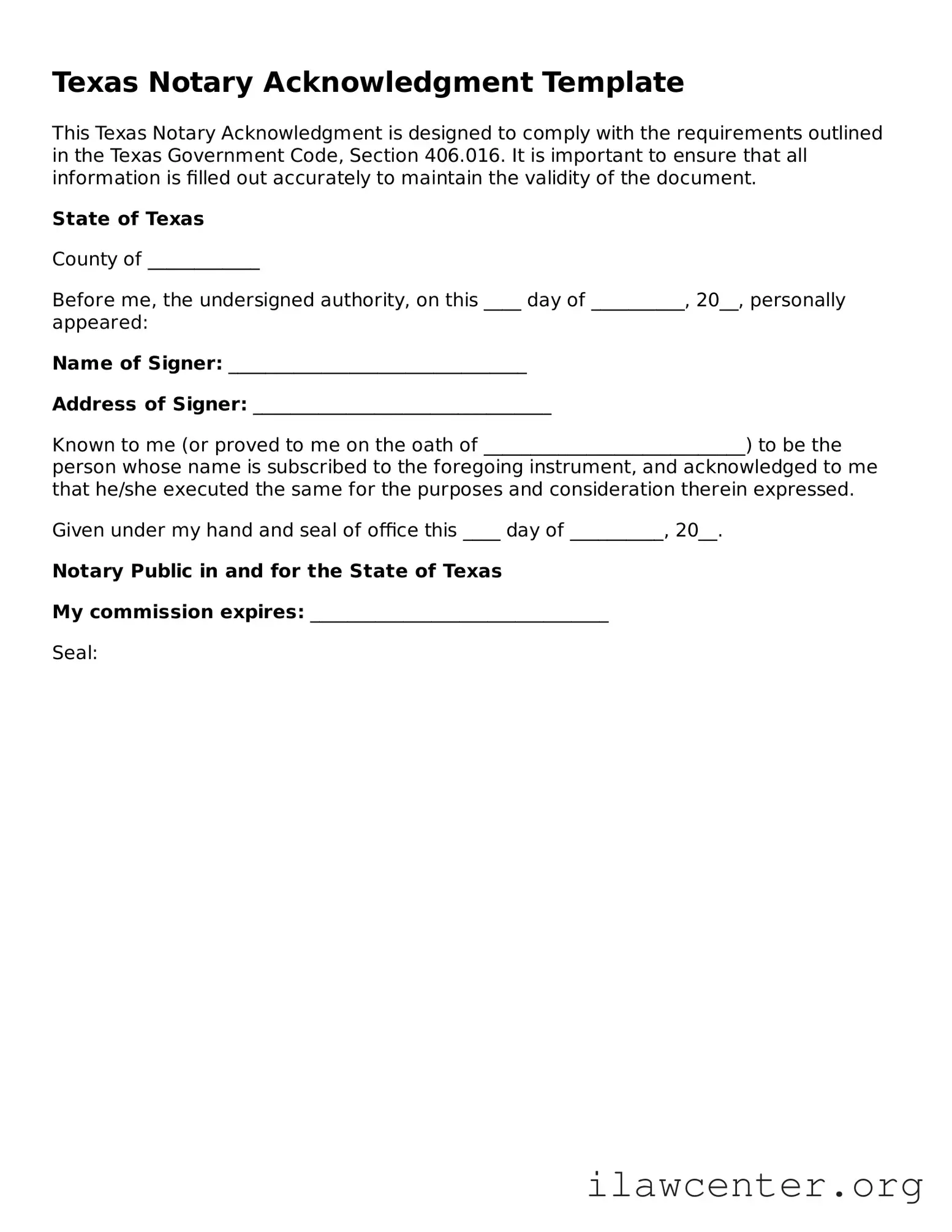
Texas Notary Acknowledgment Template

This Texas Notary Acknowledgment is designed to comply with the requirements outlined in the Texas Government Code, Section 406.016. It is important to ensure that all information is filled out accurately to maintain the validity of the document.

State of Texas

County of ____________

Before me, the undersigned authority, on this ____ day of __________, 20__, personally appeared:

Name of Signer: ________________________________

Address of Signer: ________________________________

Known to me (or proved to me on the oath of ____________________________) to be the person whose name is subscribed to the foregoing instrument, and acknowledged to me that he/she executed the same for the purposes and consideration therein expressed.

Given under my hand and seal of office this ____ day of __________, 20__.

Notary Public in and for the State of Texas

My commission expires: ________________________________

Seal:

PDF Form Characteristics

Fact Name Description
Purpose The Texas Notary Acknowledgment form is used to verify the identity of individuals signing documents and to affirm that they did so willingly.
Governing Law This form is governed by the Texas Government Code, specifically Section 406.001 through 406.007.
Signature Requirement For the acknowledgment to be valid, the signer must appear before the notary public and sign the document in their presence.
Format The form must include specific language as required by Texas law, ensuring clarity and compliance with state regulations.

Instructions on Utilizing Texas Notary Acknowledgement

Once you have the Texas Notary Acknowledgement form ready, you will need to complete it accurately to ensure it serves its intended purpose. This process involves filling in specific information that verifies the identity of the signer and the details of the document being notarized.

  1. Begin by locating the section titled "State of Texas." This is usually at the top of the form.
  2. Next, fill in the county where the acknowledgment is taking place. This is often labeled as "County of __________."
  3. Proceed to the area where you will write the name of the person who is signing the document. Ensure the name is spelled correctly and matches their identification.
  4. In the next line, you will need to include the date on which the acknowledgment is being made. Use the format of month, day, and year.
  5. Now, look for the section that states, "Before me, the undersigned authority, on this day personally appeared." Here, you will write the name of the notary public who is witnessing the signature.
  6. After that, you should find a space for the notary public to sign. This is where the notary will provide their signature after the acknowledgment process is complete.
  7. Finally, include the notary's seal or stamp, which is typically required for the form to be valid.

After filling out the form, it is essential to review all entries for accuracy. Once confirmed, the notary can proceed with the signing and sealing process, completing the acknowledgment. This ensures that the document is officially notarized and ready for use.

Important Facts about Texas Notary Acknowledgement

What is a Texas Notary Acknowledgement form?

The Texas Notary Acknowledgement form is a legal document that verifies the identity of a signer and confirms that they willingly signed a document. This form is often used in real estate transactions, legal agreements, and other situations where proof of signing is required. It serves as a safeguard against fraud and provides assurance that the signer is who they claim to be.

Who can serve as a notary public in Texas?

In Texas, a notary public must be at least 18 years old, a resident of Texas, and a U.S. citizen or a legal resident. Additionally, they must complete an application process, which includes a background check and passing an exam. Once appointed, a notary public can perform notarial acts throughout the state.

What information is required on the Notary Acknowledgement form?

The form typically requires the name of the signer, the date of the acknowledgment, and a description of the document being signed. The notary must also include their signature, seal, and the date of their commission. This information is essential to validate the acknowledgment and ensure its legality.

Is a Texas Notary Acknowledgement form mandatory?

While not every document requires a notary acknowledgment, many legal documents do benefit from it. For example, real estate deeds and powers of attorney often require notarization to be enforceable. It’s important to check the specific requirements for the type of document you are dealing with.

How does one complete the Notary Acknowledgement form?

To complete the form, the signer must appear in person before the notary. The notary will verify the signer’s identity, usually through a government-issued ID. After confirming the identity, the signer will then sign the document in the presence of the notary, who will complete the acknowledgment section of the form.

What happens if a document is not notarized?

If a document that requires notarization is not notarized, it may be deemed invalid or unenforceable. This can lead to complications, especially in legal matters. It’s crucial to ensure that any necessary documents are properly acknowledged to avoid potential disputes or issues down the line.

Can a notary public refuse to notarize a document?

Yes, a notary public has the right to refuse to notarize a document if they believe the signer is not acting voluntarily, if the document is incomplete, or if they cannot verify the identity of the signer. Notaries must act ethically and ensure that all requirements are met before proceeding with notarization.

How long is a Texas Notary Acknowledgement form valid?

The validity of a Texas Notary Acknowledgement form is generally tied to the document it accompanies rather than the acknowledgment itself. Once notarized, the acknowledgment remains valid as long as the underlying document is valid. However, it’s wise to check the specific timeframes for the type of document involved, as they can vary.

Common mistakes

Filling out the Texas Notary Acknowledgement form can be straightforward, but mistakes often occur. One common error is not including the correct name of the signer. The name must match the identification provided. If there is a discrepancy, the notarization may be questioned later.

Another mistake is failing to provide the date of the acknowledgment. This date is crucial because it indicates when the notary witnessed the signing. Without it, the document may lack validity, leading to potential issues down the line.

Some individuals forget to check the notary's commission expiration date. The notary must be commissioned at the time of the acknowledgment. If the commission has expired, the notarization is not valid, and the document could be rejected.

Additionally, people sometimes overlook the requirement for the notary's signature. The notary must sign the form in the designated area. An unsigned acknowledgment cannot serve its purpose and may cause legal complications.

Another frequent oversight is not including the notary's seal. The seal serves as proof of the notary's authority and credibility. Without it, the acknowledgment may be deemed incomplete.

Some individuals fail to fill out the correct venue. The venue indicates where the acknowledgment took place. It should reflect the county and state where the notarization occurs. Incorrect information can lead to confusion and disputes.

Finally, people may misinterpret the wording of the acknowledgment itself. It is essential to ensure that the acknowledgment accurately reflects the intent of the signer. Misunderstandings can result in legal challenges or the need for re-notarization.

Documents used along the form

When engaging in legal transactions in Texas, several forms and documents often accompany the Notary Acknowledgment form. Each serves a unique purpose in ensuring that the documentation process is thorough and legally sound.

  • Power of Attorney: This document grants one person the authority to act on behalf of another in legal or financial matters. It is often notarized to confirm the identity of the principal and the agent.
  • Affidavit: A written statement confirmed by oath or affirmation, used as evidence in court. Notarization adds credibility and ensures the affiant's identity is verified.
  • Deed: A legal document that transfers property ownership from one party to another. Notarization is typically required to validate the transfer and protect against fraud.
  • Contract: An agreement between two or more parties that is enforceable by law. Notarization can help confirm the identities of the parties involved and the authenticity of their signatures.
  • Loan Documents: These include various forms required for securing a loan, such as promissory notes and mortgage agreements. Notarization is often necessary to protect both the lender and borrower.
  • Wills: A legal document expressing a person's wishes regarding the distribution of their assets after death. Notarizing a will can help prevent disputes and verify its authenticity.
  • Trust Documents: These outline how assets will be managed for the benefit of another party. Notarization helps ensure that the trust is valid and that all parties understand its terms.
  • Release of Liability: This document protects one party from legal claims by another. Notarization can help confirm that the releasing party fully understands the implications of the release.

Understanding these documents can simplify the legal process and ensure that all parties are protected. When working with the Texas Notary Acknowledgment form, consider these additional documents to ensure a comprehensive approach to your legal needs.

Similar forms

The Notary Acknowledgment form serves a specific purpose in the realm of notarization, but it shares similarities with several other important documents. Here are seven documents that are akin to the Notary Acknowledgment form, along with a brief explanation of how they relate:

  • Affidavit: Like a Notary Acknowledgment, an affidavit is a written statement confirmed by oath or affirmation. Both documents require a notary to verify the identity of the signer and the authenticity of the signature.
  • Power of Attorney: This document grants someone the authority to act on another's behalf. A notary is often needed to ensure that the principal understands the implications of the document, similar to the verification process in a Notary Acknowledgment.
  • Deed: A deed transfers property ownership. Just as a Notary Acknowledgment confirms the identity of the signer, a notary’s role in a deed is to ensure that the parties involved are who they claim to be, providing legal assurance for the transaction.
  • Loan Documents: When obtaining a loan, various documents require notarization to confirm the identity of the borrower. This process is similar to the Notary Acknowledgment, which also aims to authenticate the signature of the individual signing.
  • Last Will and Testament: A will may need to be notarized to ensure it is valid and enforceable. The notary's role is akin to that in a Notary Acknowledgment, as both involve confirming the identity of the person making the declaration.
  • Contract: Many contracts require notarization to be legally binding. The process of notarizing a contract mirrors that of a Notary Acknowledgment, where the notary verifies the identities of the signers and their willingness to enter into the agreement.
  • Certificate of Acknowledgment: This document specifically serves to confirm that a person has signed a document in the presence of a notary. It directly parallels the Notary Acknowledgment form, as both serve to validate the act of signing.

Understanding these documents can help you navigate various legal situations more effectively. Each serves a unique purpose, yet they all rely on the fundamental principle of verifying identities and ensuring informed consent.

Dos and Don'ts

When filling out the Texas Notary Acknowledgment form, it is essential to follow certain guidelines to ensure accuracy and compliance. Below is a list of things you should and shouldn't do.

  • Do ensure that the signer is present at the time of notarization.
  • Do verify the identity of the signer using a valid form of identification.
  • Do complete all required fields on the form, including the date and location of the notarization.
  • Do sign and seal the form in the designated areas.
  • Don't fill out the form in advance without the signer present.
  • Don't use an expired identification document for verification.
  • Don't forget to keep a record of the notarization in your notary journal.
  • Don't alter any information on the form after it has been signed.

Misconceptions

Understanding the Texas Notary Acknowledgment form is essential for anyone involved in legal documents. However, several misconceptions often arise. Here are eight common misunderstandings about this important form:

  1. Notaries can certify copies of documents. Many people believe that notaries have the authority to certify copies of documents. In Texas, notaries are not permitted to do this unless specifically authorized by law.

  2. All notary acknowledgments are the same. There is a misconception that notary acknowledgments are uniform across all states. In reality, each state, including Texas, has its own specific requirements and formats for notary acknowledgments.

  3. Notary acknowledgment is the same as notarization. While both terms involve the notary, acknowledgment specifically refers to the process of verifying the identity of the signer and their willingness to sign the document. Notarization can include other acts, such as witnessing signatures.

  4. Only the signer needs to be present. Some individuals think that only the person signing the document must be present for the acknowledgment. However, in Texas, the notary must also witness the signing, ensuring that the correct person is signing the document.

  5. Notaries can provide legal advice. A common myth is that notaries can offer legal advice regarding the documents they are notarizing. This is not true; notaries are not authorized to give legal counsel.

  6. Notaries can refuse to notarize any document. While notaries have discretion, they cannot refuse to notarize a document without a valid reason, such as a lack of proper identification or if they suspect fraud.

  7. Once notarized, a document is legally binding. Many believe that notarization automatically makes a document legally binding. However, a notary's role is to verify the identity of the signer, not to validate the content of the document itself.

  8. Notary acknowledgments are optional. Some individuals think that notary acknowledgments are merely optional. In many cases, however, a notarized acknowledgment is required for the document to be accepted by courts or other entities.

By dispelling these misconceptions, individuals can better navigate the process of using notary acknowledgments in Texas, ensuring that their documents are properly executed and recognized.

Key takeaways

  • Ensure that the form is filled out completely and accurately. Missing information can lead to delays or invalid acknowledgments.

  • The signer must be present during the notarization process. A notary cannot acknowledge a signature if the signer is not in front of them.

  • Identification is crucial. The notary must verify the identity of the signer using a valid form of ID.

  • The date of the acknowledgment should be clearly indicated. This helps establish when the document was notarized.

  • Use the correct notary seal. The seal must comply with Texas state regulations to ensure the acknowledgment is valid.

  • Keep a record of the notarization. Notaries should maintain a journal of their notarial acts for accountability and reference.