Attorney-Verified  Operating Agreement Document for Texas

Attorney-Verified Operating Agreement Document for Texas

The Texas Operating Agreement is a crucial document that outlines the management structure and operational procedures of a limited liability company (LLC) in Texas. This agreement helps clarify the roles and responsibilities of members, ensuring smooth operations and reducing potential disputes. Ready to get started? Fill out the form by clicking the button below.

Article Guide

The Texas Operating Agreement form serves as a crucial document for limited liability companies (LLCs) operating within the state. This agreement outlines the internal governance structure and operational procedures of the LLC, providing clarity on the roles and responsibilities of members and managers. Key aspects include the distribution of profits and losses, procedures for adding or removing members, and guidelines for decision-making processes. Additionally, the form addresses the management structure, whether member-managed or manager-managed, and establishes protocols for meetings and voting. By detailing these elements, the Texas Operating Agreement helps to prevent disputes among members and ensures compliance with state laws. It is an essential tool for both new and existing LLCs, offering a framework that supports effective management and operational efficiency.

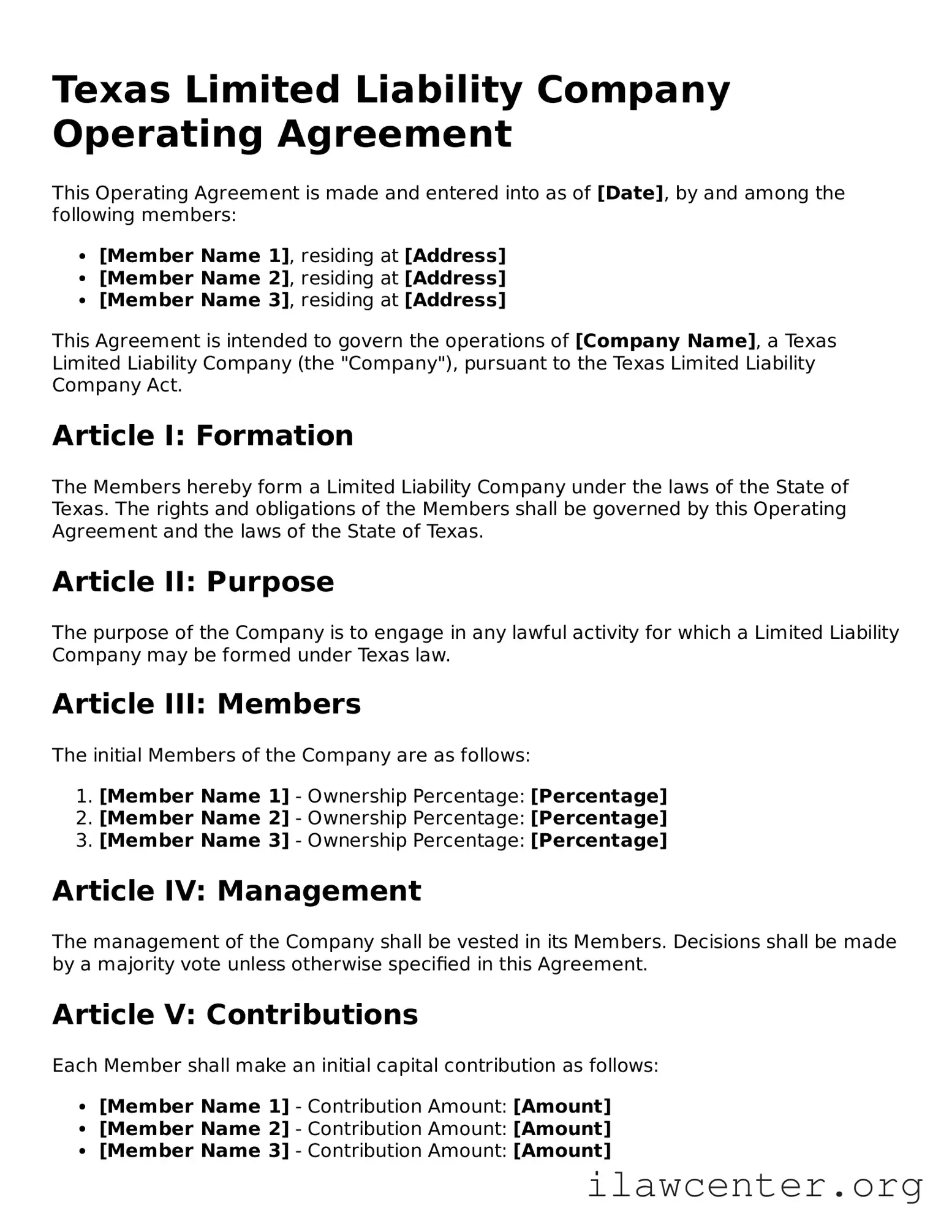
Texas Operating Agreement Preview

Texas Limited Liability Company Operating Agreement

This Operating Agreement is made and entered into as of [Date], by and among the following members:

  • [Member Name 1], residing at [Address]
  • [Member Name 2], residing at [Address]
  • [Member Name 3], residing at [Address]

This Agreement is intended to govern the operations of [Company Name], a Texas Limited Liability Company (the "Company"), pursuant to the Texas Limited Liability Company Act.

Article I: Formation

The Members hereby form a Limited Liability Company under the laws of the State of Texas. The rights and obligations of the Members shall be governed by this Operating Agreement and the laws of the State of Texas.

Article II: Purpose

The purpose of the Company is to engage in any lawful activity for which a Limited Liability Company may be formed under Texas law.

Article III: Members

The initial Members of the Company are as follows:

  1. [Member Name 1] - Ownership Percentage: [Percentage]
  2. [Member Name 2] - Ownership Percentage: [Percentage]
  3. [Member Name 3] - Ownership Percentage: [Percentage]

Article IV: Management

The management of the Company shall be vested in its Members. Decisions shall be made by a majority vote unless otherwise specified in this Agreement.

Article V: Contributions

Each Member shall make an initial capital contribution as follows:

  • [Member Name 1] - Contribution Amount: [Amount]
  • [Member Name 2] - Contribution Amount: [Amount]
  • [Member Name 3] - Contribution Amount: [Amount]

Article VI: Distributions

Distributions of profits and losses shall be allocated to the Members in proportion to their respective ownership percentages, unless otherwise agreed upon in writing.

Article VII: Indemnification

The Company shall indemnify each Member to the fullest extent permitted by Texas law against any loss or damage incurred in connection with the Company.

Article VIII: Amendments

This Agreement may be amended only by a written agreement signed by all Members.

Article IX: Governing Law

This Agreement shall be governed by and construed in accordance with the laws of the State of Texas.

IN WITNESS WHEREOF, the Members have executed this Operating Agreement as of the date first above written.

______________________________
[Member Name 1]

______________________________
[Member Name 2]

______________________________
[Member Name 3]

PDF Form Characteristics

Fact Name Description
Definition The Texas Operating Agreement outlines the management structure and operational procedures of a limited liability company (LLC).
Governing Law The agreement is governed by the Texas Business Organizations Code.
Mandatory vs. Optional While not legally required, having an Operating Agreement is highly recommended for LLCs in Texas.
Members' Rights The document specifies the rights and responsibilities of each member of the LLC.
Management Structure It can outline whether the LLC is member-managed or manager-managed.
Capital Contributions The agreement details the initial capital contributions made by members and any future contributions.
Profit Distribution It defines how profits and losses will be distributed among members.
Amendments The Operating Agreement can include provisions for how it may be amended in the future.
Dispute Resolution It may provide mechanisms for resolving disputes among members, such as mediation or arbitration.
Duration The agreement can specify the duration of the LLC's existence, whether it is perpetual or for a set term.

Instructions on Utilizing Texas Operating Agreement

After obtaining the Texas Operating Agreement form, you will need to carefully fill it out to ensure that all necessary information is accurately provided. This document outlines the management structure and operational guidelines for your business. Follow these steps to complete the form correctly.

  1. Begin by entering the name of your Limited Liability Company (LLC) at the top of the form.
  2. Provide the principal office address of the LLC. This should be a physical address, not a P.O. Box.
  3. List the names and addresses of all members of the LLC. Ensure that each member’s information is complete and accurate.
  4. Specify the percentage of ownership for each member. This should reflect the financial interest each member has in the LLC.
  5. Outline the management structure of the LLC. Indicate whether it will be managed by members or by appointed managers.
  6. Include any specific provisions regarding the management and operation of the LLC. This could cover decision-making processes, voting rights, and any other relevant operational details.
  7. Sign and date the form. All members should sign to acknowledge their agreement to the terms outlined in the document.

Once the form is filled out, review it for accuracy before submitting it to the appropriate state agency. Ensure that all signatures are in place and that the information reflects your intended structure and agreements.

Important Facts about Texas Operating Agreement

What is a Texas Operating Agreement?

A Texas Operating Agreement is a legal document that outlines the ownership and operational procedures of a limited liability company (LLC) in Texas. It serves as a roadmap for how the business will be run and how decisions will be made. This agreement is crucial for defining the roles of members, managing profits, and addressing potential disputes.

Is an Operating Agreement required in Texas?

No, Texas does not legally require LLCs to have an Operating Agreement. However, having one is highly recommended. It helps establish clear guidelines and can prevent misunderstandings among members. Additionally, banks and investors often prefer to see this document before engaging with an LLC.

What should be included in a Texas Operating Agreement?

Your Operating Agreement should include several key elements. These typically cover the LLC’s name, purpose, duration, member contributions, profit distribution, management structure, and procedures for adding or removing members. Including a dispute resolution process can also be beneficial.

Can I change the Operating Agreement after it’s created?

Yes, you can modify your Operating Agreement as needed. It’s essential to follow the procedures outlined within the document for making amendments. Most agreements will require a vote or consensus among members to approve any changes.

How does an Operating Agreement protect my LLC?

An Operating Agreement provides legal protection by clearly defining the roles and responsibilities of members. It helps to limit personal liability, ensuring that members are not personally responsible for the LLC’s debts or obligations. This document can also help in maintaining the LLC’s status as a separate legal entity.

What happens if I don’t have an Operating Agreement?

Without an Operating Agreement, your LLC will be governed by Texas state laws, which may not align with your specific business needs. This could lead to unintended consequences, such as default management structures and profit-sharing rules that may not reflect your intentions. It can also make resolving disputes more complicated.

How do I create a Texas Operating Agreement?

You can create an Operating Agreement by drafting it yourself or using templates available online. It’s important to ensure that it meets Texas legal requirements. Alternatively, consulting with a legal professional can help tailor the agreement to fit your specific business needs and ensure compliance.

Is it necessary to file the Operating Agreement with the state?

No, you do not need to file your Operating Agreement with the state of Texas. It is an internal document, meant for the members of the LLC. However, it should be kept in a safe place and made accessible to all members, as it may be needed for reference or in case of disputes.

Common mistakes

Filling out the Texas Operating Agreement form is a crucial step for anyone starting a limited liability company (LLC) in Texas. However, many people make common mistakes that can lead to confusion or even legal issues down the line. One frequent error is failing to specify the management structure of the LLC. Without clear designation of whether the company will be member-managed or manager-managed, it can create ambiguity in decision-making and operational authority.

Another mistake involves overlooking the importance of defining the roles and responsibilities of members. Each member should have a clear understanding of their duties and contributions to the LLC. If these roles are not explicitly stated, it can lead to misunderstandings and disputes among members, undermining the cooperative spirit of the business.

Additionally, many individuals neglect to include provisions for profit and loss distribution. This section is vital for outlining how profits will be shared among members. Without this clarity, disagreements may arise regarding financial expectations, potentially harming relationships and the business itself.

Some people also fail to address the process for adding or removing members. This oversight can create complications if a member wants to leave the LLC or if new members want to join. Establishing a clear procedure in advance helps prevent conflict and ensures smooth transitions within the company.

Finally, a common mistake is not having the Operating Agreement reviewed by a legal professional. While it might seem like an unnecessary expense, a lawyer can provide valuable insights and catch potential issues before they become significant problems. Investing time and resources into this review can save considerable headaches in the future.

Documents used along the form

The Texas Operating Agreement is a crucial document for limited liability companies (LLCs) in Texas, outlining the management structure and operational guidelines of the business. Alongside this agreement, several other forms and documents are often utilized to ensure comprehensive legal compliance and effective business operations. Below is a list of these essential documents.

  • Articles of Organization: This document is filed with the Texas Secretary of State to officially form the LLC. It includes basic information such as the company name, registered agent, and purpose of the business.
  • Employer Identification Number (EIN): Issued by the IRS, this number is necessary for tax purposes. It allows the LLC to hire employees, open a bank account, and file tax returns.
  • Membership Certificates: These certificates serve as proof of ownership for members of the LLC. They can outline each member's percentage of ownership and voting rights within the company.
  • Bylaws: While not always required, bylaws can provide additional governance rules for the LLC. They often address procedures for meetings, voting, and member responsibilities.
  • Operating Procedures: This document details the day-to-day operations of the LLC. It may include guidelines for financial management, decision-making processes, and conflict resolution.
  • Annual Reports: Many states, including Texas, require LLCs to file annual reports. These reports typically include updated information about the company and its members, ensuring compliance with state regulations.
  • Bank Resolution: This document authorizes specific individuals to open and manage the LLC's bank accounts. It helps establish clear financial management practices and accountability.

In summary, the Texas Operating Agreement is just one part of a broader framework of documents essential for the effective operation of an LLC. Each of these forms plays a vital role in ensuring legal compliance, clarifying ownership rights, and establishing operational procedures. Together, they contribute to the overall stability and success of the business.

Similar forms

  • Bylaws: Similar to an Operating Agreement, bylaws govern the internal management of a corporation. They outline the roles of directors and officers, as well as the procedures for meetings and decision-making.
  • Partnership Agreement: This document details the rights and responsibilities of partners in a partnership. Like an Operating Agreement, it defines how profits and losses are shared, and how decisions are made.
  • Shareholder Agreement: This agreement is used by corporations to outline the rights of shareholders. It can address issues such as share transfers and voting rights, similar to how an Operating Agreement addresses member rights in an LLC.
  • Joint Venture Agreement: In a joint venture, two or more parties collaborate on a specific project. This agreement outlines each party's contributions and responsibilities, akin to how an Operating Agreement delineates member roles in an LLC.
  • Non-Disclosure Agreement (NDA): While primarily focused on confidentiality, an NDA can include terms about how parties will interact and share information, similar to the operational guidelines found in an Operating Agreement.
  • Employment Agreement: This document outlines the terms of employment for an individual. It may cover roles, responsibilities, and compensation, much like how an Operating Agreement specifies member roles and distributions.
  • Franchise Agreement: A franchise agreement governs the relationship between a franchisor and franchisee. It includes operational guidelines and responsibilities, mirroring the structure of an Operating Agreement for LLCs.
  • Lease Agreement: This document specifies the terms under which one party rents property from another. Like an Operating Agreement, it outlines rights, responsibilities, and terms of use.
  • Terms of Service: Often used in online businesses, these terms outline the rules users must agree to when using a service. They define user rights and responsibilities, akin to the member guidelines in an Operating Agreement.
  • Articles of Incorporation: This document establishes a corporation's existence and outlines its basic structure. While it serves a different purpose, it complements the Operating Agreement by detailing foundational governance.

Dos and Don'ts

When filling out the Texas Operating Agreement form, it is crucial to approach the task with care. Here are six essential dos and don'ts to keep in mind:

  • Do ensure that all member names and addresses are accurately listed.
  • Do clearly define the management structure of the LLC.
  • Do specify the percentage of ownership for each member.
  • Don't leave any sections blank; incomplete information can lead to issues later.
  • Don't use vague language; clarity is key to avoid misunderstandings.
  • Don't forget to have all members sign and date the agreement.

Completing this form correctly is vital for the smooth operation of your LLC. Take the time to review your entries carefully.

Misconceptions

When it comes to the Texas Operating Agreement form, many people have misconceptions that can lead to confusion. Understanding the truth behind these myths can help ensure that you navigate the process smoothly. Here’s a list of ten common misconceptions:

  1. It’s not necessary for all LLCs. Many believe that an Operating Agreement is optional for Texas LLCs. However, having one is crucial for outlining the management structure and operational guidelines, even if it’s not legally required.
  2. All Operating Agreements are the same. Some think that a standard template will suffice for every business. In reality, each Operating Agreement should be tailored to reflect the specific needs and goals of the LLC.
  3. It must be filed with the state. There is a misconception that the Operating Agreement needs to be submitted to the Texas Secretary of State. In fact, it is an internal document and does not need to be filed.
  4. Verbal agreements are enough. Many assume that a verbal agreement among members is sufficient. However, without a written Operating Agreement, disputes can arise and be difficult to resolve.
  5. It only covers financial matters. Some people think that the Operating Agreement only deals with finances. In truth, it encompasses various aspects, including management roles, voting rights, and procedures for adding new members.
  6. Once created, it can’t be changed. There is a belief that an Operating Agreement is set in stone. In reality, it can be amended as the needs of the business evolve, provided all members agree to the changes.
  7. It’s only for multi-member LLCs. Some believe that Operating Agreements are only necessary for LLCs with multiple members. However, even single-member LLCs can benefit from having one to establish clear guidelines.
  8. It’s only about ownership percentages. Many think that the Operating Agreement primarily outlines ownership stakes. While that is important, it also addresses management structure, responsibilities, and procedures for decision-making.
  9. It’s a one-time task. Some assume that drafting an Operating Agreement is a one-off task. However, it should be reviewed and updated regularly to reflect changes in the business or membership.
  10. Legal advice isn’t necessary. Many believe they can draft an Operating Agreement without professional help. While it’s possible to create one independently, consulting with a legal expert can ensure that all important aspects are covered and compliant with Texas law.

By dispelling these misconceptions, you can better appreciate the importance of a Texas Operating Agreement and how it can benefit your LLC.

Key takeaways

When filling out and utilizing the Texas Operating Agreement form, it is essential to keep several key points in mind.

  • Clarity is Crucial: Ensure that all sections of the agreement are completed clearly and accurately. Ambiguities can lead to misunderstandings among members.
  • Member Roles: Clearly define the roles and responsibilities of each member. This helps in establishing expectations and accountability.
  • Amendment Procedures: Include a section that outlines how amendments to the agreement can be made. This provides a structured approach for any future changes.
  • Compliance with State Laws: Be aware of Texas state laws regarding operating agreements. Compliance is necessary to ensure the validity and enforceability of the document.

By considering these takeaways, individuals can create a more effective and legally sound Operating Agreement that supports their business objectives.