Attorney-Verified  Power of Attorney Document for Texas

Attorney-Verified Power of Attorney Document for Texas

The Texas Power of Attorney form is a legal document that allows an individual to designate another person to make decisions on their behalf. This authority can cover a range of matters, including financial and healthcare decisions. To ensure your wishes are respected, consider filling out the form by clicking the button below.

Article Guide

In the state of Texas, the Power of Attorney form serves as a vital legal document that empowers individuals to designate another person to act on their behalf in a variety of financial and medical matters. This form can be tailored to meet specific needs, allowing the principal—the person granting the authority—to choose whether to grant broad powers or limit the authority to particular transactions. It is crucial to understand that the authority bestowed upon the agent, also known as the attorney-in-fact, can encompass anything from managing bank accounts and real estate transactions to making healthcare decisions when the principal is unable to do so. Additionally, the Texas Power of Attorney form comes in different types, including durable and non-durable, each serving distinct purposes and offering varying levels of control and protection. The durable power of attorney remains effective even if the principal becomes incapacitated, while the non-durable version ceases to be valid under such circumstances. Understanding these nuances is essential for anyone considering the use of this form, as it not only facilitates important decisions but also safeguards the principal’s interests in times of need.

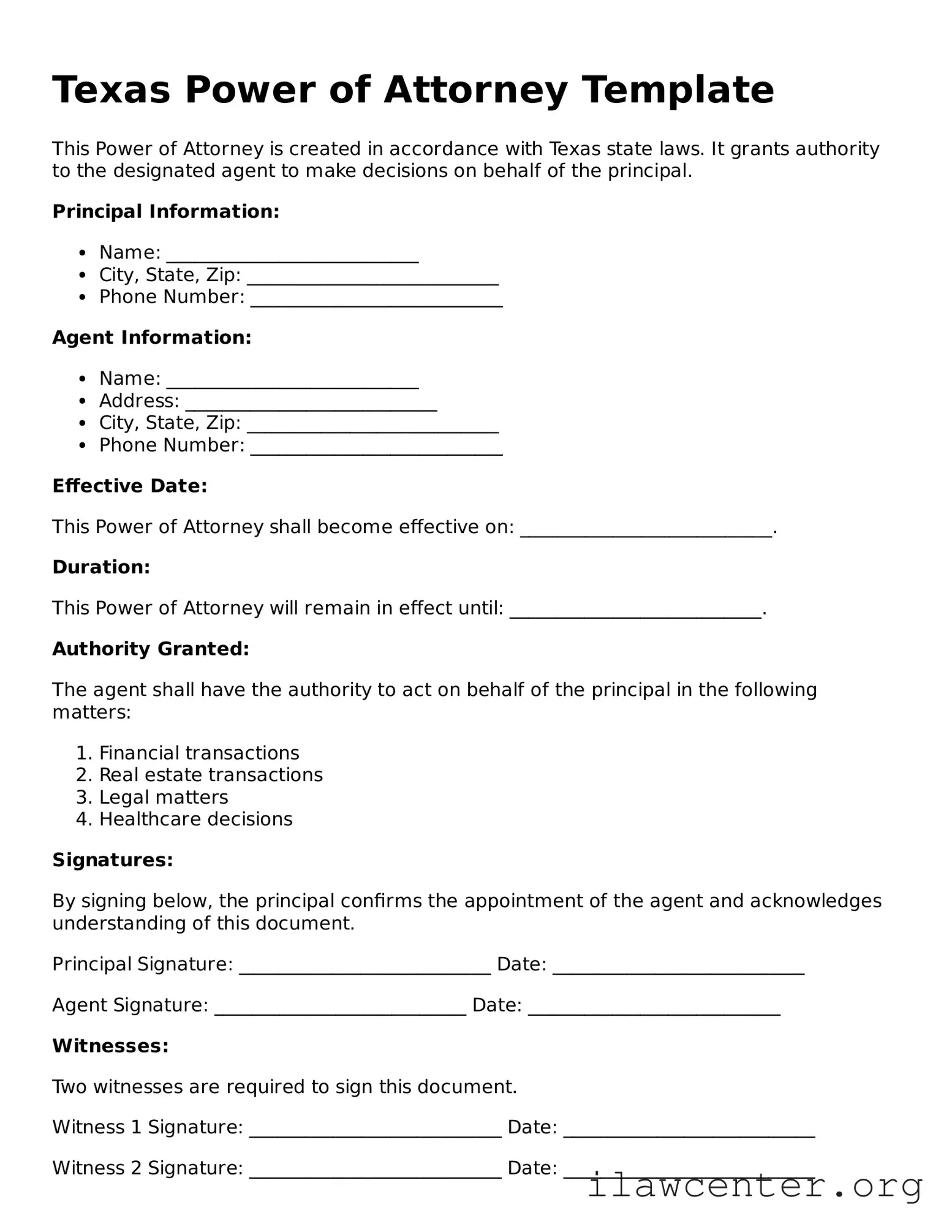
Texas Power of Attorney Preview

Texas Power of Attorney Template

This Power of Attorney is created in accordance with Texas state laws. It grants authority to the designated agent to make decisions on behalf of the principal.

Principal Information:

  • Name: ___________________________
  • City, State, Zip: ___________________________
  • Phone Number: ___________________________

Agent Information:

  • Name: ___________________________
  • Address: ___________________________
  • City, State, Zip: ___________________________
  • Phone Number: ___________________________

Effective Date:

This Power of Attorney shall become effective on: ___________________________.

Duration:

This Power of Attorney will remain in effect until: ___________________________.

Authority Granted:

The agent shall have the authority to act on behalf of the principal in the following matters:

  1. Financial transactions
  2. Real estate transactions
  3. Legal matters
  4. Healthcare decisions

Signatures:

By signing below, the principal confirms the appointment of the agent and acknowledges understanding of this document.

Principal Signature: ___________________________ Date: ___________________________

Agent Signature: ___________________________ Date: ___________________________

Witnesses:

Two witnesses are required to sign this document.

Witness 1 Signature: ___________________________ Date: ___________________________

Witness 2 Signature: ___________________________ Date: ___________________________

This document must be notarized to be valid under Texas law.

PDF Form Characteristics

Fact Name Description
Definition A Texas Power of Attorney form allows an individual to designate another person to act on their behalf in legal or financial matters.
Governing Law The Texas Power of Attorney is governed by the Texas Estates Code, specifically Title 2, Chapter 751.
Types There are several types of Power of Attorney forms, including durable, medical, and limited, each serving different purposes.
Durability A durable Power of Attorney remains effective even if the principal becomes incapacitated.
Execution Requirements The form must be signed by the principal in the presence of a notary public or two witnesses to be valid.
Revocation The principal can revoke the Power of Attorney at any time as long as they are competent to do so.
Agent's Authority The agent's authority can be broad or limited, depending on the specifications outlined in the form.
Healthcare Decisions A separate Medical Power of Attorney form is recommended for healthcare decisions, though it can be included in a general Power of Attorney.
Filing Generally, a Power of Attorney does not need to be filed with the court unless it is being used in a legal proceeding.
Validity The Power of Attorney remains valid until revoked, the principal passes away, or the specified time period expires.

Instructions on Utilizing Texas Power of Attorney

After obtaining the Texas Power of Attorney form, you'll need to fill it out carefully. This document allows you to designate someone to act on your behalf in legal and financial matters. Follow these steps to complete the form accurately.

  1. Begin by entering the date at the top of the form.
  2. Provide your full name and address in the designated section.
  3. Identify the person you are appointing as your agent. Include their full name and address.
  4. Specify the powers you are granting to your agent. You may choose to give them general powers or limit them to specific tasks.
  5. Include any additional instructions or limitations regarding the powers granted, if necessary.
  6. Sign the form in the appropriate space. Make sure to do this in front of a notary public.
  7. Have the notary public sign and stamp the document to validate it.
  8. Keep a copy of the completed form for your records and provide a copy to your agent.

Important Facts about Texas Power of Attorney

What is a Texas Power of Attorney?

A Texas Power of Attorney is a legal document that allows an individual, known as the principal, to appoint someone else, referred to as the agent or attorney-in-fact, to make decisions on their behalf. This can include financial matters, healthcare decisions, or other personal affairs. The document grants specific powers and can be tailored to fit the principal's needs.

What types of Power of Attorney are available in Texas?

In Texas, there are several types of Power of Attorney. The most common include a General Power of Attorney, which grants broad powers to the agent, and a Durable Power of Attorney, which remains effective even if the principal becomes incapacitated. There is also a Medical Power of Attorney, specifically for healthcare decisions, and a Limited Power of Attorney, which restricts the agent's authority to specific tasks or time periods.

How do I create a Power of Attorney in Texas?

To create a Power of Attorney in Texas, the principal must complete a form that outlines the powers being granted. This form must be signed by the principal in the presence of a notary public. While it is not legally required to have witnesses, having them can provide additional validation and may be beneficial in certain situations.

Can I revoke a Power of Attorney in Texas?

Yes, a Power of Attorney can be revoked at any time by the principal, as long as they are mentally competent. To revoke, the principal should create a written document stating the revocation and notify the agent and any relevant third parties who may rely on the Power of Attorney. It is advisable to also retrieve any copies of the original document to prevent misuse.

What happens if the principal becomes incapacitated?

If the principal becomes incapacitated, a Durable Power of Attorney remains in effect, allowing the agent to continue making decisions on their behalf. However, a standard Power of Attorney would typically become void upon the principal's incapacitation. It is crucial for the principal to specify their wishes regarding incapacity when drafting the document.

Do I need an attorney to create a Power of Attorney?

While it is not legally required to have an attorney to create a Power of Attorney in Texas, consulting with one is highly recommended. An attorney can help ensure that the document complies with state laws and accurately reflects the principal's intentions. This guidance can prevent potential disputes or misunderstandings in the future.

Can an agent be held liable for decisions made under a Power of Attorney?

Generally, an agent is not personally liable for decisions made in good faith while acting under a Power of Attorney. However, if the agent acts outside the authority granted, engages in fraud, or neglects their duties, they may be held accountable. It is essential for agents to act in the best interest of the principal and keep accurate records of their actions.

Is a Power of Attorney valid in other states?

A Power of Attorney created in Texas is typically valid in other states, but acceptance may vary. Some states have specific requirements or forms, so it is wise to check the laws of the state where the Power of Attorney will be used. In some cases, it may be beneficial to execute a new Power of Attorney that complies with the other state's regulations.

What should I consider when choosing an agent?

Choosing an agent is a significant decision. The agent should be someone trustworthy, responsible, and capable of making decisions in the principal's best interest. Consider their understanding of the principal's values, financial situation, and healthcare preferences. It may also be wise to discuss the responsibilities with the potential agent before finalizing the appointment.

Can a Power of Attorney be used for real estate transactions?

Yes, a Power of Attorney can be used for real estate transactions. The principal can grant the agent authority to buy, sell, or manage real estate on their behalf. However, the Power of Attorney must specifically include the power to handle real estate matters. It is advisable to consult an attorney to ensure that the document is appropriately drafted for this purpose.
Common mistakes

Filling out a Texas Power of Attorney (POA) form is a significant step in planning for the future. However, many people make common mistakes that can lead to complications down the road. Understanding these pitfalls can help ensure that your intentions are clearly communicated and legally binding.

One frequent mistake is not specifying the powers granted. A general POA gives broad authority, but it’s essential to outline specific powers, especially if the agent will handle financial matters or make healthcare decisions. Without clear specifications, the agent may not have the authority to act in certain situations, potentially leaving you or your loved ones in a difficult position.

Another common error is failing to date the document. A Power of Attorney should always include a date to establish when it becomes effective. Without a date, it can create confusion regarding its validity, especially if there are multiple versions or if the circumstances change over time.

People often overlook the importance of signatures and witnesses. Texas law requires that the principal (the person granting the power) must sign the document, and in some cases, it must be notarized. Failing to secure the necessary signatures can render the document invalid, leading to potential legal disputes.

Another mistake is not discussing the POA with the chosen agent. It’s crucial to have a conversation with the person you intend to appoint. This ensures they understand their responsibilities and are willing to accept the role. Surprises can lead to reluctance or refusal to act when the time comes.

Additionally, many individuals neglect to review the document periodically. Life changes, such as marriage, divorce, or the birth of a child, can affect your needs and the appropriateness of the appointed agent. Regular reviews can help keep the document relevant and effective.

Some people mistakenly believe that a POA is only necessary for the elderly or those with health issues. In reality, anyone can benefit from having a Power of Attorney in place. Unexpected events, such as accidents or sudden illness, can happen at any age, making it essential to plan ahead.

Moreover, not considering alternate agents can be a significant oversight. If the primary agent is unavailable or unable to serve, having a backup ensures that your affairs can still be managed without delay. This foresight can save time and reduce stress for your loved ones.

Another error is using outdated forms. Laws can change, and using an old version of the POA form might lead to complications. Always ensure that you are using the most current form to avoid any legal issues.

Finally, many individuals fail to store the document safely. After completing the Power of Attorney, it’s important to keep it in a secure yet accessible location. Inform your agent and trusted family members about where the document is stored. This ensures that it can be easily located when needed.

By avoiding these common mistakes, individuals can create a Texas Power of Attorney that truly reflects their wishes and provides peace of mind for themselves and their families.

Documents used along the form

When creating a Texas Power of Attorney, several additional forms and documents may be necessary to ensure comprehensive legal coverage. Below is a list of common documents that are often used in conjunction with the Power of Attorney form.

  • Medical Power of Attorney: This document allows an individual to designate someone to make healthcare decisions on their behalf if they become unable to do so.
  • Living Will: A living will outlines an individual's preferences regarding medical treatment in situations where they cannot communicate their wishes, particularly at the end of life.
  • Durable Power of Attorney: This form remains effective even if the principal becomes incapacitated, allowing the agent to manage financial and legal matters continuously.
  • Financial Power of Attorney: Similar to a general Power of Attorney, this document specifically grants authority to manage financial affairs, such as banking and property transactions.
  • HIPAA Release Form: This form authorizes healthcare providers to share medical information with designated individuals, ensuring that the agent can make informed decisions.
  • Trust Documents: If a trust is established, these documents outline the management and distribution of assets, often working alongside the Power of Attorney.
  • Will: A will details how a person's assets will be distributed upon their death. It can complement the Power of Attorney by clarifying wishes for estate management.
  • Guardianship Documents: If a person needs a guardian due to incapacity, these documents establish the legal authority for someone to make personal and financial decisions on their behalf.

These documents can provide clarity and support in various situations where legal authority and decision-making are required. It is advisable to consider each document's relevance based on individual circumstances and needs.

Similar forms

The Power of Attorney (POA) form is a legal document that allows one person to act on behalf of another in various matters. Several other documents serve similar purposes, granting authority or designating responsibilities. Below is a list of documents that share similarities with a Power of Attorney:

  • Living Will: This document outlines an individual's preferences regarding medical treatment in situations where they are unable to communicate their wishes. Like a POA, it designates authority concerning health care decisions.
  • Health Care Proxy: This document allows an individual to appoint someone to make medical decisions on their behalf. It is similar to a POA but specifically focuses on health care matters.
  • Durable Power of Attorney: This is a type of POA that remains effective even if the principal becomes incapacitated. It serves the same purpose as a standard POA but with added durability in specific situations.
  • Financial Power of Attorney: This document specifically grants authority to manage financial affairs. It is a subset of the broader POA, tailored for financial matters.
  • Trust Agreement: A trust document allows a person to transfer assets to a trustee for the benefit of beneficiaries. Like a POA, it involves delegating authority over assets but typically has a longer-term focus.
  • Appointment of Guardian: This document designates a guardian for a minor or an incapacitated adult. Similar to a POA, it grants authority to make decisions on behalf of another person.
  • Advance Directive: This document combines elements of a living will and health care proxy, providing instructions for medical care and designating a decision-maker. It shares the POA's focus on health care authority.
  • Executor Appointment: This document names an executor for an estate after a person passes away. It is similar to a POA in that it grants authority to manage affairs but pertains to posthumous responsibilities.

Dos and Don'ts

When filling out the Texas Power of Attorney form, it's important to follow certain guidelines to ensure the document is valid and effective. Here are some key do's and don'ts:

  • Do clearly identify the principal and the agent.
  • Do specify the powers you are granting to the agent.
  • Do sign the document in front of a notary public.
  • Do date the form when you sign it.
  • Don't leave any sections blank; fill out all required information.
  • Don't use vague language that could lead to confusion.
  • Don't forget to keep a copy for your records.

Following these guidelines can help ensure that your Power of Attorney is properly executed and meets your needs.

Misconceptions

Understanding the Texas Power of Attorney form is essential for making informed decisions about legal representation and financial management. Here are eight common misconceptions:

  1. All Power of Attorney forms are the same.

    Many people believe that Power of Attorney forms are interchangeable. In reality, each state has specific requirements and types of Power of Attorney, which can affect their validity and use.

  2. A Power of Attorney can make any decision on my behalf.

    This is not entirely true. The authority granted depends on the specific powers outlined in the document. A Power of Attorney can only act within the scope defined by the principal.

  3. Once I sign a Power of Attorney, I lose control.

    Signing a Power of Attorney does not mean you relinquish control. You can revoke it at any time, as long as you are mentally competent.

  4. My agent can act without any restrictions.

    While an agent has significant authority, they are still bound by fiduciary duties. They must act in your best interest and cannot misuse their power.

  5. A Power of Attorney is only for financial matters.

    This is a misconception. A Power of Attorney can also cover medical decisions, depending on how it is structured. A separate document, known as a Medical Power of Attorney, may be needed for healthcare decisions.

  6. Once created, a Power of Attorney lasts forever.

    Power of Attorney documents can have expiration dates or conditions under which they become invalid. It's important to review and update them as needed.

  7. My family can automatically act on my behalf.

    Family members do not have inherent authority to act for you. A formal Power of Attorney must be established for them to legally represent you.

  8. I don’t need a Power of Attorney if I have a will.

    A will only takes effect after death. A Power of Attorney is necessary for managing affairs while you are still alive, especially if you become incapacitated.

Key takeaways

When considering a Power of Attorney (POA) in Texas, it is essential to understand the implications and processes involved. Here are some key takeaways to keep in mind:

  • Understanding the Purpose: A Power of Attorney allows you to designate someone to make decisions on your behalf, particularly in financial or healthcare matters.
  • Choosing the Right Agent: Select a trustworthy individual as your agent. This person will have significant authority over your affairs.
  • Specific vs. General Authority: You can grant specific powers for particular tasks or general authority to handle a wide range of decisions.
  • Durable Power of Attorney: A durable POA remains effective even if you become incapacitated. Ensure you specify this if desired.
  • Signing Requirements: The form must be signed by you and acknowledged by a notary public to be legally valid in Texas.
  • Revocation: You can revoke a Power of Attorney at any time, provided you follow the proper procedures to do so.
  • Limitations: Understand that a POA does not allow your agent to make decisions about your medical care unless explicitly stated.
  • Storing the Document: Keep the original POA document in a safe place and provide copies to your agent and relevant institutions.
  • Consulting an Attorney: While forms are available online, consulting with a legal professional can ensure that your POA meets your specific needs and complies with Texas law.