Attorney-Verified  Prenuptial Agreement Document for Texas

Attorney-Verified Prenuptial Agreement Document for Texas

A Texas Prenuptial Agreement form is a legal document that outlines the terms and conditions regarding the division of assets and financial responsibilities between partners in the event of a divorce or separation. This agreement helps couples clarify their financial rights and obligations, ensuring a smoother process should the relationship end. To get started on your own agreement, fill out the form by clicking the button below.

Article Guide

When considering marriage, many couples overlook the importance of a prenuptial agreement, particularly in Texas, where such agreements can play a crucial role in protecting individual assets and clarifying financial responsibilities. A Texas prenuptial agreement form serves as a legal document that outlines how assets and debts will be handled in the event of a divorce or separation. It typically addresses key areas such as property division, spousal support, and the management of debts acquired during the marriage. By clearly defining each partner's rights and obligations, the agreement can help prevent misunderstandings and disputes down the line. Furthermore, it can be tailored to reflect the unique circumstances and preferences of each couple, making it a flexible tool in marriage planning. Understanding the nuances of this form is essential for anyone looking to safeguard their financial future while entering into a new relationship. As such, it is vital to approach this topic with careful consideration and awareness of the legal implications involved.

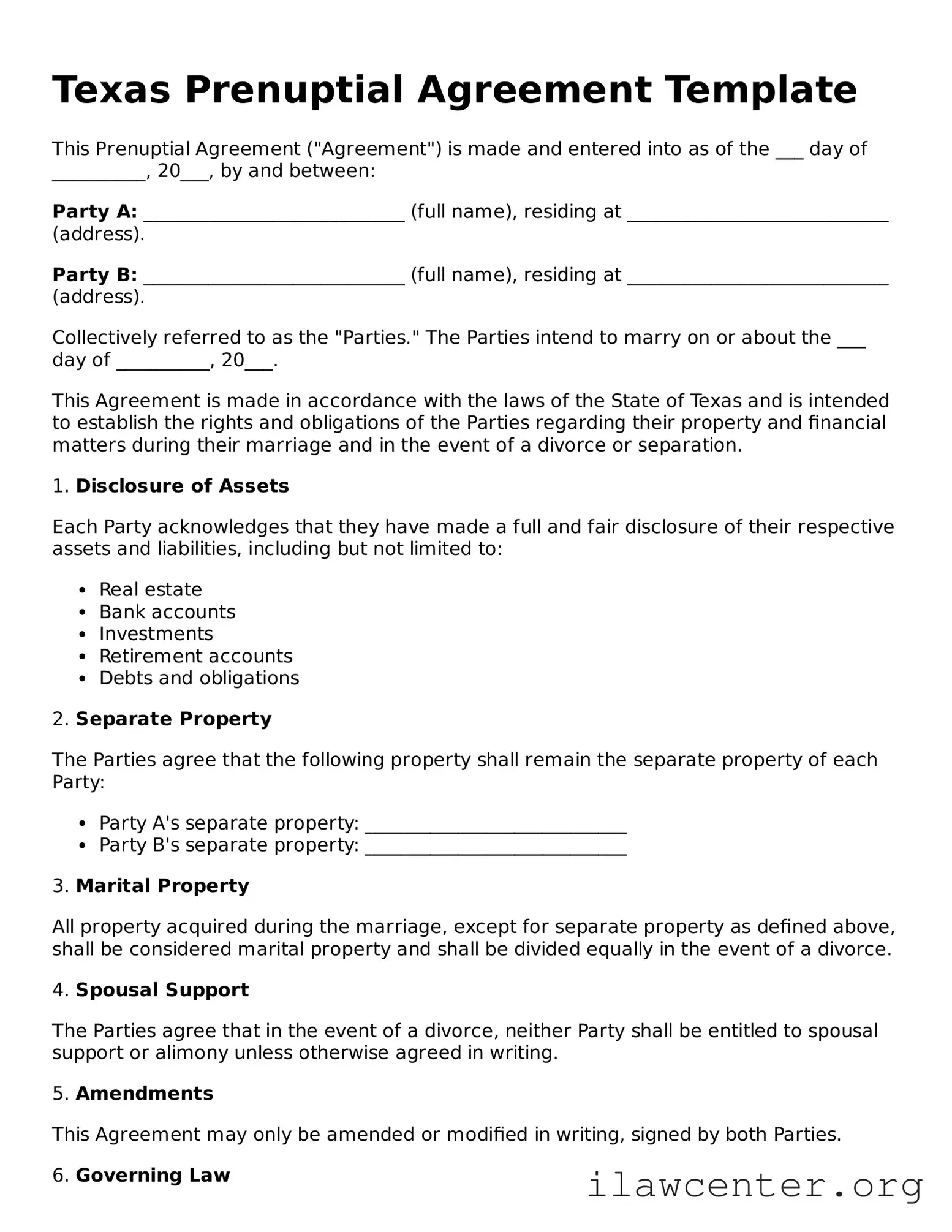
Texas Prenuptial Agreement Preview

Texas Prenuptial Agreement Template

This Prenuptial Agreement ("Agreement") is made and entered into as of the ___ day of __________, 20___, by and between:

Party A: ____________________________ (full name), residing at ____________________________ (address).

Party B: ____________________________ (full name), residing at ____________________________ (address).

Collectively referred to as the "Parties." The Parties intend to marry on or about the ___ day of __________, 20___.

This Agreement is made in accordance with the laws of the State of Texas and is intended to establish the rights and obligations of the Parties regarding their property and financial matters during their marriage and in the event of a divorce or separation.

1. Disclosure of Assets

Each Party acknowledges that they have made a full and fair disclosure of their respective assets and liabilities, including but not limited to:

  • Real estate
  • Bank accounts
  • Investments
  • Retirement accounts
  • Debts and obligations

2. Separate Property

The Parties agree that the following property shall remain the separate property of each Party:

  • Party A's separate property: ____________________________
  • Party B's separate property: ____________________________

3. Marital Property

All property acquired during the marriage, except for separate property as defined above, shall be considered marital property and shall be divided equally in the event of a divorce.

4. Spousal Support

The Parties agree that in the event of a divorce, neither Party shall be entitled to spousal support or alimony unless otherwise agreed in writing.

5. Amendments

This Agreement may only be amended or modified in writing, signed by both Parties.

6. Governing Law

This Agreement shall be governed by and construed in accordance with the laws of the State of Texas.

IN WITNESS WHEREOF, the Parties have executed this Prenuptial Agreement as of the date first above written.

______________________________

Party A Signature

______________________________

Party B Signature

______________________________

Date

______________________________

Witness Signature

______________________________

Date

PDF Form Characteristics

Fact Name Description
Definition A prenuptial agreement is a contract made before marriage outlining the distribution of assets and responsibilities in the event of divorce or separation.
Governing Law Texas Family Code governs prenuptial agreements in Texas.
Written Requirement In Texas, a prenuptial agreement must be in writing to be enforceable.
Voluntary Agreement Both parties must enter into the agreement voluntarily without coercion.
Full Disclosure Each party should fully disclose their assets and liabilities for the agreement to be valid.
Legal Representation While not required, it is advisable for both parties to have independent legal counsel.
Modification A prenuptial agreement can be modified or revoked after marriage, but this must also be in writing.
Enforceability Texas courts generally uphold prenuptial agreements unless they are found to be unconscionable or signed under duress.
Postnuptial Agreement A postnuptial agreement, similar to a prenuptial agreement, is created after marriage.
Common Misconception Many believe prenuptial agreements are only for wealthy individuals; however, they can benefit anyone looking to protect their interests.

Instructions on Utilizing Texas Prenuptial Agreement

Completing the Texas Prenuptial Agreement form involves several important steps. This process ensures that both parties understand their rights and responsibilities before entering into marriage. Follow these steps carefully to fill out the form correctly.

  1. Begin by obtaining the Texas Prenuptial Agreement form. You can find it online or at legal supply stores.
  2. Read the form thoroughly to understand its sections and requirements.
  3. At the top of the form, fill in the names of both parties. Make sure to include any middle names for clarity.
  4. Provide the date of the agreement. This should be the date when both parties sign the document.
  5. Detail the assets and liabilities of each party. List all property, bank accounts, debts, and any other financial information relevant to the agreement.
  6. Discuss and outline how property will be divided in the event of a divorce or separation. Be specific about what belongs to whom.
  7. Include any provisions regarding spousal support, if applicable. Clearly state any agreements made regarding financial support after divorce.
  8. Review the form with both parties to ensure all information is accurate and agreed upon.
  9. Sign the document in the presence of a notary public. This step is crucial for the agreement to be legally binding.
  10. Make copies of the signed agreement for both parties to keep for their records.

Once the form is filled out and signed, both parties should keep a copy in a safe place. This document will serve as a reference in the future, should any legal matters arise regarding the marriage.

Important Facts about Texas Prenuptial Agreement

What is a prenuptial agreement in Texas?

A prenuptial agreement, often referred to as a prenup, is a legal contract that a couple enters into before marriage. In Texas, this agreement outlines the division of assets and financial responsibilities in the event of divorce or death. It can cover various topics, including property rights, debt responsibilities, and spousal support. The goal is to provide clarity and protection for both parties, helping to prevent disputes in the future.

Why should couples consider a prenuptial agreement?

Couples might consider a prenuptial agreement for several reasons. For one, it can protect individual assets acquired before marriage. Additionally, it allows couples to establish their own rules regarding financial matters rather than relying on state laws, which might not align with their wishes. A prenup can also be particularly beneficial for those entering a second marriage or those with significant assets or debts.

What are the legal requirements for a prenuptial agreement in Texas?

In Texas, for a prenuptial agreement to be valid, it must be in writing and signed by both parties. It’s important that both individuals fully disclose their assets and debts before signing. The agreement cannot be unconscionable, meaning it should not be excessively unfair to one party. Additionally, both parties should ideally have independent legal counsel to ensure that they understand the agreement’s implications.

Can a prenuptial agreement be modified or revoked?

Yes, a prenuptial agreement can be modified or revoked at any time, but both parties must agree to the changes in writing. This process ensures that both individuals are on the same page regarding their financial arrangements. It’s advisable to consult with legal professionals when making modifications to ensure that the changes are enforceable and properly documented.

What happens if a prenuptial agreement is challenged in court?

If a prenuptial agreement is challenged in court, the judge will review its validity based on several factors. These may include whether there was full disclosure of assets, whether the agreement was signed voluntarily, and whether it was unconscionable at the time of signing. If the court finds that the prenup does not meet legal standards, it may be deemed unenforceable, and state laws will dictate asset division instead.

Are there any limitations on what a prenuptial agreement can cover?

Yes, there are limitations. In Texas, a prenuptial agreement cannot dictate child custody arrangements or child support obligations. Courts prioritize the best interests of the child, and any agreements made regarding these matters may not be upheld. Additionally, a prenup cannot include provisions that are illegal or against public policy.

How does a prenuptial agreement affect debt responsibility?

A prenuptial agreement can specify how debts will be handled during the marriage and in the event of divorce. For instance, if one partner enters the marriage with significant debt, the prenup can clarify that the other partner will not be responsible for that debt. This clarity can help prevent financial disputes and protect both parties’ credit ratings.

Is a prenuptial agreement only for wealthy individuals?

No, a prenuptial agreement is not solely for wealthy individuals. Anyone entering a marriage can benefit from having a prenup, regardless of their financial status. It serves as a tool to ensure both parties understand their rights and responsibilities, which can be particularly important in situations involving children, business ownership, or significant personal assets.
Common mistakes

Filling out a Texas Prenuptial Agreement form can be a straightforward process, yet many individuals make common mistakes that could lead to complications later on. One frequent error is the failure to fully disclose all assets and debts. Transparency is essential in a prenuptial agreement. If one party does not reveal their financial situation accurately, it may result in the agreement being challenged in court.

Another mistake is not considering future changes in circumstances. Life events such as career changes, inheritance, or the birth of children can significantly impact financial situations. A prenuptial agreement should be flexible enough to accommodate these potential changes. Failing to account for this can render the agreement less effective in the long run.

Additionally, many individuals overlook the importance of legal counsel. While it may seem cost-effective to fill out the form independently, having an attorney review the agreement can ensure that it meets legal standards and adequately protects both parties' interests. Legal advice can also help clarify any misunderstandings about the implications of the agreement.

Another common error is using vague language. Specificity is crucial in a prenuptial agreement. If terms are not clearly defined, it may lead to disputes in the future. For instance, rather than simply stating "property division," it is better to outline how specific assets will be divided.

Moreover, some individuals fail to consider the timing of when the agreement is signed. It is advisable to complete the prenuptial agreement well in advance of the wedding. Signing it too close to the wedding date can raise questions about coercion or pressure, potentially undermining the agreement's validity.

Lastly, neglecting to update the agreement over time can be detrimental. As life evolves, so too do financial circumstances and personal relationships. Regularly reviewing and updating the prenuptial agreement ensures that it remains relevant and reflective of both parties' current situations. This proactive approach can help prevent misunderstandings and disputes in the future.

Documents used along the form

A Texas prenuptial agreement is a legal document that outlines the division of assets and responsibilities between partners before marriage. While the prenuptial agreement itself is crucial, there are other forms and documents that often accompany it. These additional documents help clarify terms, protect interests, and ensure a smooth process as couples prepare for their marriage. Below is a list of common forms and documents that may be used alongside a Texas prenuptial agreement.

  • Financial Disclosure Statement: This document requires both parties to disclose their assets, debts, and income. Transparency is key in a prenuptial agreement, and this statement helps ensure that both partners are fully informed about each other's financial situation.
  • Postnuptial Agreement: Similar to a prenuptial agreement, a postnuptial agreement is created after marriage. It can address changes in circumstances or clarify issues that were not resolved in the prenup. This document can be especially useful if the couple's financial situation evolves over time.
  • Marital Property Agreement: This form specifies how property acquired during the marriage will be treated. It can outline whether certain assets will be considered community property or separate property, helping to prevent disputes in the future.
  • Separation Agreement: In the event that a couple decides to separate, this document outlines the terms of the separation, including asset division, child custody, and support arrangements. It can be a useful tool to establish clear expectations during a difficult time.
  • Will: While not directly related to a prenuptial agreement, having a will is essential for any couple. It ensures that each partner's wishes regarding asset distribution after death are clearly stated. A will can complement the prenup by providing additional clarity on how assets should be handled in the event of one partner's passing.

These documents serve to enhance the effectiveness of a prenuptial agreement and provide a comprehensive framework for managing financial and personal matters in a marriage. By utilizing these forms, couples can foster better communication and understanding, ultimately contributing to a healthier relationship.

Similar forms

A Prenuptial Agreement is a legal document that outlines the division of assets and responsibilities in the event of a divorce or separation. Several other documents serve similar purposes in different contexts. Here are four documents that share similarities with a Prenuptial Agreement:

  • Postnuptial Agreement: This document is created after marriage and serves to outline the same types of financial arrangements as a prenuptial agreement. It can address issues that may arise during the marriage, such as changes in income or assets.
  • Separation Agreement: A separation agreement is used when a couple decides to live apart but not divorce. It details the terms of their separation, including asset division, child custody, and support obligations, similar to what a prenuptial agreement does for couples before marriage.
  • Marital Settlement Agreement: This document is typically created during divorce proceedings. It outlines the terms of asset division, spousal support, and other relevant matters, akin to the provisions found in a prenuptial agreement.
  • Living Together Agreement: For couples who are cohabitating without marriage, this agreement addresses financial responsibilities and asset ownership. It serves a similar function to a prenuptial agreement by clarifying expectations and protecting individual interests.

Dos and Don'ts

When considering a prenuptial agreement in Texas, it's essential to approach the process with care. Here’s a list of things to keep in mind while filling out the agreement form.

  • Do be honest about your assets and debts. Transparency is crucial for the agreement to be valid.
  • Don't rush the process. Take your time to ensure all details are accurate and complete.
  • Do consult with a lawyer who specializes in family law. Professional guidance can help you navigate complex legal language.
  • Don't forget to discuss the agreement openly with your partner. Communication is key to mutual understanding.
  • Do consider including provisions for future changes in circumstances, such as children or significant income changes.
  • Don't use vague language. Clearly define terms to avoid confusion later on.
  • Do ensure both parties sign the agreement voluntarily, without any coercion.
  • Don't overlook the importance of notarization. A notary can help authenticate the document.
  • Do review the agreement periodically, especially if major life events occur.

By following these guidelines, individuals can create a prenuptial agreement that protects their interests while fostering a healthy dialogue between partners.

Misconceptions

Understanding prenuptial agreements in Texas can be tricky, especially with all the misconceptions floating around. Here’s a list of ten common myths about the Texas Prenuptial Agreement form, along with clarifications to help set the record straight.

  1. Prenuptial agreements are only for the wealthy. Many people believe that only those with significant assets need a prenup. In reality, anyone can benefit from a prenup, regardless of their financial situation. It can help clarify financial responsibilities and expectations.
  2. Prenups are only for divorce. While prenuptial agreements do address divorce, they can also outline financial arrangements during the marriage, ensuring both partners are on the same page.
  3. Prenuptial agreements are not enforceable in Texas. This is false. Texas law recognizes prenuptial agreements as valid and enforceable, provided they meet certain requirements, such as being in writing and signed by both parties.
  4. Once signed, a prenup cannot be changed. Prenuptial agreements can be modified or revoked at any time, as long as both parties agree to the changes in writing.
  5. Prenups are only for second marriages. While they are common among individuals entering a second marriage, first-time couples can also benefit from a prenup. It helps set expectations from the start.
  6. Prenuptial agreements are a sign of distrust. Many people view prenups as a lack of faith in the relationship. However, they can actually promote open communication about finances, which is crucial for a healthy partnership.
  7. Prenuptial agreements are complicated and expensive. While some may be complex, a straightforward prenup can be created without excessive costs. Investing in a prenup can save money and stress in the long run.
  8. Only one partner needs to hire a lawyer. It’s advisable for both parties to seek independent legal advice to ensure that the agreement is fair and that both understand their rights.
  9. Prenups can include anything. While prenups can cover a variety of financial matters, they cannot include provisions that are illegal or against public policy, such as waiving child support.
  10. Prenuptial agreements are only for heterosexual couples. This is not true. Same-sex couples can and should consider prenuptial agreements to protect their rights and clarify financial responsibilities.

By debunking these myths, couples can make informed decisions about whether a prenuptial agreement is right for them. Open discussions about finances and expectations can strengthen a relationship, paving the way for a successful partnership.

Key takeaways

When considering a Texas Prenuptial Agreement, it's essential to understand several key points. Here are some important takeaways to keep in mind:

  1. Understand the Purpose: A prenuptial agreement outlines how assets and debts will be handled during marriage and in the event of divorce.
  2. Full Disclosure: Both parties must fully disclose their financial situations, including assets, debts, and income.
  3. Legal Requirements: The agreement must be in writing and signed by both parties to be enforceable in Texas.
  4. Voluntary Agreement: Both parties must enter into the agreement voluntarily, without any coercion or undue pressure.
  5. Independent Legal Advice: It’s advisable for both parties to seek independent legal counsel to ensure their rights are protected.
  6. Review and Revise: Regularly review the agreement, especially if there are significant changes in circumstances, such as the birth of children or changes in income.
  7. Not a Substitute for Estate Planning: A prenuptial agreement does not replace the need for a will or other estate planning documents.
  8. Consider Future Changes: Address how future financial changes, like inheritances or business acquisitions, will be handled in the agreement.
  9. Enforceability: Courts may not enforce provisions that are deemed unfair or unconscionable, so fairness is crucial.

By understanding these key points, individuals can better prepare for a successful and fair prenuptial agreement process in Texas.