Attorney-Verified  Quitclaim Deed Document for Texas

Attorney-Verified Quitclaim Deed Document for Texas

A Texas Quitclaim Deed is a legal document used to transfer ownership of real estate from one person to another without guaranteeing that the title is clear. This form is often utilized when the parties know each other, such as family members or friends. If you are ready to fill out the form, please click the button below.

Article Guide

When it comes to transferring property ownership in Texas, the Quitclaim Deed form serves as a crucial tool for individuals looking to convey their interest in real estate. This form allows a property owner, known as the grantor, to relinquish their rights to the property without making any guarantees about the title's validity. It’s particularly useful in situations such as family transfers, divorces, or settling estates, where the parties involved may not require a full title search or warranty. The Quitclaim Deed is straightforward in its structure, typically requiring basic information like the names of the parties, a legal description of the property, and the signature of the grantor. Importantly, while this deed facilitates a quick transfer, it does not protect the grantee from any potential claims against the property, making it essential for individuals to understand the implications of using this form. As such, those considering a Quitclaim Deed in Texas should weigh their options carefully and may want to seek guidance to ensure their interests are adequately protected.

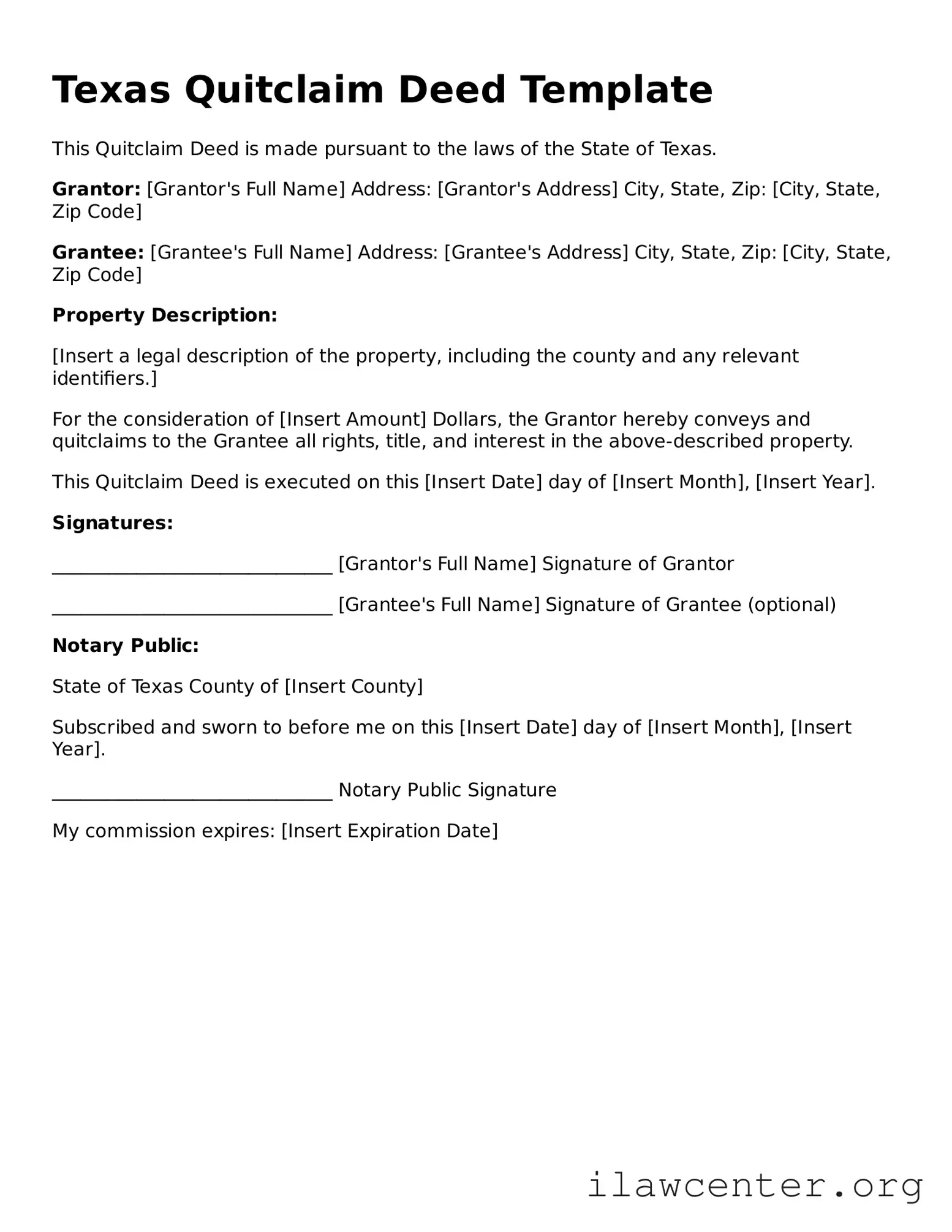
Texas Quitclaim Deed Preview

Texas Quitclaim Deed Template

This Quitclaim Deed is made pursuant to the laws of the State of Texas.

Grantor: [Grantor's Full Name] Address: [Grantor's Address] City, State, Zip: [City, State, Zip Code]

Grantee: [Grantee's Full Name] Address: [Grantee's Address] City, State, Zip: [City, State, Zip Code]

Property Description:

[Insert a legal description of the property, including the county and any relevant identifiers.]

For the consideration of [Insert Amount] Dollars, the Grantor hereby conveys and quitclaims to the Grantee all rights, title, and interest in the above-described property.

This Quitclaim Deed is executed on this [Insert Date] day of [Insert Month], [Insert Year].

Signatures:

______________________________ [Grantor's Full Name] Signature of Grantor

______________________________ [Grantee's Full Name] Signature of Grantee (optional)

Notary Public:

State of Texas County of [Insert County]

Subscribed and sworn to before me on this [Insert Date] day of [Insert Month], [Insert Year].

______________________________ Notary Public Signature

My commission expires: [Insert Expiration Date]

PDF Form Characteristics

Fact Name Description
Definition A quitclaim deed is a legal document used to transfer ownership of real estate without any warranties.
Governing Law The Texas Quitclaim Deed is governed by the Texas Property Code.
Parties Involved The parties involved are the grantor (the person transferring the property) and the grantee (the person receiving the property).
No Warranty This type of deed does not guarantee that the grantor has clear title to the property.
Use Cases Commonly used among family members or in divorce settlements where no money is exchanged.
Form Requirements The deed must be in writing, signed by the grantor, and must include a legal description of the property.
Recording To protect the interests of the grantee, the quitclaim deed should be recorded in the county where the property is located.
Tax Implications Transfer taxes may apply, depending on the value of the property and local regulations.
Revocation A quitclaim deed cannot be revoked once it has been executed and recorded without the consent of the grantee.
Limitations It is not suitable for transactions where the grantee requires assurance of clear title.

Instructions on Utilizing Texas Quitclaim Deed

After you have gathered all necessary information, you are ready to fill out the Texas Quitclaim Deed form. This document allows one party to transfer their interest in real property to another party. It is important to ensure that all information is accurate and complete to avoid any issues in the future.

  1. Obtain the Texas Quitclaim Deed form. You can find this form online or at your local county clerk's office.
  2. At the top of the form, fill in the name of the county where the property is located.
  3. Enter the date of the deed's execution in the appropriate space.
  4. In the section for the grantor (the person transferring the property), write the full legal name of the current owner. Include any necessary identifying information.
  5. In the section for the grantee (the person receiving the property), provide the full legal name of the new owner. Ensure this is accurate to avoid future disputes.
  6. Describe the property being transferred. Include the address and any relevant details such as lot number or subdivision name.
  7. In the consideration section, state the amount being exchanged for the property, or indicate if it is a gift.
  8. Sign the document where indicated. The grantor must sign the deed in the presence of a notary public.
  9. Have the deed notarized. The notary will provide their signature and seal to validate the document.
  10. After notarization, make copies of the completed deed for your records.
  11. File the original Quitclaim Deed with the county clerk's office in the county where the property is located. There may be a filing fee.

Important Facts about Texas Quitclaim Deed

What is a Texas Quitclaim Deed?

A Texas Quitclaim Deed is a legal document used to transfer ownership of real estate from one party to another without making any guarantees about the property’s title. This type of deed is often used among family members or in situations where the grantor does not want to be held liable for any claims against the property.

When should I use a Quitclaim Deed in Texas?

You might consider using a Quitclaim Deed when transferring property between family members, adding or removing a spouse from the title, or clearing up title issues. It is particularly useful when the parties know each other well and trust that there are no hidden claims on the property.

How do I complete a Quitclaim Deed in Texas?

To complete a Quitclaim Deed, you need to include the names of the grantor (the person transferring the property) and the grantee (the person receiving the property), a legal description of the property, and the date of the transfer. Once filled out, both parties should sign the deed in front of a notary public. This ensures the document is legally binding.

Do I need to have the Quitclaim Deed notarized?

Yes, in Texas, a Quitclaim Deed must be notarized to be valid. The notary public will verify the identities of the signers and witness the signing of the document. This step is crucial to prevent fraud and ensure the deed is enforceable.

Is a Quitclaim Deed the same as a Warranty Deed?

No, a Quitclaim Deed is not the same as a Warranty Deed. A Warranty Deed provides a guarantee that the grantor holds clear title to the property and has the right to transfer it. In contrast, a Quitclaim Deed offers no such guarantees, which means the grantee accepts the property "as is," with any existing claims or liens.

Are there any tax implications when using a Quitclaim Deed in Texas?

While transferring property using a Quitclaim Deed generally does not trigger capital gains taxes, it’s essential to consult a tax professional. The transfer may still impact property taxes, especially if the property’s ownership changes significantly. Understanding these implications can help avoid surprises down the line.

How do I record a Quitclaim Deed in Texas?

To record a Quitclaim Deed, you must take the signed and notarized document to the county clerk’s office in the county where the property is located. There may be a small fee for recording the deed. Once recorded, the deed becomes part of the public record, providing notice of the change in ownership.

Can I revoke a Quitclaim Deed after it has been executed?

Once a Quitclaim Deed has been executed and recorded, it cannot be revoked unilaterally. However, the grantor may execute a new deed to transfer the property back or to another party. Legal advice is recommended to navigate this process effectively.

Common mistakes

Filling out a Texas Quitclaim Deed form can be straightforward, but many people make common mistakes that can lead to complications later. One frequent error is failing to include the correct names of the parties involved. The grantor (the person transferring the property) and the grantee (the person receiving the property) must be clearly identified. If names are misspelled or incomplete, it could cause issues with the deed's validity.

Another common mistake is neglecting to provide a proper legal description of the property. A vague or inaccurate description can create confusion about what property is being transferred. It is essential to include the exact location, boundaries, and any relevant identifiers, such as lot numbers or subdivision names.

Many individuals also forget to sign the deed. A Quitclaim Deed must be signed by the grantor to be legally binding. Without a signature, the document is ineffective, and the transfer of property will not occur. It's also important to ensure that the signature is notarized, as this adds an extra layer of authenticity.

People often overlook the need for a date on the Quitclaim Deed. While it might seem minor, the date indicates when the transfer took place. This information is crucial for legal records and can affect future transactions related to the property.

Another mistake involves the failure to check for any existing liens or encumbrances on the property. If the property has outstanding debts, the Quitclaim Deed does not remove these obligations. The grantee could inherit these issues, leading to potential financial liability.

Some individuals mistakenly believe that a Quitclaim Deed can be used to transfer property to a trust or business entity without additional documentation. In reality, additional steps may be required to ensure that the transfer is valid and recognized by the state.

Additionally, individuals often do not file the Quitclaim Deed with the appropriate county office after completion. Filing is necessary to make the transfer official and to provide public notice of the change in ownership. Failure to file can lead to disputes and confusion about property ownership.

People sometimes use outdated forms or templates that do not comply with current Texas law. It's crucial to use the most recent version of the Quitclaim Deed form to ensure that all legal requirements are met.

Finally, many overlook the importance of consulting with a legal professional before completing the deed. While filling out the form might seem simple, having expert guidance can help avoid costly mistakes and ensure that the property transfer goes smoothly.

Documents used along the form

The Texas Quitclaim Deed is a vital document for transferring property ownership. However, several other forms and documents often accompany it to ensure a smooth transaction and protect the interests of all parties involved. Below are some key documents frequently used alongside a Quitclaim Deed in Texas.

  • Property Transfer Tax Form: This form is required to report the transfer of property for tax purposes. It helps ensure that all applicable taxes are paid and recorded correctly.
  • Affidavit of Heirship: When property is inherited, this document establishes the rightful heirs of the deceased owner. It is essential for clarifying ownership and avoiding disputes among potential heirs.
  • Title Commitment: This document outlines the terms and conditions of the title insurance policy. It provides assurance that the title is clear and free of liens or other encumbrances before the transfer occurs.
  • Warranty Deed: Unlike a Quitclaim Deed, a Warranty Deed guarantees that the grantor holds clear title to the property and has the right to sell it. It offers greater protection to the buyer against future claims.

Using these documents in conjunction with the Texas Quitclaim Deed can facilitate a more secure and effective property transfer process. It is essential to understand the purpose of each document to navigate real estate transactions confidently.

Similar forms

A Quitclaim Deed is a specific legal document used to transfer ownership of property. Several other documents serve similar purposes in real estate transactions. Here are five documents that share similarities with a Quitclaim Deed:

  • Warranty Deed: This document guarantees that the seller holds clear title to the property and has the right to sell it. Unlike a Quitclaim Deed, it offers protection against future claims.
  • Grant Deed: A Grant Deed transfers property ownership and includes assurances that the property has not been sold to anyone else. It provides more security than a Quitclaim Deed.
  • Special Purpose Deed: This type of deed is used for specific transactions, such as transferring property into a trust. It may have limited warranties but is often used for similar purposes as a Quitclaim Deed.
  • Deed of Trust: This document secures a loan with real property as collateral. While its primary purpose is different, it still involves the transfer of interest in the property, akin to a Quitclaim Deed.
  • Lease Agreement: A Lease Agreement allows one party to use another's property for a specified time. While it does not transfer ownership, it grants rights similar to those conveyed in a Quitclaim Deed.

Dos and Don'ts

When filling out a Texas Quitclaim Deed form, there are several important things to keep in mind. Here’s a list of what you should and shouldn’t do to ensure the process goes smoothly.

  • Do make sure to include the correct legal description of the property.
  • Do clearly identify the grantor and grantee, including full names.
  • Do sign the deed in front of a notary public.
  • Do check for any outstanding liens or encumbrances on the property.
  • Do file the completed deed with the county clerk’s office.
  • Don't use vague terms when describing the property.
  • Don't forget to include the date of the transaction.
  • Don't leave any fields blank; all information is important.
  • Don't assume that a Quitclaim Deed transfers warranties or guarantees.
  • Don't overlook the need for witnesses, if required by your county.

By following these guidelines, you can navigate the process of filling out a Quitclaim Deed with confidence. Remember, careful attention to detail can save you from future complications.

Misconceptions

When dealing with the Texas Quitclaim Deed form, several misconceptions often arise. Understanding these can help individuals navigate property transfers more effectively.

  • Misconception 1: A quitclaim deed guarantees ownership.
  • Many believe that a quitclaim deed transfers ownership rights without any issues. However, this type of deed does not guarantee that the grantor has valid title to the property. It merely conveys whatever interest the grantor has, if any.

  • Misconception 2: A quitclaim deed is only for transferring property between family members.
  • While quitclaim deeds are often used among family members, they are not limited to familial transfers. They can be used in various situations, including sales, partnerships, or even to clear up title issues.

  • Misconception 3: A quitclaim deed eliminates all liabilities associated with the property.
  • Some individuals think that by using a quitclaim deed, they can escape any debts or liens tied to the property. In reality, the new owner may still be responsible for existing debts, taxes, or other obligations attached to the property.

  • Misconception 4: A quitclaim deed is sufficient for all types of property transfers.
  • Not every property transfer can be effectively completed with a quitclaim deed. For certain transactions, such as those involving financing or legal disputes, a warranty deed or other forms may be more appropriate.

Key takeaways

When dealing with property transfers in Texas, a Quitclaim Deed can be a straightforward option. Here are some key takeaways to keep in mind:

  • Understanding the Quitclaim Deed: This document allows one party to transfer their interest in a property to another party without guaranteeing that the title is clear.
  • Who Uses It: Quitclaim Deeds are often used among family members, divorcing spouses, or in situations where the parties trust each other.
  • Filling Out the Form: Make sure to include the full names of both the grantor (the person giving up their interest) and the grantee (the person receiving the interest).
  • Property Description: Clearly describe the property being transferred. This includes the address and any legal description that may be necessary.
  • Signatures: The grantor must sign the deed in the presence of a notary public. This step is crucial for the document to be legally binding.
  • Filing the Deed: After signing, the Quitclaim Deed must be filed with the county clerk's office where the property is located. This ensures that the transfer is officially recorded.
  • Consulting Professionals: While filling out a Quitclaim Deed can be straightforward, it’s wise to consult with a real estate attorney or a title company to ensure everything is done correctly.

By keeping these points in mind, you can navigate the Quitclaim Deed process with confidence. Always remember that clarity and accuracy are key in property transactions!