Attorney-Verified  Rental Application Document for Texas

Attorney-Verified Rental Application Document for Texas

The Texas Rental Application form is a crucial document used by landlords to assess potential tenants. This form collects essential information such as employment history, rental history, and personal references to help landlords make informed decisions. If you're looking to rent a property in Texas, be sure to fill out the application form by clicking the button below.

Article Guide

The Texas Rental Application form serves as a crucial tool for both landlords and prospective tenants in the rental process. This document collects essential information that helps landlords assess the suitability of applicants. Typically, it includes sections for personal details, employment history, income verification, and rental history. Additionally, applicants may be asked to provide references and consent to background checks. It’s important to note that the form also outlines any application fees and the conditions under which the application may be approved or denied. Understanding the components of this form can streamline the rental experience, ensuring that both parties are informed and protected throughout the leasing process.

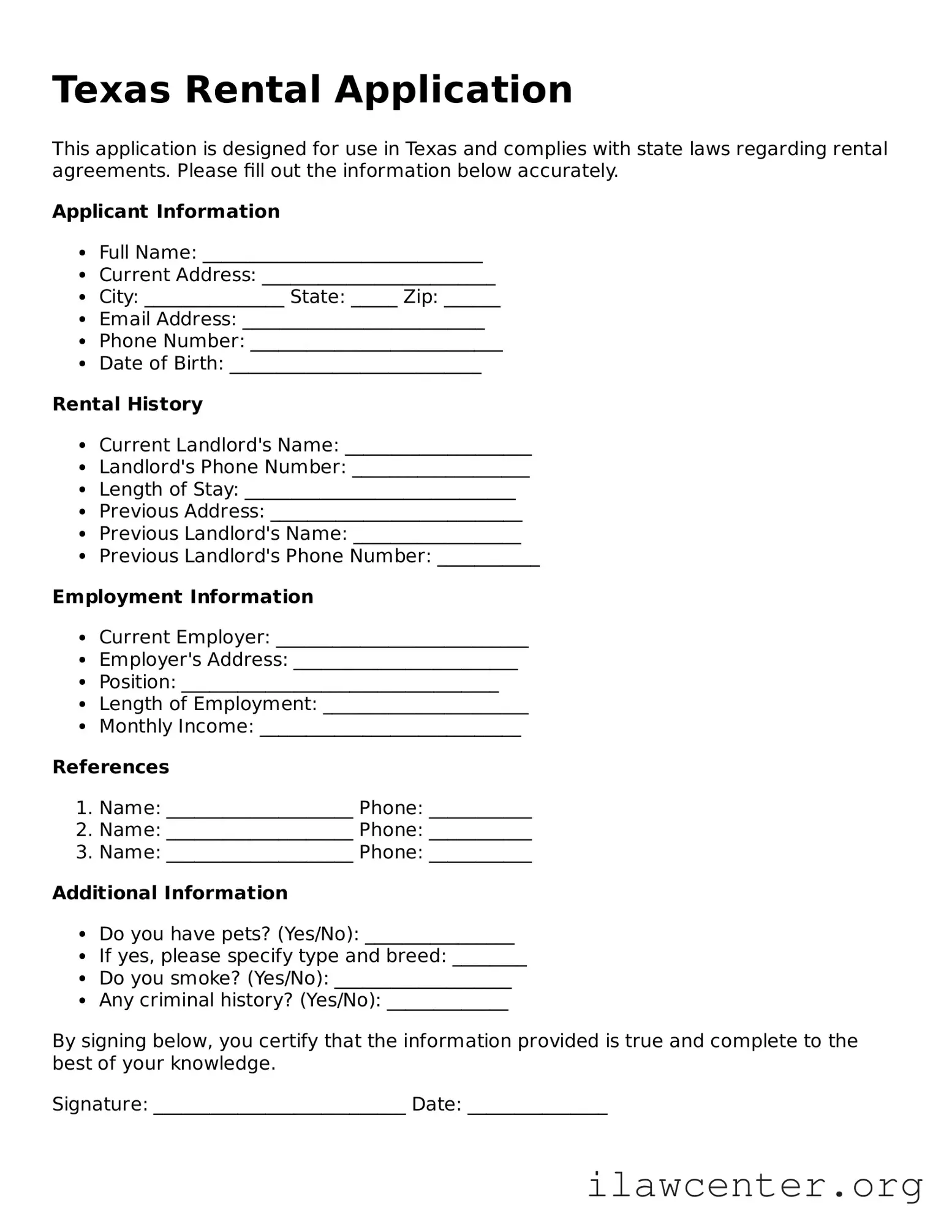
Texas Rental Application Preview

Texas Rental Application

This application is designed for use in Texas and complies with state laws regarding rental agreements. Please fill out the information below accurately.

Applicant Information

  • Full Name: ______________________________
  • Current Address: _________________________
  • City: _______________ State: _____ Zip: ______
  • Email Address: __________________________
  • Phone Number: ___________________________
  • Date of Birth: ___________________________

Rental History

  • Current Landlord's Name: ____________________
  • Landlord's Phone Number: ___________________
  • Length of Stay: _____________________________
  • Previous Address: ___________________________
  • Previous Landlord's Name: __________________
  • Previous Landlord's Phone Number: ___________

Employment Information

  • Current Employer: ___________________________
  • Employer's Address: ________________________
  • Position: __________________________________
  • Length of Employment: ______________________
  • Monthly Income: ____________________________

References

  1. Name: ____________________ Phone: ___________
  2. Name: ____________________ Phone: ___________
  3. Name: ____________________ Phone: ___________

Additional Information

  • Do you have pets? (Yes/No): ________________
  • If yes, please specify type and breed: ________
  • Do you smoke? (Yes/No): ___________________
  • Any criminal history? (Yes/No): _____________

By signing below, you certify that the information provided is true and complete to the best of your knowledge.

Signature: ___________________________ Date: _______________

PDF Form Characteristics

Fact Name Description
Governing Law The Texas Rental Application form is governed by the Texas Property Code, specifically Chapter 92, which outlines landlord-tenant relationships.
Purpose This form is used by landlords to collect information from prospective tenants to evaluate their suitability for renting a property.
Required Information Applicants typically must provide personal details, including their name, contact information, employment history, and rental history.
Application Fee Landlords may charge an application fee to cover the costs of processing the application and conducting background checks.
Background Checks Landlords often conduct background checks, which may include credit history, criminal records, and rental history verification.
Equal Opportunity The application process must comply with the Fair Housing Act, ensuring that all applicants are treated equally without discrimination.
Security Deposit While not part of the application form, the security deposit is typically discussed at this stage, outlining the amount required if the application is approved.
Privacy Considerations Landlords are required to protect the personal information provided in the application and must follow privacy laws when handling this data.

Instructions on Utilizing Texas Rental Application

Completing the Texas Rental Application form is an important step in securing a rental property. This process requires careful attention to detail to ensure all necessary information is provided accurately. Once the form is filled out, it will be submitted to the landlord or property management company for review.

  1. Start by downloading the Texas Rental Application form from the appropriate source.
  2. Read the entire form carefully to understand the information required.
  3. Begin with your personal information, including your full name, current address, and contact details.
  4. Provide your Social Security number and date of birth as requested.
  5. Fill in your employment history, including your current employer’s name, address, and your position.
  6. Include your monthly income and any additional sources of income.
  7. List your rental history, detailing previous addresses, landlord names, and contact information.
  8. Disclose any criminal history or evictions, if applicable, as this is often a required section.
  9. Provide references, which may include personal or professional contacts who can vouch for your character.
  10. Review the application for any errors or missing information.
  11. Sign and date the application to certify that all information is accurate.
  12. Submit the completed application along with any required fees to the landlord or property management.

Important Facts about Texas Rental Application

What is a Texas Rental Application form?

The Texas Rental Application form is a document used by landlords to collect information from potential tenants. It typically includes personal details, rental history, employment information, and references. This form helps landlords assess the suitability of applicants for their rental properties.

Why do I need to fill out a rental application?

Filling out a rental application is a standard procedure that allows landlords to evaluate your background and financial stability. It helps them determine if you can afford the rent and if you have a history of responsible tenancy. This process protects both the landlord and the tenant.

What information is typically required on the application?

A Texas Rental Application usually requires your full name, contact information, social security number, and date of birth. You will also need to provide details about your current and previous addresses, employment history, and income. Additionally, references may be requested, including previous landlords or personal contacts.

How is my personal information protected?

Landlords are required to handle your personal information with care. They should comply with privacy laws and use your data solely for the purpose of evaluating your rental application. It is advisable to ask how your information will be stored and whether it will be shared with third parties.

Can I be denied a rental application? If so, why?

Yes, a rental application can be denied for various reasons. Common reasons include poor credit history, insufficient income, or a negative rental history, such as evictions. Landlords may also consider criminal history or incomplete applications. Understanding these factors can help you prepare a stronger application.

Is there an application fee?

Many landlords charge an application fee to cover the costs of background checks and processing. This fee can vary widely, so it's important to ask about it upfront. Be aware that this fee is typically non-refundable, even if your application is denied.

How long does the application process take?

The application process duration can vary. It may take anywhere from a few hours to several days, depending on the landlord's policies and the thoroughness of the background checks. Following up with the landlord can help you understand the timeline better.

What should I do if my application is denied?

If your application is denied, you have the right to ask for the reasons behind the decision. Landlords are often required to provide this information. You can address any issues, such as correcting inaccuracies in your credit report, and consider reapplying in the future.

Can I appeal a denial of my rental application?

While there is no formal appeal process for rental application denials, you can communicate with the landlord to discuss your situation. Providing additional documentation or references may help your case. It’s essential to remain polite and professional during this conversation.
Common mistakes

When filling out the Texas Rental Application form, many people inadvertently make mistakes that can hinder their chances of securing a rental property. One common error is leaving sections blank. Each part of the application is important, and omitting information can raise red flags for landlords. Always strive to provide complete and accurate details.

Another frequent mistake is providing inaccurate information. Whether it's a misspelled name, incorrect phone number, or wrong employment details, inaccuracies can lead to delays or even denial of the application. Double-checking your information before submitting can save you from potential issues.

Some applicants forget to include their rental history. Landlords often want to know where you've lived in the past, how long you stayed, and why you left. Not providing this information can create uncertainty. Make sure to list all previous addresses along with the contact information of past landlords.

Financial details are crucial on a rental application, yet many people underestimate their importance. Failing to disclose all sources of income can lead to complications. It's best to be transparent about your financial situation, including any additional income sources like side jobs or benefits.

Another mistake is neglecting to provide references. Landlords appreciate hearing from previous landlords or employers about your reliability as a tenant. If you don’t include references, it may leave landlords questioning your credibility.

Some applicants overlook the significance of the application fee. It’s essential to understand that this fee is often non-refundable. Not including the fee or not following the payment instructions can result in your application being rejected outright.

Many people fail to read the fine print. The rental application often contains important terms and conditions that you must understand. Ignoring these details can lead to misunderstandings down the line. Always take the time to read everything carefully.

In addition, applicants sometimes rush through the process. Filling out an application should be done thoughtfully. Taking your time to provide accurate and comprehensive information can make a significant difference in the outcome.

Finally, some individuals forget to sign and date the application. A missing signature can render the application invalid. Always check that you’ve completed every required field, including your signature, before submitting.

Documents used along the form

When applying for a rental property in Texas, several forms and documents may accompany the Texas Rental Application. These documents help landlords evaluate potential tenants more thoroughly. Here are some commonly used forms:

  • Credit Report Authorization: This form allows landlords to obtain a credit report on the applicant. It provides insight into the applicant's financial history, including credit score and payment behavior.
  • Background Check Consent: This document grants permission for landlords to conduct a background check. It typically includes criminal history, which helps landlords assess the safety of their property and community.
  • Income Verification: Applicants often provide proof of income, such as pay stubs or bank statements. This documentation confirms that they can afford the rent and meet financial obligations.
  • Rental History Verification: This form collects information about the applicant's previous rentals. It may include contact details for past landlords, rental duration, and payment history, giving landlords a clearer picture of the applicant's reliability.

Having these documents ready can streamline the rental application process and improve the chances of securing a desired property. Each form plays a vital role in ensuring a fair and informed decision for both landlords and tenants.

Similar forms

The Rental Application form shares similarities with several other documents commonly used in the housing and rental process. Below is a list of eight documents that are comparable to the Rental Application form, highlighting their similarities.

  • Lease Agreement: Like the Rental Application, a Lease Agreement outlines the terms and conditions of renting a property. Both documents require personal information from the applicant.
  • Tenant Screening Report: This report assesses a potential tenant's background and credit history. It is similar to the Rental Application as it helps landlords evaluate applicants based on their financial stability.
  • Employment Verification Form: This document confirms an applicant's employment status and income. Both forms aim to ensure that the applicant can afford the rent.
  • Rental History Verification: This form collects information about a tenant's past rental experiences. Similar to the Rental Application, it helps landlords gauge the reliability of an applicant.
  • Guarantor Agreement: If a tenant requires a guarantor, this document outlines the responsibilities of the guarantor. It is similar to the Rental Application as it includes personal details about the guarantor.
  • Credit Application: This form is used to assess an applicant's creditworthiness. Like the Rental Application, it collects financial information to determine eligibility.
  • Pet Application: For applicants with pets, this document gathers information about the pet. It is similar to the Rental Application in that it requires details about the applicant and their living situation.
  • Background Check Authorization: This document allows landlords to conduct a background check on the applicant. It is similar to the Rental Application as it involves consent for the collection of personal information.

Dos and Don'ts

When filling out a Texas Rental Application, it's essential to approach the process with care. Here’s a list of ten things to consider, including both recommended practices and common pitfalls to avoid.

  • Do read the entire application carefully before filling it out.
  • Do provide accurate and truthful information.
  • Do include all required documents, such as proof of income or identification.
  • Do check for any application fees and be prepared to pay them.
  • Do follow up with the landlord or property manager after submitting your application.
  • Don't leave any sections blank; fill in all required fields.
  • Don't provide false information, as this can lead to application denial.
  • Don't forget to review your application for spelling or grammatical errors.
  • Don't assume the landlord will contact your references without your permission.
  • Don't rush through the application; take your time to ensure accuracy.

By adhering to these guidelines, you can enhance your chances of securing the rental property you desire. Attention to detail can make a significant difference in the outcome of your application.

Misconceptions

Understanding the Texas Rental Application form is crucial for both landlords and tenants. However, several misconceptions can lead to confusion. Here are nine common misconceptions:

  1. The application fee is non-refundable. Many believe that once paid, the application fee cannot be returned. In Texas, landlords may choose to refund this fee, but it is not a legal requirement.
  2. All landlords require the same information. Each landlord can set their own criteria for rental applications. While many ask for similar information, requirements can vary significantly.
  3. Submitting an application guarantees approval. This is not true. Completing the application does not ensure that a tenant will be approved for the rental property.
  4. Landlords cannot deny applications based on income. Landlords have the right to establish income requirements. They may deny applications if the income does not meet their criteria.
  5. Credit checks are optional for landlords. Many landlords conduct credit checks as part of their screening process. This helps them assess a tenant's financial responsibility.
  6. All rental applications are the same across Texas. Rental applications can differ by property management companies and landlords. Always read the specific application you are filling out.
  7. A criminal background check is always required. While many landlords perform background checks, it is not a universal requirement. Some may choose to forego this step.
  8. Once you are approved, you cannot change your mind. Approval does not bind a tenant to the lease. If circumstances change, tenants can decline the rental before signing.
  9. Landlords must provide a written explanation for denial. In Texas, landlords are not legally required to provide a reason for denying an application, though it is a good practice to do so.

Being informed about these misconceptions can help both tenants and landlords navigate the rental process more smoothly.

Key takeaways

When filling out and using the Texas Rental Application form, consider the following key takeaways:

  • Provide accurate and complete information. Landlords use this data to assess your suitability as a tenant.
  • Be prepared to pay an application fee. This fee is often non-refundable and varies by property.
  • Gather necessary documents beforehand. Common requirements include proof of income, identification, and rental history.
  • Understand the screening process. Landlords may check your credit, background, and rental history.
  • Review the terms of the lease carefully. Ensure you understand your rights and responsibilities before signing.
  • Keep a copy of your application. This can be useful for future applications or discussions with landlords.