
Texas residential property affidavit T-47 PDF Template

Texas residential property affidavit T-47 PDF Template

The Texas residential property affidavit T-47 form is a legal document used to affirm the ownership and condition of a residential property. This form is essential for buyers and sellers in Texas, as it helps clarify property details during real estate transactions. To ensure a smooth process, consider filling out the T-47 form by clicking the button below.

Article Guide

The Texas residential property affidavit T-47 form plays a crucial role in real estate transactions, particularly when it comes to clarifying the status of a property. This form is typically used to affirm the ownership of a residential property and confirm that the seller has not made any significant changes or improvements that would affect the property's value or title since the last transfer. It serves as a declaration of facts that can help streamline the closing process, making it easier for buyers, sellers, and lenders to understand the property's history. By providing essential information about the property's condition and any encumbrances, the T-47 form helps ensure transparency and protects all parties involved in the transaction. Whether you are a first-time homebuyer or an experienced investor, understanding the nuances of this affidavit can be key to navigating the complexities of real estate in Texas.

Texas residential property affidavit T-47 Preview

Form T-47 Sec. V Effective November 1, 2024
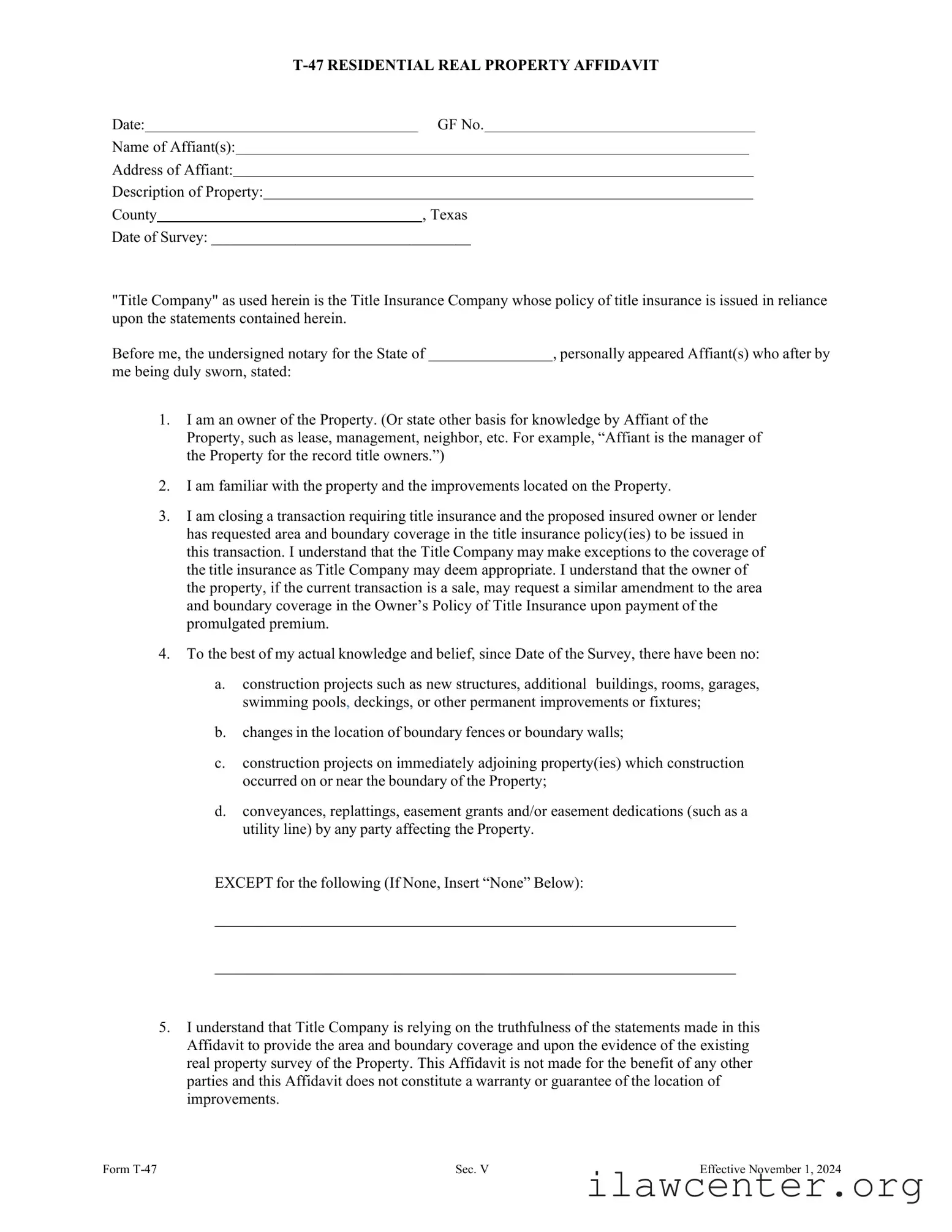
T-47 RESIDENTIAL REAL PROPERTY AFFIDAVIT
Date: GF No.
Name of Affiant(s):
Address of Affiant:
Description of Property:
County , Texas
Date of Survey: __________________________________
"Title Company" as used herein is the Title Insurance Company whose policy of title insurance is issued in reliance
upon the statements contained herein.
Before me, the undersigned notary for the State of , personally appeared Affiant(s) who after by
me being duly sworn, stated:
1. I am an owner of the Property. (Or state other basis for knowledge by Affiant of the
Property, such as lease, management, neighbor, etc. For example, “Affiant is the manager of
the Property for the record title owners.”)
2. I am familiar with the property and the improvements located on the Property.
3. I am closing a transaction requiring title insurance and the proposed insured owner or lender
has requested area and boundary coverage in the title insurance policy(ies) to be issued in
this transaction. I understand that the Title Company may make exceptions to the coverage of
the title insurance as Title Company may deem appropriate. I understand that the owner of
the property, if the current transaction is a sale, may request a similar amendment to the area
and boundary coverage in the Owner’s Policy of Title Insurance upon payment of the
promulgated premium.
4. To the best of my actual knowledge and belief, since Date of the Survey, there have been no:
a. construction projects such as new structures, additional buildings, rooms, garages,
swimming pools, deckings, or other permanent improvements or fixtures;
b. changes in the location of boundary fences or boundary walls;
c. construction projects on immediately adjoining property(ies) which construction
occurred on or near the boundary of the Property;
d. conveyances, replattings, easement grants and/or easement dedications (such as a
utility line) by any party affecting the Property.
EXCEPT for the following (If None, Insert “None” Below):
___________________________________________________________________
___________________________________________________________________
5. I understand that Title Company is relying on the truthfulness of the statements made in this
Affidavit to provide the area and boundary coverage and upon the evidence of the existing
real property survey of the Property. This Affidavit is not made for the benefit of any other
parties and this Affidavit does not constitute a warranty or guarantee of the location of
improvements.
Form T-47 Sec. V Effective November 1, 2024
6. I understand that I have no liability to Title Company should the information in this Affidavit
be incorrect other than information that I personally know to be incorrect and which I do not
disclose to the Title Company.
SWORN AND SUBSCRIBED this day of , 20 .
________________________________________
Notary Public
Affiant
Signed:
_________________________________________
I declare under penalty of perjury that the foregoing is
true
and correct.
Affiant
Signed:
__________________________________________
I declare under penalty of perjury that the foregoing is
true
and correct.

File Properties

Fact Name Description
Purpose The T-47 form is used to provide a sworn statement regarding the property and its improvements for residential real estate transactions in Texas.
Governing Law The form is governed by the Texas Property Code, specifically under Title 11, Chapter 12.
Affidavit Requirement This affidavit is required by title companies to verify property boundaries and improvements.
Signatories The form must be signed by the property owner or authorized representative.
Notarization The T-47 form requires notarization to validate the affidavit.
Use in Transactions This form is commonly used in the sale and refinancing of residential properties.
Submission The completed form must be submitted to the title company as part of the closing process.
Limitations The T-47 form does not replace a survey; it is a supplementary document that provides additional information.

Instructions on Utilizing Texas residential property affidavit T-47

Filling out the Texas residential property affidavit T-47 form is a straightforward process. This form is essential for property owners who need to provide certain information regarding their property. Make sure to have all necessary details on hand before starting.

  1. Begin by entering the property owner's name at the top of the form.
  2. Next, fill in the property address, including the street number, street name, city, and zip code.
  3. Provide the legal description of the property. This can usually be found on your property deed or tax documents.
  4. Indicate the date of acquisition of the property. This is the date you purchased or otherwise obtained the property.
  5. Complete the section regarding any mortgages or liens on the property, if applicable. Include the lender's name and the amount owed.
  6. Sign and date the form at the bottom. Ensure your signature matches the name you provided at the top.
  7. Finally, make a copy of the completed form for your records before submitting it.

Important Facts about Texas residential property affidavit T-47

What is the Texas residential property affidavit T-47 form?

The Texas residential property affidavit T-47 form is a legal document used primarily in real estate transactions. It serves to confirm certain facts about a property, including its ownership and any existing liens or encumbrances. This affidavit is often required by title companies to ensure that the title to the property is clear and that there are no undisclosed claims against it. By signing this form, the property owner attests to the accuracy of the information provided, which helps facilitate a smooth closing process.

Who needs to complete the T-47 form?

The T-47 form must be completed by the current property owner, typically the seller in a real estate transaction. It is crucial for the seller to provide accurate information regarding the property, as this affidavit helps protect both the buyer and the lender. If the property has multiple owners, all parties may need to sign the form to ensure full disclosure and agreement on the property’s status.

When is the T-47 form required?

The T-47 form is generally required during the closing process of a real estate transaction. Title companies often request this affidavit to verify the seller's claims about the property. If the property is being sold, refinanced, or transferred, the T-47 may be necessary to confirm that there are no outstanding issues that could affect the title. It is advisable to check with the title company or real estate attorney to determine if the form is needed in your specific situation.

What information is included in the T-47 form?

The T-47 form typically includes details such as the property address, the names of the current owners, and any relevant information regarding existing liens or encumbrances. The affidavit also asks the owner to confirm that they have not made any improvements to the property that could affect its value or title since the last transaction. This information is crucial for establishing a clear title and ensuring that the buyer is fully informed about the property’s status.

How do I file the T-47 form?

The T-47 form is not filed with any government agency; instead, it is submitted to the title company handling the transaction. After the form is completed and signed, it should be provided to the title company as part of the closing documentation. The title company will then use the information to conduct a title search and ensure that the property can be sold without any legal complications.

What happens if I provide false information on the T-47 form?

Providing false information on the T-47 form can have serious consequences. If inaccuracies are discovered after the transaction is completed, the buyer may have grounds to pursue legal action against the seller for misrepresentation. This could lead to financial liability or even the reversal of the sale. It is essential to be truthful and thorough when completing the form to avoid potential legal issues and protect all parties involved in the transaction.

Common mistakes

When filling out the Texas residential property affidavit T-47 form, many individuals encounter common pitfalls that can lead to complications in the property transfer process. Understanding these mistakes can help ensure a smoother experience. Here are five mistakes to avoid.

One frequent error is providing inaccurate property descriptions. The T-47 form requires precise details about the property, including its legal description. Omitting this information or using vague terms can lead to confusion and potential disputes. Always double-check the property’s legal description against official records to ensure accuracy.

Another mistake involves failing to sign the affidavit correctly. The T-47 form must be signed by the property owner in the presence of a notary. Neglecting to have the signature notarized can invalidate the document. It’s essential to follow the signing and notarization process carefully to ensure the affidavit holds legal weight.

Many people also overlook the importance of including all relevant parties. If there are multiple owners or stakeholders involved in the property, their names should be listed on the form. Failing to include all necessary parties can lead to future claims or disputes, complicating the transfer process.

Additionally, some individuals mistakenly assume that the T-47 form is optional. In fact, this affidavit is often required by lenders during real estate transactions. Ignoring this requirement can delay the closing process or even jeopardize financing. Being proactive about submitting the T-47 form can help avoid unnecessary hurdles.

Lastly, individuals sometimes neglect to review the completed form before submission. Errors in spelling, dates, or other details can create issues later on. Taking the time to carefully review the document ensures that all information is accurate and complete, ultimately facilitating a smoother transaction.

Documents used along the form

The Texas residential property affidavit T-47 form is often used in real estate transactions to clarify property boundaries and ownership. When dealing with property matters, several other documents may be necessary to ensure a smooth process. Below is a list of common forms and documents that you might encounter alongside the T-47.

  • Deed: This legal document transfers ownership of real property from one party to another. It includes details such as the names of the buyer and seller, a description of the property, and any conditions of the sale.
  • Title Insurance Policy: This insurance protects buyers and lenders from financial loss due to defects in the title, such as liens or claims against the property. It ensures that the buyer has clear ownership.
  • Survey: A survey provides a detailed map of the property, showing its boundaries, dimensions, and any structures or easements. It helps to confirm the accuracy of property lines.
  • Closing Statement: This document outlines all financial details of the transaction, including purchase price, closing costs, and any adjustments. It is reviewed and signed at the closing of the sale.
  • Property Disclosure Statement: Sellers often provide this document to inform buyers of any known issues with the property, such as repairs needed or past damage. It promotes transparency in the transaction.
  • Loan Agreement: If financing is involved, this document outlines the terms of the loan, including the amount borrowed, interest rate, and repayment schedule. It is crucial for both buyers and lenders.
  • Homeowners Association (HOA) Documents: If the property is part of an HOA, these documents include rules, regulations, and fees associated with the community. They are essential for understanding community living.
  • Power of Attorney: This document allows one person to act on behalf of another in legal matters, including real estate transactions. It may be necessary if the seller cannot be present at closing.
  • Affidavit of Heirship: In cases of inheritance, this document establishes the rightful heirs of a deceased property owner. It can help clarify ownership when transferring property after someone's passing.

Understanding these documents can help you navigate the complexities of real estate transactions in Texas. Having the right forms prepared and available will ensure a smoother process and protect your interests.

Similar forms

The Texas residential property affidavit T-47 form shares similarities with several other documents commonly used in real estate transactions. Each of these documents serves a specific purpose and may be required in different situations. Here are eight documents that are similar to the T-47 form:

  • Affidavit of Title: This document confirms the ownership of a property and outlines any claims or liens against it, similar to how the T-47 verifies ownership and property details.
  • Property Disclosure Statement: Sellers often provide this statement to disclose known issues with the property, paralleling the T-47's role in clarifying property conditions.
  • Warranty Deed: A warranty deed transfers ownership and guarantees that the title is clear, akin to the T-47's purpose of affirming property ownership.
  • Quitclaim Deed: This document transfers any interest the grantor has in the property without warranties, similar to the T-47's focus on ownership without guaranteeing title quality.
  • Title Commitment: Issued by a title company, this document outlines the terms of title insurance, much like the T-47 provides assurance about property ownership.
  • Lease Agreement: A lease outlines the terms for renting a property, which can be related to the T-47 when rental properties are involved in ownership disputes.
  • Real Estate Purchase Agreement: This agreement details the terms of a property sale, similar to the T-47 in that it establishes ownership and conditions of the property.
  • Notice of Default: This document indicates that a borrower has failed to meet mortgage obligations, which can affect property ownership, similar to the T-47's role in clarifying ownership status.

Dos and Don'ts

When filling out the Texas residential property affidavit T-47 form, it is essential to follow certain guidelines to ensure accuracy and compliance. Below is a list of things you should and shouldn't do.

  • Do read the instructions carefully before starting to fill out the form.
  • Do provide accurate and complete information to avoid delays.
  • Do double-check all entries for spelling and numerical accuracy.
  • Do sign and date the form where required.
  • Don't leave any required fields blank; fill them in as needed.
  • Don't use white-out or similar correction products on the form.
  • Don't submit the form without making a copy for your records.
  • Don't ignore deadlines; submit the form in a timely manner.

Following these guidelines will help ensure that your affidavit is processed smoothly and efficiently.

Misconceptions

The Texas residential property affidavit T-47 form is often misunderstood. Here are eight common misconceptions about this form, along with clarifications to help you better understand its purpose and use.

  1. It is only for sellers.

    The T-47 form can be used by both sellers and buyers. It provides important information about the property that can benefit all parties involved in a transaction.

  2. It replaces a title search.

    The T-47 does not replace a title search. It serves as a supplementary document that provides additional information about the property’s condition and ownership.

  3. It is not legally binding.

    The T-47 form is a legally binding document. By signing it, the parties affirm the accuracy of the information provided, which can have legal implications.

  4. It only addresses physical property issues.

    While the T-47 does cover physical aspects of the property, it also addresses legal ownership and any encumbrances that may affect the property.

  5. Anyone can fill it out.

    Although the form can be completed by the property owner, it is advisable to seek assistance from a real estate professional to ensure accuracy and completeness.

  6. It is only needed for residential properties.

    The T-47 form is primarily used for residential properties, but it can also apply to certain types of commercial properties in specific situations.

  7. It must be filed with the county.

    The T-47 form is typically submitted to the title company, not directly filed with the county. The title company uses it during the closing process.

  8. It is a one-time requirement.

    The T-47 may need to be updated or re-submitted if significant changes occur regarding the property, such as renovations or changes in ownership.

Understanding these misconceptions can help clarify the role of the T-47 form in real estate transactions in Texas.

Key takeaways

When dealing with the Texas residential property affidavit T-47 form, it’s important to keep several key points in mind. Understanding these can help streamline the process and ensure that all necessary information is accurately conveyed.

  • The T-47 form is used to confirm the ownership of a property and to establish the identity of the property owner.
  • It is typically required by lenders during the closing process for residential real estate transactions.
  • Ensure that all information on the form is complete and accurate to avoid delays in the transaction.
  • The affidavit must be signed in front of a notary public to be considered valid.
  • Keep a copy of the completed T-47 form for your records after submission.
  • Filing the T-47 form may help resolve issues related to title insurance and property ownership disputes.
  • Consulting with a real estate professional can provide additional guidance on filling out the form correctly.