Attorney-Verified  RV Bill of Sale Document for Texas

Attorney-Verified RV Bill of Sale Document for Texas

The Texas RV Bill of Sale form is a legal document that records the sale and transfer of ownership of a recreational vehicle in Texas. This form provides essential details about the transaction, including the buyer, seller, and vehicle specifics. To ensure a smooth transfer of ownership, fill out the form by clicking the button below.

Article Guide

The Texas RV Bill of Sale form is an essential document for anyone involved in the buying or selling of a recreational vehicle in Texas. This form serves multiple purposes, providing a clear record of the transaction between the buyer and the seller. It includes important details such as the names and addresses of both parties, the vehicle identification number (VIN), and a description of the RV, including its make, model, and year. Additionally, the form outlines the sale price and any terms related to the payment. By documenting the sale, this form helps protect both parties in case of disputes or misunderstandings in the future. Proper completion of the RV Bill of Sale can also facilitate the transfer of ownership and assist with registration processes with the Texas Department of Motor Vehicles. Understanding how to accurately fill out this form is crucial for a smooth transaction, ensuring that all necessary information is captured and that both parties are aware of their rights and responsibilities.

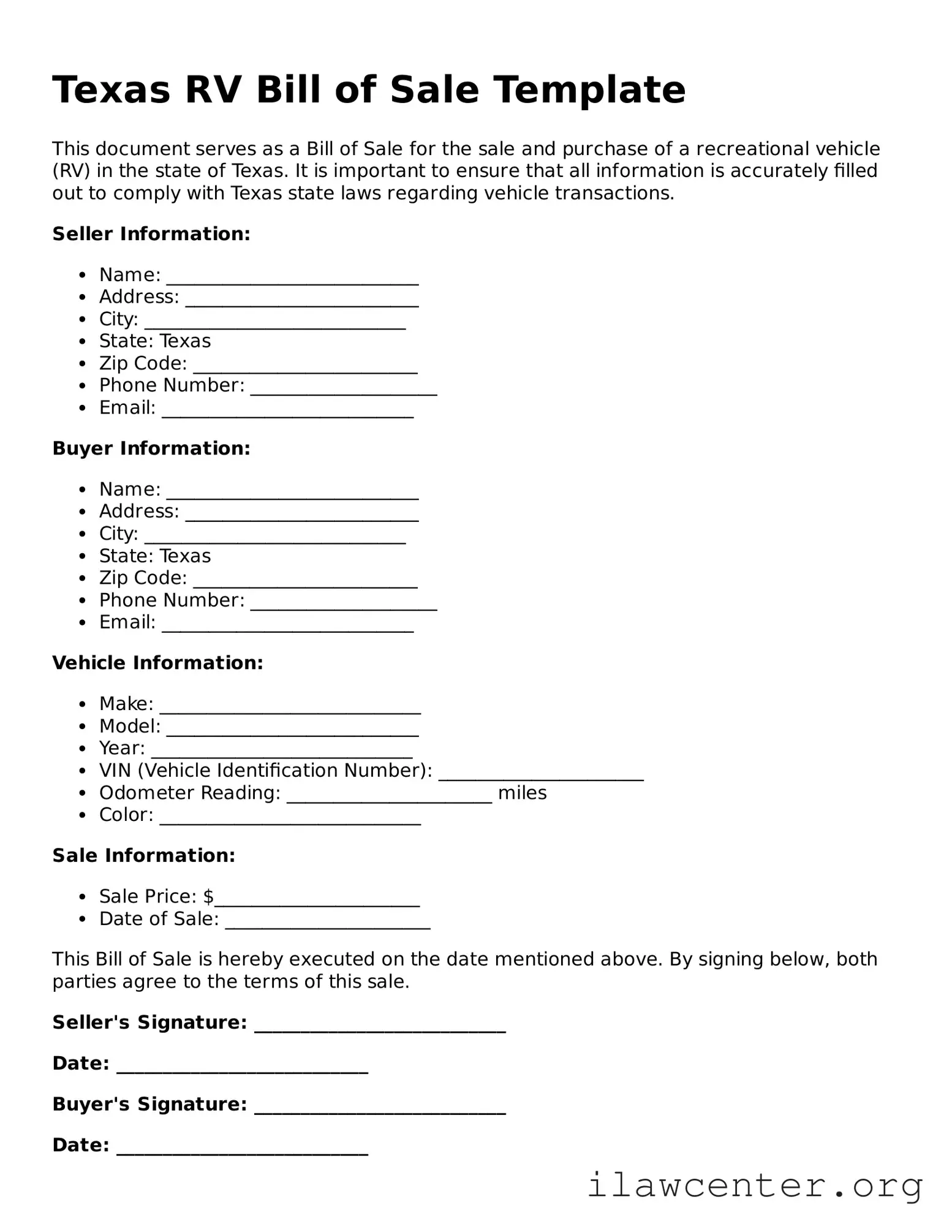
Texas RV Bill of Sale Preview

Texas RV Bill of Sale Template

This document serves as a Bill of Sale for the sale and purchase of a recreational vehicle (RV) in the state of Texas. It is important to ensure that all information is accurately filled out to comply with Texas state laws regarding vehicle transactions.

Seller Information:

  • Name: ___________________________
  • Address: _________________________
  • City: ____________________________
  • State: Texas
  • Zip Code: ________________________
  • Phone Number: ____________________
  • Email: ___________________________

Buyer Information:

  • Name: ___________________________
  • Address: _________________________
  • City: ____________________________
  • State: Texas
  • Zip Code: ________________________
  • Phone Number: ____________________
  • Email: ___________________________

Vehicle Information:

  • Make: ____________________________
  • Model: ___________________________
  • Year: ____________________________
  • VIN (Vehicle Identification Number): ______________________
  • Odometer Reading: ______________________ miles
  • Color: ____________________________

Sale Information:

  • Sale Price: $______________________
  • Date of Sale: ______________________

This Bill of Sale is hereby executed on the date mentioned above. By signing below, both parties agree to the terms of this sale.

Seller's Signature: ___________________________

Date: ___________________________

Buyer's Signature: ___________________________

Date: ___________________________

It is recommended to keep a copy of this document for your records. This Bill of Sale is an important legal document that outlines the transaction and protects both the seller and the buyer.

PDF Form Characteristics

Fact Name Description
Purpose The Texas RV Bill of Sale is used to document the sale or transfer of ownership of a recreational vehicle in Texas.
Governing Law This form is governed by Texas state laws, specifically the Texas Transportation Code.
Required Information It must include details such as the buyer's and seller's names, addresses, and the RV's description, including the Vehicle Identification Number (VIN).
Signatures Both the buyer and seller must sign the document to validate the transaction.
Notarization While notarization is not required, it is recommended to enhance the document's credibility.
Record Keeping Both parties should keep a copy of the Bill of Sale for their records after the transaction is completed.

Instructions on Utilizing Texas RV Bill of Sale

Once you have your Texas RV Bill of Sale form ready, you’ll want to ensure that all the necessary information is accurately filled out. This document serves as proof of the transaction between the buyer and the seller. It’s important to complete it carefully to avoid any issues down the line.

  1. Obtain the Form: Download or print the Texas RV Bill of Sale form from a reliable source.
  2. Fill in Seller Information: Enter the seller's full name, address, and contact information at the top of the form.
  3. Fill in Buyer Information: Provide the buyer's full name, address, and contact information in the designated section.
  4. Describe the RV: Include the make, model, year, vehicle identification number (VIN), and any other relevant details about the RV.
  5. Enter Sale Price: Clearly state the agreed-upon sale price for the RV.
  6. Indicate Date of Sale: Write the date when the sale is taking place.
  7. Signatures: Both the seller and the buyer must sign and date the form to validate the transaction.
  8. Notarization (if required): If necessary, have the form notarized to ensure its legality.

After completing the form, both parties should keep a copy for their records. This will help in case any questions arise in the future regarding the sale. Make sure to follow any additional local requirements for registering the RV under the new owner’s name.

Important Facts about Texas RV Bill of Sale

What is a Texas RV Bill of Sale form?

A Texas RV Bill of Sale form is a legal document that records the sale of a recreational vehicle (RV) between a seller and a buyer in Texas. This form provides essential details such as the names and addresses of both parties, a description of the RV, the sale price, and the date of the transaction. It serves as proof of ownership transfer and is often required for registration purposes with the Texas Department of Motor Vehicles.

Why is it important to have a Bill of Sale for an RV?

Having a Bill of Sale for an RV is crucial for several reasons. First, it protects both the buyer and seller by documenting the terms of the sale. This can help prevent disputes over ownership or payment. Second, it is often necessary for the buyer to register the RV in their name. Lastly, it provides a record of the transaction for tax purposes, ensuring compliance with state regulations.

What information should be included in the Texas RV Bill of Sale?

The Texas RV Bill of Sale should include specific information to be valid. Key details include the full names and addresses of both the buyer and seller, the RV’s make, model, year, Vehicle Identification Number (VIN), and the sale price. Additionally, the date of the sale and any warranties or conditions of the sale should be noted. Both parties should sign the document to confirm their agreement.

Do I need to notarize the Texas RV Bill of Sale?

While notarization is not required for a Texas RV Bill of Sale, it is highly recommended. Notarizing the document adds an extra layer of authenticity and can help in case of future disputes. A notary public verifies the identities of both parties and ensures that they are signing the document willingly. This can be beneficial for both parties involved in the transaction.

Where can I obtain a Texas RV Bill of Sale form?

You can obtain a Texas RV Bill of Sale form from various sources. Many online legal document services provide templates that you can customize. Additionally, the Texas Department of Motor Vehicles may offer forms on their website. It’s important to ensure that the form you use complies with Texas state laws and includes all necessary information for your specific transaction.

Common mistakes

When filling out the Texas RV Bill of Sale form, one common mistake is failing to provide complete information about the RV. Buyers and sellers often overlook essential details such as the Vehicle Identification Number (VIN), make, model, and year. Without this information, the document may not serve its purpose effectively, leading to potential disputes in the future.

Another frequent error involves incorrect dates. People sometimes write the wrong sale date or fail to include it altogether. This can create confusion regarding when the transaction took place, which is crucial for legal and tax purposes. Always double-check the date to ensure accuracy.

Many individuals neglect to include the sale price. Leaving this field blank or entering an incorrect amount can lead to complications, especially when it comes to taxes and registration. The sale price is a vital piece of information that must be accurately recorded.

Lastly, signatures are often a point of contention. Both the buyer and seller must sign the form for it to be valid. Sometimes, one party forgets to sign, or the signatures do not match the names printed on the form. This oversight can render the document ineffective, so ensure that all required signatures are present and correct.

Documents used along the form

When purchasing or selling a recreational vehicle (RV) in Texas, several additional documents may be required to ensure a smooth transaction. These documents serve various purposes, from establishing ownership to facilitating registration and financing. Below is a list of common forms and documents that are often used in conjunction with the Texas RV Bill of Sale.

  • Title Transfer Document: This document is essential for transferring ownership of the RV from the seller to the buyer. It includes details such as the vehicle identification number (VIN), the names of both parties, and their signatures.
  • Application for Texas Title: This form is used to apply for a new title after the purchase of the RV. It is necessary for registering the vehicle in the buyer's name.
  • Vehicle Registration Application: After acquiring the RV, the new owner must complete this application to register the vehicle with the Texas Department of Motor Vehicles (DMV).
  • Odometer Disclosure Statement: This statement is required for RVs that are less than ten years old. It verifies the mileage at the time of sale and helps prevent fraud.
  • Bill of Sale for Trade-In: If the buyer is trading in another vehicle as part of the transaction, this document outlines the details of the trade and its value.
  • Proof of Insurance: Before registering the RV, the new owner must provide proof of insurance coverage, which is a requirement in Texas.
  • Financing Agreement: If the buyer is financing the purchase, this agreement outlines the terms of the loan, including interest rates and payment schedules.
  • Inspection Report: An inspection report may be necessary to confirm the RV's condition and compliance with safety standards before registration.
  • Power of Attorney: If the seller cannot be present for the transaction, a power of attorney document allows another person to sign on their behalf.

These documents play a crucial role in the process of buying or selling an RV in Texas. Ensuring that all necessary paperwork is completed can help prevent legal issues and facilitate a successful transaction. Always consult with a professional or legal expert if there are any uncertainties regarding the documentation required for your specific situation.

Similar forms

The RV Bill of Sale form serves a specific purpose in the transfer of ownership for recreational vehicles. However, several other documents share similarities in function and importance. Here’s a list of nine documents that are akin to the RV Bill of Sale, highlighting how they relate:

  • Car Bill of Sale: Like the RV Bill of Sale, this document records the transfer of ownership for a motor vehicle, detailing the buyer, seller, and purchase price.
  • Boat Bill of Sale: Similar in nature, this form is used to document the sale of a boat, ensuring a clear transfer of ownership and protecting both parties involved.
  • Motorcycle Bill of Sale: This document serves the same purpose for motorcycles, providing a written record of the transaction and essential details about the vehicle.
  • Trailer Bill of Sale: Used for the sale of trailers, this form captures necessary information about the trailer and the terms of the sale, just like the RV Bill of Sale.
  • Aircraft Bill of Sale: This document is crucial for transferring ownership of an aircraft, outlining the details of the transaction and ensuring compliance with aviation regulations.
  • Mobile Home Bill of Sale: Similar to the RV Bill of Sale, this form facilitates the transfer of ownership for mobile homes, providing essential details about the property.
  • Personal Property Bill of Sale: This document covers the sale of various personal items, ensuring a record of the transaction and protecting both the buyer and seller.
  • Real Estate Purchase Agreement: While focused on real property, this agreement details the sale terms, akin to how the RV Bill of Sale outlines the specifics of RV transactions.
  • Lease Agreement: Though primarily for rentals, a lease agreement can serve a similar purpose in documenting terms and conditions for the use of a vehicle or property.

Understanding these documents is essential for anyone involved in buying or selling vehicles or property. Each serves to protect the interests of both parties and ensures a smooth transaction.

Dos and Don'ts

When filling out the Texas RV Bill of Sale form, it's important to follow some key guidelines to ensure everything is completed correctly. Here are five things to keep in mind:

  • Do provide accurate information about the RV, including the make, model, year, and VIN.
  • Do include the sale price and the date of the transaction.
  • Do sign and date the form to validate the sale.
  • Don't leave any required fields blank; this can lead to issues later.
  • Don't use white-out or any other correction fluid on the form; it can make the document invalid.

By following these guidelines, you can help ensure a smooth and hassle-free transaction.

Misconceptions

The Texas RV Bill of Sale form is an important document for anyone buying or selling a recreational vehicle in Texas. However, there are several misconceptions surrounding this form that can lead to confusion. Below are five common misconceptions, along with clarifications.

  • Misconception 1: The RV Bill of Sale is not necessary for private sales.
  • Many people believe that a Bill of Sale is only required for transactions involving dealerships. In reality, it is advisable to use a Bill of Sale for private sales as well. This document serves as proof of the transaction and can help prevent disputes in the future.

  • Misconception 2: The form needs to be notarized.
  • Some sellers think that the RV Bill of Sale must be notarized to be valid. While notarization can add an extra layer of authenticity, it is not a legal requirement in Texas. The form is valid as long as both parties sign it.

  • Misconception 3: The Bill of Sale includes a warranty on the vehicle.
  • Buyers may assume that the Bill of Sale guarantees the condition of the RV. However, the form typically states that the sale is "as-is," meaning the seller does not provide any warranties regarding the vehicle's condition.

  • Misconception 4: The form is the same for all types of vehicles.
  • Some individuals think that a Bill of Sale is interchangeable between different types of vehicles. In Texas, specific forms exist for different vehicle types, including RVs. Using the correct form is essential for proper documentation.

  • Misconception 5: You can only obtain the form from a legal professional.
  • Many believe that the only way to get a Bill of Sale is through an attorney. However, the Texas RV Bill of Sale form is readily available online and can be completed without legal assistance, making it accessible for anyone involved in a sale.

Key takeaways

When dealing with the purchase or sale of an RV in Texas, understanding the RV Bill of Sale form is crucial. Here are some key takeaways to keep in mind:

  • Purpose of the Form: The Texas RV Bill of Sale serves as a legal document that records the transfer of ownership from the seller to the buyer.
  • Essential Information: Ensure that the form includes important details such as the names and addresses of both parties, the RV’s make, model, year, and Vehicle Identification Number (VIN).
  • Sales Price: Clearly state the agreed-upon sales price. This figure is important for both the buyer and seller for tax purposes.
  • Condition of the RV: It’s advisable to describe the condition of the RV, including any known issues or repairs. This helps set clear expectations.
  • Signatures: Both the buyer and seller must sign the document. This signature indicates that both parties agree to the terms of the sale.
  • Notarization: While notarization is not required, having the document notarized can add an extra layer of legitimacy and protection for both parties.
  • Record Keeping: After the sale, both parties should keep a copy of the signed Bill of Sale for their records. This can be helpful for future reference.
  • Title Transfer: Remember that completing the Bill of Sale is just one step. The buyer will also need to apply for a title transfer with the Texas Department of Motor Vehicles.
  • Consultation: If there are any uncertainties, consider consulting with a legal professional to ensure all aspects of the sale are properly handled.

By following these key points, you can navigate the process of filling out and using the Texas RV Bill of Sale with confidence.