Attorney-Verified  Self-Proving Affidavit Document for Texas

Attorney-Verified Self-Proving Affidavit Document for Texas

A Texas Self-Proving Affidavit is a legal document that allows a testator's will to be validated without the need for witnesses to testify in court. This form simplifies the probate process by confirming that the will was executed properly. If you're ready to complete your Self-Proving Affidavit, click the button below.

Article Guide

In the realm of estate planning and the execution of wills, the Texas Self-Proving Affidavit form plays a crucial role in simplifying the probate process. This legal document allows a testator, or the person making the will, to affirm the authenticity of their will without the need for witnesses to testify in court after their passing. By signing this affidavit in the presence of a notary public, the testator and witnesses declare that they executed the will voluntarily and that they were of sound mind at the time. This not only streamlines the probate process but also helps to reduce potential disputes over the will's validity. Additionally, the form must be attached to the will itself, ensuring that all necessary information is readily available during probate. Understanding the significance of the Texas Self-Proving Affidavit can empower individuals to make informed decisions about their estate planning, ultimately providing peace of mind for both themselves and their loved ones.

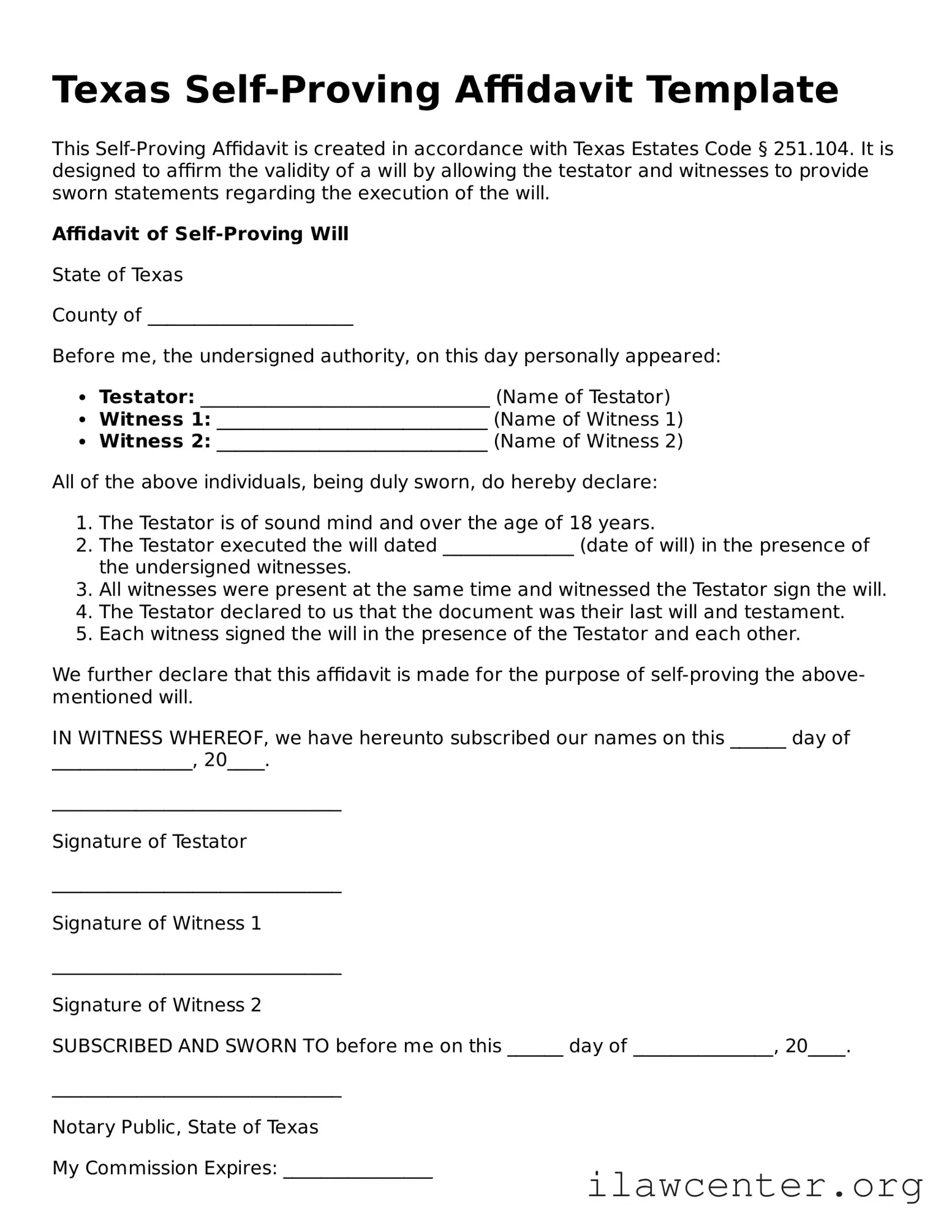
Texas Self-Proving Affidavit Preview

Texas Self-Proving Affidavit Template

This Self-Proving Affidavit is created in accordance with Texas Estates Code § 251.104. It is designed to affirm the validity of a will by allowing the testator and witnesses to provide sworn statements regarding the execution of the will.

Affidavit of Self-Proving Will

State of Texas

County of ______________________

Before me, the undersigned authority, on this day personally appeared:

  • Testator: _______________________________ (Name of Testator)
  • Witness 1: _____________________________ (Name of Witness 1)
  • Witness 2: _____________________________ (Name of Witness 2)

All of the above individuals, being duly sworn, do hereby declare:

  1. The Testator is of sound mind and over the age of 18 years.
  2. The Testator executed the will dated ______________ (date of will) in the presence of the undersigned witnesses.
  3. All witnesses were present at the same time and witnessed the Testator sign the will.
  4. The Testator declared to us that the document was their last will and testament.
  5. Each witness signed the will in the presence of the Testator and each other.

We further declare that this affidavit is made for the purpose of self-proving the above-mentioned will.

IN WITNESS WHEREOF, we have hereunto subscribed our names on this ______ day of _______________, 20____.

_______________________________

Signature of Testator

_______________________________

Signature of Witness 1

_______________________________

Signature of Witness 2

SUBSCRIBED AND SWORN TO before me on this ______ day of _______________, 20____.

_______________________________

Notary Public, State of Texas

My Commission Expires: ________________

PDF Form Characteristics

Fact Name Details
Definition A Texas Self-Proving Affidavit is a legal document that allows a will to be validated without the need for witnesses during probate.
Governing Law The Texas Self-Proving Affidavit is governed by Texas Estates Code, Section 251.104.
Purpose This affidavit simplifies the probate process by confirming the validity of a will and the testator's intent.
Requirements The testator and witnesses must sign the affidavit in front of a notary public.
Format The affidavit must be attached to the will or included within it, typically at the end.
Benefits Using this affidavit can expedite the probate process and reduce legal disputes over the will.
Revocation A new will or affidavit can revoke the previous one, provided it meets the necessary legal requirements.
Validity The affidavit remains valid as long as the will is valid and has not been revoked.

Instructions on Utilizing Texas Self-Proving Affidavit

Once you have gathered all necessary information and documents, you can begin filling out the Texas Self-Proving Affidavit form. This form is essential for verifying the validity of a will in the state of Texas. Following these steps will ensure that you complete the form correctly and efficiently.

  1. Obtain the form: Download the Texas Self-Proving Affidavit form from a reliable legal resource or obtain a physical copy from a local courthouse.
  2. Read the instructions: Familiarize yourself with the instructions provided with the form to understand what information is required.
  3. Fill in the decedent's information: Write the full name of the deceased person (the decedent) and their date of death in the designated spaces.
  4. List the witnesses: Enter the names and addresses of the witnesses who were present when the will was signed.
  5. Provide the affidavit details: Complete the sections that require the witnesses to affirm their presence and the decedent's signature on the will.
  6. Sign the affidavit: Each witness must sign the affidavit in the presence of a notary public. Ensure all signatures are dated appropriately.
  7. Notarization: Take the completed affidavit to a notary public, who will verify the identities of the witnesses and affix their seal.
  8. Keep copies: Make copies of the signed and notarized affidavit for your records and for any future legal proceedings.

Important Facts about Texas Self-Proving Affidavit

What is a Texas Self-Proving Affidavit?

A Texas Self-Proving Affidavit is a legal document that allows a will to be validated without the need for witnesses to testify in court. This affidavit is typically signed by the testator (the person who created the will) and witnesses at the same time the will is executed. By doing this, it streamlines the probate process, making it easier for the will to be accepted by the court.

Why should I use a Self-Proving Affidavit?

Using a Self-Proving Affidavit can save time and effort during the probate process. If the affidavit is included with the will, the court can accept the will without requiring the witnesses to appear. This is particularly beneficial if the witnesses are unavailable or have passed away. It adds an extra layer of assurance that the will is valid and reflects the testator's true intentions.

How do I create a Self-Proving Affidavit in Texas?

To create a Self-Proving Affidavit, you must first ensure that your will is properly executed according to Texas law. This means it must be signed by the testator and at least two witnesses. After the will is signed, the testator and witnesses can sign the Self-Proving Affidavit in front of a notary public. The notary will then notarize the affidavit, making it official.

Can I add a Self-Proving Affidavit to an existing will?

Yes, it is possible to add a Self-Proving Affidavit to an existing will. However, the process requires that the will be re-executed with the new affidavit. This means that the testator and the witnesses must sign both the will and the affidavit again in front of a notary public. It’s essential to follow the proper legal procedures to ensure that the will remains valid.

What happens if I don’t use a Self-Proving Affidavit?

If you choose not to use a Self-Proving Affidavit, your will may still be valid. However, the probate process could become more complicated and time-consuming. The court may require the witnesses to testify about the will’s authenticity, which can lead to delays and additional expenses. In some cases, if witnesses cannot be located, it may complicate the probate process further.

Is there a specific format for the Self-Proving Affidavit?

While there is no single required format for a Self-Proving Affidavit in Texas, it must contain certain essential elements. It should include the testator's name, the names of the witnesses, and a statement affirming that the will was signed in their presence. Additionally, the affidavit must be notarized. Many templates are available online to help ensure all necessary information is included.

Can I revoke a Self-Proving Affidavit?

A Self-Proving Affidavit can be revoked if the will itself is revoked. This can happen if the testator creates a new will that explicitly revokes the previous one or if the testator physically destroys the will. However, simply revoking the Self-Proving Affidavit does not affect the validity of the will itself unless the will is also revoked. It’s important to consult with a legal professional if you have questions about revocation.
Common mistakes

Filling out the Texas Self-Proving Affidavit form is a crucial step in ensuring that a will is accepted in probate court without the need for witnesses to testify. However, many individuals make mistakes that can lead to complications down the line. One common error is failing to provide accurate information about the testator. It is essential to ensure that the name, address, and other identifying details are correct, as discrepancies can raise questions about the validity of the will.

Another frequent mistake involves the signatures. Both the testator and the witnesses must sign the affidavit. If either signature is missing or not properly executed, the affidavit may be deemed invalid. It is vital to double-check that all required parties have signed in the appropriate places.

Many people also overlook the date on the affidavit. The date must correspond with the execution of the will and the signatures. If the dates do not align, it can create confusion and potentially challenge the authenticity of the document. Always ensure that the dates are clear and accurate.

Additionally, individuals sometimes neglect to have the affidavit notarized. A notary public must witness the signatures to validate the affidavit. Without this step, the affidavit may not hold up in court. It is crucial to include this part of the process to avoid future complications.

In some cases, people fail to read the instructions carefully. Each section of the affidavit has specific requirements, and skipping over details can lead to incomplete or incorrect submissions. Taking the time to thoroughly review the instructions can prevent many common mistakes.

Another mistake is using outdated forms. The Texas Self-Proving Affidavit may change over time, and using an old version can result in legal issues. Always ensure that you are using the most current form available from a reliable source.

Moreover, individuals often do not keep copies of the completed affidavit. It is essential to retain a copy for personal records and to provide it to the executor of the estate. Without a copy, there may be disputes or confusion about the terms of the will.

Finally, some people underestimate the importance of consulting with a legal professional. While it is possible to fill out the form independently, having an attorney review the affidavit can help catch mistakes and ensure that everything is in order. This step can save time and prevent costly errors in the future.

Documents used along the form

The Texas Self-Proving Affidavit is an important document that helps validate a will by confirming the testator's signature and the witnesses' presence. Several other forms and documents are often used in conjunction with this affidavit to ensure a smooth probate process. Below is a list of these documents, each serving a specific purpose.

  • Last Will and Testament: This document outlines how a person's assets and affairs should be handled after their death. It names beneficiaries and may appoint an executor to manage the estate.
  • Executor's Oath: This form is completed by the executor of the estate. It confirms their acceptance of the role and their commitment to carry out the terms of the will according to the law.
  • Application for Probate: This document is filed with the court to initiate the probate process. It formally requests the court to recognize the will and appoint the executor.
  • Notice to Beneficiaries: This notice informs all beneficiaries named in the will about the probate proceedings. It ensures that they are aware of their rights and the process ahead.
  • Inventory and Appraisement: This document lists all assets of the estate and provides an estimate of their value. It is essential for assessing the total worth of the estate for distribution purposes.
  • Final Accounting: This form details all financial transactions related to the estate, including income, expenses, and distributions to beneficiaries. It provides transparency and accountability in the management of the estate.

Using these documents together with the Texas Self-Proving Affidavit can streamline the probate process and help ensure that the wishes of the deceased are honored. It is advisable to handle these forms with care to avoid complications in the future.

Similar forms

The Self-Proving Affidavit is a document used in the estate planning process, primarily to validate a will. Several other documents serve similar purposes in confirming the authenticity of legal instruments or intentions. Here are eight documents that share similarities with the Self-Proving Affidavit:

  • Last Will and Testament: This document outlines how a person's assets will be distributed after their death. Like the Self-Proving Affidavit, it often requires signatures and witnesses to ensure its validity.
  • Durable Power of Attorney: This document grants someone the authority to act on another's behalf in legal or financial matters. It is similar in that it must be executed with proper formalities to be effective.
  • Living Will: A Living Will expresses an individual's wishes regarding medical treatment in case they become incapacitated. It requires clear documentation of intent, akin to the Self-Proving Affidavit.
  • Trust Agreement: This document establishes a trust, detailing how assets are managed and distributed. It often includes signatures and may require notarization, similar to the Self-Proving Affidavit.
  • Codicil: A Codicil amends an existing will. It must be executed with the same formalities as the original will, mirroring the requirements of a Self-Proving Affidavit.
  • Affidavit of Heirship: This document establishes the heirs of a deceased person. It is sworn under oath, similar to the Self-Proving Affidavit, to affirm its truthfulness.
  • Guardianship Petition: This document requests the court to appoint a guardian for an incapacitated person. It requires supporting affidavits to validate the claims made, much like the Self-Proving Affidavit.
  • Revocation of Will: This document formally cancels a previously executed will. It must be signed and witnessed, paralleling the execution process of a Self-Proving Affidavit.

Dos and Don'ts

When filling out the Texas Self-Proving Affidavit form, it's important to follow certain guidelines to ensure everything is done correctly. Here are four things you should and shouldn't do:

  • Do read the instructions carefully before starting.
  • Do provide accurate information about the testators and witnesses.
  • Don't rush through the form; take your time to avoid mistakes.
  • Don't forget to sign the affidavit in front of a notary public.

Misconceptions

Understanding the Texas Self-Proving Affidavit form is crucial for anyone involved in estate planning or handling a will. However, several misconceptions can lead to confusion. Here are eight common misconceptions about this form:

  1. It is mandatory to use a Self-Proving Affidavit. Many believe that this affidavit is required for all wills in Texas. In reality, it is optional. A will can still be valid without it.
  2. Only attorneys can create a Self-Proving Affidavit. While it is advisable to consult a legal professional, individuals can draft their own affidavit as long as it meets the legal requirements.
  3. The affidavit must be signed in front of a notary public. This is true; however, it can also be signed by the testator and witnesses at the same time, making the process more convenient.
  4. A Self-Proving Affidavit eliminates the need for probate. This is a misconception. The affidavit simplifies the probate process but does not avoid it altogether.
  5. All witnesses must be present at the same time. While it is ideal for all witnesses to sign together, Texas law allows for some flexibility in how the signatures are obtained.
  6. Self-Proving Affidavits are only for holographic wills. This is incorrect. They can be used for any type of will, not just those written in the testator's handwriting.
  7. The Self-Proving Affidavit must be filed with the court immediately. There is no requirement to file the affidavit right away. It can be kept with the will until probate is initiated.
  8. Once a Self-Proving Affidavit is signed, it cannot be changed. This is misleading. While the affidavit itself is a declaration of the will's validity, the will can still be amended or revoked following the proper legal procedures.

Being aware of these misconceptions can help individuals navigate the estate planning process more effectively. Understanding the Texas Self-Proving Affidavit can ensure that your intentions are clear and legally upheld.

Key takeaways

When dealing with the Texas Self-Proving Affidavit form, understanding the nuances can make a significant difference in the process of validating a will. Here are some key takeaways to keep in mind:

  • Purpose: The Self-Proving Affidavit serves to simplify the probate process by allowing a will to be accepted without the need for witnesses to testify.
  • Eligibility: This form can only be used in conjunction with a valid will that has been properly executed under Texas law.
  • Signatures Required: Both the testator (the person making the will) and the witnesses must sign the affidavit in front of a notary public.
  • Notary Public: It’s essential to have a notary present during the signing to ensure the affidavit is legally binding.
  • Timing: The affidavit should ideally be completed at the same time as the will to avoid complications later.
  • Format: The affidavit must be in the proper format as prescribed by Texas law to be accepted in probate court.
  • Record Keeping: Keep a copy of the Self-Proving Affidavit with the will to ensure it is readily accessible when needed.
  • Legal Advice: While it’s possible to complete the form without an attorney, seeking legal advice can help clarify any uncertainties.

Understanding these points will help ensure that the Texas Self-Proving Affidavit is filled out correctly and serves its intended purpose effectively.