Attorney-Verified  Small Estate Affidavit Document for Texas

Attorney-Verified Small Estate Affidavit Document for Texas

The Texas Small Estate Affidavit is a legal document that allows individuals to settle a deceased person's estate without the need for formal probate proceedings. This form is particularly useful for estates that fall below a certain value threshold, streamlining the process for heirs and beneficiaries. To get started on filling out the form, click the button below.

Article Guide

The Texas Small Estate Affidavit is a legal tool designed to simplify the process of settling small estates in Texas. When a person passes away and leaves behind a modest estate, this form allows heirs to claim assets without going through the lengthy and costly probate process. To qualify, the total value of the estate must fall below a certain threshold, which is adjusted periodically. The affidavit must be completed and filed with the appropriate court, and it requires the signatures of all heirs. Key information includes the decedent's details, a list of assets, and the names of those entitled to inherit. This streamlined process not only saves time but also reduces the emotional burden on families during a difficult period. Understanding the requirements and implications of the Small Estate Affidavit is essential for anyone navigating the complexities of estate settlement in Texas.

Texas Small Estate Affidavit Preview

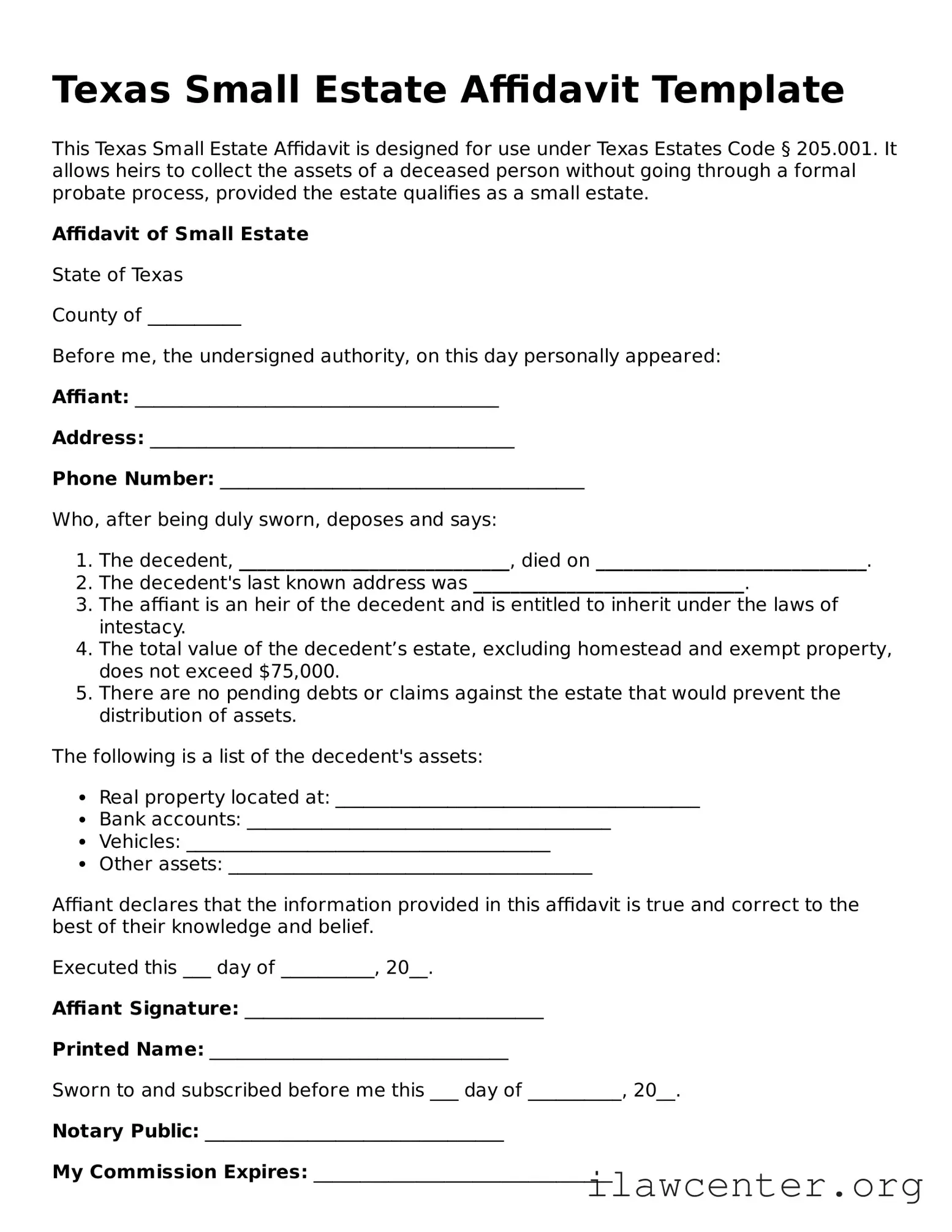
Texas Small Estate Affidavit Template

This Texas Small Estate Affidavit is designed for use under Texas Estates Code § 205.001. It allows heirs to collect the assets of a deceased person without going through a formal probate process, provided the estate qualifies as a small estate.

Affidavit of Small Estate

State of Texas

County of __________

Before me, the undersigned authority, on this day personally appeared:

Affiant: _______________________________________

Address: _______________________________________

Phone Number: _______________________________________

Who, after being duly sworn, deposes and says:

  1. The decedent, _____________________________, died on _____________________________.
  2. The decedent's last known address was _____________________________.
  3. The affiant is an heir of the decedent and is entitled to inherit under the laws of intestacy.
  4. The total value of the decedent’s estate, excluding homestead and exempt property, does not exceed $75,000.
  5. There are no pending debts or claims against the estate that would prevent the distribution of assets.

The following is a list of the decedent's assets:

  • Real property located at: _______________________________________
  • Bank accounts: _______________________________________
  • Vehicles: _______________________________________
  • Other assets: _______________________________________

Affiant declares that the information provided in this affidavit is true and correct to the best of their knowledge and belief.

Executed this ___ day of __________, 20__.

Affiant Signature: ________________________________

Printed Name: ________________________________

Sworn to and subscribed before me this ___ day of __________, 20__.

Notary Public: ________________________________

My Commission Expires: ________________________________

PDF Form Characteristics

Fact Name Description
Definition The Texas Small Estate Affidavit is a legal document that allows heirs to claim a decedent's property without going through formal probate proceedings.
Governing Law This form is governed by Texas Estates Code, Chapter 205.
Eligibility To use this affidavit, the estate must not exceed $75,000 in value, excluding certain exempt property.
Required Information The affidavit requires information about the decedent, the heirs, and a detailed list of the estate’s assets.
Filing Process Once completed, the affidavit must be filed with the county clerk in the county where the decedent lived.
Signatures The affidavit must be signed by all heirs and notarized to be considered valid.
Limitations This process cannot be used if the decedent had a will that requires formal probate or if there are disputes among heirs.

Instructions on Utilizing Texas Small Estate Affidavit

After gathering the necessary information, you can begin filling out the Texas Small Estate Affidavit form. This process involves providing specific details about the deceased and their estate. Ensure that all information is accurate and complete, as this will facilitate the next steps in settling the estate.

  1. Obtain the Texas Small Estate Affidavit form. This can be found online or at your local courthouse.
  2. Fill in the name of the deceased individual in the designated space.
  3. Provide the date of death of the deceased.
  4. List the address of the deceased at the time of their death.
  5. Identify the heirs of the deceased by including their names and relationships to the deceased.
  6. Detail the assets of the estate, including real property, bank accounts, and personal property.
  7. Indicate any debts or liabilities that the estate may have.
  8. Sign the affidavit in front of a notary public. This is required for the affidavit to be legally valid.
  9. Submit the completed affidavit to the appropriate court in Texas.

Important Facts about Texas Small Estate Affidavit

What is a Texas Small Estate Affidavit?

The Texas Small Estate Affidavit is a legal document that allows heirs to claim property and assets of a deceased person without going through a formal probate process. This option is available when the total value of the estate is below a certain threshold, which is currently set at $75,000 for personal property and $100,000 for real property. By using this affidavit, heirs can simplify the transfer of assets and avoid the time and expense associated with probate court.

Who is eligible to use the Small Estate Affidavit?

To be eligible, you must be an heir of the deceased person. Heirs can include children, spouses, parents, or other relatives as defined by Texas law. Additionally, the estate must meet the value limits mentioned earlier. If the deceased had a will, it must be probated if it is contested or if the estate exceeds the small estate limits. It is important to ensure that no debts remain that could affect the estate's value.

How do I complete the Small Estate Affidavit?

Completing the Small Estate Affidavit requires gathering information about the deceased's assets and debts. You will need to fill out the affidavit form, providing details such as the deceased's name, date of death, and a list of the estate's assets. It is crucial to include a statement affirming that the estate qualifies as a small estate. Once completed, the affidavit must be signed in front of a notary public. After notarization, you can file the affidavit with the county clerk where the deceased lived.

What happens after I file the Small Estate Affidavit?

Once filed, the Small Estate Affidavit serves as a legal document that allows you to access and transfer the deceased's assets. Financial institutions and other entities may require a copy of the affidavit to release funds or transfer property. It's important to keep copies of the affidavit for your records and to provide to any institutions holding the deceased's assets. The process can take time, so patience is necessary as you work through the necessary steps.

Can I contest a Small Estate Affidavit?

Common mistakes

Filling out the Texas Small Estate Affidavit can be a straightforward process, but many people make common mistakes that can delay or complicate the probate process. Understanding these pitfalls can save time and frustration.

One frequent error is failing to include all necessary information about the deceased. The affidavit requires specific details such as the full name, date of death, and last known address. Omitting any of this information can lead to rejection of the affidavit.

Another mistake involves not providing accurate descriptions of the estate's assets. Individuals often underestimate or overestimate the value of property or fail to list all assets. This can create discrepancies that may lead to legal challenges down the road.

People sometimes forget to sign the affidavit in the presence of a notary public. A signature without notarization renders the document invalid. This step is crucial to ensure the affidavit is legally binding.

In addition, some individuals neglect to list all heirs or beneficiaries. The form requires a complete list of those entitled to inherit. Missing an heir can complicate the distribution of assets and cause disputes among family members.

Providing outdated or incorrect contact information for heirs is another common mistake. This can hinder communication and delay the process of asset distribution. Ensure that all contact details are current and accurate.

Many people also fail to include a statement confirming that the estate qualifies as a small estate. The Texas Small Estate Affidavit is only applicable under specific conditions, and not meeting these can invalidate the form.

Moreover, individuals sometimes ignore the requirement to attach supporting documentation. This may include a death certificate or proof of asset ownership. Without these documents, the affidavit may not be accepted.

Finally, some may not realize that the affidavit must be filed in the correct county. Filing in the wrong jurisdiction can lead to delays and additional complications. Always verify the proper venue before submission.

By avoiding these common mistakes, individuals can streamline the process of completing the Texas Small Estate Affidavit and ensure a smoother transition during what can be a difficult time.
Documents used along the form

When dealing with the Texas Small Estate Affidavit, several other forms and documents may be necessary to ensure a smooth process. Each document serves a specific purpose, helping to clarify the estate's assets and facilitate the transfer of property. Below is a list of common forms used alongside the Small Estate Affidavit.

  • Death Certificate: This official document verifies the death of the deceased and is often required to initiate the estate settlement process.
  • Will: If the deceased left a will, it provides insight into their wishes regarding asset distribution. It can be a key reference in the affidavit process.
  • Affidavit of Heirship: This document establishes the rightful heirs of the deceased's estate when there is no will. It helps clarify who is entitled to the assets.
  • List of Assets: A detailed inventory of the deceased's assets, including property, bank accounts, and personal belongings, is crucial for the affidavit.
  • Identification Documents: Copies of IDs for the affiant and heirs may be required to verify identities and establish relationships.
  • Creditors' Claims: Any claims from creditors against the estate should be documented. This helps ensure that debts are settled before asset distribution.
  • Tax Returns: Recent tax returns may be necessary to assess any outstanding tax liabilities associated with the estate.
  • Notice to Creditors: This document informs potential creditors of the estate's administration, allowing them to make claims if necessary.
  • Court Order (if applicable): In some cases, a court order may be required to validate the Small Estate Affidavit, especially if disputes arise.
  • Power of Attorney: If the deceased granted someone power of attorney, this document may be relevant in managing the estate's affairs.

Having these documents ready can significantly ease the process of settling an estate in Texas. Each form plays a vital role in ensuring that everything proceeds in accordance with state laws and the wishes of the deceased.

Similar forms

The Small Estate Affidavit is a useful tool for settling the affairs of a deceased person's estate when it falls below a certain value threshold. Several other documents serve similar purposes in estate management. Here are five such documents:

  • Will: A will outlines how a person's assets should be distributed after their death. While a Small Estate Affidavit simplifies the process for smaller estates, a will provides a more comprehensive plan for larger estates, detailing specific bequests and appointing an executor.
  • Trust: A trust allows a person to transfer assets to a trustee for the benefit of beneficiaries. Like the Small Estate Affidavit, it can help avoid probate, but it requires more formal setup and management, offering greater control over asset distribution.
  • Probate Petition: A probate petition is filed in court to initiate the probate process. This document is necessary for larger estates and involves court oversight, unlike the Small Estate Affidavit, which allows for a more straightforward transfer of assets without court involvement.
  • Transfer on Death Deed: This deed allows property owners to designate beneficiaries who will receive their property upon death. Similar to the Small Estate Affidavit, it bypasses probate, but it specifically applies to real estate and requires proper execution to be valid.
  • Affidavit of Heirship: This affidavit is used to establish the heirs of a deceased person when there is no will. It serves a similar purpose to the Small Estate Affidavit by facilitating the transfer of assets, particularly in cases where the estate is small and does not require full probate proceedings.

Dos and Don'ts

When filling out the Texas Small Estate Affidavit form, it is important to follow certain guidelines to ensure accuracy and compliance. Here are some dos and don'ts to consider:

  • Do gather all necessary information before starting the form.
  • Do ensure that the deceased's estate qualifies as a small estate under Texas law.
  • Do provide accurate details about the deceased, including full name and date of death.
  • Do list all heirs and their relationship to the deceased clearly.
  • Do sign the affidavit in front of a notary public.
  • Don't leave any sections of the form blank; incomplete forms may be rejected.
  • Don't include information about debts that exceed the estate's value.
  • Don't forget to check for any required attachments or supporting documents.
  • Don't rush through the process; take your time to review all entries.

By adhering to these guidelines, you can help ensure a smoother process when filing the Texas Small Estate Affidavit.

Misconceptions

Understanding the Texas Small Estate Affidavit can be confusing, and several misconceptions often arise. Here are seven common misunderstandings about this important legal document:

  1. Only wealthy individuals can use a Small Estate Affidavit.

    This is not true. The Small Estate Affidavit is designed for estates that fall below a certain value threshold, making it accessible for many individuals, regardless of their financial status.

  2. The Small Estate Affidavit can be used for any type of asset.

    In reality, this affidavit is primarily for personal property and does not cover real estate. Understanding what can and cannot be included is crucial.

  3. You must hire a lawyer to file a Small Estate Affidavit.

    While legal advice can be helpful, it is not a requirement. Many individuals successfully prepare and file the affidavit on their own.

  4. The Small Estate Affidavit takes a long time to process.

    In fact, once filed, the affidavit can be processed relatively quickly, often allowing heirs to access assets without lengthy delays.

  5. All heirs must agree to use the Small Estate Affidavit.

    This is a common misconception. Only the affiant, or the person filing the affidavit, needs to sign it, though it’s best to have the support of other heirs.

  6. The Small Estate Affidavit is the same as a will.

    They serve different purposes. A will outlines how a person wants their estate distributed after death, while the Small Estate Affidavit is a tool for settling smaller estates without probate.

  7. You cannot change the Small Estate Affidavit once filed.

    While the affidavit itself cannot be altered, if circumstances change, you can file a new affidavit or take other legal steps to address the situation.

By debunking these misconceptions, individuals can better navigate the process of settling small estates in Texas, ensuring that their loved ones receive what they are entitled to without unnecessary complications.

Key takeaways

When dealing with a small estate in Texas, understanding the Small Estate Affidavit form is crucial. Here are some key takeaways to keep in mind:

  • Eligibility Requirements: The estate must not exceed $75,000 in value, excluding certain assets like homesteads and exempt property.
  • Affidavit Purpose: This document allows heirs to claim property without going through formal probate, streamlining the process.
  • Filing Process: The affidavit must be filed in the county where the deceased lived at the time of death.
  • Signature Requirements: All heirs must sign the affidavit, affirming their relationship to the deceased and their entitlement to the estate.
  • Asset Distribution: The affidavit provides instructions on how the assets will be distributed among heirs, according to Texas law.
  • Legal Advice: While the form is designed for simplicity, consulting with an attorney can help ensure compliance with state laws and proper completion.

By following these guidelines, individuals can navigate the Small Estate Affidavit process more effectively and efficiently.