Attorney-Verified  Transfer-on-Death Deed Document for Texas

Attorney-Verified Transfer-on-Death Deed Document for Texas

A Transfer-on-Death Deed is a legal document in Texas that allows property owners to transfer their real estate to beneficiaries without the need for probate after their death. This form provides a straightforward way to ensure that your property goes directly to your chosen heirs. To get started with the process, fill out the form by clicking the button below.

Article Guide

The Texas Transfer-on-Death Deed form serves as a powerful estate planning tool that allows property owners to designate beneficiaries who will receive their real estate upon their death, without the need for probate. This straightforward document provides a clear and efficient way to transfer ownership, ensuring that the property bypasses the lengthy and often costly probate process. By completing this form, individuals can maintain control over their property during their lifetime while providing peace of mind to their loved ones regarding future ownership. The deed must be properly executed and recorded to be effective, and it can be revoked or modified at any time before the owner's death. Understanding the nuances of this form is essential for anyone looking to simplify the transfer of their property and protect their heirs from potential disputes or complications. With its unique features, the Texas Transfer-on-Death Deed form stands out as a practical option for estate planning in the Lone Star State.

Texas Transfer-on-Death Deed Preview

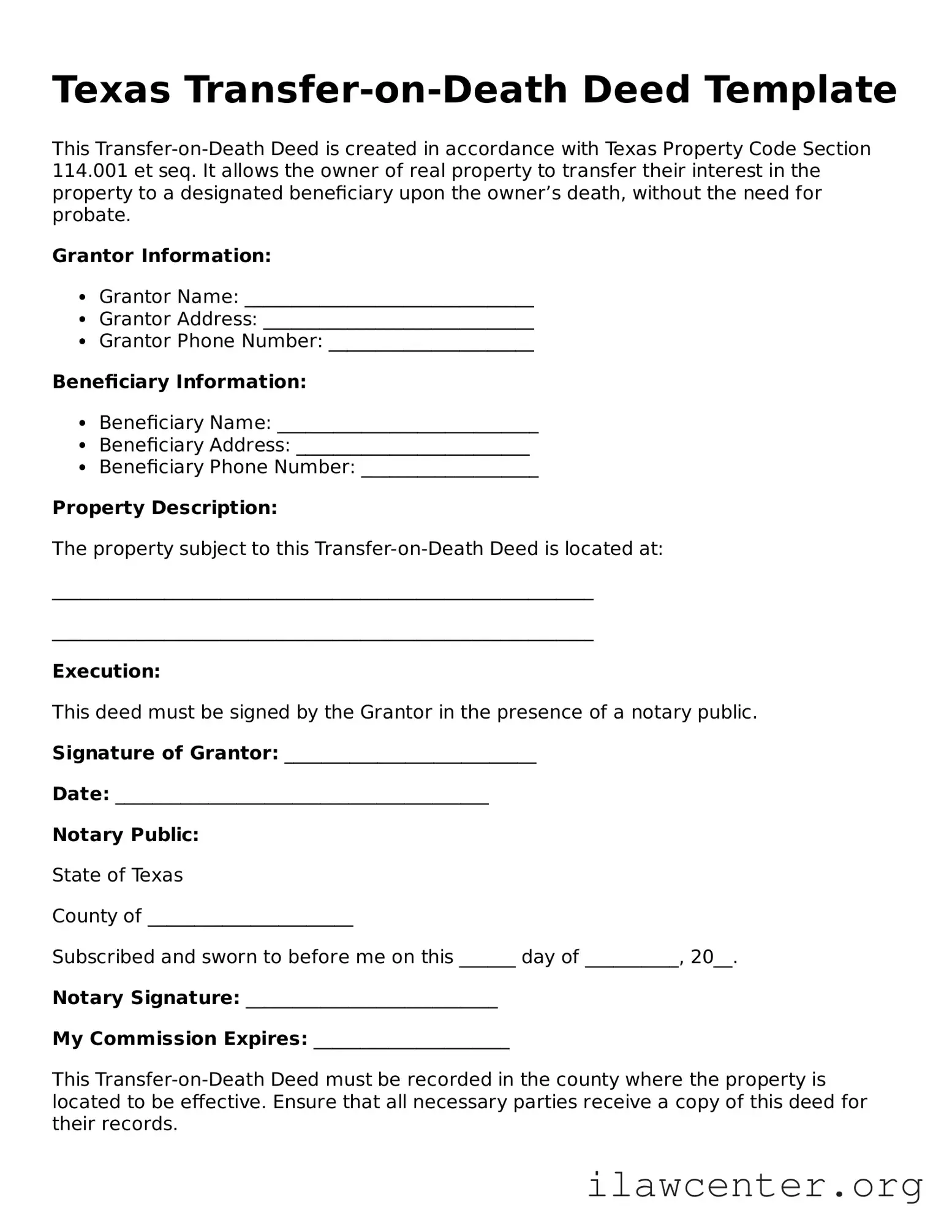
Texas Transfer-on-Death Deed Template

This Transfer-on-Death Deed is created in accordance with Texas Property Code Section 114.001 et seq. It allows the owner of real property to transfer their interest in the property to a designated beneficiary upon the owner’s death, without the need for probate.

Grantor Information:

  • Grantor Name: _______________________________
  • Grantor Address: _____________________________
  • Grantor Phone Number: ______________________

Beneficiary Information:

  • Beneficiary Name: ____________________________
  • Beneficiary Address: _________________________
  • Beneficiary Phone Number: ___________________

Property Description:

The property subject to this Transfer-on-Death Deed is located at:

__________________________________________________________

__________________________________________________________

Execution:

This deed must be signed by the Grantor in the presence of a notary public.

Signature of Grantor: ___________________________

Date: ________________________________________

Notary Public:

State of Texas

County of ______________________

Subscribed and sworn to before me on this ______ day of __________, 20__.

Notary Signature: ___________________________

My Commission Expires: _____________________

This Transfer-on-Death Deed must be recorded in the county where the property is located to be effective. Ensure that all necessary parties receive a copy of this deed for their records.

PDF Form Characteristics

Fact Name Description
Definition A Transfer-on-Death Deed (TODD) allows property owners in Texas to transfer real estate to beneficiaries upon their death, avoiding probate.
Governing Law The Texas Transfer-on-Death Deed is governed by Texas Estates Code, Chapter 114.
Eligibility Any individual who owns real property in Texas can create a Transfer-on-Death Deed.
Form Requirements The deed must be in writing, signed by the owner, and must include the legal description of the property.
Recording The Transfer-on-Death Deed must be recorded in the county where the property is located to be effective.
Revocation Property owners can revoke a Transfer-on-Death Deed at any time before their death by executing a new deed or a revocation document.
Beneficiary Designation Property owners can designate one or more beneficiaries in the deed, and they can also specify alternate beneficiaries.
Tax Implications Transfer-on-Death Deeds do not trigger immediate tax consequences; taxes are assessed to beneficiaries upon transfer.
Limitations The deed cannot be used to transfer property held in a trust or property subject to a life estate.
Legal Assistance While individuals can create a TODD without an attorney, consulting a legal professional is recommended to ensure compliance with all requirements.

Instructions on Utilizing Texas Transfer-on-Death Deed

Once you have the Texas Transfer-on-Death Deed form, it's important to fill it out accurately. After completing the form, you will need to file it with the county clerk's office where the property is located. This ensures that the deed is properly recorded and will take effect upon your passing.

  1. Begin by entering your name as the grantor. This is the person transferring the property.
  2. Provide your address. Make sure it is complete and accurate.
  3. Next, identify the property being transferred. Include the legal description, which can typically be found on your property tax statement or previous deed.
  4. Clearly state the name of the beneficiary who will receive the property upon your passing. This could be an individual or multiple individuals.
  5. Include the address of the beneficiary or beneficiaries to ensure proper identification.
  6. If there are multiple beneficiaries, indicate how the property should be divided among them.
  7. Sign and date the form in the designated area. Your signature must match your name as the grantor.
  8. Have the form notarized. A notary public will verify your identity and witness your signature.
  9. Finally, make a copy of the completed and notarized deed for your records before filing it with the county clerk.

Important Facts about Texas Transfer-on-Death Deed

What is a Transfer-on-Death Deed?

A Transfer-on-Death Deed (TODD) is a legal document that allows property owners in Texas to designate one or more beneficiaries to receive their real estate upon their death. This deed enables the transfer of property without the need for probate, simplifying the process for heirs and ensuring a smoother transition of ownership.

Who can create a Transfer-on-Death Deed?

Any individual who holds title to real estate in Texas can create a Transfer-on-Death Deed. This includes sole owners as well as co-owners. However, it is important that the property owner is of sound mind and is not under duress when executing the deed.

How do I complete a Transfer-on-Death Deed?

To complete a Transfer-on-Death Deed, the property owner must fill out the appropriate form, which includes information such as the property description, the names of the beneficiaries, and the owner’s signature. It is crucial to ensure that the deed is executed in accordance with Texas law, including notarization and recording with the county clerk's office where the property is located.

Are there any costs associated with creating a Transfer-on-Death Deed?

While there is no fee for creating a Transfer-on-Death Deed itself, there may be costs associated with notarization and recording the deed with the county clerk. These fees can vary by county, so it is advisable to check with the local office for specific pricing.

Can I revoke a Transfer-on-Death Deed?

Yes, a Transfer-on-Death Deed can be revoked at any time before the property owner’s death. To do so, the owner must execute a new deed that explicitly states the revocation or file a formal revocation document with the county clerk's office where the original deed was recorded.

What happens if the beneficiary predeceases the property owner?

If a designated beneficiary passes away before the property owner, the transfer will not occur to that beneficiary. Instead, the property owner may want to designate an alternate beneficiary in the deed or update the deed to reflect new beneficiaries to ensure the property is transferred according to their wishes.

Is a Transfer-on-Death Deed the right choice for everyone?

A Transfer-on-Death Deed can be an effective estate planning tool for many property owners, but it may not be suitable for everyone. Individuals with complex estates, those who have significant debts, or those who wish to impose conditions on the transfer may benefit from consulting an estate planning attorney to explore all available options and ensure their estate plan aligns with their goals.
Common mistakes

Filling out a Texas Transfer-on-Death Deed form can seem straightforward, yet many individuals make common mistakes that can lead to complications down the road. One frequent error is failing to include all required information. The form demands specific details about the property and the beneficiary. Omitting even a single piece of crucial information can render the deed invalid.

Another common mistake involves incorrect property descriptions. The property must be clearly identified, often requiring a legal description rather than just a street address. Inaccuracies in this section can cause confusion and disputes among heirs later on.

People often overlook the need for proper signatures. The form must be signed by the grantor in the presence of a notary public. If the signature is missing or not notarized correctly, the deed may not hold up in court.

Additionally, individuals sometimes forget to record the deed with the county clerk's office. A Transfer-on-Death Deed is only effective if it is properly filed. Failing to do so can result in the property passing through probate instead of directly to the beneficiary.

Some people mistakenly believe that the deed can be changed or revoked easily. While it is possible to amend or revoke a Transfer-on-Death Deed, the process must be done according to Texas law. Failure to follow the correct procedure can lead to unintended consequences.

Another issue arises when multiple beneficiaries are named without clear instructions on how to divide the property. If the deed does not specify whether the beneficiaries share the property equally or in specific proportions, it can lead to disputes among them after the grantor's death.

Moreover, individuals may neglect to consider the implications of their decisions on tax liabilities. Beneficiaries should be aware of potential tax consequences associated with inheriting property, and it is wise to consult a tax professional before finalizing the deed.

People often underestimate the importance of clarity in beneficiary designations. Using vague terms or nicknames instead of legal names can create confusion and complicate the transfer process. It is essential to use the full legal names of all beneficiaries to avoid any ambiguity.

Another mistake involves not discussing the deed with family members. Open communication can prevent misunderstandings and ensure that all parties are aware of the grantor's intentions. Failing to have these conversations can lead to disputes and emotional turmoil after the grantor passes away.

Lastly, many individuals do not seek legal advice when filling out the Transfer-on-Death Deed form. While it is possible to complete the form independently, consulting with an attorney can provide valuable insights and help avoid costly mistakes. Legal professionals can guide individuals through the nuances of property transfer and ensure that the deed is executed correctly.

Documents used along the form

The Texas Transfer-on-Death Deed allows individuals to transfer real property to beneficiaries upon their death without the need for probate. When utilizing this deed, there are several other forms and documents that may be necessary to ensure a smooth transfer process. Below is a list of commonly associated documents.

  • Affidavit of Heirship: This document establishes the heirs of a deceased person. It is often used when the deceased did not leave a will, providing a legal declaration of who is entitled to inherit the property.
  • Will: A will outlines how an individual wishes to distribute their assets upon death. While the Transfer-on-Death Deed can operate independently, having a will can clarify intentions and address any other assets not covered by the deed.
  • Deed of Trust: This document secures a loan by placing a lien on the property. If the property has an existing mortgage, this document is essential to understand the financial obligations tied to the property before transferring ownership.
  • Title Insurance Policy: This insurance protects against potential issues with the title of the property. Obtaining a title insurance policy can help ensure that the property is free of liens or other claims that could complicate the transfer process.

Utilizing these documents alongside the Transfer-on-Death Deed can help ensure that the transfer of property is executed smoothly and in accordance with the individual's wishes. Proper documentation is key to avoiding disputes and ensuring clarity for all parties involved.

Similar forms

The Transfer-on-Death Deed (TOD Deed) is a unique legal document that allows property owners to pass their real estate directly to beneficiaries upon their death, avoiding probate. However, there are several other documents that share similarities with the TOD Deed in terms of purpose or function. Here’s a breakdown of six such documents:

  • Last Will and Testament: Like a TOD Deed, a Last Will outlines how a person's assets should be distributed after their death. However, it typically requires probate, while a TOD Deed does not.
  • Living Trust: A living trust allows a person to place assets into a trust during their lifetime, which can then be distributed to beneficiaries upon their death. Both documents help avoid probate, but a living trust may offer more comprehensive management of assets.
  • Beneficiary Designation Forms: These forms are often used for financial accounts, such as retirement plans or life insurance policies. They allow the account holder to name beneficiaries directly, similar to how a TOD Deed designates heirs for real estate.
  • Joint Tenancy with Right of Survivorship: This arrangement allows two or more people to own property together. When one owner dies, their share automatically passes to the surviving owner(s), much like the transfer of property through a TOD Deed.
  • Payable-on-Death Accounts: These accounts allow individuals to designate beneficiaries who will receive the funds upon their death. This is similar to a TOD Deed in that it facilitates direct transfer of assets without going through probate.
  • Life Estate Deed: A life estate deed allows a person to retain the right to live in a property for their lifetime, with the property passing to a designated beneficiary after their death. This is akin to a TOD Deed in that it establishes a clear path for property transfer upon death.

Understanding these documents can help individuals make informed decisions about how to manage and transfer their assets effectively. Each document has its own advantages and considerations, so it's essential to choose the one that best fits your needs and circumstances.

Dos and Don'ts

When filling out the Texas Transfer-on-Death Deed form, there are important dos and don'ts to consider. Following these guidelines can help ensure that your deed is valid and effective.

  • Do provide accurate information about the property and the beneficiaries.
  • Do sign the deed in the presence of a notary public.
  • Do ensure that the deed is recorded with the county clerk's office.
  • Do keep a copy of the recorded deed for your records.
  • Don't leave any blank spaces on the form.
  • Don't forget to include the legal description of the property.
  • Don't assume the deed is effective until it has been properly recorded.

Following these steps can help prevent complications in the future and ensure that your wishes are honored.

Misconceptions

Understanding the Texas Transfer-on-Death Deed (TODD) can be tricky. Here are some common misconceptions that people often have about this important legal tool:

  • It automatically transfers property upon death. Many believe that the TODD transfers property immediately upon death. In reality, the transfer occurs only after the death of the property owner and once the deed is properly recorded.
  • It can only be used for residential properties. Some think that the TODD is limited to residential real estate. However, it can be used for various types of real property, including land and commercial properties.
  • All beneficiaries must be present to sign. A common misunderstanding is that all beneficiaries need to be present when the deed is created or signed. In fact, only the property owner needs to sign the deed, and beneficiaries do not need to be involved at that time.
  • It overrides a will. Some people believe that a TODD will automatically override any existing will. While it does transfer property outside of probate, it does not negate the terms of a will if the property is included in both documents.
  • It’s a complicated process. Many think that creating a TODD is overly complex. In truth, the process is straightforward and can often be completed without the need for an attorney, although legal advice can be beneficial.
  • It doesn’t require any maintenance. Some assume that once a TODD is in place, no further action is needed. However, it’s essential to keep the deed updated if circumstances change, such as the sale of the property or changes in beneficiaries.
  • It’s only for wealthy individuals. There’s a misconception that only wealthy individuals can benefit from a TODD. In reality, anyone who owns property can use this deed to simplify the transfer process for their heirs.
  • It is the same as a living trust. Many confuse a TODD with a living trust. While both serve to transfer property upon death, a living trust involves more extensive management of assets during the owner’s lifetime, whereas a TODD is solely focused on transferring property at death.

By clearing up these misconceptions, individuals can make more informed decisions about their estate planning options in Texas.

Key takeaways

Filling out and utilizing the Texas Transfer-on-Death Deed form can be a straightforward process, but it’s essential to understand the key aspects to ensure it serves its intended purpose effectively. Here are six important takeaways to keep in mind:

  • Purpose of the Deed: A Transfer-on-Death Deed allows property owners to designate beneficiaries who will inherit their property upon their death, bypassing the probate process.
  • Eligibility: Only real property, such as land or houses, can be transferred using this deed. Personal property, like vehicles or bank accounts, requires different methods.
  • Filling Out the Form: It’s crucial to complete the form accurately. Include the legal description of the property and the names of the beneficiaries clearly to avoid any confusion later.
  • Signing Requirements: The deed must be signed by the property owner in the presence of a notary public. This step is vital to ensure the deed is legally valid.
  • Filing the Deed: After signing, the deed must be filed with the county clerk’s office where the property is located. This step officially records the transfer and protects the rights of the beneficiaries.
  • Revocation: The property owner can revoke the deed at any time before their death. To do so, a new deed must be filed, clearly stating the revocation.

Understanding these key points can help ensure that the Transfer-on-Death Deed serves its purpose effectively, providing peace of mind regarding the future of your property.