Attorney-Verified  Vehicle Purchase Agreement Document for Texas

Attorney-Verified Vehicle Purchase Agreement Document for Texas

The Texas Vehicle Purchase Agreement form is a legal document that outlines the terms and conditions of a vehicle sale between a buyer and a seller. This agreement serves to protect both parties by clearly stating the details of the transaction, including the purchase price, vehicle description, and any warranties. Understanding this form is essential for a smooth and transparent vehicle buying experience, so be sure to fill out the form by clicking the button below.

Article Guide

The Texas Vehicle Purchase Agreement form serves as a crucial document in the process of buying or selling a vehicle within the state. This form outlines essential details such as the buyer's and seller's information, the vehicle's identification number (VIN), make, model, and year, as well as the purchase price and payment terms. It ensures that both parties understand their rights and obligations throughout the transaction. Additionally, the agreement may include provisions regarding warranties, disclosures, and any conditions that must be met prior to the transfer of ownership. By providing a clear framework, this form helps to prevent misunderstandings and disputes, making the vehicle purchasing process smoother and more transparent for everyone involved. Understanding the components of this agreement is vital for both buyers and sellers to protect their interests and ensure compliance with Texas laws.

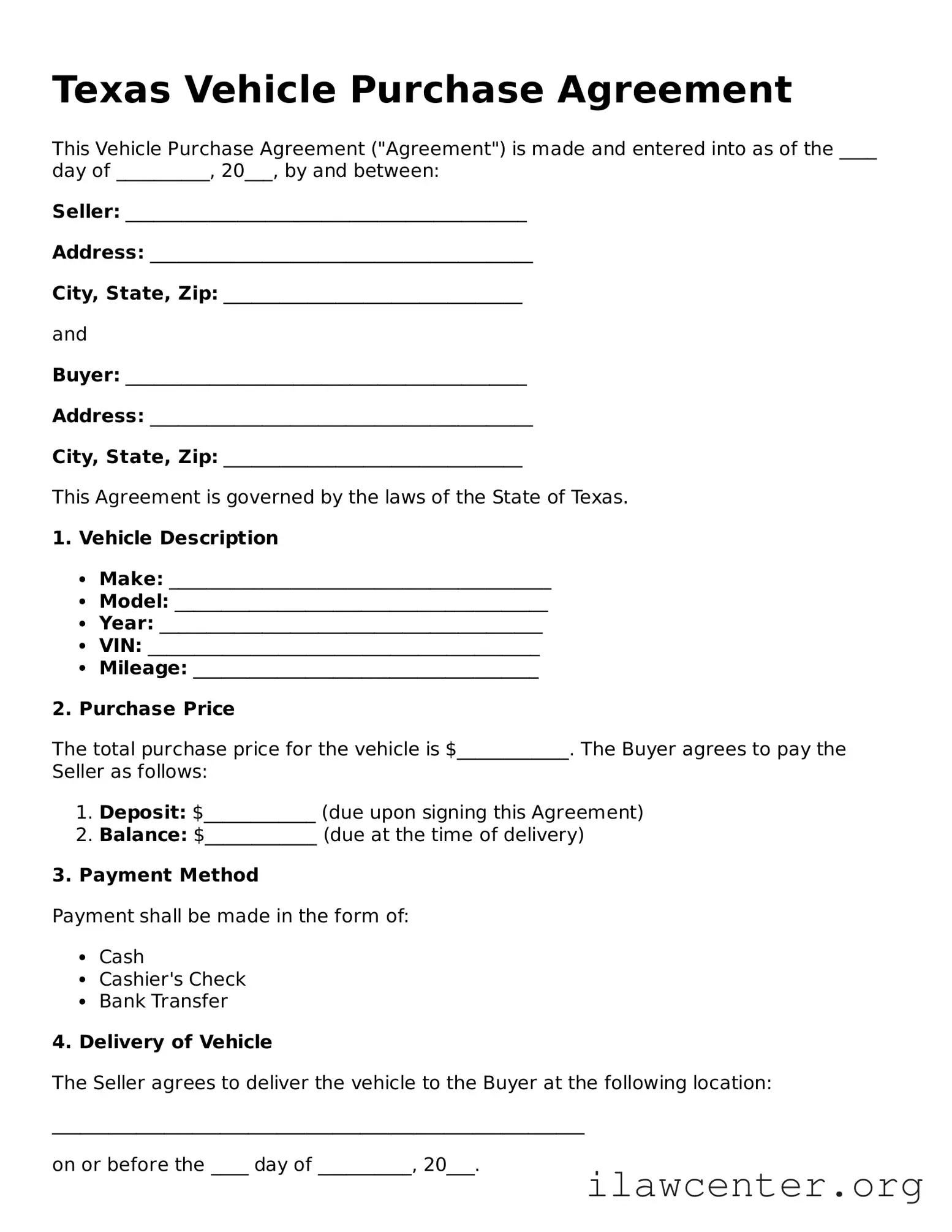
Texas Vehicle Purchase Agreement Preview

Texas Vehicle Purchase Agreement

This Vehicle Purchase Agreement ("Agreement") is made and entered into as of the ____ day of __________, 20___, by and between:

Seller: ___________________________________________

Address: _________________________________________

City, State, Zip: ________________________________

and

Buyer: ___________________________________________

Address: _________________________________________

City, State, Zip: ________________________________

This Agreement is governed by the laws of the State of Texas.

1. Vehicle Description

  • Make: _________________________________________
  • Model: ________________________________________
  • Year: _________________________________________
  • VIN: __________________________________________
  • Mileage: _____________________________________

2. Purchase Price

The total purchase price for the vehicle is $____________. The Buyer agrees to pay the Seller as follows:

  1. Deposit: $____________ (due upon signing this Agreement)
  2. Balance: $____________ (due at the time of delivery)

3. Payment Method

Payment shall be made in the form of:

  • Cash
  • Cashier's Check
  • Bank Transfer

4. Delivery of Vehicle

The Seller agrees to deliver the vehicle to the Buyer at the following location:

_________________________________________________________

on or before the ____ day of __________, 20___.

5. Condition of Vehicle

The Buyer accepts the vehicle in its current condition, "as is," and acknowledges that the Seller has made no warranties regarding the vehicle's condition or performance.

6. Governing Law

This Agreement shall be governed by and construed in accordance with the laws of the State of Texas.

7. Signatures

IN WITNESS WHEREOF, the parties have executed this Agreement as of the date first above written.

Seller's Signature: _____________________________

Date: ________________________________________

Buyer's Signature: _____________________________

Date: ________________________________________

PDF Form Characteristics

Fact Name Description
Purpose The Texas Vehicle Purchase Agreement form outlines the terms of sale for a vehicle between a buyer and a seller.
Governing Law This agreement is governed by the laws of the State of Texas.
Required Information The form typically requires details such as the buyer's and seller's names, vehicle identification number (VIN), and purchase price.
Signatures Both parties must sign the agreement to make it legally binding, ensuring that all terms are accepted.

Instructions on Utilizing Texas Vehicle Purchase Agreement

After obtaining the Texas Vehicle Purchase Agreement form, it's time to fill it out carefully. This document will require specific details about the transaction, the buyer, and the seller. Completing it accurately ensures that both parties are protected during the sale.

  1. Begin by entering the date of the agreement at the top of the form.
  2. Fill in the buyer's full name and address in the designated sections.
  3. Provide the seller's full name and address next.
  4. Describe the vehicle being purchased, including the make, model, year, and Vehicle Identification Number (VIN).
  5. Specify the purchase price of the vehicle clearly.
  6. Indicate any terms of the sale, such as whether it is a cash transaction or involves financing.
  7. Include any additional terms or conditions that both parties agree upon.
  8. Have both the buyer and seller sign and date the agreement at the bottom of the form.

Once completed, both parties should keep a copy of the signed agreement for their records. This document will serve as proof of the transaction and can be important for future reference, especially for title transfer and registration purposes.

Important Facts about Texas Vehicle Purchase Agreement

What is the Texas Vehicle Purchase Agreement form?

The Texas Vehicle Purchase Agreement form is a legal document used in the state of Texas to outline the terms and conditions of a vehicle sale. It serves as a record of the transaction between the buyer and the seller, detailing important information such as the vehicle's make, model, year, identification number, sale price, and payment method. This agreement helps protect the rights of both parties and ensures clarity in the transaction process.

Who should use the Texas Vehicle Purchase Agreement form?

This form is intended for use by individuals or businesses involved in the sale or purchase of a vehicle in Texas. Both private sellers and buyers can utilize this agreement to formalize the transaction. It is especially useful for used vehicle sales, where the condition and history of the vehicle may need to be documented clearly to avoid disputes later on.

Is the Texas Vehicle Purchase Agreement form legally binding?

Yes, once both parties sign the Texas Vehicle Purchase Agreement, it becomes a legally binding contract. This means that both the buyer and the seller are obligated to adhere to the terms outlined in the agreement. It is crucial for both parties to review the document carefully before signing to ensure that all details are accurate and agreed upon.

What happens if there is a dispute after signing the agreement?

If a dispute arises after the agreement has been signed, the parties may need to refer back to the terms outlined in the Vehicle Purchase Agreement. Depending on the nature of the dispute, it may be necessary to seek mediation or legal counsel to resolve the issue. Having a well-documented agreement can provide essential evidence in such situations, helping to clarify each party's responsibilities and rights.

Common mistakes

When filling out the Texas Vehicle Purchase Agreement form, many individuals make common mistakes that can lead to complications later on. One frequent error is not providing complete and accurate information. Buyers often overlook essential details such as the vehicle identification number (VIN) or the correct spelling of names. Incomplete information can delay the processing of the agreement and create confusion.

Another mistake is failing to read the entire agreement before signing. Some people may rush through the document, missing important terms and conditions. This oversight can result in misunderstandings about the purchase, including payment terms and warranty information. Taking the time to review the document thoroughly can prevent future disputes.

Additionally, individuals sometimes neglect to include the correct purchase price. This can happen if buyers assume the price is already filled in or if they forget to account for additional fees, such as taxes and registration costs. An inaccurate purchase price can lead to issues with financing or registration.

People also frequently forget to sign and date the agreement. A signature is essential for the document to be legally binding. Without it, the agreement may be considered invalid, causing problems for both the buyer and seller.

Another common error is not keeping a copy of the completed agreement. After signing, buyers should always request a copy for their records. Without a copy, it may be difficult to resolve any future issues related to the purchase.

Lastly, some individuals fail to check for any outstanding liens on the vehicle. It is crucial to ensure that the seller has the legal right to sell the vehicle and that there are no financial obligations attached. Buyers should conduct a thorough check to avoid potential legal complications down the road.

Documents used along the form

When engaging in the purchase of a vehicle in Texas, several important documents accompany the Texas Vehicle Purchase Agreement form. Each document serves a specific purpose in ensuring a smooth transaction and protecting the interests of both the buyer and the seller.

  • Title Transfer Document: This document is essential for transferring ownership of the vehicle from the seller to the buyer. It includes information about the vehicle, such as the VIN, and must be signed by both parties to be valid.
  • Bill of Sale: This document acts as a receipt for the transaction. It outlines the details of the sale, including the purchase price, vehicle description, and the names of both the buyer and seller. It provides proof of the transaction for both parties.
  • Odometer Disclosure Statement: Required by federal law, this statement certifies the vehicle's mileage at the time of sale. Both the buyer and seller must sign this document to confirm the accuracy of the odometer reading.
  • Financing Agreement (if applicable): If the buyer is financing the vehicle, this document outlines the terms of the loan. It includes the loan amount, interest rate, payment schedule, and any other relevant conditions of the financing arrangement.

These documents collectively ensure that the vehicle purchase process is clear and legally binding. Properly completing and exchanging these forms helps facilitate a successful transaction, providing peace of mind for both the buyer and seller.

Similar forms

The Vehicle Purchase Agreement form shares similarities with several other documents commonly used in transactions involving vehicles. Each document serves a unique purpose but often contains overlapping elements such as terms of sale, buyer and seller information, and conditions of the sale. Below is a list of documents that are similar to the Vehicle Purchase Agreement:

  • Bill of Sale: This document provides proof of the sale and includes details about the vehicle, the buyer, and the seller. It serves as a receipt for the transaction.
  • Lease Agreement: Similar to a purchase agreement, a lease agreement outlines the terms under which a vehicle is leased, including payment terms and duration.
  • Financing Agreement: This document details the terms of financing for a vehicle purchase, including interest rates, payment schedules, and obligations of the borrower.
  • Trade-In Agreement: When a vehicle is traded in, this agreement specifies the terms of the trade, including the value of the trade-in vehicle and how it applies to the purchase of a new vehicle.
  • Title Transfer Document: This document is used to officially transfer ownership of the vehicle from the seller to the buyer and includes necessary information about the vehicle and parties involved.
  • Warranty Agreement: A warranty agreement outlines the coverage provided for a vehicle after purchase, detailing what repairs or replacements are included and for how long.
  • Inspection Report: This document provides a detailed assessment of the vehicle's condition prior to purchase, often including information about repairs needed or existing issues.
  • Purchase Order: A purchase order may be used in commercial transactions to confirm the details of a vehicle purchase, including pricing, specifications, and delivery terms.

Dos and Don'ts

When filling out the Texas Vehicle Purchase Agreement form, it's important to approach the process with care. Here are some key do's and don'ts to keep in mind:

  • Do ensure all information is accurate and complete.
  • Do read the entire agreement carefully before signing.
  • Do keep a copy of the signed agreement for your records.
  • Do ask questions if anything is unclear.
  • Don't rush through the form; take your time.
  • Don't leave any sections blank unless instructed to do so.
  • Don't sign the agreement without reviewing all terms.
  • Don't ignore any additional fees that may be included.

By following these guidelines, you can help ensure a smoother vehicle purchasing experience in Texas.

Misconceptions

When it comes to the Texas Vehicle Purchase Agreement form, several misconceptions can lead to confusion for buyers and sellers alike. Understanding the truth behind these misconceptions can help ensure a smoother transaction. Here’s a look at seven common misunderstandings:

  • 1. The form is only necessary for used vehicles. Many believe that the Vehicle Purchase Agreement is only required for used cars. In reality, it is important for both new and used vehicle transactions.
  • 2. The agreement is just a formality. Some people think the agreement is merely a formality and does not hold any legal weight. However, this document is a binding contract that outlines the terms of the sale.
  • 3. Verbal agreements are sufficient. A common misconception is that a verbal agreement is enough to complete a vehicle sale. In Texas, having a written agreement protects both parties and clarifies the terms of the sale.
  • 4. The seller must provide financing options. Buyers often assume that sellers are obligated to offer financing options. In fact, the seller is not required to provide financing, and buyers should be prepared to secure their own financing if needed.
  • 5. The agreement can be modified after signing. Some believe that once the agreement is signed, it can be changed at any time. In truth, modifications to the agreement should be made in writing and signed by both parties to be enforceable.
  • 6. Only the buyer needs to sign the agreement. It’s a common mistake to think that only the buyer’s signature is necessary. Both the buyer and seller must sign the Vehicle Purchase Agreement for it to be valid.
  • 7. The form is the same across all states. Many assume that the Vehicle Purchase Agreement is standardized across the country. Each state, including Texas, has its own specific requirements and forms, so it’s important to use the correct one for your location.

Understanding these misconceptions can help you navigate the vehicle purchasing process with confidence. Always ensure that you have the correct documentation and that both parties are clear on the terms of the sale.

Key takeaways

When filling out and using the Texas Vehicle Purchase Agreement form, it is essential to understand the following key points:

  • Accurate Information: Ensure that all information provided on the form is correct and complete. This includes details about the buyer, seller, and the vehicle itself.
  • Signatures Required: Both the buyer and the seller must sign the agreement. This indicates mutual consent to the terms outlined in the document.
  • Purchase Price: Clearly state the agreed-upon purchase price. This amount should be reflected accurately to avoid disputes later.
  • Vehicle Identification: Include the vehicle identification number (VIN) and other identifying details. This helps in verifying the vehicle's identity and ownership.
  • As-Is Clause: If applicable, include an "as-is" clause. This clarifies that the buyer accepts the vehicle in its current condition without warranties from the seller.
  • Payment Method: Specify the method of payment. This can include cash, check, or financing details, ensuring transparency in the transaction.
  • Retention of Copies: Both parties should retain a copy of the signed agreement. This serves as a reference and proof of the transaction in the future.