Tn Counter Offer PDF Template

Tn Counter Offer PDF Template

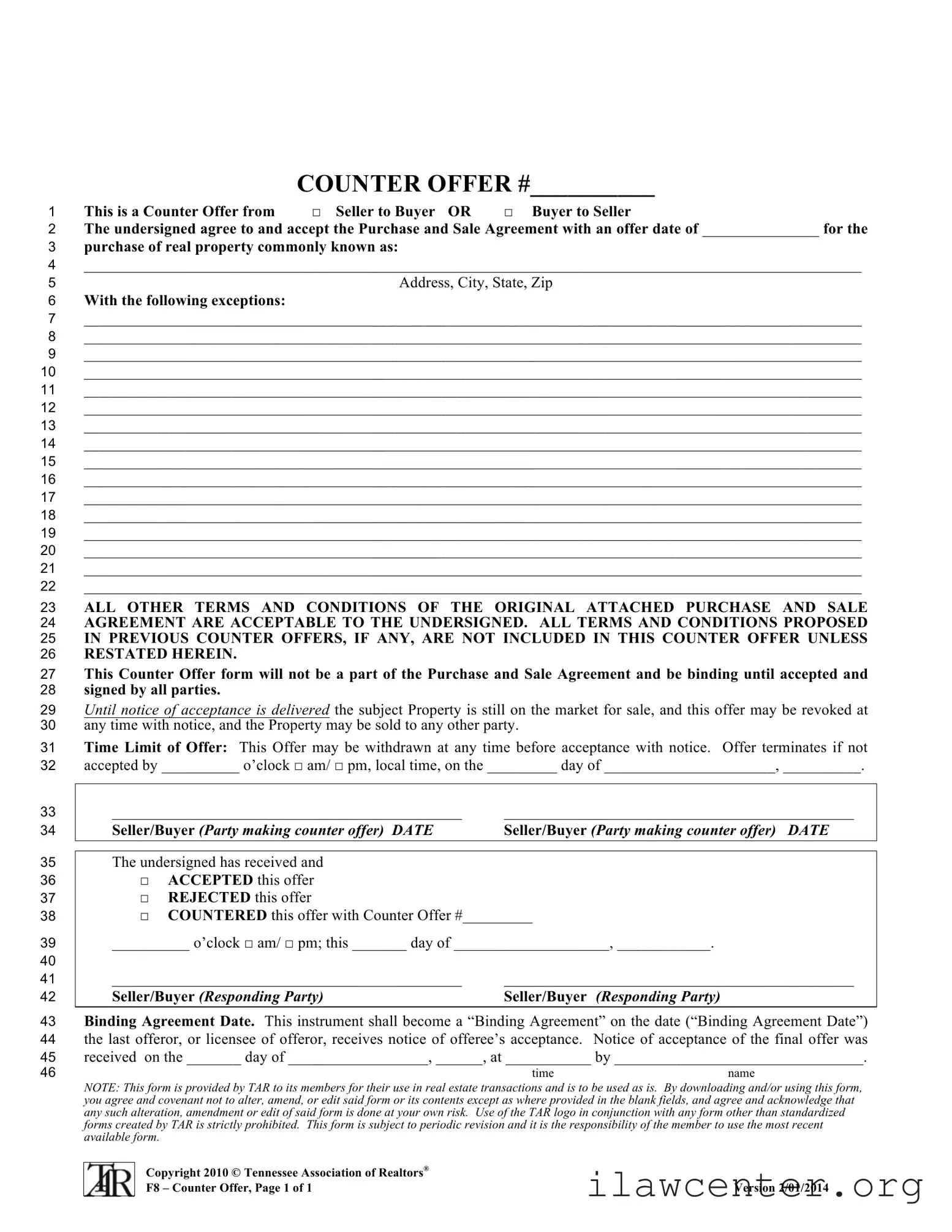
The Tennessee Counter Offer form serves as a formal document allowing one party to propose changes to the terms of an existing Purchase and Sale Agreement. This form can be utilized by either the seller or the buyer to clarify their intentions and outline specific exceptions to the original agreement. It is crucial to fill out this form accurately to ensure that all parties are on the same page before proceeding with the sale.

To fill out the form, please click the button below.

Article Guide

When navigating the real estate market in Tennessee, understanding the Tn Counter Offer form is essential for both buyers and sellers. This form serves as a crucial tool in the negotiation process, allowing one party to propose changes to the terms of an existing purchase agreement. It outlines the specific exceptions or modifications to the original offer, ensuring clarity and mutual understanding. The form also emphasizes that all other terms from the original purchase agreement remain intact unless explicitly altered in the counter offer. Importantly, it stipulates that until all parties have signed and accepted the counter offer, the property remains on the market, highlighting the dynamic nature of real estate transactions. Additionally, the form includes a time limit for acceptance, which adds a layer of urgency to the negotiation. By utilizing this form correctly, both buyers and sellers can communicate their intentions clearly, facilitating a smoother transaction process.

Tn Counter Offer Preview

Copyright 2010 © Tennessee Association of Realtors
®
F8 Counter Offer, Page 1 of 1 Version 2/01/2014
COUNTER OFFER #__________
This is a Counter Offer from Seller to Buyer OR Buyer to Seller 1
The undersigned agree to and accept the Purchase and Sale Agreement with an offer date of _______________ for the 2
purchase of real property commonly known as: 3
____________________________________________________________________________________________________ 4
Address, City, State, Zip 5
With the following exceptions: 6
____________________________________________________________________________________________________ 7
____________________________________________________________________________________________________8
____________________________________________________________________________________________________9
____________________________________________________________________________________________________10
____________________________________________________________________________________________________11
____________________________________________________________________________________________________12
____________________________________________________________________________________________________13
____________________________________________________________________________________________________14
____________________________________________________________________________________________________15
____________________________________________________________________________________________________16
____________________________________________________________________________________________________17
____________________________________________________________________________________________________18
____________________________________________________________________________________________________19
____________________________________________________________________________________________________20
____________________________________________________________________________________________________21
____________________________________________________________________________________________________ 22
ALL OTHER TERMS AND CONDITIONS OF THE ORIGINAL ATTACHED PURCHASE AND SALE 23
AGREEMENT ARE ACCEPTABLE TO THE UNDERSIGNED. ALL TERMS AND CONDITIONS PROPOSED 24
IN PREVIOUS COUNTER OFFERS, IF ANY, ARE NOT INCLUDED IN THIS COUNTER OFFER UNLESS 25
RESTATED HEREIN. 26
This Counter Offer form will not be a part of the Purchase and Sale Agreement and be binding until accepted and 27
signed by all parties. 28
Until notice of acceptance is delivered the subject Property is still on the market for sale, and this offer may be revoked at
29
any time with notice, and the Property may be sold to any other party. 30
Time Limit of Offer: This Offer may be withdrawn at any time before acceptance with notice. Offer terminates if not 31
accepted by __________ o’clock am/ pm, local time, on the _________ day of ______________________, __________. 32
_____________________________________________ _____________________________________________
33
Seller/Buyer (Party making counter offer) DATE Seller/Buyer (Party making counter offer) DATE
34
The undersigned has received and
35
ACCEPTED this offer
36
REJECTED this offer
37
COUNTERED this offer with Counter Offer #_________
38
__________ o’clock am/ pm; this _______ day of ____________________, ____________.
39
40
_____________________________________________ _____________________________________________
41
Seller/Buyer (Responding Party) Seller/Buyer (Responding Party)
42
Binding Agreement Date. This instrument shall become a “Binding Agreement” on the date (“Binding Agreement Date”) 43
the last offeror, or licensee of offeror, receives notice of offeree’s acceptance. Notice of acceptance of the final offer was 44
received on the _______ day of __________________, ______, at ___________ by ________________________________. 45
time name 46
NOTE: This form is provided by TAR to its members for their use in real estate transactions and is to be used as is. By downloading and/or using this form,
you agree and covenant not to alter, amend, or edit said form or its contents except as where provided in the blank fields, and agree and acknowledge that
any such alteration, amendment or edit of said form is done at your own risk. Use of the TAR logo in conjunction with any form other than standardized
forms created by TAR is strictly prohibited. This form is subject to periodic revision and it is the responsibility of the member to use the most recent
available form.

File Properties

Fact Name Details
Purpose The Tn Counter Offer form is used to propose changes to an existing Purchase and Sale Agreement in real estate transactions.
Parties Involved This form can be filled out by either the Seller or the Buyer, indicating who is making the counter offer.
Exceptions Specific exceptions to the original agreement can be detailed in the provided space within the form.
Binding Agreement The agreement only becomes binding when all parties accept and sign the counter offer.
Revocation The offer can be revoked at any time before acceptance, allowing flexibility for the party making the offer.
Time Limit The form includes a section to specify a time limit for acceptance, which helps to create urgency in the negotiation process.
Acceptance Notice Notice of acceptance must be delivered to the last offeror for the agreement to become binding.
Use of TAR Form This form is provided by the Tennessee Association of Realtors (TAR) and should not be altered, except in designated areas.
Copyright Information The form is copyrighted by the Tennessee Association of Realtors, indicating its proprietary nature.
Governing Law The form is governed by Tennessee real estate laws, ensuring compliance with state regulations.

Instructions on Utilizing Tn Counter Offer

After obtaining the Tn Counter Offer form, it’s important to fill it out accurately. This ensures that all parties understand the terms being proposed. Follow these steps to complete the form correctly.

  1. Fill in the counter offer number in the space provided at the top of the form.
  2. Indicate whether the counter offer is from the Seller to the Buyer or from the Buyer to the Seller by checking the appropriate box.
  3. Enter the offer date for the Purchase and Sale Agreement in the designated space.
  4. Provide the address of the property, including the city, state, and zip code.
  5. List any exceptions to the agreement in the space provided. Be clear and specific about what is excluded.
  6. Note that all other terms and conditions from the original Purchase and Sale Agreement are acceptable. Make sure this is clearly stated.
  7. Indicate that all terms from previous counter offers are not included unless restated in this document.
  8. Specify the time limit for the offer. Write down the exact date and time by which the offer must be accepted.
  9. Sign and date the form in the spaces provided for the party making the counter offer.
  10. Leave space for the responding party to accept, reject, or counter this offer. They will fill this out later.
  11. Ensure the binding agreement date is filled out correctly when the final offer is accepted.

Once the form is completed, it will be ready for submission. The responding party will then have the opportunity to review and respond to the counter offer. Make sure to keep a copy for your records.

Important Facts about Tn Counter Offer

What is a Tennessee Counter Offer form?

The Tennessee Counter Offer form is a document used in real estate transactions to modify the terms of an existing Purchase and Sale Agreement. It allows either the seller or the buyer to propose changes to the original offer, ensuring that both parties can negotiate terms that are acceptable to them. This form is crucial for clarifying any exceptions or modifications while maintaining the integrity of the original agreement.

How does the Counter Offer process work?

When a counter offer is made, it must be signed by the party proposing the changes. The responding party then has the option to accept, reject, or counter the offer again. Until the counter offer is accepted and signed by all involved parties, the property remains on the market. This means that the seller can continue to entertain other offers, and the original offer can be revoked at any time before acceptance. It’s essential to act promptly, as time is often of the essence in real estate transactions.

What happens if a counter offer is not accepted?

If a counter offer is not accepted by the specified deadline, it automatically terminates. This means that the original offer is no longer valid, and the property can be sold to another buyer. It’s vital for both parties to be aware of the time limits set in the counter offer to avoid any misunderstandings. Always keep track of these deadlines to ensure you don’t miss out on a potential agreement.

Can changes be made to the Counter Offer form?

While the Tennessee Counter Offer form is standardized, you can fill in the blank fields to specify your terms. However, altering or editing the form itself is not allowed. This restriction helps maintain the integrity of the document and ensures that it meets legal standards. Always use the most recent version of the form to avoid any complications, as real estate forms are subject to periodic revisions.

Common mistakes

When filling out the TN Counter Offer form, individuals often make critical mistakes that can lead to confusion or complications in the real estate transaction. One common error is failing to clearly specify the parties involved. Whether the counter offer is from the Seller to Buyer or Buyer to Seller, this distinction is crucial. Omitting this information can create misunderstandings about who is making the offer and who is expected to respond.

Another frequent mistake involves neglecting to include the offer date. The form requires a specific date for the original Purchase and Sale Agreement. Without this date, it can be difficult to determine the timeline of the transaction. This oversight may result in disputes over deadlines or the validity of the offer.

Additionally, many people forget to restate any exceptions or modifications to the original agreement. The section for exceptions is vital for clarifying what terms differ from the initial offer. If this section is left blank, it may be assumed that all terms are acceptable, potentially leading to conflicts later on. Clear communication about what has changed is essential for a smooth negotiation process.

Lastly, individuals often overlook the time limit for the offer. The form provides a space to specify when the offer will expire. Failing to fill this in can leave the offer open indefinitely, which might not align with the intentions of the parties involved. Setting a clear deadline helps ensure that all parties are on the same page and can act accordingly.

Documents used along the form

When navigating the complexities of real estate transactions in Tennessee, several forms and documents complement the Tn Counter Offer form. Each of these documents plays a crucial role in ensuring clarity and legal compliance throughout the buying and selling process. Below is a list of commonly used forms that can accompany the Tn Counter Offer form.

  • Purchase and Sale Agreement: This foundational document outlines the terms and conditions of the property sale, including the purchase price, financing details, and contingencies. It serves as the primary contract between the buyer and seller.
  • Disclosure Statements: Sellers are often required to provide disclosures regarding the condition of the property. These statements inform buyers about any known issues, such as structural problems or environmental hazards, ensuring transparency in the transaction.
  • Lead-Based Paint Disclosure: For properties built before 1978, federal law mandates a lead-based paint disclosure. This document alerts buyers to the potential risks of lead exposure and requires sellers to provide relevant information about lead paint hazards.
  • Earnest Money Agreement: This agreement details the earnest money deposit made by the buyer to demonstrate their serious intent to purchase the property. It outlines how the funds will be handled and under what circumstances they may be forfeited or returned.
  • Inspection Contingency: Often included in the Purchase and Sale Agreement, this contingency allows the buyer to conduct inspections of the property. If significant issues are discovered, the buyer can negotiate repairs or withdraw from the agreement without penalty.
  • Financing Addendum: This document specifies the buyer's financing arrangements, including loan types and terms. It clarifies any conditions related to securing financing, which can affect the overall transaction timeline.
  • Title Commitment: Issued by a title company, this document outlines the current status of the property’s title. It ensures that the title is clear of liens or encumbrances, providing peace of mind to the buyer.
  • Closing Statement: This comprehensive document details all financial transactions occurring at closing. It includes the purchase price, closing costs, and any adjustments, ensuring both parties understand the financial aspects of the sale.
  • Deed: The deed is the legal document that transfers ownership of the property from the seller to the buyer. It must be executed and recorded to finalize the sale and protect the buyer’s ownership rights.
  • Post-Closing Occupancy Agreement: If the seller needs to remain in the property after closing, this agreement outlines the terms of occupancy, including duration and rental fees, ensuring a smooth transition for both parties.

Understanding these documents and their purposes can significantly enhance the real estate transaction experience. Each form serves to protect the interests of both buyers and sellers, fostering a transparent and efficient process. As you navigate your real estate journey, being familiar with these documents will empower you to make informed decisions.

Similar forms

The Tennessee Counter Offer form shares similarities with several other real estate documents. Each serves a unique purpose but often overlaps in function and intent. Here’s a list of seven documents that are similar to the Counter Offer form:

  • Purchase Agreement: This document outlines the initial terms of the sale, including price and conditions. The Counter Offer modifies these terms based on negotiations between the buyer and seller.
  • Letter of Intent: A preliminary agreement that expresses the intention to enter into a contract. Like the Counter Offer, it sets the stage for further negotiations and adjustments.
  • Addendum: This document adds new terms or conditions to an existing agreement. Similar to the Counter Offer, it modifies the original terms but is typically used after the initial offer has been accepted.
  • Acceptance Form: This form signifies acceptance of an offer. It is similar to the Counter Offer in that it requires signatures from both parties, indicating agreement on terms.
  • Termination Agreement: This document ends negotiations or cancels an agreement. It parallels the Counter Offer by allowing parties to formally communicate changes in their intent regarding the property.
  • Contingency Agreement: This outlines specific conditions that must be met for the sale to proceed. Like the Counter Offer, it allows for adjustments to the terms based on the outcome of certain events.
  • Final Offer Form: This document presents the last terms proposed before an agreement is finalized. It is similar to the Counter Offer as it represents a negotiation stage before reaching a binding contract.

Dos and Don'ts

When completing the TN Counter Offer form, it is important to follow certain guidelines to ensure clarity and compliance. The following list outlines things to do and avoid.

  • Do fill in all required fields accurately, including names and dates.
  • Do clearly state any exceptions to the original offer.
  • Do use clear and concise language throughout the form.
  • Do ensure all parties sign and date the form to validate the offer.
  • Do keep a copy of the completed form for your records.
  • Don't leave any important sections blank, as this may cause confusion.
  • Don't make any alterations to the form outside of the designated fields.
  • Don't forget to specify the time limit for acceptance of the counter offer.
  • Don't include terms from previous counter offers unless they are explicitly restated.
  • Don't submit the form without ensuring all parties are aware of the terms.

Misconceptions

Misconceptions about the TN Counter Offer form can lead to confusion during real estate transactions. Here are ten common misunderstandings:

  1. It automatically binds both parties. Many believe that submitting a counter offer creates a binding agreement. In reality, it only becomes binding once all parties have accepted and signed it.
  2. All previous terms are included. Some think that all terms from earlier offers carry over. However, the counter offer specifically states that previous terms are not included unless restated.
  3. It guarantees the property is off the market. There is a misconception that once a counter offer is made, the property is no longer available. The property remains on the market until acceptance is communicated.
  4. Counter offers can’t be rejected. Many assume that a counter offer must be accepted. In fact, the responding party can accept, reject, or make another counter offer.
  5. Time limits are flexible. Some people think the time limit for acceptance is negotiable. The form clearly states a specific deadline for acceptance.
  6. It can be altered easily. There is a belief that the counter offer can be changed at will. However, the form should not be altered, except in the designated fields.
  7. It is the same as an initial offer. Many confuse a counter offer with an initial offer. A counter offer modifies the original terms rather than presenting new ones.
  8. Verbal agreements are sufficient. Some think that verbal acceptance of a counter offer is enough. Acceptance must be in writing to be valid.
  9. It’s only for buyers. There’s a misconception that only buyers can make counter offers. Both buyers and sellers can initiate a counter offer.
  10. The form is always up to date. Some assume that the form is always the latest version. It is essential to verify that you are using the most current form provided by the Tennessee Association of Realtors.

Understanding these misconceptions can help parties navigate real estate transactions more effectively.

Key takeaways

When filling out and using the TN Counter Offer form, keep the following key takeaways in mind:

  • Identify the Parties: Clearly specify whether the counter offer is from the Seller to the Buyer or vice versa. This distinction is crucial for clarity in the transaction.
  • Detail Exceptions: Clearly outline any exceptions to the original Purchase and Sale Agreement. This ensures that all parties understand the specific terms being modified.
  • Binding Agreement: Understand that this form does not create a binding agreement until all parties have accepted and signed it. Until acceptance is communicated, the property remains available for sale.
  • Time Limits: Be aware of the time limit for acceptance. The offer can be withdrawn at any time before acceptance, so timely communication is essential.