
Tow Truck Receipt PDF Template

Tow Truck Receipt PDF Template

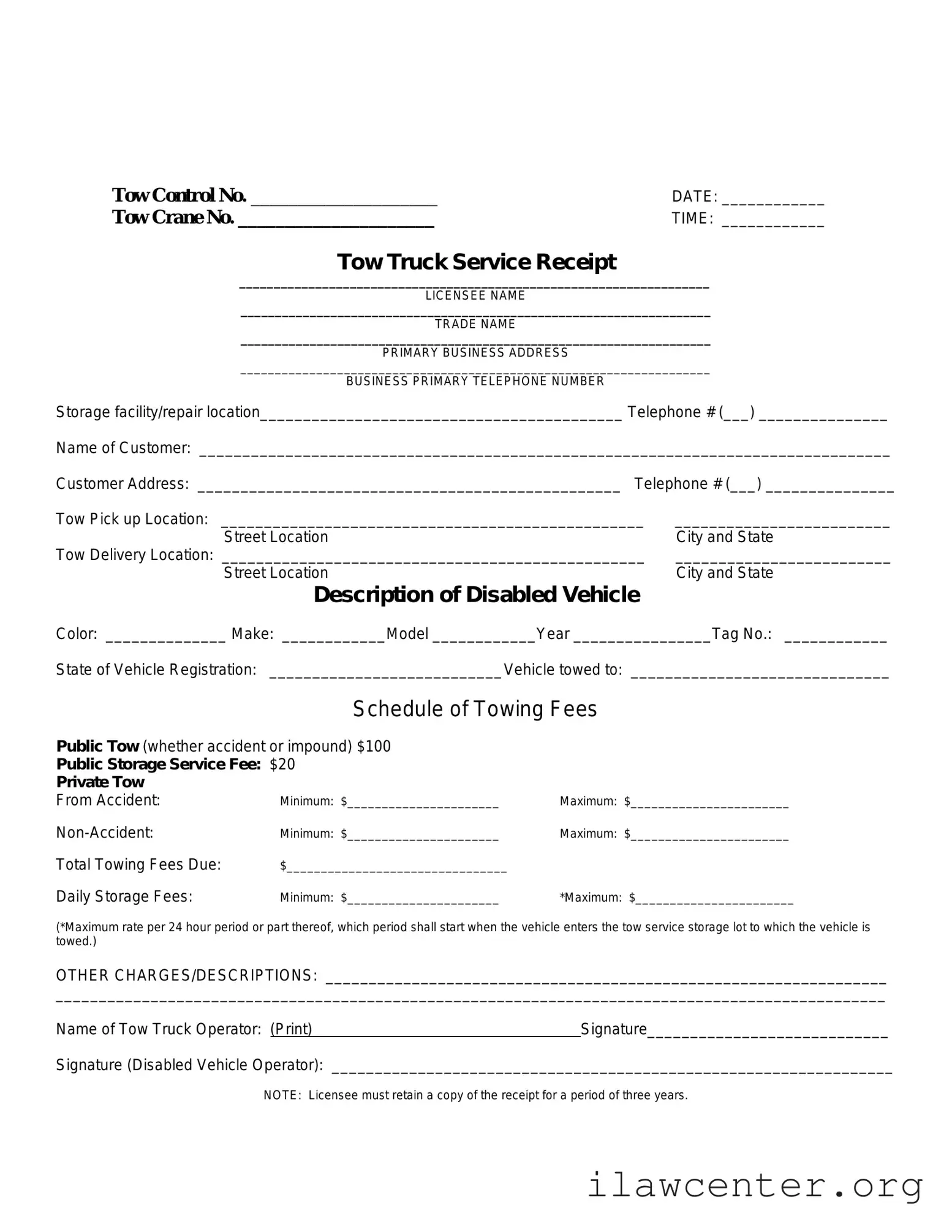
The Tow Truck Receipt form is a crucial document that records the details of a towing service transaction. It includes essential information such as the date, time, and location of the tow, along with the fees charged for the service. For accurate record-keeping and transparency, it's important to fill out this form correctly; start by clicking the button below.

Article Guide

When a vehicle is towed, it can be a stressful experience for the owner, and having a clear and comprehensive receipt is essential for both parties involved. The Tow Truck Receipt form serves as an important document that outlines the details of the towing service provided. This form captures critical information such as the date and time of the tow, the identification of the tow truck and operator, and the specific locations of both the pickup and delivery. Additionally, it includes essential details about the disabled vehicle, including its make, model, color, and registration information. The receipt also delineates the various fees associated with the towing service, which may include public towing fees, storage service fees, and any other applicable charges. Transparency is key, as the form ensures that customers are fully informed about the costs they may incur. It is also important to note that the licensee is required to retain a copy of this receipt for three years, which provides an added layer of accountability. By clearly documenting this transaction, the Tow Truck Receipt form not only protects the rights of the service provider but also offers peace of mind to the vehicle owner during a potentially challenging time.

Tow Truck Receipt Preview

____________________________________________________________________
____________________________________________________________________
____________________________________________________________________
____________________________________________________________________
________________________________________________________________________________________________
Tow Control No. ____________________ DATE: ____________
Tow Crane No. _____________________ TIME: ____________
Tow Truck Service Receipt
LICENSEE NAME
TRADE NAME
PRIMARY BUSINESS ADDRESS
BUSINESS PRIMARY TELEPHONE NUMBER
Storage facility/repair location__________________________________________ Telephone # (___) _______________
Name of Customer: ________________________________________________________________________________
Customer Address: _________________________________________________ Telephone # (___) _______________
Tow Pick up Location: _________________________________________________ _________________________
Street Location City and State
Tow Delivery Location: _________________________________________________ _________________________
Street Location City and State
Description of Disabled Vehicle
Color: ______________ Make: ____________Model ____________Year ________________Tag No.: ____________
State of Vehicle Registration: ___________________________Vehicle towed to: ______________________________
Schedule of Towing Fees
Public Tow (whether accident or impound) $100
Public Storage Service Fee: $20
Private Tow
From Accident:
Minimum: $______________________ Maximum: $_______________________
Non-Accident: Minimum: $______________________ Maximum: $_______________________
Total Towing Fees Due: $________________________________
Daily Storage Fees: Minimum: $______________________ *Maximum: $_______________________
(*Maximum rate per 24 hour period or part thereof, which period shall start when the vehicle enters the tow service storage lot to which the vehicle is
towed.)
OTHER CHARGES/DESCRIPTIONS: _________________________________________________________________
Name of Tow Truck Operator: (Print) Signature____________________________
Signature (Disabled Vehicle Operator): _________________________________________________________________
NOTE: Licensee must retain a copy of the receipt for a period of three years.

File Properties

Fact Name Description
Minimum Charges The receipt must indicate the minimum charges for towing services, which can vary by service provider.
Tow Control Number A unique Tow Control Number is required for tracking the tow service transaction.
Licensee Information The form requires the name, trade name, primary business address, and telephone number of the towing service provider.
Customer Details Information about the customer, including name, address, and telephone number, must be included on the receipt.
Vehicle Information Details about the disabled vehicle, such as color, make, model, year, tag number, and state of registration, are necessary.
Towing Fees Schedule The receipt outlines a schedule of towing fees, including public and private tow rates, as well as storage fees.
Retention Requirement According to state law, the licensee must retain a copy of the receipt for a period of three years.

Instructions on Utilizing Tow Truck Receipt

After you have gathered all necessary information, you can begin filling out the Tow Truck Receipt form. This form captures important details about the towing service provided. Ensure that all sections are completed accurately to avoid any issues later on.

  1. Start with the Minimum fields at the top of the form. Fill in the required amounts.
  2. Write the Tow Control No. in the designated space.
  3. Enter the DATE of the towing service.
  4. Fill in the Tow Crane No. next to the appropriate label.
  5. Record the TIME of the tow.
  6. Provide the LICENSEE NAME in the space provided.
  7. Next, fill in the TRADE NAME of the towing service.
  8. Complete the PRIMARY BUSINESS ADDRESS section with the business's address.
  9. Enter the BUSINESS PRIMARY TELEPHONE NUMBER.
  10. In the Storage facility/repair location section, write the location where the vehicle will be stored or repaired.
  11. Include the Telephone # for the storage facility.
  12. Fill in the Name of Customer and their Customer Address.
  13. Record the Telephone # for the customer.
  14. Provide the Tow Pick up Location details, including street, city, and state.
  15. Next, enter the Tow Delivery Location in the same format.
  16. Describe the Disabled Vehicle by filling in the color, make, model, year, tag number, and state of vehicle registration.
  17. List the Total Towing Fees Due and fill in the maximum amounts where indicated.
  18. Record the Daily Storage Fees with the minimum and maximum amounts.
  19. Write any OTHER CHARGES/DESCRIPTIONS that may apply.
  20. Finally, print the Name of Tow Truck Operator and provide their signature.
  21. Have the Disabled Vehicle Operator sign in the designated area.

Important Facts about Tow Truck Receipt

What is the purpose of the Tow Truck Receipt form?

The Tow Truck Receipt form serves as an official document that details the towing service provided to a customer. It includes essential information such as the date and time of the tow, the locations involved, and the details of the vehicle towed. This receipt is crucial for both the towing company and the customer, as it acts as proof of the transaction and outlines any fees associated with the service. Additionally, it helps ensure transparency and accountability in the towing process.

What information do I need to provide on the Tow Truck Receipt?

When filling out the Tow Truck Receipt, several key pieces of information are required. You will need to enter the date and time of the tow, the tow control number, and details about the towing company, including its name, trade name, address, and phone number. Customer information is also necessary, such as the name, address, and contact number of the individual whose vehicle is being towed. Finally, details about the vehicle itself, including its make, model, year, color, and registration information, must be included to ensure accurate record-keeping.

What are the fees associated with towing services?

The Tow Truck Receipt outlines various fees associated with towing services. For public tows, whether due to an accident or impoundment, the minimum fee is typically set at $100. Additionally, there may be a public storage service fee of $20. If the tow is private, the fees may vary based on the circumstances, such as whether it is an accident or a non-accident tow. Daily storage fees also apply, which have minimum and maximum rates, starting from the time the vehicle enters the storage lot. These fees should be clearly detailed on the receipt.

How long should I keep the Tow Truck Receipt?

It is important for both the towing company and the customer to retain a copy of the Tow Truck Receipt for a period of three years. This retention period is essential for record-keeping and may be necessary for any future disputes or inquiries regarding the towing service. Keeping this document can also help in case of insurance claims or legal matters related to the tow.

What should I do if I have a dispute regarding the towing service?

If a dispute arises regarding the towing service, the first step is to review the Tow Truck Receipt carefully. This document contains all the pertinent details about the transaction, including fees and services rendered. If there are discrepancies or concerns, contact the towing company directly to discuss the issue. If the matter cannot be resolved through direct communication, consider seeking legal advice or contacting local authorities to understand your rights and options regarding the dispute.

Common mistakes

When filling out the Tow Truck Receipt form, people often make mistakes that can lead to confusion or disputes later on. One common error is failing to complete the licensee name and trade name sections. These details are crucial for identifying the towing company and ensuring accountability. Without this information, it can be difficult to trace back any issues or questions regarding the service.

Another frequent mistake involves the customer address and telephone number fields. Incomplete or incorrect information can hinder communication. If the customer needs to be contacted regarding their vehicle, having the wrong details can create significant delays and frustration. Always double-check this information before submitting the form.

Many people overlook the importance of accurately recording the tow pick-up and delivery locations. If these addresses are incorrect, it can lead to significant problems, such as the vehicle being taken to the wrong location. This not only complicates the retrieval process but can also result in additional fees for the customer. Clear and precise details are essential.

Lastly, individuals sometimes neglect to fill in the total towing fees due section completely. This includes both the public tow fees and any additional charges. Omitting this information can lead to disputes over payment later on. It’s important to ensure all fees are clearly stated to avoid any misunderstandings when the customer comes to pay.

Documents used along the form

When handling towing services, several documents often accompany the Tow Truck Receipt form. Each of these documents plays a crucial role in ensuring transparency and compliance with regulations. Here’s a brief overview of these forms.

  • Towing Authorization Form: This document gives the tow truck operator permission to tow the vehicle. It must be signed by the vehicle owner or an authorized representative.
  • Vehicle Release Form: This form is used when the vehicle owner wants to retrieve their vehicle from the tow yard. It usually requires the owner’s signature and may include identification verification.
  • Incident Report: This report details the circumstances surrounding the tow, especially if it was due to an accident. It can include information from law enforcement if applicable.
  • Storage Agreement: This document outlines the terms and conditions for storing the vehicle at the tow yard. It specifies fees and responsibilities of both the storage facility and the vehicle owner.
  • Payment Receipt: This is a separate receipt that confirms payment has been made for towing and storage services. It serves as proof of payment for the vehicle owner.
  • Inspection Report: This report documents the condition of the vehicle at the time of towing. It helps protect both the tow company and the vehicle owner from disputes regarding damage.
  • Insurance Claim Form: If the tow was due to an accident, this form may be needed for insurance purposes. It allows the vehicle owner to file a claim for damages or towing costs.

Understanding these documents can help ensure a smooth process when dealing with towing services. Keep copies of all relevant paperwork for your records to avoid any future complications.

Similar forms

The Tow Truck Receipt form shares similarities with several other documents commonly used in transportation and service industries. Here are six such documents:

  • Invoice: Like the Tow Truck Receipt, an invoice details services rendered and includes payment information. Both documents serve as proof of transaction for the customer and the service provider.
  • Work Order: A work order outlines the tasks to be completed and often includes customer information and service details. Similar to the Tow Truck Receipt, it helps track the services provided and ensures accountability.
  • Service Agreement: This document specifies the terms of service between the provider and the customer. It is similar to the Tow Truck Receipt in that both establish expectations and responsibilities regarding the service rendered.
  • Delivery Receipt: A delivery receipt confirms the delivery of goods or services. Much like the Tow Truck Receipt, it provides verification that the service was completed and accepted by the customer.
  • Estimate: An estimate provides a cost projection for services before they are rendered. It shares commonalities with the Tow Truck Receipt, as both documents communicate pricing and service details to the customer.
  • Payment Receipt: This document confirms that payment has been made for services. Similar to the Tow Truck Receipt, it serves as a record for both the customer and the service provider, indicating the completion of a financial transaction.

Dos and Don'ts

When filling out the Tow Truck Receipt form, it’s essential to be thorough and accurate. Here’s a list of things to do and avoid to ensure the process goes smoothly.

  • Do fill in all required fields completely.
  • Do double-check the tow control number for accuracy.
  • Do clearly write the date and time of the tow.
  • Do provide the correct address for both the pickup and delivery locations.
  • Do include a detailed description of the disabled vehicle, including its color, make, model, year, and tag number.
  • Do specify the type of tow (public or private) and the corresponding fees.
  • Do ensure the customer’s information is accurate and complete.
  • Do sign the receipt where required.
  • Do keep a copy of the receipt for your records.
  • Do communicate any additional charges clearly.
  • Don't leave any fields blank unless they are optional.
  • Don't use abbreviations that may confuse the reader.
  • Don't forget to include the storage facility address if applicable.
  • Don't overlook the importance of legible handwriting.
  • Don't forget to indicate the state of vehicle registration.
  • Don't misrepresent the nature of the tow (accident vs. non-accident).
  • Don't ignore the maximum and minimum fee requirements.
  • Don't fail to provide the tow truck operator's name and signature.
  • Don't neglect to inform the customer about the retention policy for the receipt.
  • Don't forget to check for any additional notes or instructions on the form.

Misconceptions

Misconceptions about the Tow Truck Receipt form can lead to confusion for both customers and towing companies. Here are six common misunderstandings:

  • The receipt is not necessary. Many people believe that they don’t need to keep the receipt. In reality, the towing company must retain a copy for three years, and customers should keep theirs for potential disputes or claims.
  • All towing fees are the same. Some think that towing fees are standardized. However, fees can vary based on factors like the type of tow (public or private) and the circumstances surrounding the tow.
  • Storage fees only apply after a certain time. It’s a common belief that storage fees don’t kick in immediately. In fact, the maximum daily storage fee starts accruing as soon as the vehicle enters the storage lot.
  • The receipt is just a formality. Some view the receipt as a mere formality. In truth, it serves as an important legal document that outlines services rendered and costs incurred.
  • Only the towing company needs a copy of the receipt. It’s a misconception that only the towing company retains the receipt. Customers should also keep their copies for their records and potential future needs.
  • The information on the receipt is optional. Many think that filling out the receipt can be done casually. However, all sections, including details about the vehicle and services provided, are crucial for clarity and legal purposes.

Key takeaways

  • Always ensure that you fill in the minimum and maximum charges clearly. This helps avoid confusion later on.

  • Accurate documentation is crucial. Record the Tow Control Number, date, and time of the tow to maintain a reliable record.

  • Clearly state the licensee name and trade name. This identifies the towing service and builds trust with customers.

  • Include the primary business address and telephone number for easy communication. Customers may need to reach you for follow-up questions.

  • Document the customer's information accurately. This includes their name, address, and phone number, which is vital for billing and communication.

  • Provide detailed descriptions of the disabled vehicle, including color, make, model, year, and tag number. This ensures clarity and can prevent disputes.

  • Finally, remember to keep a copy of the receipt for at least three years. This is a legal requirement and protects your business in case of future inquiries.