Transamerica 401K Withdrawal PDF Template

Transamerica 401K Withdrawal PDF Template

The Transamerica 401K Withdrawal form is a document used by participants to request a distribution from their 401(k) retirement plan. This form must be completed accurately and submitted for processing, ensuring all necessary signatures are obtained. To get started on your withdrawal, click the button below to fill out the form.

Article Guide

The Transamerica 401(k) Withdrawal form is a crucial document for individuals seeking to access their retirement savings. It encompasses several key sections that guide participants through the withdrawal process. Initially, users must provide personal information, including their name, Social Security number, and employment details. The form also requires participants to specify the reason for their withdrawal, which can range from termination of employment to retirement or disability. Importantly, the form distinguishes between Traditional and Roth 401(k) accounts, offering tailored options for each type. Participants can choose to roll over their funds into an IRA or receive a cash distribution, with clear instructions on tax implications and potential penalties. Additionally, if married, spousal consent may be necessary, particularly if annuity options are involved. To ensure the process runs smoothly, all required signatures, including those from the plan administrator, must be obtained before submission. By carefully following the instructions outlined in the form, individuals can effectively navigate their 401(k) withdrawal and make informed decisions about their retirement funds.

Transamerica 401K Withdrawal Preview

2220 Distribution Request - ISC MEP Page
1
of
6
(2/16/23)
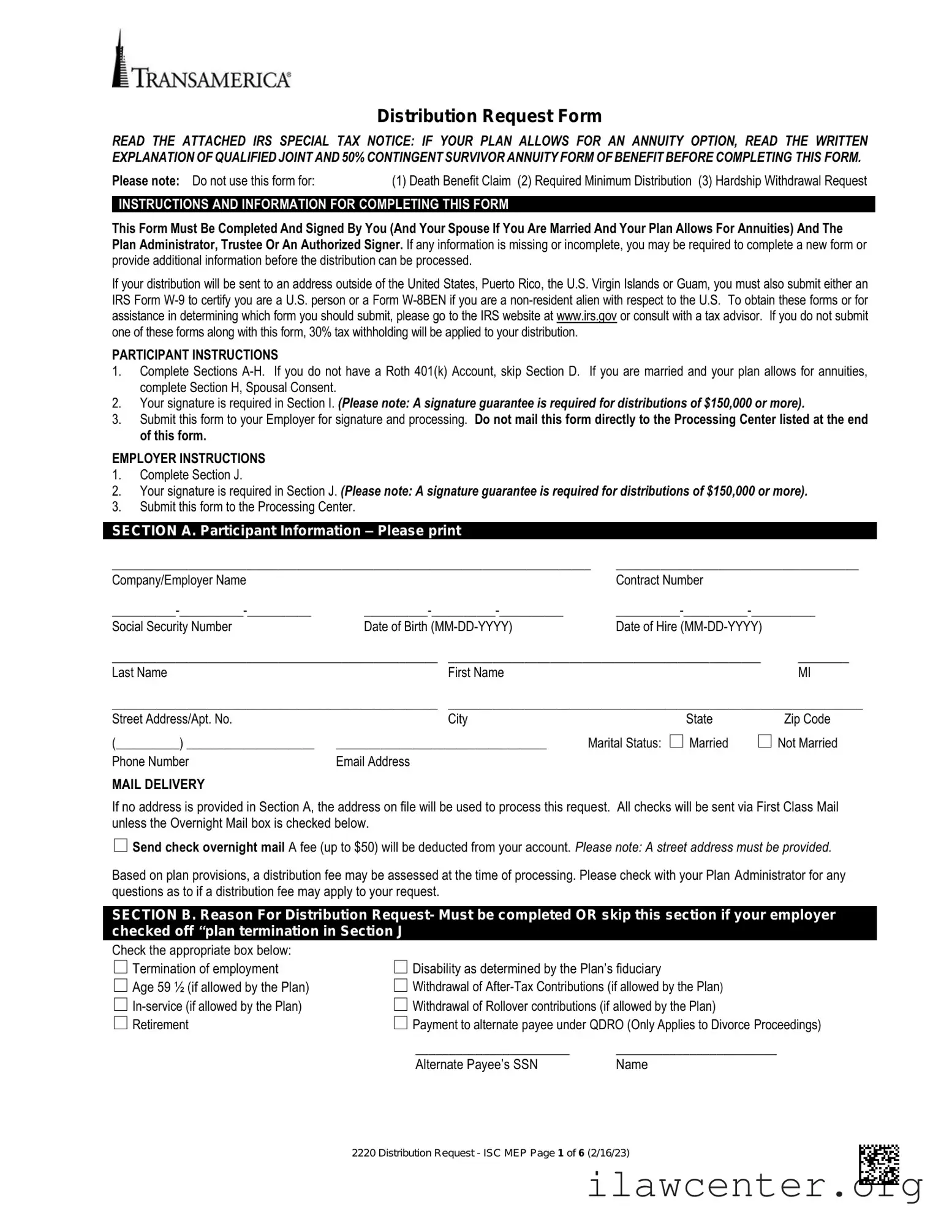
Distribution Request Form
READ THE ATTACHED IRS SPECIAL TAX NOTICE: IF YOUR PLAN ALLOWS FOR AN ANNUITY OPTION, READ THE WRITTEN
EXPLANATION OF QUALIFIED JOINT AND 50% CONTINGENT SURVIVOR ANNUITY FORM OF BENEFIT BEFORE COMPLETING THIS FORM.
Please note: Do not use this form for: (1) Death Benefit Claim (2) Required Minimum Distribution (3) Hardship Withdrawal Request
INSTRUCTIONS AND INFORMATION FOR COMPLETING THIS FORM
This Form Must Be Completed And Signed By You (And Your Spouse If You Are Married And Your Plan Allows For Annuities) And The
Plan Administrator, Trustee Or An Authorized Signer. If any information is missing or incomplete, you may be required to complete a new form or
provide additional information before the distribution can be processed.
If your distribution will be sent to an address outside of the United States, Puerto Rico, the U.S. Virgin Islands or Guam, you must also submit either an
IRS Form W-9 to certify you are a U.S. person or a Form W-8BEN if you are a non-resident alien with respect to the U.S. To obtain these forms or for
assistance in determining which form you should submit, please go to the IRS website at www.irs.gov or consult with a tax advisor. If you do not submit
one of these forms along with this form, 30% tax withholding will be applied to your distribution.
PARTICIPANT INSTRUCTIONS
1. Complete Sections A-H. If you do not have a Roth 401(k) Account, skip Section D. If you are married and your plan allows for annuities,
complete Section H, Spousal Consent.
2. Your signature is required in Section I. (Please note: A signature guarantee is required for distributions of $150,000 or more).
3. Submit this form to your Employer for signature and processing. Do not mail this form directly to the Processing Center listed at the end
of this form.
EMPLOYER INSTRUCTIONS
1. Complete Section J.
2. Your signature is required in Section J. (Please note: A signature guarantee is required for distributions of $150,000 or more).
3. Submit this form to the Processing Center.
SECTION A. Participant Information Please print
___________________________________________________________________________ ______________________________________
Company/Employer Name Contract Number
__________-__________-__________ __________-__________-__________ __________-__________-__________
Social Security Number Date of Birth (MM-DD-YYYY) Date of Hire (MM-DD-YYYY)
___________________________________________________ _________________________________________________ ________
Last Name First Name MI
___________________________________________________ _________________________________________________________________
Street Address/Apt. No. City State Zip Code
(__________) ____________________ _________________________________ Marital Status: Married Not Married
Phone Number Email Address
MAIL DELIVERY
If no address is provided in Section A, the address on file will be used to process this request. All checks will be sent via First Class Mail
unless the Overnight Mail box is checked below.
Send check overnight mail
A fee (up to $50) will be deducted from your account. Please note: A street address must be provided.
Based on plan provisions, a distribution fee may be assessed at the time of processing. Please check with your Plan Administrator for any
questions as to if a distribution fee may apply to your request.
SECTION B. Reason For Distribution Request- Must be completed OR skip this section if your employer
checked off plan termination in Section J
Check the appropriate box below:
Termination of employment
Disability as determined by the Plans fiduciary
Age 59 ½ (if allowed by the Plan)
Withdrawal of After-Tax Contributions (if allowed by the Plan)
In-service (if allowed by the Plan)
Withdrawal of Rollover contributions (if allowed by the Plan)
Retirement
Payment to alternate payee under QDRO (Only Applies to Divorce Proceedings)
_______________________ ________________________
Alternate Payees SSN Name
2220 Distribution Request - ISC MEP Page
2
of
6
(2/16/23)
SECTION C. Form of Payment for Traditional 401(k) Account Only choose one of the three options
¹
Option 1 (Rollover) I am requesting a Direct Rollover of
my Traditional 401(k) account.
If Age 59 ½, In-service or Withdrawal of Rollover Contributions is selected in Section B, please indicate the amount to be rolled
over $__________________ (or leave blank if you wish to have your entire account distributed).
Direct Rollover to (Select Only One):
AN IRA OFFERED THROUGH Transamerica (Minimum rollover amount is $20,000). If you are interested in the Rollover IRA option
through Transamerica, call (866) 691-0030 to learn more and to establish an account. An IRA account number is required before the
rollover can be processed.
AN ELIGIBLE RETIREMENT PLAN (401(a), 401(k), 403(b), and Governmental 457)
AN IRA
NEW ACCOUNT INFORMATION: MAILING ADDRESS:
IRA Account Number (Required) / Plan Name Name of Trustee or Custodian for the New Plan or IRA
Make Check Payable To: Address Number & Street
City State Zip Code
______________________________________________________________________________________________________________________
¹
Option 2 (Combination) I am requesting a distribution of my entire Traditional 401(k) account to be paid partially to me and partially as a
Direct Rollover. I understand that the portion payable to me may be subject to 20% federal income tax withholding unless I select a
percentage greater than 20% on IRS Form W-4R.
Distribute my Traditional 401(k) account based on the following percentages:
__________% paid directly to me, and
__________% applied to the Direct Rollover Account indicated below.
The above two percentages must equal 100%
Direct Rollover to (Select Only One):
AN IRA OFFERED THROUGH Transamerica (Minimum rollover amount is $20,000). If you are interested in the Rollover IRA option
through Transamerica, call (866) 691-0030 to learn more and to establish an account. An IRA account number is required before the
rollover can be processed.
AN ELIGIBLE RETIREMENT PLAN (401(a), 401(k), 403(b), and Governmental 457)
AN IRA
NEW ACCOUNT INFORMATION: MAILING ADDRESS:
IRA Account Number (Required) / Plan Name Name of Trustee or Custodian for the New Plan or IRA
Make Check Payable To: Address Number & Street
City State Zip Code
______________________________________________________________________________________________________________________
Option 3 (Cash) I am requesting a distribution of
my Traditional 401(k) account. I am
not
electing a Direct Rollover of any portion of
the distribution. I understand the check will be made payable to me and that the amount payable to me may be subject to 20%
federal income tax withholding unless I select a percentage greater than 20% on IRS Form W-4R.
If Age 59 ½, In-service or Withdrawal of Rollover Contributions is selected in Section B, please indicate the amount to be paid
directly to you $__________________ (or leave blank if you wish to have your entire account distributed).
______________________________________________________________________________________________________________________
¹
DIRECT ROLLOVER
In a Direct Rollover, an eligible rollover distribution is paid from your retirement plan directly to an IRA or your new Employer's 401(a), 401(k), 403(b) or governmental 457 Plan. An
IRS Form 1099-R will still be completed and submitted to the IRS; however, no federal or state income tax is withheld from amounts directly rolled over. The Direct Rollover check will
be made payable to the IRA/plan trustee or custodian for the benefit of the participant or alternate payee unless otherwise indicated above.
2220 Distribution Request - ISC MEP Page
3
of
6
(2/16/23)
SECTION D. Form of Payment for a Roth 401(k) Account Complete only if your plan allows for Roth
Contributions. Only choose one of the three options
¹
Option 1 (Rollover) I am requesting a Direct Rollover of
my Roth 401(k) account.
If Age 59 ½, In-service or Withdrawal of Rollover Contributions is selected in Section B, please indicate the amount to be rolled
over $__________________ (or leave blank if you wish to have your entire account distributed).
Direct Rollover to (Select Only One):
A ROTH IRA OFFERED THROUGH Transamerica (Minimum rollover amount is $20,000). If you are interested in the Rollover IRA
option through Transamerica, call (866) 691-0030 to learn more and to establish an account. An IRA account number is required
before the rollover can be processed.
A DESIGNATED ROTH ACCOUNT (401(k), 403(b)) or ROTH IRA
NEW ACCOUNT INFORMATION: MAILING ADDRESS:
Roth IRA Account Number (Required) / Plan Name Name of Trustee or Custodian for the New Roth 401(k) or Roth IRA
Make Check Payable To: Address Number & Street
City State Zip Code
______________________________________________________________________________________________________________________
¹
Option 2 (Combination) I am requesting a distribution of my entire Roth 401(k) account to be paid partially to me and partially as a Direct
Rollover. I understand that the portion payable to me may be subject to 20% federal income tax withholding unless I select a
percentage greater than 20% on IRS Form W-4R.
Distribute my Roth 401(k) account based on the following percentages:
__________% paid directly to me, and
__________% applied to the Direct Rollover Account indicated below.
The above two percentages must equal 100%
Direct Rollover to (Select Only One):
A ROTH IRA OFFERED THROUGH Transamerica (Minimum rollover amount is $20,000). If you are interested in the Rollover IRA
option through Transamerica, call (866) 691-0030 to learn more and to establish an account. An IRA account number is required
before the rollover can be processed.
A DESIGNATED ROTH ACCOUNT (401(k), 403(b)) or ROTH IRA
NEW ACCOUNT INFORMATION: MAILING ADDRESS:
IRA Account Number (Required) / Plan Name Name of Trustee or Custodian for the New Plan or IRA
Make Check Payable To: Address Number & Street
City State Zip Code
______________________________________________________________________________________________________________________
Option 3 (Cash) I am requesting a distribution of
my Roth 401(k) account. I am
not
electing a Direct Rollover of any portion of the
distribution. I understand the check will be made payable to me and that the amount may be subject to 20% federal income tax
withholding unless I select a percentage greater than 20% on IRS Form W-4R.
If Age 59 ½, In-service or Withdrawal of Rollover Contributions is selected in Section B, please indicate the amount to be paid
directly to you $__________________ (or leave blank if you wish to have your entire account distributed).
______________________________________________________________________________________________________________________
¹
DIRECT ROLLOVER
In a Direct Rollover, an eligible rollover distribution is paid from your retirement plan directly to an IRA or your new Employer's 401(a), 401(k), 403(b) or governmental 457 Plan. An
IRS Form 1099-R will still be completed and submitted to the IRS; however, no federal or state income tax is withheld from amounts directly rolled over. The Direct Rollover check will
be made payable to the IRA/plan trustee or custodian for the benefit of the participant or alternate payee unless otherwise indicated above.
For participants required to take a minimum distribution during the current year that was not satisfied, please note the following: Your required minimum distribution
(RMD) for the current year will need to be completed and made payable to you prior to the processing of your direct rollover request.
2220 Distribution Request - ISC MEP Page
4
of
6
(2/16/23)
SECTION E. Annuity Request (Not applicable to vested account under $5,000 or if your plan does not offer
annuities)
Skip this section if you made an election in Section C or D.
By selecting this option your entire account balance will be distributed in order to purchase the annuity
Annuity: If the plan offers annuities as a form of benefit payment, I elect payment as a monthly annuity with payments to commence
_______________________. Upon my death, my spouse’s payments should be__________% (from 50% to 100%) of my payments. My
spouse’s date of birth is______/______/______. Such annuity will be a Joint and Contingent Survivor Annuity if I am married and a Single
Life Annuity if I am not married. I also understand that if I am married, my spouse need not consent to this election if I choose a Qualified
Joint and Contingent Survivor Annuity (“QJSA”).
I understand that if I request a periodic payment payable over a period of 10 years or more, withholding will be based on a filing status of
single with no adjustments unless I make a different election on IRS Form W-4P.
SECTION F. Outstanding Loan Payoff Instructions
Skip this section if you do not have an outstanding loan or
are requesting an In-Service Withdrawal, Withdrawal of After-Tax Contributions, 59 ½ Withdrawal or a QDRO.
If you have an outstanding loan please payoff the loan in full prior to submitting this Distribution Form. Submit a completed Distribution Form after
you have submitted the loan payoff amount and the loan is paid in full.
Your outstanding loan balance will be defaulted and become taxable to you if the loan payoff is not processed prior to receiving a completed
Distribution Form.
SECTION G. Income Tax Withholding
The income tax withholding requirements vary depending on whether or not the distribution requested is an eligible rollover distribution. Please see
the attached Special Tax Notice for the definition of eligible rollover distribution and a detailed explanation of the federal income tax withholding rules.
If you request a Direct Rollover, no federal income tax will be withheld from the amount directly rolled over.
FEDERAL INCOME TAX
Withholding is determined by the type of distribution and if you make an independent election to have a different rate apply. If you do not make a
separate election, the following default withholding will apply:
Eligible Rollover Distributions: If you request a Direct Rollover, no federal income tax will be withheld from the amount directly rolled over. If you
request a cash distribution, 20% withholding will apply unless you select a percentage greater than 20% on IRS Form W-4R.
Periodic Payments: If you request a periodic payment payable over a period of 10 years or more, withholding will be based on a filing
status of single with no adjustments unless you make a different election on IRS Form W-4P.
The IRS Form W-4R and IRS Form W-4P can be found at https://www.irs.gov/pub/irs-pdf/fw4r.pdf and https://www.irs.gov/pub/irs-pdf/fw4p.pdf or
from www.irs.gov. If the appropriate form is not included, the default withholding, as described above, will apply.
STATE INCOME TAX
The state of withholding will be presumed to be the state that has been provided in your address as previously provided on the form. Tax
withholding rules vary by state. More likely than not, your home state (a) requires a minimum withholding amount when federal withholding is
required; (b) requires withholding unless you can opt out; (c) allows a voluntary withholding election; or (d) does not have state income tax and
does not permit withholding. Unless requested, state withholding will not be deducted for states with voluntary withholding. Some states require
the completion of their State Withholding Certificate to make an independent election. Consult with your tax advisor or state revenue department
to obtain the most up-to-date information and to confirm if your state's withholding form is required to be submitted. If permitted by your state,
please select one of the options below.
NO, I ELECT NOT TO HAVE STATE INCOME TAX WITHHELD
YES, I ELECT TO HAVE _____ % AS STATE INCOME TAX WITHHELD
YES, I ELECT TO HAVE $______ (WHOLE DOLLAR ONLY) AS STATE INCOME TAX WITHHELD
YES, I ELECT TO HAVE STATE INCOME TAX WITHHELD USING THE DEFAULT FILING STATUS AS PER MY STATE OF RESIDENCE
WITHHOLDING CERTIFICATE (Note: ONLY CHECK THIS BOX FOR PERIODIC PAYMENTS WITHHOLDING).
NOTE: Withholding may be greater if the amount you select is less than the minimum required. Withholding will be processed for states that require
withholding or do not allow you to opt out without your state's form.
2220 Distribution Request - ISC MEP Page
5
of
6
(2/16/23)
SECTION H. Spousal Consent
Check with your Employer/Plan Administrator or Summary Plan Description to determine whether your plan is subject to spousal consent
requirements. If spousal consent is required, complete this section. If your plan is not subject to spousal consent requirements, skip to Section I.
Please note: You must have your spouse’s signature notarized or have a plan representative witness your spouse’s signature if your vested
account balance is greater than $5,000 and your plan provides for joint and survivor annuities. However, if your vested account balance is less than
$5,000 spousal consent is not required.
Spousal Consent
I, the undersigned spouse of the participant, have read the “Special Tax Notice Regarding Payments From Qualified Plans” provided to me and
understand the effects of the waiver. I understand that federal law requires that the retirement benefit of my spouse must be paid under a Qualified
Joint and Survivor Annuity Form as described in the attached “Special Tax Notice Regarding Payments From Qualified Plans,” unless I consent
otherwise in writing to another benefit form. I hereby consent to the waiver of the annuity and consent to the form of benefit elected by my spouse.
Signature of Participant’s Spouse:_____________________________________________________________ Date: ___________________
Statement of Plan Representative or Notary Public
The spouse whose signature I have witnessed is known to me and signed this form in my presence.
Plan Representative:_____________________________________ ___________________________________ Date: ___________________
Notary Public Signature:_____________________________________________________________________ Date: ___________________
PLACE SEAL HERE (if applicable)
SECTION I. Participant Signature
A request for a withdrawal of $150,000 or more requires that this completed form be stamped with a medallion signature guarantee. You can obtain a
medallion signature guarantee from a financial institution such as a commercial bank, savings bank, credit union, or broker-dealer. A notary is NOT a
medallion signature guarantee.
The original form, stamped with the medallion signature guarantee, must be presented to your Plan Administrator for approval.
Please note, for this purpose, the value of the withdrawal is based on the amount available (for full distributions and rollovers) on the date of processing
and multiple withdrawal requests within a 14-day period that total $150,000 or more will be subject to the medallion signature guarantee requirements.
PARTICIPANT SIGNATURE
*Participants will receive the price as of market close on the day that all required and completed forms are received by Transamerica in good
order. Forms that are sent in good order, but received after the close of market, will be processed based on the next business day’s market close.
*Processing usually takes 1-4 business days, but can take several days longer if invested in only fixed funds; however, as noted above, pricing is
based on the day that forms are received in good order.
My signature acknowledges that I have read, understand and agree to all the terms of this Distribution Request form, and affirm that all information that
I have provided is true and correct. Further, I acknowledge that I have received the “Special Tax Notice Regarding Payments From Qualified Plans”
and other required notices. The above information is true and correct to the best of my knowledge. I further understand that I may revoke this
election at any time prior to the distribution taking place.
___________________________________________________________________ _______________________
Signature of Participant Date
PARTICIPANT: RETURN COMPLETED FORM TO YOUR PLAN ADMINISTRATOR FOR PROCESSING
Signature Guarantee Place Medallion Stamp Below (Required if distribution is $150,000 or more.)
Participants Distribution is $150,000 or more
Medallion Signature Guarantee Place Medallion Stamp Below
2220 Distribution Request - ISC MEP Page
6
of
6
(2/16/23)
SECTION J. For Completion by Plan Administrator, Trustee Or Authorized Signer Only
______________________________________________________________________________________________________________________
Plan Name
____________________ _________________________ ____________________ ___________________________________
Contract Number Sub ID/Division # (if applicable) Participants SSN # Participants Termination Date (if applicable)
The Participant is entitled to a vested benefit of ____________% of company contributions.
Please refer to your Plan Document for the vesting schedule.
Is payment of this benefit subject to Plan Termination? No Yes
By signing below, I hereby authorize Transamerica to process the distribution described in this form. This request is in compliance with plan
provisions. If spousal consent is not provided, then in accordance with the terms and provisions of the plan and under the current law, spousal
consent is not required for payment of the requested benefit.
If this request is for a disability distribution, I certify that the participant meets the requirements of Section 72(m)(7).
Only submit this form after final contributions and loan repayments have been processed for termination distributions.
Once this form has been completed with all of the necessary information and required signatures, please forward to the Processing Center for
processing.
This form cannot be processed without the Plan Administrator, Trustee or Authorized Signer’s signature.
Be sure to keep a copy for your records.
___________________________________________________________________ _______________________
By: Signature of MEP Plan Administrator, Trustee or Authorized Signer Date
(Please verify that all information in Section A is completed)
___________________________________________________________________ _______________________
Print Name of MEP Plan Administrator, Trustee or Authorized Signer Date
FOR PLAN ADMINISTRATOR USE ONLY MAIL TO:
Processing Center, 6400 C Street SW, Cedar Rapids, IA 52499 or Fax to 833-200-9987
ExplanationofDistributionOptions
Thisinformationonlyappliestodefinedcontributionretirementplansthatarenotsubjecttothejointandsurvivorannuityrequirements.The
informationprovidedinthisExplanationisintendedtobegeneralinnature;notallplanprovisionsandoptionsareavailableunderyourplan. To
confirmthespecifictermsofyourplan,pleaserefertoyourSummaryPlanDescriptionorcontactyourPlanAdministrator.
General
Asaplanparticipant,youmayhavetherighttoreceivebenefitswhenyoureachyournormalretirementageundertheplanorterminate
employment,providedyourplanaccounthasmoniesinitavailableforyourwithdrawal.Ifyourplanallowsinservicewithdrawalsforhardshipor
uponyourattainmentofage591/2orforanyotherreasons,youmayalsoelecttoreceivebenefitpaymentsifyouhavesatisfiedtheapplicable
planrequirements.
Pleasenote,theplanmayprovidethatifthecashvalueofyourbenefitislessthanaspecifiedamount(generally$5,000orless,ifany),yourbenefit
willbepaidtoyouinasinglesum,orautomaticallyrolledovertoanIRA(ifrequiredbyfederallaw)unlessyouelectotherwise.
Undertheprovisionsoftheplan,youmayrequestthatyourbenefitbepaidundertheoptionalformofbenefitwhichisbestsuitedtoyour
particularneedsandcircumstances.Theamountofmonthlyincomepayablewilldependupontheformofpaymentelected,yourage(andyour
designatedbeneficiary’sage)aswellasyourvestedaccountbalanceasofyourretirementdate,or,ifearlier,dateofthiselection.
SummaryofFormsofBenefit(Availabilityofthefollowingoptionswilldependuponplanprovisions)
SingleSumPayment:Thevestedbalanceinyouraccountwillbepaidinasinglesum.
InstallmentPayment(specificlimitationsmayapplytothisoptionunderthetermsofyourplan): Thevestedbalanceinyouraccountwillbepaid
inmonthly,quarterly,semiannualorannualinstallmentpayments.
PartialPayment:Thevestedbalanceinyouraccountwillbepaidinpartialpayments.
FixedPeriodCertainAnnuity‐No“Life”Guarantee: Amonthlyincomeispayabletoyoubeginningonyourbenefitstartingdate,inequal
installmentsoveraspecifiedperiodofnotlessthan12normorethan240months.Ifyoudieduringthespecifiedperiodelected,theincomewill
becontinuedfortheremainderofthespecifiedperiodtoyourdesignatedbeneficiary.Youmayelectthatsuchpaymenttoyourbeneficiaryistobe
madeinasinglesum.
StraightLifeAnnuity‐No“Years”Certain: Alifetimemonthlyincomeispayabletoyou,beginningonyourbenefitstartingdateandcontinuing
untilthelastpaymentduebeforeyourdeath.Ifyoudieafteryourbenefitstartingdate,therewillbenodeathbenefitpayable.Ifyouaremarried,
youmayelectthisformofpaymentonlywithyourspouse’sconsent.
LifeAnnuitywithPeriodCertain:Alifetimemonthlyincomeispayabletoyou,beginningonyourbenefitstartingdateandcontinuinguntilthelast
paymentduebeforeyourdeath.Ifyoudieduringtheperiodcertainwhichbeginsonyourbenefitstartingdate,themonthlyincomewillbe
continuedtoyourdesignatedbeneficiaryfortheremainderoftheperiodcertain.Thebeneficiarymayelectthatsuchpaymentbemadeinalump
sum.
JointandSurvivorAnnuity:Alifetimemonthlyincomeispayabletoyou,beginningonyourbenefitstartingdateandcontinuinguntilthelast
paymentduebeforeyourdeath.Uponyourdeath,yourjointannuitantwillreceiveamonthlyincomeforlifeequalto,dependingontheprovisions
ofyourplan,atleastonehalf(andnotmorethan100%)oftheamountofmonthlyincomeyouwerereceiving.Ifyouaremarried,yourjoint
annuitantmustbeyourspouseunlessyourspouseconsentstoanotherannuitantonaformprovidedbythePlanAdministrator.
ElectionofAnnuityBenefit
Ifyouaremarried(andyourplanprovidesannuitiesasaformofbenefit)andyouwishtoelectanannuityformofbenefit,otherthanaJointand
SurvivorAnnuitywithyourspouseasyourjointannuitant,yourspousemustconsenttoyourelection,inwriting,witnessedbyyourPlan
AdministratororaNotaryPublic,duringthe180dayperiodbeforeyourbenefitstartingdate.Ifyouaremarriedandwishtodesignateaperson
otherthanyourspouseasyourjointannuitant,youmustobtainyourspouse’swrittenconsenttoyourbeneficiarydesignation.(Ifestablishedto
thesatisfactionofyourPlanAdministratorthatyourspousecannotbelocated,spousalconsentisnotrequired.) Yourspouse’sconsentmustbe
madeonaspecialformavailablefromyourPlanAdministrator.
Page 6 of 17
2220 Distribution Request - ISC MEP
September
2020
ComparisonofFormsofBenefit
Theseexamplescomparebenefitsunderformsofpaymentthatmaybeavailableundertheplan.Theseexamplesarebasedonspecificassumptions
andcertaininterestratesandmortalityrates.Theamountsshownareestimates,providedtoillustratethedifferencesamongthevariousoptions
andarenotintendedtorepresenttheactualamountpayabletoyou.Uponyourrequest,amoreprecisecalculationwillbeprovided.Yourrequest
shouldbesenttotheaddressbelowifinwriting.Ifyouwishtocallinyourrequest,seethenumberprovidedbelowforyoutocall.
Assumeaparticipantretiringatage65hasabeneficiaryofthesameageanda$200,000accountbalance.
Age65Commencement
FormofBenefit Benefit toParticipant
BenefittoSpouse/BeneficiaryAfter
ParticipantsDeath
QualifiedJointandSurvivorAnnuity
50% $ 914.31permonth $457.16permonth
66.7% $890.56permonth $593.71permonth
75% $879.15permonth $659.36permonth
100% $846.58permonth $846.58permonth
StraightLifeAnnuity $993.76permonth
LifeAnnuitywith5YearsCertain $988.91permonth
LifeAnnuitywith10YearsCertain $974.01permonth
PeriodCertain5 $3,392.05 permonth
PeriodCertain10Years $1,814.58permonth
Anyannuityelectedwillbeprovidedbypurchasinganannuitycontractfromaninsurancecompanywithyourvestedaccountbalanceunder
theplan.Dollaramountsshowndonotreflectanyrequiredtaxwithholding,ongoingaccountexpenses,orpossiblefeeschargedbytheannuity
provider.
ElectionRights
Youhaveatleast30daystoconsiderwhichformofbenefitpaymentyouwanttoelect.If,afterreceivingthisExplanation,youaffirmativelyelect
adistribution,yourdistributionmaybemadelessthan30daysfromthedatethisExplanationwasgiventoyou.Ifyouelectanannuityformof
payment:
Yourdistributionelectionisrevocableuntilthelaterof(a)yourbenefitstartingdate,or(b)priortotheexpirationofthe7dayperiodthatbegins
thedateafteryoureceivethisExplanation;
YourbenefitstartingdateisadateafterthedateyoureceivedthisExplanation;
Distributioninaccordancewithyourbenefitelectionispaidmorethan7daysafterthedatethisExplanationwasprovided.
ConsequencesofYourTakingtheDistributionInsteadofDeferringReceiptoftheDistribution
Ifyouareeligibletoreceiveadistributionfromtheplan,butalsohavetherighttodeferreceiptofsuchdistributionbecause,e.g.,thevalueofyour
nonforfeitableaccountbalanceexceeds$5,000(orsuchlowerautomaticcashoutlimitsetbytheplan),yourdecisionnottodeferreceiptofyour
distributionincludesthefollowingconsequencesifyoudonotdirectly(orindirectlywithin60daysofreceiptofthedistribution)rolloveryour
distributiontoanIRAoranothereligibleretirementplan: (1)youwillbetaxedonthetaxableamountofthedistributionintheyearthedistribution
ismadeandwillnolong
erbeabletodeferthetaxationofthedistribution,(2)anIRSearlydistribution10%penaltytaxmayapplytothetaxable
portionofyourdistributionifyoureceivethedistributioneitherbeforeattainingage59½orafterseparatingfromservicebeforetheyearinwhich
youattainage55,and(3)youwilllosetheopportunitytodeferthetaxationoffutureearningsonyourdistribution.
PleasenotethatsomecurrentlyavailableinvestmentoptionsmaynotbegenerallyavailableonsimilartermsoutsidethePlan.Inaddition,feesand
expenses(includingadministrativeorinvestmentrelatedfees)outsidethePlanmaybedifferentfromfeesandexpensesthatapplytothePlan’s
accounts.Pleasecontactyourfinancialadvisorforadditionalinformation.
Yourplanmayincludeotherprovisionsthatmightaffectyourdecisionwhethertodeferreceiptofadistribution.Youshouldreviewtheplan’s
summaryplandescriptionbeforedecidingtoelectadistribution,anddiscussthisissuewithyourtaxadvisor.Acopyoftheplan’ssummaryplan
descriptionisavailablefromthePlanAdministrator.
RighttoRequestParticipantSpecificInformation
Youhavetherighttorequestspecificinformationwithrespecttoeachformofbenefitavailabletoyouundertheplan,includingadescriptionofthe
financialeffectofelectingeachformofbenefitavailabletoyouundertheplan.WrittenrequestsshouldbesenttoyourPlanAdministrator.
Page 7 of 17
2220 Distribution Request - ISC MEP
September
2020
2768-TRS (rev 1/25/21) (Page 1 of 8)
YOUR ROLLOVER OPTIONS
You are receiving this notice because all or a portion of a payment you are receiving from your employer’s retirement plan is eligible to be rolled over
to a Traditional IRA, a Roth IRA or an employer plan. This notice is intended to help you decide whether to do such a rollover.
Section I of this notice describes the rollover rules that apply to payments from the Plan that are not from a designated Roth account (a type of
account in some employer plans that is subject to special tax rules).
Section II applies if you also receive a payment from a designated Roth account in the Plan, in which case the plan administrator or the payor will tell you
the amount that is being paid from each account.
Rules that apply to most payments from a plan are described in the “General Information About Rollovers” section. Special rules that only apply in certain
circumstances are described in the Special Rules and Options” section.
Generally, neither a direct rollover nor a payment can be made from the Plan until at least 30 days after your receipt of this notice. Thus, after
receiving this notice, you have at least 30 days to consider whether or not to have your withdrawal directly rolled over. If you do not wish to wait until
this 30-day notice period ends before your election is processed, you may waive the notice period by making an affirmative election indicating
whether or not you wish to make a direct rollover. Your withdrawal will then be processed in accordance with your election as soon as practical after it
is received by the Plan Administrator.
Section I: GENERAL INFORMATION ABOUT ROLLOVERS FROM YOUR RETIREMENT PLAN (Not Including Any Designated Roth Account)
How can a rollover affect my taxes?
You will generally be taxed on a payment from the Plan if you do not roll it over. However, rollovers to a designated Roth account within the Plan or to
a Roth IRA that are not from a designated Roth account are subject to taxation, as discussed below. If you are under age 59½ and do not do a rollover,
you will also have to pay a 10% additional income tax on early distributions (generally, distributions made before age 59½), unless an exception
applies. However, if you do a rollover, you will not have to pay tax until you receive payments later and the 10% additional income tax will not apply if
those payments are made after you are age 59 1/2 (or if an exception to the 10% additional income tax applies).
What types of retirement accounts and plans may accept my rollover?
You may roll over the payment to either an IRA (an individual retirement account or individual retirement annuity) or an employer plan (a tax- qualified
plan, section 403(b) plan, or governmental section 457(b) plan) that will accept the rollover. The rules of the IRA or employer plan that holds the rollover
will determine your investment options, fees, and rights to payment from the IRA or employer plan (for example, IRAs are not subject to spousal consent
rules and IRAs may not provide loans). Further, the amount rolled over will become subject to the tax rules that apply to the IRA or employer plan.
You may also roll over the payment to a designated Roth account within the Plan.
How do I do a rollover?
There are two ways to do a rollover. You can generally do either a direct rollover or a 60-day rollover.
If you do a direct rollover, the Plan will make the payment directly to your IRA or an employer plan. You should contact the IRA sponsor or the
administrator of the employer plan for information on how to do a direct rollover.
If you do not do a direct rollover, you may still do a rollover by making a deposit into an IRA or eligible employer plan that will accept it. Generally, you will
have 60 days after you receive the payment to make the deposit. If you do not do a direct rollover, the Plan is required to withhold 20% of the payment for
federal income taxes (up to the amount of cash and property received other than employer stock). This means that, in order to roll over the entire payment
in a 60-day rollover, you must use other funds to make up for the 20% withheld. If you do not roll over the entire amount of the payment, the portion not
rolled over will be taxed and will be subject to the 10% additional income tax on early distributions if you are under age 59 1/2 (unless an exception
applies).
How much may I roll over?
If you wish to do a rollover, you may roll over all or part of the amount eligible for rollover. Any payment from the Plan is eligible for rollover, except:
Certain payments spread over a period of at least 10 years or over your life or life expectancy (or the joint lives or joint life expectancies
of you and your beneficiary);
Required minimum distributions after age 70 ½ (if you were born before July 1, 1949), after age 72 (if you were born after June 30, 1949) or
after death;
Hardship distributions;
Payments of employee stock ownership plan (ESOP) dividends;
Corrective distributions of contributions that exceed tax law limitations;
Loans treated as deemed distributions (for example, loans in default due to missed payments before your employment ends)
Cost of life insurance paid by the Plan;
Payments of certain automatic enrollment contributions that you request to withdraw within 90 days of your first contribution;
Amounts treated as distributed because of a prohibited allocation of S corporation stock under an ESOP (also, there generally will be
adverse tax consequences if you roll over a distribution of S corporation stock to an IRA): and
Distributions of certain premiums for health and accident insurance
Special Tax Notice Regarding Plan Payments
(Including Payments From Your Designated Roth Account, If Applicable)
2768-TRS (rev 1/25/21) (Page 2 of 8)
The plan administrator or the payor can tell you what portion of a payment is eligible for rollover.
If I don’t do a rollover, will I have to pay the 10% additional income tax on early distributions?
If you are under age 59 1/2, you will have to pay the 10% additional income tax on early distributions for any payment from the Plan (including
amounts withheld for income tax) that you do not roll over, unless one of the exceptions listed below applies. This tax applies to the part of the
distribution that you must include in income and is in addition to the regular income tax on the payment not rolled over.
The 10% additional income tax does not apply to the following payments from the Plan:
Payments made after you separate from service if you will be at least age 55 in the year of the separation;
Payments that start after you separate from service if paid at least annually in equal or close to equal amounts over your life or life expectancy (or
the joint lives or joint life expectancies of you and your beneficiary);
Payments from a governmental plan made after you separate from service if you are a qualified public safety employee and you will be at least
age 50 in the year of the separation;
Payments made due to disability;
Payments after your death;
Payments of ESOP dividends;
Corrective distributions of contributions that exceed tax law limitations;
Cost of life insurance paid by the Plan;
Payments made directly to the government to satisfy a federal tax levy;
Payments made under a qualified domestic relations order (QDRO);
Payments of up to $5,000 made to you from a defined contribution plan if the payment is a qualified birth or adoption distribution;
Payments up to the amount of your deductible medical expenses (without regard to whether you itemize deductions for the taxable year);
Certain payments made while you are on active duty if you were a member of a reserve component called to duty after September 11, 2001 for
more than 179 days;
Payments of certain automatic enrollment contributions that you request to withdraw within 90 days of your first contribution;
Payments excepted from the additional income tax by federal legislation relating to certain emergencies and disasters; and
Phased retirement payments made to federal employees.
If I do a rollover to an IRA, will the 10% additional income tax apply to early distributions from the IRA?
If you receive a payment from an IRA when you are under age 59½, you will have to pay the 10% additional income tax on early distributions on the part
of the distribution that you must include in income, unless an exception applies. In general, the exceptions to the 10% additional income tax for early
distributions from an IRA are the same as the exceptions listed above for early distributions from a plan. However, there are a few differences for
payments from an IRA, including:
The exception for payments made after you separate from service if you will be at least age 55 in the year of the separation (or age 50 for
qualified public safety employees) does not apply.
The exception for qualified domestic relations orders (QDROs) does not apply (although a special rule applies under which, as part of a
divorce or separation agreement, a tax-free transfer may be made directly to an IRA of a spouse or former spouse); and
The exception for payments made at least annually in equal or close to equal amounts over a specified period applies without regard to
whether you have had a separation from service.
Additional exceptions apply for payments from an IRA, including:
Payments for qualified higher education expenses,
Payments up to $10,000 used in a qualified first-time home purchase, and
Payments for health insurance premiums after you have received unemployment compensation for 12 consecutive weeks (or would have
been eligible to receive unemployment compensation but for self-employed status.)
Will I owe State income taxes?
This notice does not address any State or local income tax rules (including withholding rules).
SPECIAL RULES AND OPTIONS For Payments From Your Retirement Account (Not Including Your Designated Roth Account)
If your payment includes after-tax contributions:
After-tax contributions included in a payment are not taxed. If you receive a partial payment of your total benefit, an allocable portion of your after-tax
contributions is included in the payment, so you cannot take a payment of only after-tax contributions. However, if you have pre-1987 after-tax
contributions maintained in a separate account, a special rule may apply to determine whether the after-tax contributions are included in the payment.
In addition, special rules apply when you do a rollover, as described below.
You may roll over to an IRA a payment that includes after-tax contributions through either a direct rollover or a 60-day rollover. You must keep track of
the aggregate amount of the after-tax contributions in all of your IRAs (in order to determine your taxable income for later payments from the IRAs). If
you do a direct rollover of only a portion of the amount paid from the Plan and at the same time the rest is paid by you, the portion rolled over consists

File Properties

Fact Name Details
Form Purpose This form is used to request a distribution from a Transamerica 401(k) plan.
Eligibility Requirements Participants must complete and sign the form, along with their spouse if applicable.
Distribution Types Options include direct rollover, combination distribution, or cash payment.
Spousal Consent Required if the participant is married and the plan allows for annuities, unless the vested account is under $5,000.
Tax Implications 20% federal income tax withholding applies to cash distributions unless rolled over.
State-Specific Forms State income tax withholding rules apply based on the participant's address.
Submission Instructions Do not mail the form directly to the processing center; submit it to your employer for processing.
IRS Notice Requirement Participants must read the attached IRS Special Tax Notice before completing the form.

Instructions on Utilizing Transamerica 401K Withdrawal

Completing the Transamerica 401K Withdrawal form is a necessary step for accessing your retirement funds. It is important to ensure that all sections are filled out accurately to avoid delays in processing your request. After you submit the form, it will be reviewed by your employer and then sent to the processing center for final action.

  1. Complete Sections A-H. If you do not have a Roth 401(k) Account, skip Section D. If you are married and your plan allows for annuities, complete Section H, Spousal Consent.
  2. Sign your name in Section I.
  3. Submit the completed form to your Employer for their signature and processing. Do not mail this form directly to the Processing Center.

For your employer:

  1. Fill out Section J.
  2. Provide your signature in Section J.
  3. Send the form to the Processing Center.

Important Facts about Transamerica 401K Withdrawal

What is the purpose of the Transamerica 401K Withdrawal form?

The Transamerica 401K Withdrawal form is used by participants to request a distribution from their 401(k) retirement account. This form facilitates various types of withdrawals, including rollovers to other retirement accounts, cash distributions, and annuity payments, depending on the individual's circumstances and the plan provisions.

Who needs to sign the Transamerica 401K Withdrawal form?

Both the participant and, if applicable, their spouse must sign the form. Additionally, the Plan Administrator, Trustee, or an authorized signer is also required to provide their signature. This ensures that all necessary parties are aware of and agree to the distribution request.

What information is required to complete the form?

Participants must fill out several sections of the form, including personal information such as name, Social Security number, and contact details. They also need to specify the reason for the distribution, the desired form of payment, and any relevant account information for rollovers. It is crucial to ensure that all sections are completed accurately to avoid delays in processing.

What should I do if I am married and my plan allows for annuities?

If you are married and your plan allows for annuities, you must complete the spousal consent section of the form. This requires your spouse's signature, which may need to be notarized or witnessed by a plan representative, depending on your plan's requirements. This step is essential for ensuring compliance with federal regulations regarding spousal rights to retirement benefits.

Are there any fees associated with processing the withdrawal request?

Yes, there may be distribution fees assessed at the time of processing, depending on your plan's provisions. Participants should consult their Plan Administrator to understand any potential fees that may apply to their specific withdrawal request. Additionally, fees may apply for expedited mail services if chosen.

What are the tax implications of withdrawing from my 401(k)?

Withdrawals from a 401(k) may be subject to federal income tax, particularly if the distribution is not rolled over into another retirement account. A mandatory 20% federal income tax withholding applies to certain distributions. Participants should refer to the attached Special Tax Notice for detailed information on tax implications and consult a tax advisor if needed.

What happens if I do not complete the form correctly?

If any information is missing or incomplete, you may be required to fill out a new form or provide additional information before your distribution can be processed. It is important to review the form thoroughly before submission to ensure all necessary details are included to avoid delays.

Common mistakes

Filling out the Transamerica 401K Withdrawal form can be straightforward, but many people make common mistakes that can delay their requests. One frequent error is not completing all required sections. Sections A through H must be filled out accurately. If a section is skipped, the form may be returned, requiring you to start over.

Another mistake involves providing incorrect personal information. Ensure that your name, Social Security number, and date of birth are accurate. Errors in these details can lead to significant delays in processing your request. Double-checking this information before submission is essential.

Omitting the spousal consent section is also a common oversight. If you are married and your plan requires spousal consent, your spouse must sign the form. Failing to obtain this signature can result in your request being denied. Additionally, if spousal consent is needed, make sure it is notarized or witnessed by a plan representative.

Many individuals forget to sign the form. Your signature is necessary in Section I, and without it, the form cannot be processed. This simple step is often overlooked, leading to unnecessary delays.

Another mistake is not checking the appropriate boxes in Section B, which identifies the reason for your distribution request. If the reason is not clearly indicated, it may cause confusion and result in a longer processing time.

People also sometimes neglect to provide a mailing address in Section A. If no address is given, the address on file will be used. This could lead to complications if your address has changed. Always ensure your current address is included to avoid issues with delivery.

Choosing the wrong payment option in Sections C and D is another frequent error. Carefully read the options available for both Traditional and Roth 401(k) accounts. Selecting an option that does not align with your intentions can lead to unexpected tax consequences.

Finally, failing to consult the attached IRS Special Tax Notice can lead to misunderstandings about the tax implications of your withdrawal. It's crucial to understand how your distribution will be taxed to avoid surprises later on. Taking the time to read this notice can save you from costly mistakes.

Documents used along the form

When you're considering a withdrawal from your Transamerica 401(k), several other forms and documents may come into play. Each serves a specific purpose and helps ensure that your withdrawal is processed smoothly. Here’s a list of some commonly associated documents you might encounter.

  • Hardship Withdrawal Request Form: This form is used when you need to withdraw funds due to an immediate and pressing financial need. It outlines the specific circumstances that justify the withdrawal.
  • Death Benefit Claim Form: In the unfortunate event of a participant's death, this form allows beneficiaries to claim any benefits due from the 401(k) plan.
  • Qualified Domestic Relations Order (QDRO): This legal document is necessary if a portion of your retirement benefits is to be awarded to a former spouse as part of a divorce settlement.
  • Required Minimum Distribution (RMD) Form: If you’re over a certain age, you’ll need to submit this form to ensure you’re withdrawing the minimum required amount from your 401(k) each year.
  • Spousal Consent Form: If your plan requires it, this form confirms that your spouse agrees to your withdrawal request, particularly if it involves annuities or significant amounts.
  • Loan Payoff Request Form: If you have an outstanding loan against your 401(k), this form is used to specify how you intend to repay or settle the loan before making a withdrawal.
  • Tax Withholding Election Form: This form allows you to specify how much federal and state tax should be withheld from your distribution, which can impact your overall tax liability.
  • Rollover IRA Application: If you choose to roll over your 401(k) funds into an IRA, this application is necessary to set up the new account and facilitate the transfer.

Understanding these forms can simplify the process of managing your retirement funds. Each document plays a role in ensuring compliance with regulations and protecting your financial interests. Be sure to consult with your plan administrator if you have questions about any of these forms.

Similar forms

The Transamerica 401K Withdrawal form shares similarities with several other important financial documents. Each of these documents serves a specific purpose in managing retirement funds or accessing benefits. Here are six documents that are similar to the Transamerica 401K Withdrawal form:

  • IRA Withdrawal Form: Like the 401K Withdrawal form, this document is used to request distributions from an Individual Retirement Account (IRA). Both forms require personal information, the reason for the withdrawal, and the participant's signature, ensuring that the request is properly documented.
  • Retirement Plan Distribution Request: This form is used for various retirement plans, such as 403(b) or governmental 457 plans. Similar to the Transamerica form, it requires detailed information about the participant and the distribution options available, including rollovers and cash payments.
  • Hardship Withdrawal Request: While the Transamerica form does not cater to hardship withdrawals, the hardship withdrawal request form is similar in that it allows participants to access their retirement funds under specific circumstances. Both forms necessitate a clear explanation of the reason for the withdrawal.
  • Qualified Domestic Relations Order (QDRO) Form: This document is used in divorce proceedings to divide retirement benefits. Like the Transamerica form, it requires detailed information about the participant and the alternate payee, ensuring compliance with legal requirements for distribution.
  • Spousal Consent Form: Often required for retirement account distributions, this form is similar to the spousal consent section of the Transamerica Withdrawal form. It ensures that a spouse is informed and consents to the distribution, which is crucial for compliance with federal regulations.
  • Tax Withholding Election Form: This document allows participants to specify their preferences for tax withholding on distributions. Similar to the tax withholding section in the Transamerica form, it provides important information about potential tax implications of withdrawals, helping participants make informed decisions.

Dos and Don'ts

When filling out the Transamerica 401K Withdrawal form, consider the following guidelines:

  • Ensure all required sections (A-H) are completed accurately.
  • Submit the form to your employer for signature and processing, rather than mailing it directly to the processing center.
  • Verify that your signature is included in Section I, and, if applicable, your spouse's signature in Section H.
  • Double-check that all information provided is complete and correct to avoid delays in processing.

Conversely, avoid the following common mistakes:

  • Do not skip any sections unless specifically instructed to do so.
  • Avoid submitting the form without the necessary signatures, as this will prevent processing.
  • Do not use this form for purposes other than those stated, such as death benefit claims or hardship withdrawals.
  • Refrain from providing incomplete or inaccurate information, as this may require you to fill out a new form.

Misconceptions

Understanding the Transamerica 401K Withdrawal form can be daunting, and several misconceptions often arise. Here are eight common misunderstandings clarified:

  • All distributions are the same: Not all withdrawal requests are treated equally. Different types of distributions, such as hardship withdrawals, terminations, or rollovers, have specific rules and implications.
  • You can submit the form directly to Transamerica: This form must be submitted to your employer for signature and processing, not sent directly to the processing center.
  • Spousal consent is always required: Spousal consent is only necessary if your plan requires it and your vested account balance exceeds $5,000. If not, you can skip that section.
  • There are no tax implications: Depending on how you withdraw funds, there may be tax consequences. For example, cash distributions may be subject to federal income tax withholding.
  • Missing information won’t affect processing: If any required information is missing or incomplete, you may have to fill out a new form or provide additional details before your request can be processed.
  • You can choose any payment method: The payment options available depend on the type of account you have (Traditional or Roth 401(k)) and the specific provisions of your plan.
  • All checks are sent via overnight mail: Standard checks are mailed via First Class Mail unless you specifically check the overnight mail option and pay the associated fee.
  • Once submitted, you cannot change your mind: You can revoke your election any time before the distribution takes place, giving you flexibility in your decision.

By understanding these common misconceptions, you can navigate the Transamerica 401K Withdrawal form with greater confidence and clarity.

Key takeaways

Key Takeaways for Filling Out the Transamerica 401K Withdrawal Form:

  • Complete all required sections: Ensure that you fill out Sections A through H, skipping Section D if you do not have a Roth 401(k) account.
  • Signatures matter: Your signature is mandatory in Section I. If you are married and your plan allows for annuities, your spouse's signature is also needed in Section H.
  • Submit correctly: Do not mail the form directly to the Processing Center. Instead, submit it to your employer for signature and processing.
  • Understand distribution options: Choose your form of payment carefully, whether it's a direct rollover, combination, or cash distribution, as each has different tax implications.
  • Check for fees: Be aware that distribution fees may apply based on your plan provisions. Consult your Plan Administrator for details.
  • Spousal consent may be required: If your account balance exceeds $5,000 and your plan includes joint and survivor annuities, spousal consent is necessary.