U.S. DoL PDF Template

U.S. DoL PDF Template

The U.S. Department of Labor (DoL) form is an essential document used to report various employment-related information, ensuring compliance with labor laws and regulations. By accurately completing this form, individuals and organizations can help maintain fair labor practices and protect workers' rights. To get started, fill out the form by clicking the button below.

Article Guide

The U.S. Department of Labor (DoL) plays a crucial role in ensuring fair labor practices and protecting the rights of workers across the nation. One of the key tools in this mission is the DoL form, which serves various purposes related to employment, wage standards, and workplace safety. These forms are designed to gather essential information from both employers and employees, facilitating compliance with labor laws and regulations. Whether it’s for reporting wage discrepancies, filing complaints about unsafe working conditions, or applying for benefits, the DoL form is integral to the process. It typically includes sections for personal details, employment history, and specific claims or requests. Understanding how to accurately complete and submit these forms can significantly impact the outcome of labor-related issues, making it essential for both workers and employers to be familiar with their contents and requirements.

U.S. DoL Preview

Rev. January 2025
OMB No.: 1235-0008
Expires: 01/31/2028
U.S. Department of Labor
Wage and Hour Division
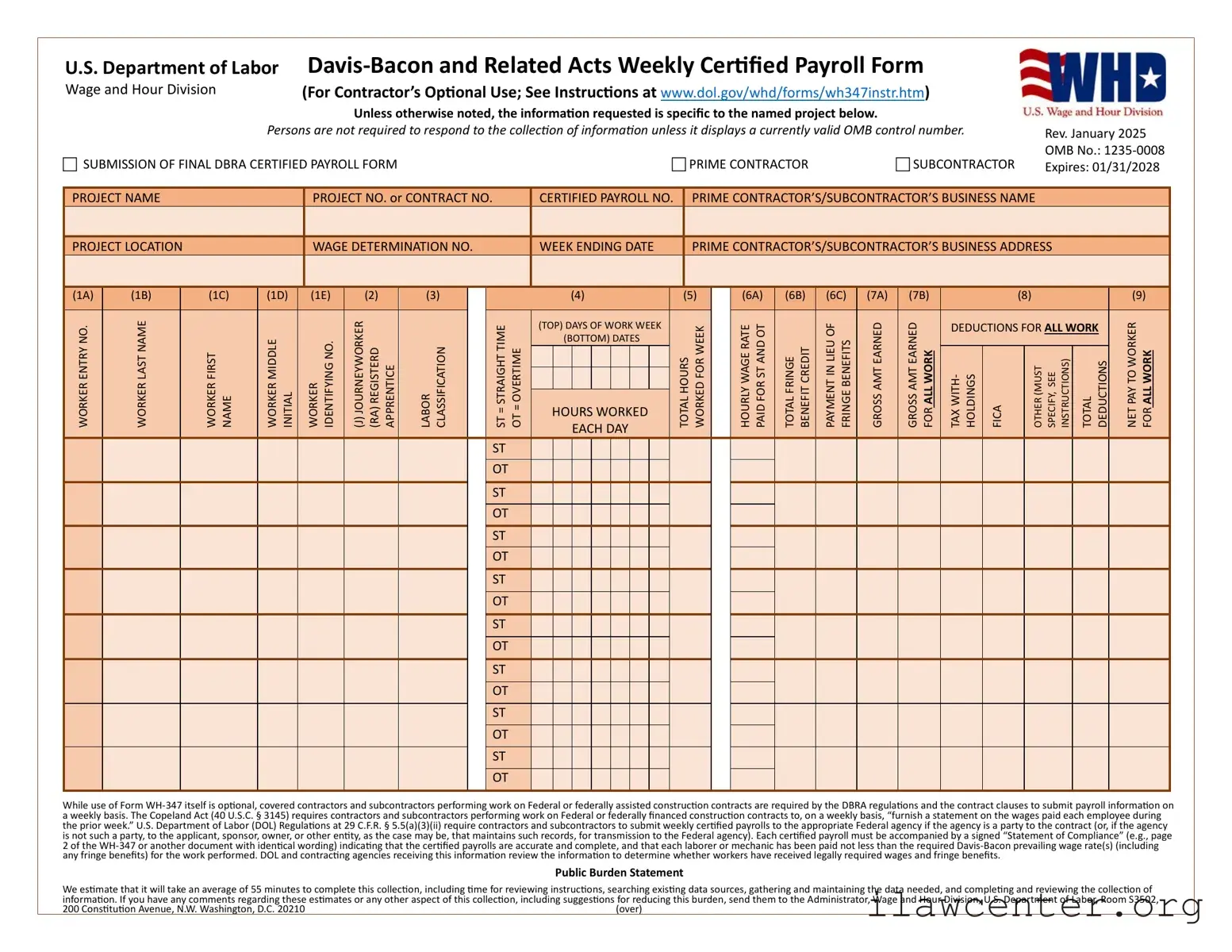
Davis-Bacon and Related Acts Weekly Cerfied Payroll Form
(For Contractors Oponal Use; See Instrucons at
www.dol.gov/whd/forms/wh347instr.htm
)
Unless otherwise noted, the informaon requested is specific to the named project below.
Persons are not required to respond to the collecon of informaon unless it displays a currently valid OMB control number.
SUBMISSION OF FINAL DBRA CERTIFIED PAYROLL FORM PRIME CONTRACTOR SUBCONTRACTOR
PROJECT NAME PROJECT NO. or CONTRACT NO. CERTIFIED PAYROLL NO. PRIME CONTRACTOR’S/SUBCONTRACTOR’S BUSINESS NAME
PROJECT LOCATION WAGE DETERMINATION NO. WEEK ENDING DATE PRIME CONTRACTOR’S/SUBCONTRACTOR’S BUSINESS ADDRESS
(1A) (1B) (1C) (1D) (1E) (2) (3) (4) (5) (6A) (6B) (6C) (7A) (7B) (8) (9)
WORKER ENTRY NO.
WORKER LAST NAME
WORKER FIRST
NAME
WORKER MIDDLE
INITIAL
WORKER
IDENTIFYING NO.
(J) JOURNEYWORKER
(RA) REGISTERD
APPRENTICE
LABOR
CLASSIFICATION
ST = STRAIGHT TIME
OT = OVERTIME
(TOP) DAYS OF WORK WEEK
(BOTTOM) DATES
TOTAL HOURS
WORKED FOR WEEK
HOURLY WAGE RATE
PAID FOR ST AND OT
TOTAL FRINGE
BENEFIT CREDIT
PAYMENT IN LIEU OF
FRINGE BENEFITS
GROSS AMT EARNED
GROSS AMT EARNED
FOR ALL WORK
DEDUCTIONS FOR ALL WORK
NET PAY TO WORKER
FOR ALL WORK
TAX WITH-
HOLDINGS
FICA
OTHER (MUST
SPECIFY, SEE
INSTRUCTIONS)
TOTAL
DEDUCTIONS
HOURS WORKED
EACH DAY
ST
OT
ST
OT
ST
OT
ST
OT
ST
OT
ST
OT
ST
OT
ST
OT
While use of Form WH-347 itself is oponal, covered contractors and subcontractors performing work on Federal or federally assisted construcon contracts are required by the DBRA regulaons and the contract clauses to submit payroll informaon on
a weekly basis. The Copeland Act (40 U.S.C. § 3145) requires contractors and subcontractors performing work on Federal or federally financed construcon contracts to, on a weekly basis, “furnish a statement on the wages paid each employee during
the prior week.” U.S. Department of Labor (DOL) Regulaons at 29 C.F.R. § 5.5(a)(3)(ii) require contractors and subcontractors to submit weekly cerfied payrolls to the appropriate Federal agency if the agency is a party to the contract (or, if the agency
is not such a party, to the applicant, sponsor, owner, or other enty, as the case may be, that maintains such records, for transmission to the Federal agency). Each cerfied payroll must be accompanied by a signed Statement of Compliance” (e.g., page
2 of the WH-347 or another document with idencal wording) indicang that the cerfied payrolls are accurate and complete, and that each laborer or mechanic has been paid not less than the required Davis-Bacon prevailing wage rate(s) (including
any fringe benefits) for the work performed. DOL and contracng agencies receiving this informaon review the informaon to determine whether workers have received legally required wages and fringe benefits.
Public Burden Statement
We esmate that it will take an average of 55 minutes to complete this collecon, including me for reviewing instrucons, searching exisng data sources, gathering and maintaining the data needed, and compleng and reviewing the collecon of
informaon. If you have any comments regarding these esmates or any other aspect of this collecon, including suggesons for reducing this burden, send them to the Administrator, Wage and Hour Division, U.S. Department of Labor, Room S3502,
200 Constuon Avenue, N.W. Washington, D.C. 20210 (over)
PROJECT NAME PROJECT NO. or CONTRACT NO. PAYROLL NO. PRIME CONTRACTOR’S/SUBCONTRACTOR’S BUSINESS NAME
PROJECT LOCATION WEEK ENDING DATE CERTIFYING OFFICIALs NAME AND TITLE
I paid or supervised the payment of the laborers or mechanics working on the above project during the stated me period. I cerfy the following:
The payroll informaon submied with this statement is correct and complete for the above project during the above period, and the wage and fringe benefit rates paid to the workers,
including credit taken for the reasonably ancipated costs of a bona fide fringe benefit plan, fund or program, are not less than the applicable wage and fringe benefits rates for the
classificaon(s) of work actually performed, as specified in the wage determinaon(s) incorporated into the contract.
All regular payrolls and all other basic records that the contractor is required to maintain for this payroll period are complete and accurate and will be made available upon request from the
agency or the Department of Labor.
The classificaons reported for each laborer or mechanic are the classificaon(s) of work that each worker actually performed.
Any workers paid as apprences during the above period are duly registered in a bona fide apprenceship program registered with the Office of Apprenceship, Employment and Training
Administraon, United States Department of Labor (“OA”), or a State Apprenceship Agency (“SAA”) recognized by Department of Labor. I have verified the registered apprenceship program
informaon provided below as accurate and applicable to any apprences idenfied on page 1 of this form.
APPRENTICESHIP PROGRAM NAME REGISTERED NAME OF LABOR CLASSIFICATION
OA SAA
OA SAA
OA SAA
Fringe benefits have been paid in cash and/or to bona fide fringe benefit plans, funds, or programs. Where the contractor is claiming an hourly credit for their contribuons to or reasonably
ancipated costs of a bona fide fringe benefit plan, fund, or program, provide plan informaon and the hourly credit claimed for each worker listed on the previous page of this form.
HOURLY CREDIT FOR FRINGE BENEFITS
If an amount is listed in (6B) on the first page of this cerfied payroll form, enter the hourly credit claimed under each plan name, type and number for each worker and check whether the plan is funded or unfunded.
NAME OF WORKER
FB NAME FB NAME FB NAME FB NAME FB NAME FB NAME
TOTAL
HOURLY
CREDIT
FB TYPE
FB TYPE
FB TYPE
FB TYPE
FB TYPE
FB TYPE
PLAN NO. PLAN NO. PLAN NO. PLAN NO. PLAN NO. PLAN NO.
Funded Unfunded Funded Unfunded Funded Unfunded Funded Unfunded Funded Unfunded Funded Unfunded
Hourly Credit
$
Hourly Credit
$
Hourly Credit
$
Hourly Credit
$
Hourly Credit
$
Hourly Credit
$ $
Hourly Credit
$
Hourly Credit
$
Hourly Credit
$
Hourly Credit
$
Hourly Credit
$
Hourly Credit
$ $
Hourly Credit
$
Hourly Credit
$
Hourly Credit
$
Hourly Credit
$
Hourly Credit
$
Hourly Credit
$ $
Hourly Credit
$
Hourly Credit
$
Hourly Credit
$
Hourly Credit
$
Hourly Credit
$
Hourly Credit
$ $
Hourly Credit
$
Hourly Credit
$
Hourly Credit
$
Hourly Credit
$
Hourly Credit
$
Hourly Credit
$ $
Hourly Credit
$
Hourly Credit
$
Hourly Credit
$
Hourly Credit
$
Hourly Credit
$
Hourly Credit
$ $
Hourly Credit
$
Hourly Credit
$
Hourly Credit
$
Hourly Credit
$
Hourly Credit
$
Hourly Credit
$ $
Hourly Credit
$
Hourly Credit
$
Hourly Credit
$
Hourly Credit
$
Hourly Credit
$
Hrly Credit
$ $
All workers on the project have been paid the full weekly wages earned, and no rebates or deducons have been or will be made either directly or indirectly, other than permissible
deducons as defined in 29 CFR part 3.
ADDITIONAL REMARKS
SIGNATURE OF CERTIFYING OFFICIAL DATE TELEPHONE NUMBER EMAIL ADDRESS
( __ __ __ ) __ __ __ __ __ __ __
THE WILLFUL FALSIFICATION OF ANY OF THE ABOVE STATEMENTS MAY SUBJECT THE CONTRACTOR OR SUBCONTRACTOR TO CIVIL OR CRIMINAL PROSECUTION (SEE SECTION 1001 OF TITLE 18 AND SECTION 3729 OF TITLE 31 OF THE UNITED STATES
CODE), AS WELL AS DEBARMENT FROM FUTURE FEDERAL AND FEDERALLY-ASSISTED CONTRACTS. INFORMATION REPORTED IN CERTIFIED PAYROLLS MAY BE SUBJECT TO DISCLOSURE IN RESPONSE TO A FREEDOM OF INFORMATION ACT REQUEST.
File Properties

Fact Name Description
Purpose of the Form The U.S. Department of Labor (DoL) forms are used for various employment-related purposes, including wage and hour claims, workplace safety, and labor standards compliance.
Common Types of Forms Common forms include the WH-1 for wage complaints, WH-2 for overtime claims, and WH-3 for family and medical leave requests.
Submission Process Forms can typically be submitted online, by mail, or in person at local DoL offices, depending on the specific form and its requirements.
State-Specific Forms Many states have their own labor forms that comply with state laws, such as California’s DLSE forms governed by the California Labor Code.
Governing Laws Federal laws like the Fair Labor Standards Act (FLSA) govern many DoL forms, while state-specific forms are governed by respective state labor laws.
Record Keeping Employers must keep records of submitted forms for a specified period, often three years, to comply with federal and state regulations.
Confidentiality Information submitted on DoL forms is generally kept confidential, although certain details may be disclosed during investigations.
Eligibility Requirements Eligibility to file a claim using DoL forms often depends on employment status, length of employment, and specific circumstances of the claim.
Response Time The DoL typically aims to respond to submitted forms within a set timeframe, but actual response times can vary based on the volume of claims.
Appeals Process If a claim is denied, individuals have the right to appeal the decision, following specific procedures outlined by the DoL or state labor agencies.

Instructions on Utilizing U.S. DoL

Filling out the U.S. Department of Labor form requires attention to detail and accuracy. Follow the steps below to ensure you complete the form correctly.

  1. Gather all necessary information, including personal details, employment history, and any relevant documentation.
  2. Read the instructions carefully to understand what information is required in each section of the form.
  3. Begin filling out the form by entering your name, address, and contact information in the designated fields.
  4. Provide your Social Security number if required, ensuring it is accurate to avoid delays.
  5. Complete the employment history section, listing all relevant jobs, including dates of employment and job titles.
  6. If applicable, fill out any sections related to specific claims or requests, providing detailed information as needed.
  7. Review your entries for accuracy and completeness before moving on to the next section.
  8. Sign and date the form where indicated. Ensure that you meet any additional requirements for signatures, such as witness signatures if necessary.
  9. Make a copy of the completed form for your records before submission.
  10. Submit the form according to the provided instructions, whether by mail or electronically.

After submitting the form, you may need to wait for a response or further instructions. Keep track of any confirmation or reference numbers you receive for future follow-up.

Important Facts about U.S. DoL

What is the U.S. Department of Labor (DoL) form?

The U.S. Department of Labor form is a document used for various purposes related to labor and employment regulations. These forms can be required for reporting, compliance, or applications for benefits. They help ensure that employers and employees adhere to federal labor laws, protecting workers' rights and ensuring fair labor practices.

Who needs to fill out the DoL form?

Individuals, employers, and organizations involved in labor relations may need to complete a DoL form. This includes employers seeking to comply with labor standards, employees filing complaints, or organizations applying for grants related to workforce development. Each specific form will have its own set of requirements regarding who must complete it.

How do I obtain a U.S. DoL form?

U.S. DoL forms can be obtained directly from the Department of Labor's official website. The website provides downloadable versions of the forms, along with instructions for completion. Additionally, local offices may have physical copies available for those who prefer to fill them out in person.

Are there different types of DoL forms?

Yes, there are numerous types of DoL forms, each serving a different purpose. Common forms include those for wage and hour claims, family and medical leave requests, and unemployment insurance applications. It is essential to select the correct form based on your specific situation to ensure proper processing.

What happens if I submit a DoL form incorrectly?

If a DoL form is submitted incorrectly, it may result in delays in processing or even rejection of the application or claim. It is crucial to review the form thoroughly before submission. If an error is discovered after submission, contacting the appropriate DoL office as soon as possible is advisable to rectify the mistake.

Is there a deadline for submitting DoL forms?

Deadlines for submitting DoL forms can vary depending on the specific form and the circumstances surrounding it. Some forms may have strict deadlines, while others may be more flexible. It is important to check the instructions provided with each form to ensure timely submission and avoid any penalties or complications.

Can I submit a DoL form online?

Many U.S. DoL forms can be submitted online, depending on the specific type of form and the services available. The Department of Labor’s website often provides options for electronic submission, which can expedite the process. However, not all forms may be available for online submission, so it is essential to check the requirements for each form.

What should I do if I have questions about a DoL form?

If you have questions regarding a DoL form, you can contact the Department of Labor directly through their website or by phone. Additionally, local labor offices can provide assistance and clarification on specific forms and their requirements. Seeking guidance ensures that you complete the form accurately and understand the necessary steps.

Can I appeal a decision made based on a DoL form?

Yes, if a decision is made based on the information provided in a DoL form and you disagree with that decision, you typically have the right to appeal. The appeal process may vary depending on the specific program or issue involved. Instructions for how to appeal are often included with the decision notice, so it is important to read that information carefully.

Common mistakes

Filling out the U.S. Department of Labor (DoL) form can be a daunting task. Many individuals make common mistakes that can lead to delays or even denials of their applications. One frequent error is not reading the instructions carefully. Each form comes with specific guidelines that are crucial for proper completion. Skipping this step can result in incomplete or incorrect submissions.

Another mistake is providing inaccurate personal information. This includes errors in names, addresses, or Social Security numbers. Even a small typo can cause significant issues down the line. It’s essential to double-check all personal details before submitting the form.

People often forget to sign and date their forms. A missing signature can halt the processing of an application. This simple oversight can lead to unnecessary delays, so it’s important to remember this final step.

In addition, many applicants fail to provide supporting documentation. Depending on the specific form, additional documents may be required to substantiate claims. Without these, the application may be considered incomplete. Gathering all necessary paperwork beforehand can save time and frustration.

Another common error is submitting the form to the wrong office. Each type of DoL form has a designated submission location. Sending it to the wrong address can lead to confusion and delays in processing. Always verify the correct submission guidelines.

Some individuals neglect to keep copies of their completed forms. Having a personal record is essential for future reference, especially if questions arise later. This can be a valuable resource if you need to follow up on your application.

Many applicants also overlook deadlines. Each form has specific timeframes for submission, and missing these can jeopardize your application. It’s wise to mark important dates on your calendar to ensure timely submission.

Additionally, people sometimes underestimate the importance of clarity in their responses. Vague or unclear answers can lead to misunderstandings. Providing detailed and straightforward information helps ensure that your application is processed smoothly.

Lastly, some applicants do not seek help when needed. If there’s confusion about how to fill out a form, it’s okay to ask for assistance. Whether from a knowledgeable friend or a professional, getting help can prevent costly mistakes.

Documents used along the form

When navigating the world of contracts and labor regulations, several key documents often accompany the U.S. Department of Labor (DoL) form. Understanding these forms can streamline the process and ensure compliance with federal guidelines. Here’s a brief overview of some essential documents you may encounter.

  • Contract Agreement: This document outlines the terms and conditions between parties involved in a project. It specifies deliverables, timelines, and payment terms, serving as a foundational agreement that guides the relationship.
  • Scope of Work (SOW): The SOW details the specific tasks and responsibilities expected from each party. It clarifies project objectives and deliverables, ensuring everyone is on the same page regarding expectations.
  • Independent Contractor Agreement: This form is used when hiring independent contractors. It defines the relationship between the contractor and the hiring entity, including payment structures and the nature of the work.
  • Non-Disclosure Agreement (NDA): An NDA protects sensitive information shared between parties. It ensures that confidential information remains private, fostering trust and security in business dealings.
  • Time Sheets: Time sheets are used to track hours worked by employees or contractors. They provide a record of time spent on various tasks, which is essential for accurate billing and compliance with labor laws.
  • Compliance Certification: This document certifies that a business complies with relevant labor laws and regulations. It often accompanies other forms to demonstrate adherence to legal standards.

Familiarizing yourself with these documents can enhance your understanding of the contractual landscape and help ensure that all parties meet their obligations. Each form plays a vital role in maintaining clear communication and compliance, ultimately contributing to a successful working relationship.

Similar forms

The U.S. Department of Labor (DoL) form serves various purposes related to employment and labor regulations. Here are eight documents that share similarities with the DoL form, along with explanations of how they are alike:

  • W-2 Form: This document reports an employee's annual wages and the taxes withheld from their paycheck. Like the DoL form, it is essential for tax reporting and compliance.
  • 1099 Form: Used to report income received by independent contractors, this form is similar to the DoL form in that it ensures proper reporting of earnings for tax purposes.
  • Form I-9: Employers use this form to verify the identity and employment eligibility of their employees. Both forms are critical for compliance with federal regulations.
  • Labor Condition Application (LCA): This document is required for certain visa applications and ensures that hiring foreign workers does not adversely affect U.S. workers. It shares a focus on labor standards with the DoL form.
  • Employee Handbook: While not a formal government document, an employee handbook outlines workplace policies and procedures, similar to how the DoL form provides guidelines for labor practices.
  • Job Offer Letter: This document formally outlines the terms of employment for a new hire. Like the DoL form, it establishes important employment conditions and expectations.
  • Pay Stub: A pay stub details an employee's earnings and deductions for a specific pay period. Both documents provide essential information related to compensation and compliance.
  • Occupational Safety and Health Administration (OSHA) Forms: These forms are used to report workplace injuries and illnesses. They focus on workplace safety, similar to how the DoL form addresses labor regulations.

Dos and Don'ts

When filling out the U.S. Department of Labor (DoL) form, it's important to be careful and thorough. Here’s a list of things to keep in mind.

  • Do: Read the instructions carefully before starting.
  • Do: Provide accurate information to avoid delays.
  • Do: Double-check your entries for typos or errors.
  • Do: Use clear and legible handwriting if filling out a paper form.
  • Do: Keep a copy of the completed form for your records.
  • Don't: Rush through the form; take your time.
  • Don't: Leave any required fields blank.
  • Don't: Submit the form without reviewing it first.
  • Don't: Ignore deadlines; submit on time.
  • Don't: Hesitate to ask for help if you're unsure about something.

By following these guidelines, you can help ensure your form is filled out correctly and processed smoothly.

Misconceptions

There are several misconceptions surrounding the U.S. Department of Labor (DoL) forms that can lead to confusion. Understanding these misconceptions can help individuals navigate the process more effectively.

  • All DoL forms are the same. Many believe that all forms from the DoL serve the same purpose. In reality, each form is designed for specific situations, such as wage claims, safety complaints, or family leave requests.
  • Filing a form guarantees a favorable outcome. Some individuals assume that submitting a form will automatically lead to a resolution in their favor. However, the outcome depends on the details of each case and the evidence provided.
  • DoL forms are only for employees. It is a common misconception that only employees can file these forms. Employers also have obligations and can use these forms to report compliance or seek guidance.
  • Once submitted, forms cannot be changed. Many people think that after submitting a form, they cannot make any changes. In fact, individuals can often amend their submissions if new information arises or if an error is discovered.
  • The process is always quick. Some expect that the review and processing of DoL forms will happen swiftly. The timeline can vary significantly based on the complexity of the case and the volume of submissions being handled.
  • Legal representation is required to file a form. While some may feel that they need a lawyer to navigate the process, individuals can file forms independently. Resources are available to assist those who choose to represent themselves.

Addressing these misconceptions can empower individuals to engage with the DoL processes more effectively and with greater confidence.

Key takeaways

Filling out and using the U.S. Department of Labor (DoL) form requires careful attention to detail and understanding of the information requested. Below are key takeaways to consider:

  • Ensure all sections of the form are completed accurately. Incomplete forms can lead to delays in processing.
  • Double-check personal information, including names, addresses, and Social Security numbers, to avoid any discrepancies.
  • Be aware of submission deadlines. Timely submission is crucial for compliance with applicable laws and regulations.
  • Keep a copy of the completed form for your records. This can be useful for future reference or if questions arise.
  • Understand the purpose of the form. Each section is designed to gather specific information related to labor standards.
  • Seek assistance if needed. Resources are available through the DoL or legal aid organizations to help navigate the process.