Ucc 1 308 PDF Template

Ucc 1 308 PDF Template

The UCC 1-308 form, also known as the Affidavit of Reservation of Rights, serves as a public declaration that an individual explicitly reserves their rights under the Uniform Commercial Code. This form is often used to assert one's rights and sovereignty, ensuring that any performance or acceptance of terms does not waive those rights. For those interested in completing this important document, please click the button below.

Article Guide

The UCC 1-308 form, also known as the Affidavit of Reservation of Rights, serves a significant purpose in protecting individual rights within the framework of commercial transactions. This form allows individuals to explicitly reserve their rights while engaging in agreements, ensuring that their liberties remain intact. By invoking UCC 1-308, a party can perform or accept performance without waiving any of their rights. The language used in this form emphasizes the importance of clarity and intent, as phrases like "without prejudice" or "under protest" signal that the individual is acting under reservation. Furthermore, the form includes a declaration of sovereignty, asserting that the individual does not recognize certain legal classifications, such as being a United States citizen under the 14th Amendment. This declaration can be a powerful statement of identity and autonomy. The form also outlines potential penalties for violations of these reserved rights, reinforcing the seriousness of the individual's position. Overall, the UCC 1-308 form is a tool for individuals seeking to navigate the complexities of legal agreements while safeguarding their inherent rights and freedoms.

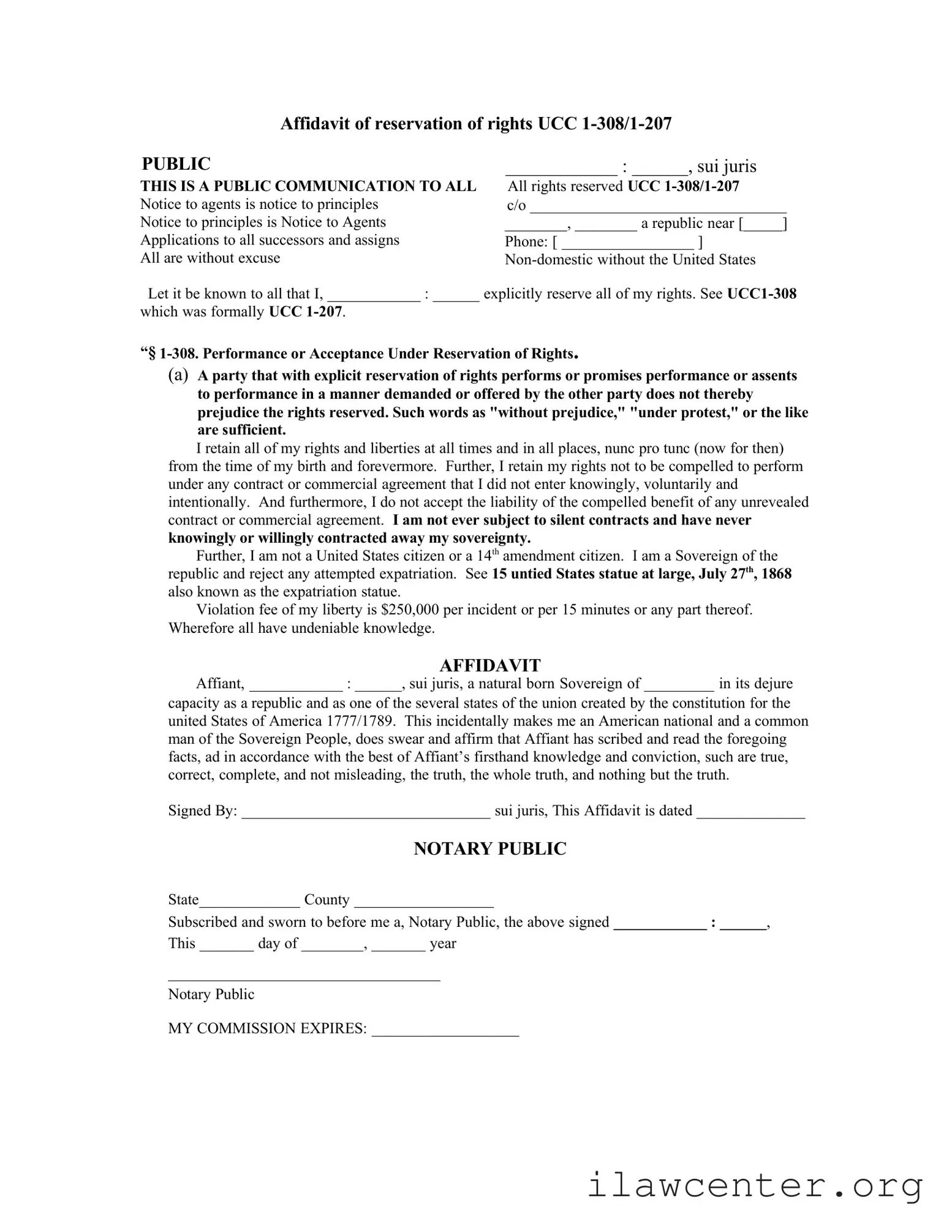
Ucc 1 308 Preview

___________________________________
Affidavit of reservation of rights UCC 1-308/1-207
PUBLIC
____________ : ______, sui juris
THIS IS A PUBLIC COMMUNICATION TO ALL All rights reserved UCC 1-308/1-207
Notice to agents is notice to principles
c/o _________________________________
Notice to principles is Notice to Agents
________, ________ a republic near [_____]
Applications to all successors and assigns
Phone: [ _________________ ]
All are without excuse
Non-domestic without the United States
Let it be known to all that I, ____________ : ______ explicitly reserve all of my rights. See UCC1-308
which was formally UCC 1-207.
“§
1-308. Performance or Acceptance Under Reservation of Rights
.
(a) A party that with explicit reservation of rights performs or promises performance or assents
to performance in a manner demanded or offered by the other party does not thereby
prejudice the rights reserved. Such words as "without prejudice," "under protest," or the like
are sufficient.
I retain all of my rights and liberties at all times and in all places, nunc pro tunc (now for then)
from the time of my birth and forevermore. Further, I retain my rights not to be compelled to perform
under any contract or commercial agreement that I did not enter knowingly, voluntarily and
intentionally. And furthermore, I do not accept the liability of the compelled benefit of any unrevealed
contract or commercial agreement. I am not ever subject to silent contracts and have never
knowingly or willingly contracted away my sovereignty.
Further, I am not a United States citizen or a 14
th
amendment citizen. I am a Sovereign of the
republic and reject any attempted expatriation. See 15 untied States statue at large, July 27
th
, 1868
also known as the expatriation statue.
Violation fee of my liberty is $250,000 per incident or per 15 minutes or any part thereof.
Wherefore all have undeniable knowledge.
AFFIDAVIT
Affiant, ____________ : ______, sui juris, a natural born Sovereign of _________ in its dejure
capacity as a republic and as one of the several states of the union created by the constitution for the
united States of America 1777/1789. This incidentally makes me an American national and a common
man of the Sovereign People, does swear and affirm that Affiant has scribed and read the foregoing
facts, ad in accordance with the best of Affiant’s firsthand knowledge and conviction, such are true,
correct, complete, and not misleading, the truth, the whole truth, and nothing but the truth.
Signed By: ________________________________ sui juris, This Affidavit is dated ______________
NOTARY PUBLIC
State_____________ County __________________
Subscribed and sworn to before me a, Notary Public, the above signed ____________ : ______,
This _______ day of ________, _______ year
Notary Public
MY COMMISSION EXPIRES: ___________________
Affidavit
of
rese
rva
tion
of
rig
ht
s UCC 1-308/1-207
PUBLIC
THI
S IS A PUBLIC
COM
MUNICA
TIO
N
TO
A
LL
Notice to agen
ts
is notice to
pri
ncip
les
Notice to principles is
Not
ice
to
Agents
Ap
pl
ica
ti
ons to
all
successors
and
as.signs
A
ll
are
with
out
excuse
John-
Ra
ymond: Doe, suijuris
All rights reserved
UCC
1-30
8/
1-207
c/
o 1218 Graymont Boulevard
Nashville, Tennessee a republic near (372 14]
Phone: [615-555
-1
212]
Non-domestic without the
Uni
t
ed
States
Let it
be
kn
own to a
ll
that I, John-Raymond: Doe explicitly reserve all
of
my rights. See
UCC
l-308 which
was forma
ll
y IJCC 1-207.
AFFIDAVIT
Affiant
.
John
-
Raymond:
Doe
.
sui
i
uris
. a
natural
born
Sover
eign
of
Tennessee
in
i
ts
dejure
capacity
as
a republic and as one
of
the several states
of
the union creat
ed
by the constitution for the
unit
ed
States
of
America 1777
/1
789. This
in
ci
dentally makes me an American national and a common
man
of
the Sovereign People, does
swe
ar
and affirm that Affiant has
scr
ibed and read the
fo
regoing
facts
.
ad
in
a
ccordance
with
the
bes
t
of
Affiant's
firsthand
kn
owledge
and
conviction.
such
arc
true
,
correc~ complete, and not misleading, the truth, the wh
ole
truth, and nothing
bu
t the truth.
Signed By:
_____________
sui
jur
is, Th
is
Affidavit is dated
_____
_
NOT
AR
Y PU
BLIC
State
______
Co
unty
_______
_
Sub
scr
ibed and swo
rn
to before me a, Notary Public, the above signed ,John-Raymond:
Do
e,
T
hi
s
___
day
of
______
year
Notary Public
MY COMMISSI
ON
EXPIRES:
______
_
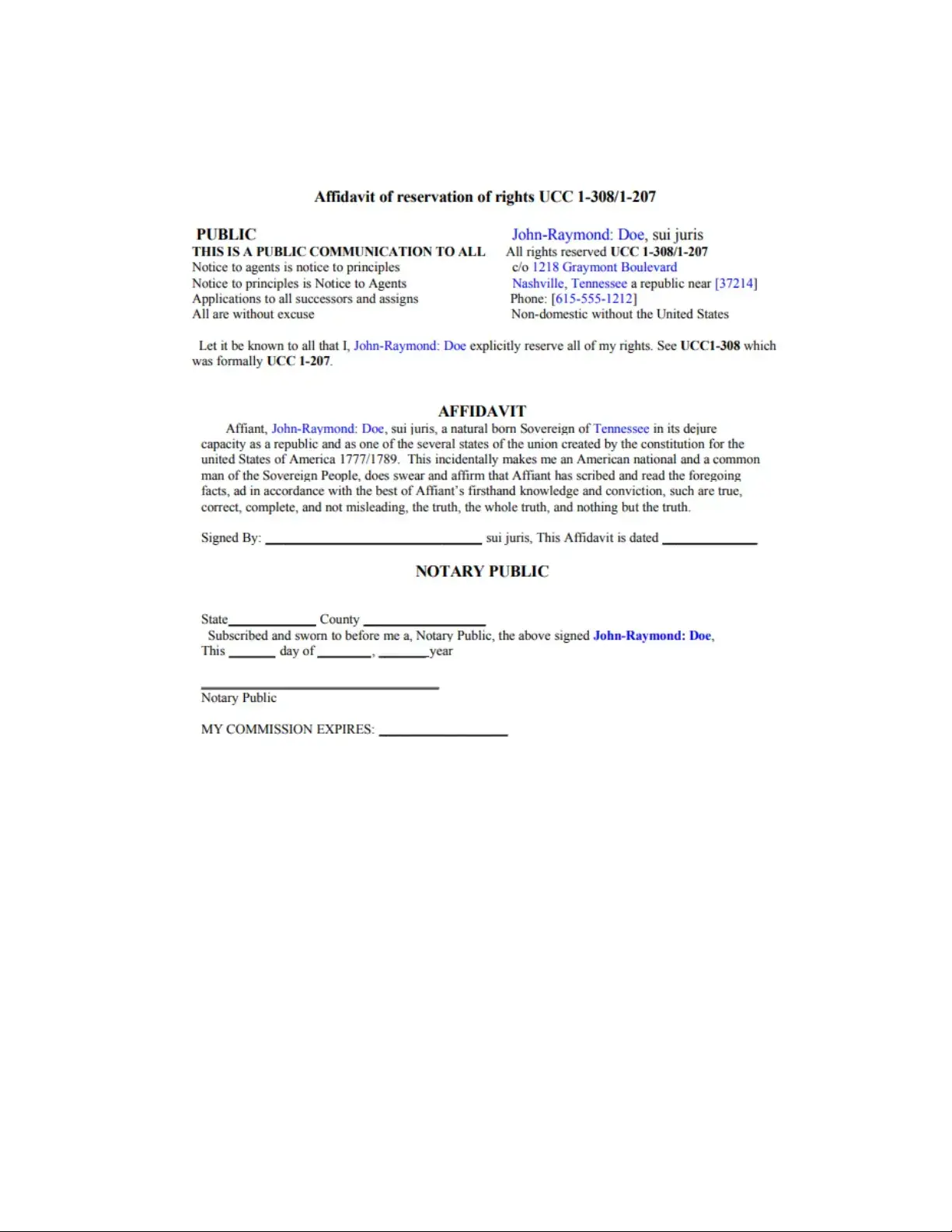
FILLED OUT EXAMPLE

File Properties

Fact Name Description
Purpose The UCC 1-308 form serves as an affidavit of reservation of rights, allowing individuals to explicitly reserve their rights in legal or commercial transactions.
Governing Law This form is governed by the Uniform Commercial Code (UCC), specifically UCC § 1-308, which addresses performance or acceptance under reservation of rights.
Rights Reserved By using this form, individuals declare that they retain all rights and liberties at all times, asserting their sovereignty and rejecting any implied contracts.
Notary Requirement The form must be signed in the presence of a notary public, who verifies the identity of the affiant and the authenticity of the signature.

Instructions on Utilizing Ucc 1 308

Filling out the UCC 1-308 form requires careful attention to detail. Once the form is completed, it can be submitted to the appropriate authorities. This step is important for ensuring that your rights are formally reserved and recognized.

  1. Begin by entering your full name in the first blank space, following the format: First-Middle: Last.
  2. In the next blank, indicate your legal status by writing sui juris.
  3. In the line labeled "c/o," write your complete address, including street address, city, state, and zip code.
  4. In the space for "Phone," provide your contact number.
  5. Next, state your intention by writing: Let it be known to all that I, [Your Name], explicitly reserve all of my rights.
  6. In the section labeled "AFFIDAVIT," repeat your name and legal status, and specify your state of residence.
  7. Affirm your status as a natural born Sovereign and include a statement about being an American national.
  8. Sign your name in the "Signed By" section, again using the format: First-Middle: Last, sui juris.
  9. Fill in the date on which you are signing the affidavit.
  10. Leave the "NOTARY PUBLIC" section for a notary to complete. This will include the state and county where the notarization occurs, as well as the notary's signature and commission expiration date.

Important Facts about Ucc 1 308

What is the UCC 1-308 form?

The UCC 1-308 form is an affidavit that allows individuals to reserve their rights under the Uniform Commercial Code (UCC). It is often used to assert that a person does not waive any rights or privileges while engaging in transactions or contracts. This form emphasizes the individual's sovereignty and their intention to retain all rights and liberties.

Who can use the UCC 1-308 form?

Any individual who wishes to reserve their rights in a legal or commercial context can use this form. It is particularly relevant for those who identify as sovereign citizens or who wish to assert their status outside of U.S. citizenship. However, it is essential to understand the implications and potential legal interpretations of using this form.

What does it mean to reserve rights under UCC 1-308?

Reserving rights under UCC 1-308 means that a person is explicitly stating that they do not relinquish any legal rights or privileges while engaging in a contract or transaction. This can be communicated through phrases like "without prejudice" or "under protest." By doing so, the individual protects themselves from being bound by terms they did not knowingly accept.

Is the UCC 1-308 form legally binding?

While the UCC 1-308 form serves as a declaration of rights, its legal enforceability can vary. Courts may not always recognize or uphold the claims made in such affidavits, especially if they conflict with established law or regulations. It is advisable to consult with a legal professional to understand how this form may be viewed in specific legal contexts.

What information is required to complete the UCC 1-308 form?

To complete the UCC 1-308 form, individuals need to provide their name, address, and a declaration of their status (e.g., "sui juris"). Additionally, it may require a statement affirming the reservation of rights, along with a signature and the date. Notarization is typically needed to validate the document.

Can the UCC 1-308 form be used for any type of contract?

The UCC 1-308 form can be used in various contexts, including commercial transactions and contracts. However, its effectiveness may depend on the specific circumstances and the nature of the agreement. It is crucial to consider whether the contract in question allows for such reservations and how they may be interpreted legally.

What are the potential consequences of using the UCC 1-308 form?

Using the UCC 1-308 form can lead to different outcomes. While it may provide a sense of security for the individual asserting their rights, it could also result in misunderstandings or disputes with other parties. In some cases, it may even lead to legal challenges if the other party does not agree with the terms outlined in the affidavit.

How does the UCC 1-308 form relate to sovereignty?

The UCC 1-308 form is often associated with the concept of sovereignty, particularly among those who identify as sovereign citizens. By using this form, individuals assert their status as sovereign entities, separate from U.S. citizenship. This declaration can be a way to challenge the authority of governmental entities or to claim rights that they believe are not subject to standard legal frameworks.

Common mistakes

When filling out the UCC 1-308 form, many people make mistakes that can lead to confusion or complications. One common error is leaving out important personal information. It is crucial to include your full name, address, and contact details. Omitting this information can result in your affidavit being deemed incomplete or invalid.

Another mistake is not properly indicating your status as a "sui juris" individual. This term signifies that you are acting in your own right and are not under any legal disability. Failing to include this designation can weaken your claims and may cause misunderstandings about your legal standing.

Many individuals also forget to specify the date of the affidavit. This date is important as it establishes when the affidavit was executed. Without it, the document may lack credibility or be challenged in the future.

Inaccurate references to legal statutes can lead to significant issues. Some people mistakenly cite the wrong UCC section or misinterpret its meaning. It is essential to ensure that you are referencing UCC 1-308 correctly and understanding its implications.

Another common error involves not signing the affidavit properly. A signature is vital for validating the document. If the affidavit is not signed, it may not be recognized as a legitimate legal document.

Lastly, people often overlook the importance of having the affidavit notarized. Notarization adds an extra layer of authenticity and can prevent challenges to the document's validity. Skipping this step can lead to complications in enforcing your rights as stated in the affidavit.

Documents used along the form

The UCC 1-308 form is often accompanied by various other documents that serve to clarify rights and obligations in commercial transactions. Understanding these documents can help individuals navigate their legal rights more effectively. Below is a list of forms and documents commonly used alongside the UCC 1-308 form.

  • Affidavit of Reservation of Rights: This document explicitly states that an individual reserves their rights under UCC 1-308. It serves as a formal declaration that the signer does not waive any rights while engaging in a transaction.
  • Notice of Default: This notice is sent to inform a party that they have failed to meet their obligations under a contract. It is often a precursor to further legal action.
  • Demand Letter: A formal request for payment or action, this letter outlines the amount owed and the consequences of non-compliance. It is often used to resolve disputes before escalating to litigation.
  • Power of Attorney: This document grants another person the authority to act on one’s behalf in legal or financial matters. It can be crucial in managing rights and obligations when one cannot act personally.
  • Commercial Lease Agreement: This contract outlines the terms under which one party rents property from another. It details the rights and responsibilities of both the landlord and tenant.
  • Sales Agreement: This document outlines the terms of a sale between a buyer and seller. It specifies the rights and obligations of each party regarding the transaction.
  • Security Agreement: This document establishes a security interest in personal property. It outlines the rights of the secured party in case of default by the borrower.
  • Notice of Intent to Lien: This notice informs a property owner that a lien may be placed on their property due to unpaid debts. It serves as a warning before formal action is taken.
  • UCC Financing Statement: This form is used to perfect a security interest in collateral. It provides public notice of the secured party's interest in the property.
  • Contract for Deed: This is an agreement in which the seller retains the title to the property until the buyer has paid the purchase price in full. It outlines the terms of the sale and payment schedule.

Each of these documents plays a vital role in protecting rights and clarifying obligations in various transactions. Familiarity with them can empower individuals to navigate their legal landscape with confidence.

Similar forms

The UCC 1-308 form, often referred to as the Affidavit of Reservation of Rights, has similarities with several other legal documents. Here are eight documents that share characteristics with the UCC 1-308 form:

  • Affidavit of Rights: This document asserts an individual's rights and can include statements about the reservation of rights, similar to the UCC 1-308 form.
  • Notice of Reservation of Rights: This notice explicitly states that an individual is reserving their rights, much like the UCC 1-308, which emphasizes the retention of rights during transactions.
  • Power of Attorney: While this document grants authority to another person, it often includes clauses that reserve certain rights for the principal, paralleling the reservation aspect of the UCC 1-308.
  • Declaration of Sovereignty: This document declares an individual's status as a sovereign entity, akin to the claims made in the UCC 1-308 about sovereignty and rights.
  • Letter of Intent: A letter of intent can express a party's intentions while reserving certain rights, similar to the performance under reservation of rights in the UCC 1-308.
  • Contract with Reservation of Rights Clause: Some contracts include specific clauses that allow parties to reserve their rights, mirroring the UCC 1-308's focus on not prejudicing reserved rights.
  • Affidavit of Truth: This document asserts facts as true and can include statements about rights, similar to the affirmations made in the UCC 1-308 form.
  • Notice of Non-Consent: This notice communicates a refusal to consent to certain actions or agreements, reflecting the UCC 1-308's emphasis on not accepting liability under unknown agreements.

Dos and Don'ts

When filling out the UCC 1-308 form, there are important guidelines to follow. Here’s a list of things you should and shouldn’t do to ensure your form is completed correctly.

  • Do ensure all personal information is accurate, including your name and address.
  • Do explicitly state your intention to reserve rights as outlined in UCC 1-308.
  • Do include your contact information for any follow-up communication.
  • Do sign the affidavit in the designated area to validate your claims.
  • Do have the affidavit notarized to provide legal authenticity.
  • Don't leave any sections of the form blank; incomplete forms may be rejected.
  • Don't use vague language; be clear and specific in your statements.
  • Don't forget to check for spelling and grammatical errors, as these can undermine your credibility.
  • Don't submit the form without reviewing it thoroughly to ensure all information is correct.

By adhering to these guidelines, you can help ensure that your UCC 1-308 form is filled out properly and stands up to scrutiny.

Misconceptions

There are several misconceptions surrounding the UCC 1-308 form that can lead to confusion. Understanding these misconceptions can help individuals navigate their rights more effectively. Below are four common misunderstandings:

  • Misconception 1: The UCC 1-308 form automatically grants immunity from all contracts.
  • This form does not provide blanket immunity from contracts. It allows individuals to reserve their rights when entering into agreements, but it does not eliminate the legal obligations that may arise from those contracts.

  • Misconception 2: Filing the UCC 1-308 form guarantees protection against all legal claims.
  • While the form can serve as a declaration of rights, it does not shield individuals from all legal claims. Courts will still evaluate each case based on its specific facts and applicable laws.

  • Misconception 3: Using the UCC 1-308 form means a person is not a citizen of the United States.
  • Filing this form does not change an individual's citizenship status. It is a statement of rights and does not negate the legal status of being a U.S. citizen or resident.

  • Misconception 4: The UCC 1-308 form is a substitute for legal advice.
  • This form is not a replacement for professional legal counsel. Individuals should seek advice from qualified legal professionals when dealing with complex legal matters.

Key takeaways

When filling out and using the UCC 1-308 form, it is essential to keep the following key points in mind:

  • Understand the Purpose: The UCC 1-308 form serves to reserve rights and protect your interests in commercial transactions.
  • Explicit Reservation: Clearly state that you are reserving all rights to ensure your position is understood.
  • Correct Information: Fill in your name and address accurately to avoid any confusion regarding your identity.
  • Notarization Required: The form must be notarized to verify its authenticity and your identity.
  • Use of Language: Phrases like “without prejudice” or “under protest” are effective in reserving rights.
  • Legal Context: Familiarize yourself with UCC 1-308 to understand its implications and applications.
  • Keep Copies: Retain copies of the completed form for your records and future reference.
  • Timeliness: Submit the form promptly to ensure your rights are recognized and protected.

These takeaways emphasize the importance of accuracy and clarity when using the UCC 1-308 form. Proper completion can help safeguard your legal rights in various transactions.