USCIS I-9 PDF Template

USCIS I-9 PDF Template

The USCIS I-9 form is a document used by employers to verify the identity and employment authorization of individuals hired for work in the United States. This form is essential for ensuring compliance with federal immigration laws. To learn more about how to fill out the I-9 form correctly, click the button below.

Article Guide

The USCIS I-9 form is a critical document for employers and employees alike, serving as a verification tool for employment eligibility in the United States. This form requires employers to confirm the identity and work authorization of their employees, ensuring compliance with federal immigration laws. Each new hire must complete the I-9 within three days of starting their job, providing necessary identification documents that establish both their identity and their right to work. Employers, on their part, must carefully review these documents and retain the completed forms for a specified period. Failure to comply with I-9 requirements can lead to significant penalties and legal issues for businesses. Understanding the nuances of the I-9 process is essential for both employers and employees to navigate the complexities of employment law effectively.

USCIS I-9 Preview

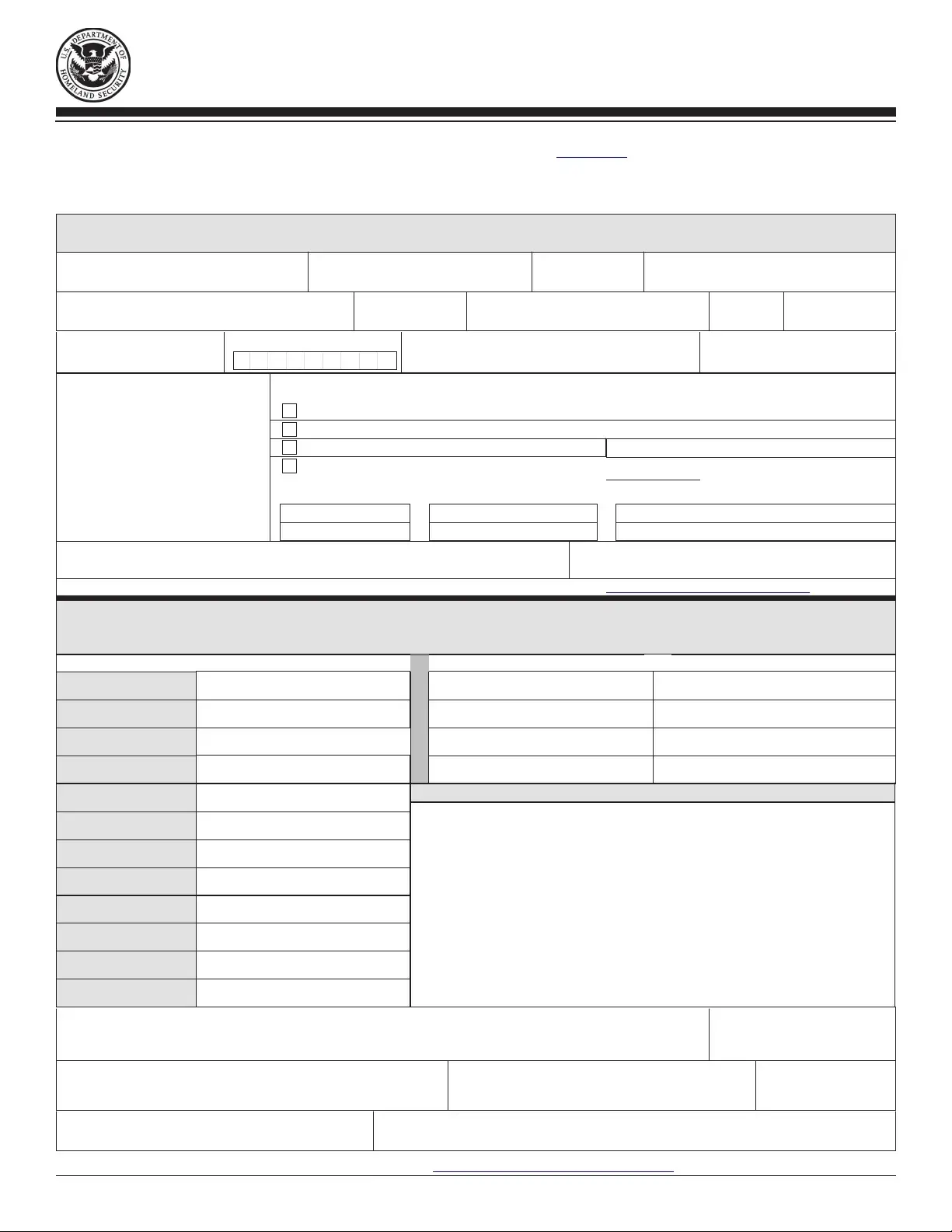
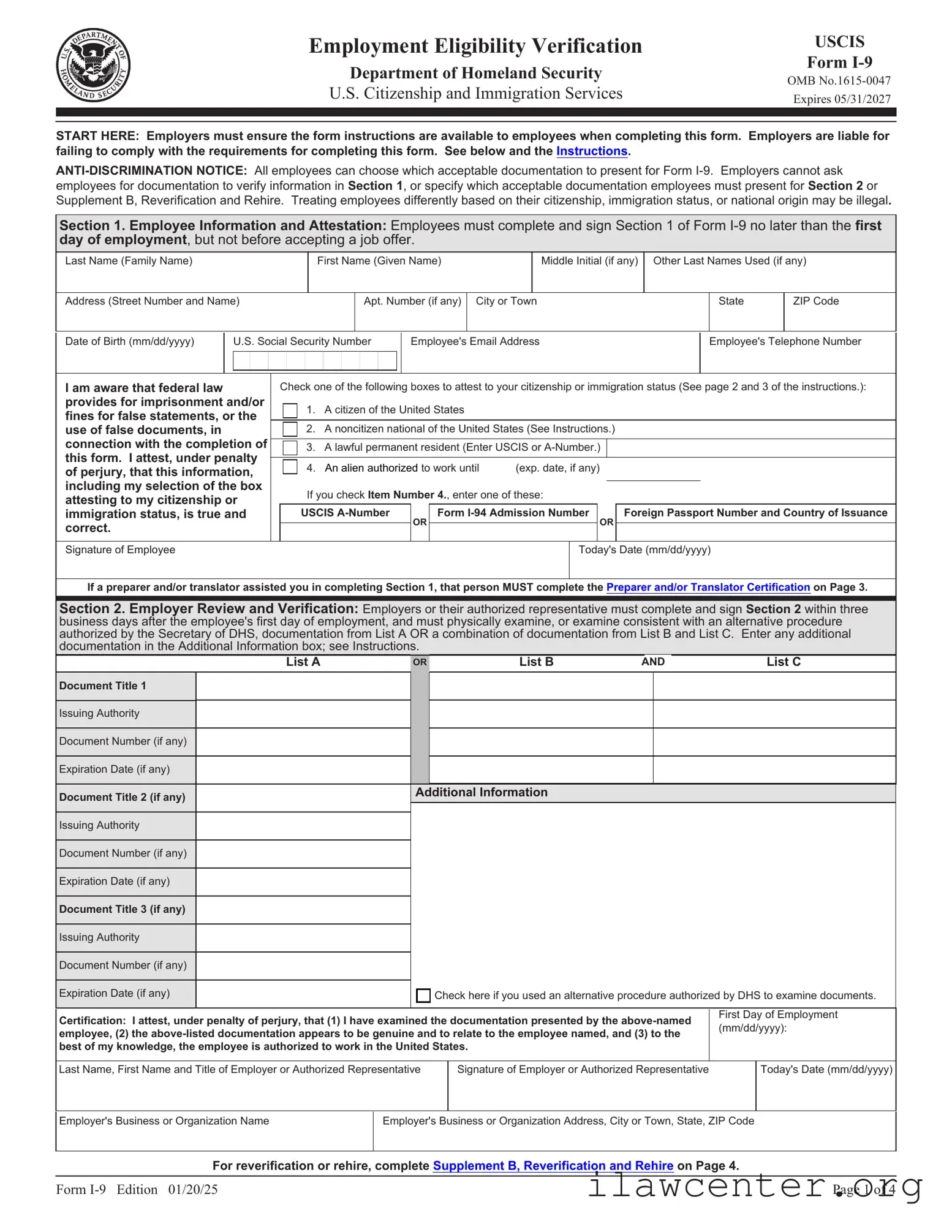
Employment Eligibility Verification
Department of Homeland Security
U.S. Citizenship and Immigration Services
USCIS
Form I-9
OMB No.1615-0047
Expires 05/31/2027
START HERE: Employers must ensure the form instructions are available to employees when completing this form. Employers are liable for
failing to comply with the requirements for completing this form. See below and the Instructions.
ANTI-DISCRIMINATION NOTICE: All employees can choose which acceptable documentation to present for Form I-9. Employers cannot ask
employees for documentation to verify information in Section 1, or specify which acceptable documentation employees must present for Section 2 or
Supplement B, Reverification and Rehire. Treating employees differently based on their citizenship, immigration status, or national origin may be illegal.
Section 1. Employee Information and Attestation: Employees must complete and sign Section 1 of Form I-9 no later than the first
day of employment, but not before accepting a job offer.
Last Name (Family Name) First Name (Given Name) Middle Initial (if any) Other Last Names Used (if any)
Address (Street Number and Name) Apt. Number (if any) City or Town State ZIP Code
Date of Birth (mm/dd/yyyy) U.S. Social Security Number Employee's Email Address Employee's Telephone Number
I am aware that federal law
provides for imprisonment and/or
fines for false statements, or the
use of false documents, in
connection with the completion of
this form. I attest, under penalty
of perjury, that this information,
including my selection of the box
attesting to my citizenship or
immigration status, is true and
correct.
Check one of the following boxes to attest to your citizenship or immigration status (See page 2 and 3 of the instructions.):
1. A citizen of the United States
2. A noncitizen national of the United States (See Instructions.)
3. A lawful permanent resident (Enter USCIS or A-Number.)
4. An alien authorized to work until (exp. date, if any)
If you check Item Number 4., enter one of these:
USCIS A-Number
OR
Form I-94 Admission Number
OR
Foreign Passport Number and Country of Issuance
Signature of Employee Today's Date (mm/dd/yyyy)
If a preparer and/or translator assisted you in completing Section 1, that person MUST complete the Preparer and/or Translator Certification on Page 3.
Section 2. Employer Review and Verification: Employers or their authorized representative must complete and sign Section 2 within three
business days after the employee's first day of employment, and must physically examine, or examine consistent with an alternative procedure
authorized by the Secretary of DHS, documentation from List A OR a combination of documentation from List B and List C. Enter any additional
documentation in the Additional Information box; see Instructions.
List A
OR
List B
AND
List C
Document Title 1
Issuing Authority
Document Number (if any)
Expiration Date (if any)
Document Title 2 (if any)
Additional Information
Issuing Authority
Check here if you used an alternative procedure authorized by DHS to examine documents.
Document Number (if any)
Expiration Date (if any)
Document Title 3 (if any)
Issuing Authority
Document Number (if any)
Expiration Date (if any)
Certification: I attest, under penalty of perjury, that (1) I have examined the documentation presented by the above-named
employee, (2) the above-listed documentation appears to be genuine and to relate to the employee named, and (3) to the
best of my knowledge, the employee is authorized to work in the United States.
First Day of Employment
(mm/dd/yyyy):
Last Name, First Name and Title of Employer or Authorized Representative Signature of Employer or Authorized Representative Today's Date (mm/dd/yyyy)
Employer's Business or Organization Name Employer's Business or Organization Address, City or Town, State, ZIP Code
For reverification or rehire, complete Supplement B, Reverification and Rehire on Page 4.
Form I-9 Edition 01/20/25 Page 1 of 4
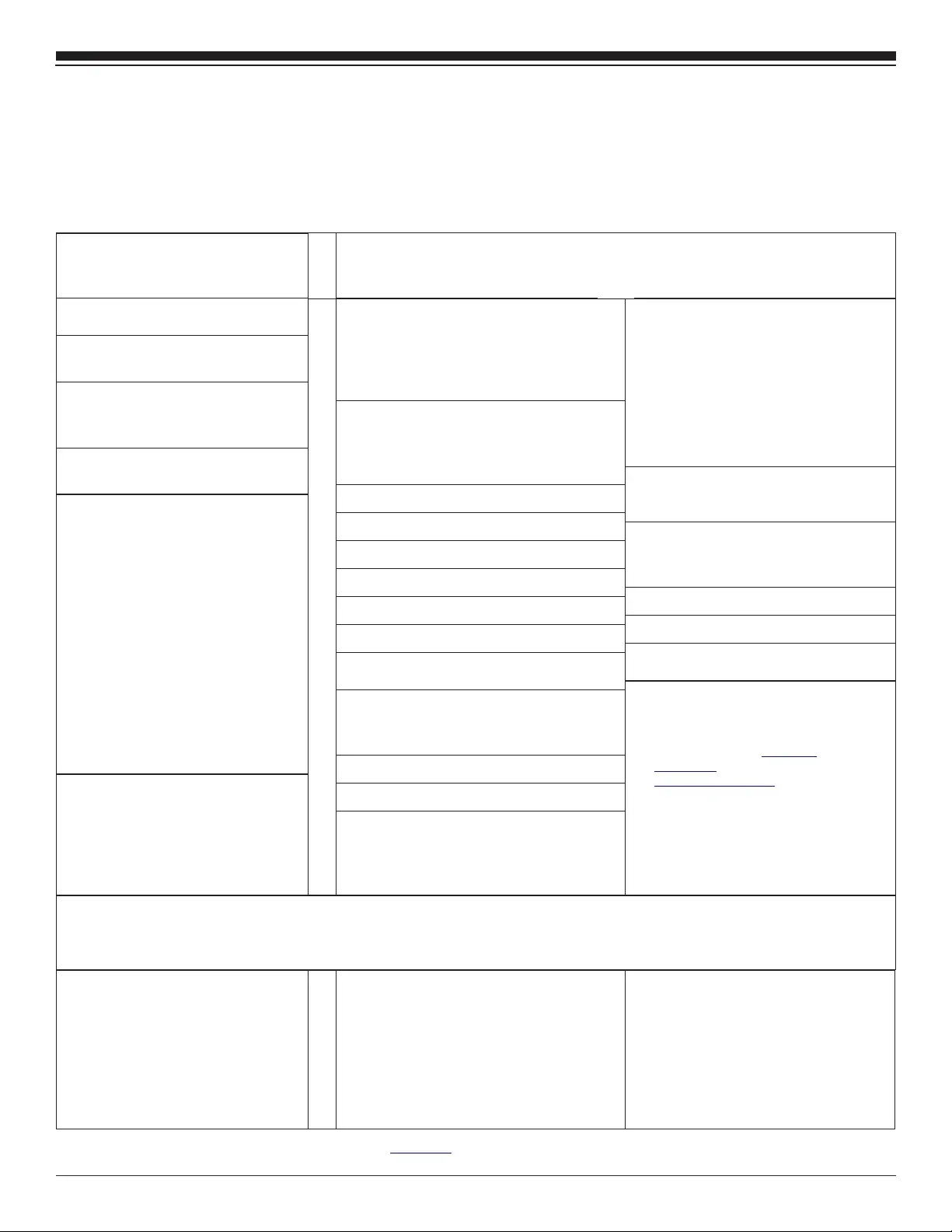
LISTS OF ACCEPTABLE DOCUMENTS
All documents containing an expiration date must be unexpired.
* Documents extended by the issuing authority are considered unexpired.
Employees may present one selection from List A or a
combination of one selection from List B and one selection from List C.
Examples of many of these documents appear in the Handbook for Employers (M-274).
LIST A
Documents that Establish Both Identity
and Employment Authorization
OR
LIST B
Documents that Establish Identity
LIST C
Documents that Establish Employment
Authorization
AND
1. U.S. Passport or U.S. Passport Card
1. Driver's license or ID card issued by a State or
outlying possession of the United States
provided it contains a photograph or
information such as name, date of birth,
sex, height, eye color, and address
1. A Social Security Account Number card,
unless the card includes one of the following
restrictions:
(1) NOT VALID FOR EMPLOYMENT
(2) VALID FOR WORK ONLY WITH
INS AUTHORIZATION
(3) VALID FOR WORK ONLY WITH
DHS AUTHORIZATION
2. Permanent Resident Card or Alien
Registration Receipt Card (Form I-551)
3. Foreign passport that contains a
temporary I-551 stamp or temporary
I-551 printed notation on a machine-
readable immigrant visa
2. ID card issued by federal, state or local
government agencies or entities, provided it
contains a photograph or information such as
name, date of birth, sex, height, eye color,
and address
4. Employment Authorization Document
that contains a photograph (Form I-766)
2. Certification of report of birth issued by the
Department of State (Forms DS-1350,
FS-545, FS-240)
3. School ID card with a photograph
5. For an individual temporarily authorized
to work for a specific employer because
of his or her status or parole:
a. Foreign passport; and
b. Form I-94 or Form I-94A that has
the following:
(1) The same name as the
passport; and
(2) An endorsement of the
individual's status or parole as
long as that period of
endorsement has not yet
expired and the proposed
employment is not in conflict
with any restrictions or
limitations identified on the form.
4. Voter's registration card
3. Original or certified copy of birth certificate
issued by a State, county, municipal
authority, or territory of the United States
bearing an official seal
5. U.S. Military card or draft record
6. Military dependent's ID card
4. Native American tribal document
7. U.S. Coast Guard Merchant Mariner Card
5. U.S. Citizen ID Card (Form I-197)
8. Native American tribal document
6. Identification Card for Use of Resident
Citizen in the United States (Form I-179)
9. Driver's license issued by a Canadian
government authority
7. Employment authorization document
issued by the Department of Homeland
Security
For examples, see Section 7 and
Section 13 of the M-274 on
uscis.gov/i-9-central.
The Form I-766, Employment
Authorization Document, is a List A, Item
Number 4. document, not a List C
document.
For persons under age 18 who are
unable to present a document
listed above:
10. School record or report card
6. Passport from the Federated States of
Micronesia (FSM) or the Republic of the
Marshall Islands (RMI) with Form I-94 or
Form I-94A indicating nonimmigrant
admission under the Compact of Free
Association Between the United States
and the FSM or RMI
11. Clinic, doctor, or hospital record
12. Day-care or nursery school record
Acceptable Receipts
May be presented in lieu of a document listed above for a temporary period.
For receipt validity dates, see the M-274.
Receipt for a replacement of a lost,
stolen, or damaged List A document.
Form I-94 issued to a lawful
permanent resident that contains an
I-551 stamp and a
photograph of the
individual.
Form I-94 with “RE” notation or
refugee stamp issued to a refugee.
OR
Receipt for a replacement of a lost, stolen, or
damaged List B document.
Receipt for a replacement of a lost, stolen, or
damaged List C document.
*Refer to the Employment Authorization Extensions page on I-9 Central for more information.
Form I-9 Edition 01/20/25 Page 2 of 4
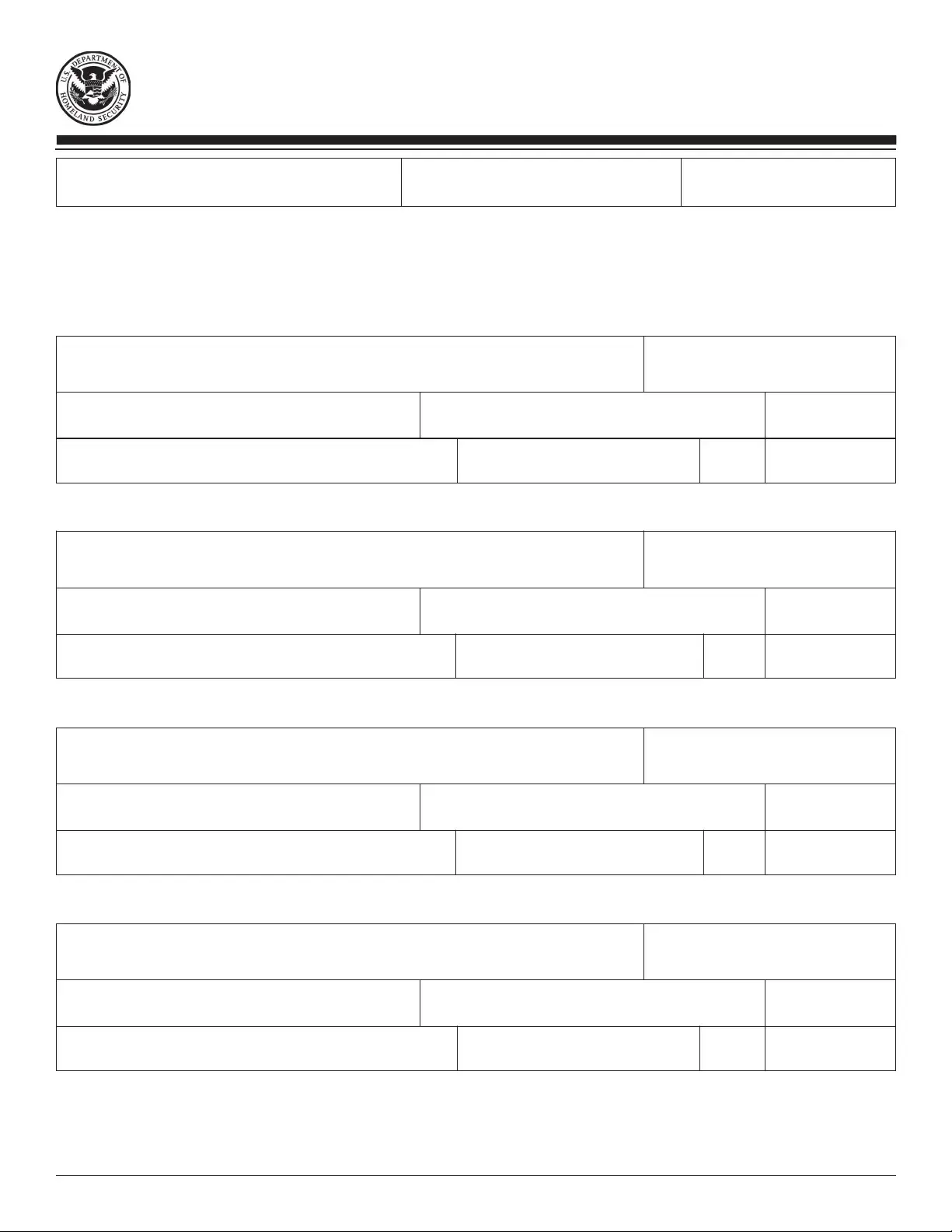
Supplement A,
Preparer and/or Translator Certification for Section 1
Department of Homeland Security
U.S. Citizenship and Immigration Services
USCIS
Form I-9
Supplement A
OMB No. 1615-0047
Expires 05/31/2027
Last Name (Family Name) from Section 1. First Name (Given Name) from Section 1.
Middle initial (if any) from Section 1.
Instructions: This supplement must be completed by any preparer and/or translator who assists an employee in completing Section 1
of Form I-9. The preparer and/or translator must enter the employee's name in the spaces provided above. Each preparer or translator
must complete, sign, and date a separate certification area. Employers must retain completed supplement sheets with the employee's
completed Form I-9.
I attest, under penalty of perjury, that I have assisted in the completion of Section 1 of this form and that to the best of my
knowledge the information is true and correct.
Signature of Preparer or Translator
Date (mm/dd/yyyy)
Last Name (Family Name) First Name (Given Name) Middle Initial (if any)
Address (Street Number and Name)
City or Town State ZIP Code
I attest, under penalty of perjury, that I have assisted in the completion of Section 1 of this form and that to the best of my
knowledge the information is true and correct.
Signature of Preparer or Translator
Date (mm/dd/yyyy)
Last Name (Family Name) First Name (Given Name) Middle Initial (if any)
Address (Street Number and Name)
City or Town State ZIP Code
I attest, under penalty of perjury, that I have assisted in the completion of Section 1 of this form and that to the best of my
knowledge the information is true and correct.
Signature of Preparer or Translator
Date (mm/dd/yyyy)
Last Name (Family Name) First Name (Given Name) Middle Initial (if any)
Address (Street Number and Name)
City or Town State ZIP Code
I attest, under penalty of perjury, that I have assisted in the completion of Section 1 of this form and that to the best of my
knowledge the information is true and correct.
Signature of Preparer or Translator
Date (mm/dd/yyyy)
Last Name (Family Name) First Name (Given Name)
Middle Initial (if any)
Address (Street Number and Name)
City or Town State ZIP Code
Form I-9 Edition 01/20/25 Page 3 of 4
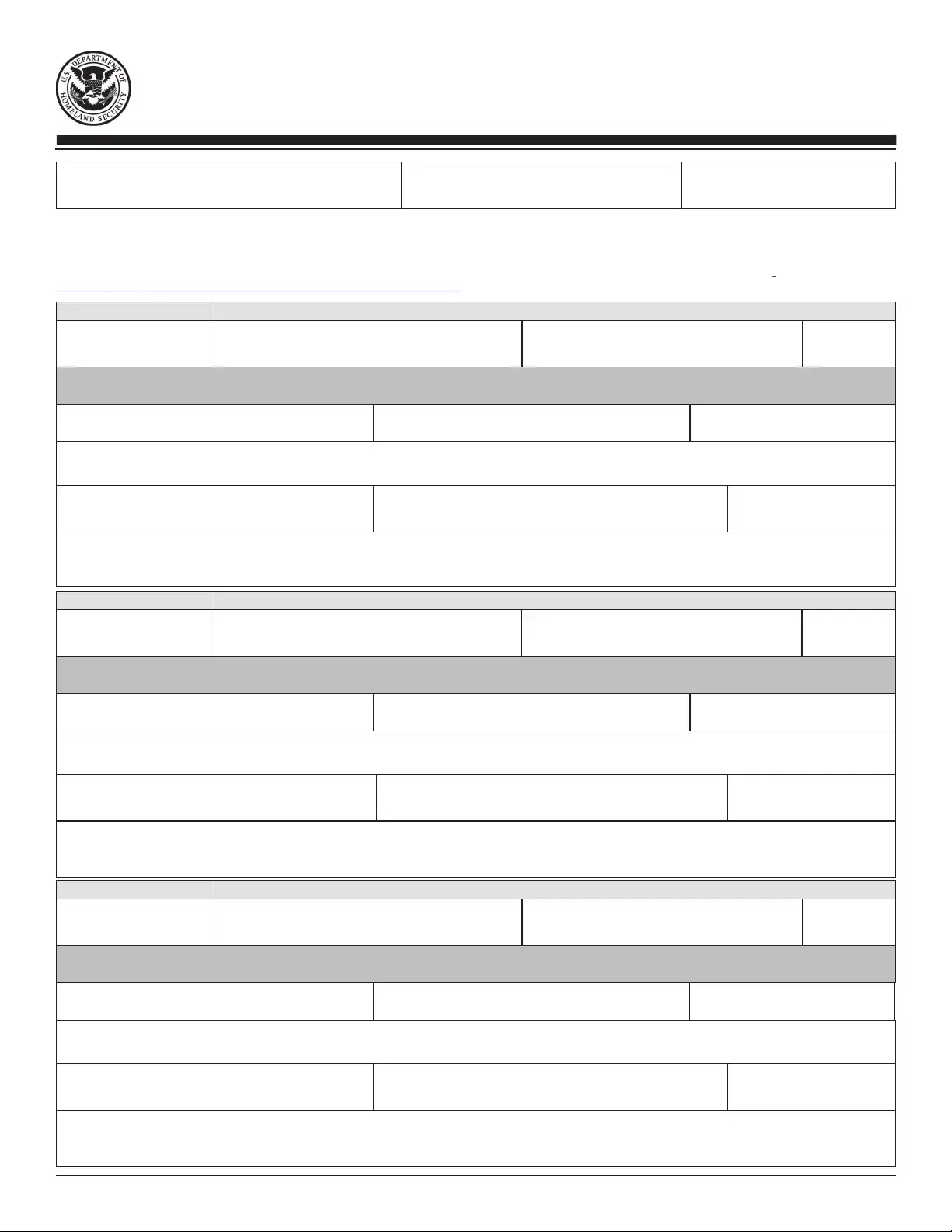
Supplement B,
Reverification and Rehire (formerly Section 3)
USCIS
Form I-9
Supplement B
OMB No. 1615-0047
Expires 05/31/2027
Department of Homeland Security
U.S. Citizenship and Immigration Services
Last Name (Family Name) from Section 1. First Name (Given Name) from Section 1.
Middle initial (if any) from Section 1.
Instructions: This supplement replaces Section 3 on the previous version of Form I-9. Only use this page if your employee requires
reverification, is rehired within three years of the date the original Form I-9 was completed, or provides proof of a legal name change. Enter
the employee's name in the fields above. Use a new section for each reverification or rehire. Review the Form I-9 instructions before
completing this page. Keep this page as part of the employee's Form I-9 record. Additional guidance can be found in the
Handbook for Employers: Guidance for Completing Form I-9 (M-274)
New Name (if applicable)Date of Rehire (if applicable)
Date (mm/dd/yyyy)
Last Name (Family Name) First Name (Given Name)
Middle Initial
Reverification: If the employee requires reverification, your employee can choose to present any acceptable List A or List C documentation to show
continued employment authorization. Enter the document information in the spaces below.
Document Title Document Number (if any) Expiration Date (if any) (mm/dd/yyyy)
I attest, under penalty of perjury, that to the best of my knowledge, this employee is authorized to work in the United States, and if the
employee presented documentation, the documentation I examined appears to be genuine and to relate to the individual who presented it.
Name of Employer or Authorized Representative Signature of Employer or Authorized Representative
Today's Date (mm/dd/yyyy)
Additional Information (Initial and date each notation.)
Check here if you used an
alternative procedure authorized
by DHS to examine documents.
Date of Rehire (if applicable) New Name (if applicable)
Date (mm/dd/yyyy)
Last Name (Family Name) First Name (Given Name) Middle Initial
Reverification: If the employee requires reverification, your employee can choose to present any acceptable List A or List C documentation to show
continued employment authorization. Enter the document information in the spaces below.
Document Title Document Number (if any) Expiration Date (if any) (mm/dd/yyyy)
I attest, under penalty of perjury, that to the best of my knowledge, this employee is authorized to work in the United States, and if the
employee presented documentation, the documentation I examined appears to be genuine and to relate to the individual who presented it.
Name of Employer or Authorized Representative Signature of Employer or Authorized Representative
Today's Date (mm/dd/yyyy)
Additional Information (Initial and date each notation.)
Check here if you used an
alternative procedure authorized
by DHS to examine documents.
Date of Rehire (if applicable) New Name (if applicable)
Date (mm/dd/yyyy)
Last Name (Family Name) First Name (Given Name) Middle Initial
Reverification: If the employee requires reverification, your employee can choose to present any acceptable List A or List C documentation to show
continued employment authorization. Enter the document information in the spaces below.
Document Title Document Number (if any)
Expiration Date (if any) (mm/dd/yyyy)
I attest, under penalty of perjury, that to the best of my knowledge, this employee is authorized to work in the United States, and if the
employee presented documentation, the documentation I examined appears to be genuine and to relate to the individual who presented it.
Name of Employer or Authorized Representative Signature of Employer or Authorized Representative
Today's Date (mm/dd/yyyy)
Additional Information (Initial and date each notation.)
Check here if you used an
alternative procedure authorized
by DHS to examine documents.
Form I-9 Edition 01/20/25 Page 4 of 4

File Properties

Fact Name Description
Purpose The I-9 form is used to verify the identity and employment authorization of individuals hired for employment in the United States.
Who Needs to Complete It All employers must have their employees complete the I-9 form, regardless of their citizenship status.
Filing Deadline Employees must complete Section 1 of the I-9 form on or before their first day of work.
Employer Responsibilities Employers must complete Section 2 of the I-9 form within three business days of the employee's start date.
Retention Period Employers are required to keep the I-9 form for three years after the employee's hire date or one year after the employee's termination, whichever is longer.
State-Specific Forms Some states may have additional requirements for employment verification. For example, California has its own laws governing employment verification.
Penalties for Non-Compliance Employers can face fines and penalties for failing to properly complete or retain I-9 forms.

Instructions on Utilizing USCIS I-9

Completing the USCIS I-9 form is an important step in the employment verification process. After filling out the form, employers will need to review the submitted information and ensure compliance with regulations. The following steps outline how to accurately fill out the form.

  1. Obtain a copy of the USCIS I-9 form. This can be downloaded from the USCIS website or provided by your employer.
  2. Begin with Section 1. Fill in your name, address, date of birth, and Social Security number. Ensure that all information is accurate and matches your identification documents.
  3. Indicate your citizenship or immigration status by checking the appropriate box. This includes options for U.S. citizens, non-citizen nationals, lawful permanent residents, and others.
  4. Sign and date the form in the designated area. This certifies that the information provided is true and correct.
  5. Proceed to Section 2. This section is typically completed by the employer. If you are the employer, you will need to review the employee's documents.
  6. List the documents presented by the employee in the appropriate fields. This includes the document title, issuing authority, document number, and expiration date if applicable.
  7. Sign and date Section 2 as the employer or authorized representative. This confirms that you have verified the employee's documents.
  8. Keep the completed I-9 form on file for the required retention period, which is typically three years after the date of hire or one year after the date of termination, whichever is later.

Important Facts about USCIS I-9

What is the USCIS I-9 form?

The USCIS I-9 form, officially known as the Employment Eligibility Verification form, is a document that employers in the United States must complete for each employee they hire. This form verifies the identity and employment authorization of individuals to work in the U.S. Both employers and employees must fill out specific sections of the form to comply with federal law.

Who needs to complete the I-9 form?

All employers in the U.S. must complete the I-9 form for every employee they hire, regardless of the employee's citizenship or immigration status. This includes full-time, part-time, and temporary workers. Employees must also complete the form to confirm their identity and eligibility to work in the country.

When should the I-9 form be completed?

The I-9 form must be completed within three days of an employee's start date. Employers should ensure that Section 1 of the form is filled out by the employee on or before their first day of work. Employers then have until the third day of employment to complete Section 2 of the form.

What documents are required for the I-9 form?

Employees must provide documents that establish their identity and employment authorization. The documents are categorized into three lists: List A includes documents that establish both identity and employment authorization, while List B includes documents that establish identity and List C includes documents that establish employment authorization. Employees can choose which documents to present from these lists.

How long should employers keep the I-9 form on file?

Employers must retain the I-9 form for three years after the date of hire or for one year after the employee's termination, whichever is longer. It is essential for employers to keep these forms accessible for inspection by authorized government officials.

What happens if an employer fails to complete the I-9 form?

If an employer fails to complete the I-9 form or does not maintain proper records, they may face penalties. Fines can be imposed for each violation, and repeated violations can lead to more severe consequences. It is crucial for employers to understand and comply with these requirements to avoid legal issues.

Can an employee be hired without completing the I-9 form?

No, an employee cannot be legally hired without completing the I-9 form. Employers must have a completed form on file for each employee before they can begin work. Failure to do so can result in penalties for the employer and may complicate the employee's employment status.

Common mistakes

Completing the USCIS I-9 form is a crucial step for both employers and employees in the United States. However, many individuals make common mistakes that can lead to complications. One prevalent error is failing to complete the form within the required timeframe. The I-9 must be filled out within three days of starting a new job. Missing this deadline can create issues for both the employer and the employee.

Another frequent mistake is not providing the correct documentation. The I-9 form requires proof of identity and employment eligibility. Employees must present acceptable documents from the lists provided in the form. Submitting documents that are not on the list can lead to rejection of the form, which can affect employment status.

Inaccurate information is another common issue. Employees sometimes make simple mistakes, such as misspelling their names or providing incorrect dates. Such inaccuracies can result in delays or complications in the verification process. It is essential to double-check all entries for accuracy before submitting the form.

Many individuals also overlook the importance of signatures. Both the employee and the employer must sign the I-9 form. Failing to include a signature can render the form invalid. It is crucial to ensure that both parties have completed their respective sections properly.

Another mistake involves not keeping the I-9 form updated. If an employee’s work authorization status changes, the employer must update the I-9 form accordingly. Neglecting to do so can lead to legal complications and penalties for the employer.

Some people mistakenly believe that the I-9 form is only necessary for new hires. In reality, employers are required to maintain I-9 forms for all employees, regardless of their start date. This misunderstanding can lead to incomplete records and potential legal issues.

Additionally, individuals sometimes fail to understand the importance of privacy. The I-9 form contains sensitive information, and it should be handled with care. Employers must ensure that the form is stored securely to protect employees’ personal data.

Finally, many people do not take the time to review the instructions carefully. The I-9 form comes with specific guidelines that must be followed. Skipping over these instructions can result in errors that could have been easily avoided. Taking the time to read and understand the requirements can save both employees and employers from future complications.

Documents used along the form

The USCIS I-9 form is essential for verifying the identity and employment eligibility of individuals hired in the United States. Alongside the I-9 form, several other documents may be needed to ensure compliance with employment laws. Here is a list of commonly used forms and documents that often accompany the I-9 form:

  • Form W-4: This form is used by employees to indicate their tax situation to their employer. It helps employers withhold the correct amount of federal income tax from employees' paychecks.
  • Form I-765: This application is used by individuals who want to request work authorization in the U.S. It is typically submitted by non-citizens seeking employment.
  • Form I-20: Issued by schools, this form is for non-immigrant students. It certifies that a student is enrolled in a program and is eligible for a student visa.
  • Form DS-2019: This form is used for individuals participating in the Exchange Visitor Program. It allows them to apply for a J-1 visa to work or study in the U.S.
  • Social Security Card: This card verifies an individual's Social Security number. It is often required for employment and tax purposes.
  • Driver's License: A state-issued driver's license serves as a form of identification. It can also confirm residency and age.
  • Passport: A valid passport is an internationally recognized form of identification. It can establish identity and citizenship for employment purposes.
  • Employment Authorization Document (EAD): This card is issued to non-citizens who are authorized to work in the U.S. It serves as proof of their work eligibility.
  • Form I-94: This form records the arrival and departure of non-citizens. It is essential for verifying the immigration status of individuals in the U.S.

These documents play a crucial role in the hiring process and ensure that employers comply with federal regulations. Having the correct paperwork in place helps facilitate a smooth onboarding experience for new employees.

Similar forms

  • W-4 Form: This form is used by employees to indicate their tax situation to their employer. Like the I-9, it helps the employer understand the employee's status, though it focuses on tax withholding rather than employment eligibility.

  • Form 1040: The IRS Form 1040 is used for individual income tax returns. Both forms collect personal information, but the 1040 is for tax purposes, while the I-9 verifies identity and work authorization.

  • Employment Application: This document gathers information about a candidate’s qualifications. Similar to the I-9, it is part of the hiring process but does not verify work eligibility.

  • Form I-20: Issued to international students, this form certifies their eligibility to study in the U.S. Like the I-9, it is essential for confirming legal status, but it pertains specifically to educational purposes.

  • Visa Application: This document is required for foreign nationals seeking to enter the U.S. for various purposes. Both the visa application and the I-9 serve to establish lawful presence in the country.

  • Social Security Card: This card is proof of an individual’s Social Security number. While the I-9 requires proof of identity and work authorization, the Social Security card is often used as one form of verification.

  • Passport: A passport serves as a government-issued identification document. Both the passport and the I-9 validate identity, but the passport is primarily for international travel.

  • Form I-551 (Green Card): This form is evidence of lawful permanent residency. It serves a similar purpose as the I-9 in confirming an individual's right to work in the U.S.

  • Form I-94: This document is issued to foreign visitors upon arrival in the U.S. It indicates the visitor's legal status, similar to how the I-9 verifies employment eligibility.

  • State Identification Card: Issued by state governments, this card provides proof of identity. Like the I-9, it is often used in various transactions to confirm identity, although it does not verify work eligibility.

Dos and Don'ts

When filling out the USCIS I-9 form, it is essential to approach the task with care and attention to detail. This form is crucial for verifying the identity and employment authorization of individuals hired for work in the United States. Here is a list of things you should and shouldn't do when completing the form:

  • Do read the instructions carefully before starting to fill out the form.
  • Do provide accurate and truthful information about your identity and employment eligibility.
  • Do use black or blue ink to fill out the form to ensure clarity.
  • Do sign and date the form in the designated areas.
  • Don't leave any sections of the form blank; all applicable fields must be completed.
  • Don't use correction fluid or tape on the form; if you make a mistake, simply cross it out and write the correct information.
  • Don't submit the form without providing the necessary supporting documents.
  • Don't forget to complete the form within three days of starting your new job.

By following these guidelines, you can ensure that your I-9 form is filled out correctly, helping to facilitate a smooth employment verification process.

Misconceptions

  • Misconception 1: The I-9 form is only for new employees.

    Many believe that the I-9 form is required only for new hires. In reality, it must be completed for all employees, regardless of their start date, as long as they are working in the U.S.

  • Misconception 2: Employers must keep the I-9 form on file indefinitely.

    Some think that employers are required to maintain I-9 forms forever. However, the forms should be kept for three years after the employee's hire date or one year after their termination, whichever is longer.

  • Misconception 3: Only U.S. citizens need to fill out the I-9 form.

    It is a common belief that only U.S. citizens are required to complete the I-9. In fact, all employees, including non-citizens, must fill out the form to verify their eligibility to work in the U.S.

  • Misconception 4: Employers can choose which documents to accept for the I-9.

    Some employers think they can accept any documents they prefer. The I-9 form specifies a list of acceptable documents. Employees must present documents from this list to establish their identity and work authorization.

  • Misconception 5: The I-9 form is optional.

    Many individuals mistakenly believe that completing the I-9 is optional. In truth, it is a legal requirement for all employers to verify the employment eligibility of their employees.

Key takeaways

The USCIS I-9 form is an essential document for employers and employees in the United States. Here are key takeaways to consider when filling it out and using it:

  • Purpose: The I-9 form verifies the identity and employment authorization of individuals hired for employment in the U.S.
  • Completion Timeline: Employers must complete the I-9 form within three days of an employee’s start date.
  • Sections: The form consists of three sections: employee information, employer review, and reverification.
  • Acceptable Documents: Employees must present valid documents that establish identity and employment eligibility. A list of acceptable documents is provided on the form.
  • Document Inspection: Employers must physically examine the documents presented by the employee to ensure they are genuine and relate to the individual.
  • Record Keeping: Employers must retain the completed I-9 form for a specified period, typically three years after the hire date or one year after termination, whichever is longer.
  • Fines for Non-Compliance: Failing to properly complete or retain the I-9 form can lead to fines and penalties for employers.
  • Electronic Submission: Employers may choose to complete and store the I-9 form electronically, provided they follow specific guidelines set by USCIS.
  • Reverification: If an employee’s work authorization expires, employers must reverify their eligibility by completing Section 3 of the I-9 form.
  • Training: Employers should train their staff on how to properly complete the I-9 form to avoid errors and ensure compliance.

Understanding these key points can help ensure that both employers and employees fulfill their responsibilities under U.S. immigration law.