
Used Car Agreement PDF Template

Used Car Agreement PDF Template

The Used Car Agreement form is a crucial document that outlines the terms of a sale between a seller and a buyer for a used vehicle. This contract includes essential details such as the vehicle's make, model, year, and condition, ensuring both parties understand their rights and responsibilities. To facilitate a smooth transaction, consider filling out the form by clicking the button below.

Article Guide

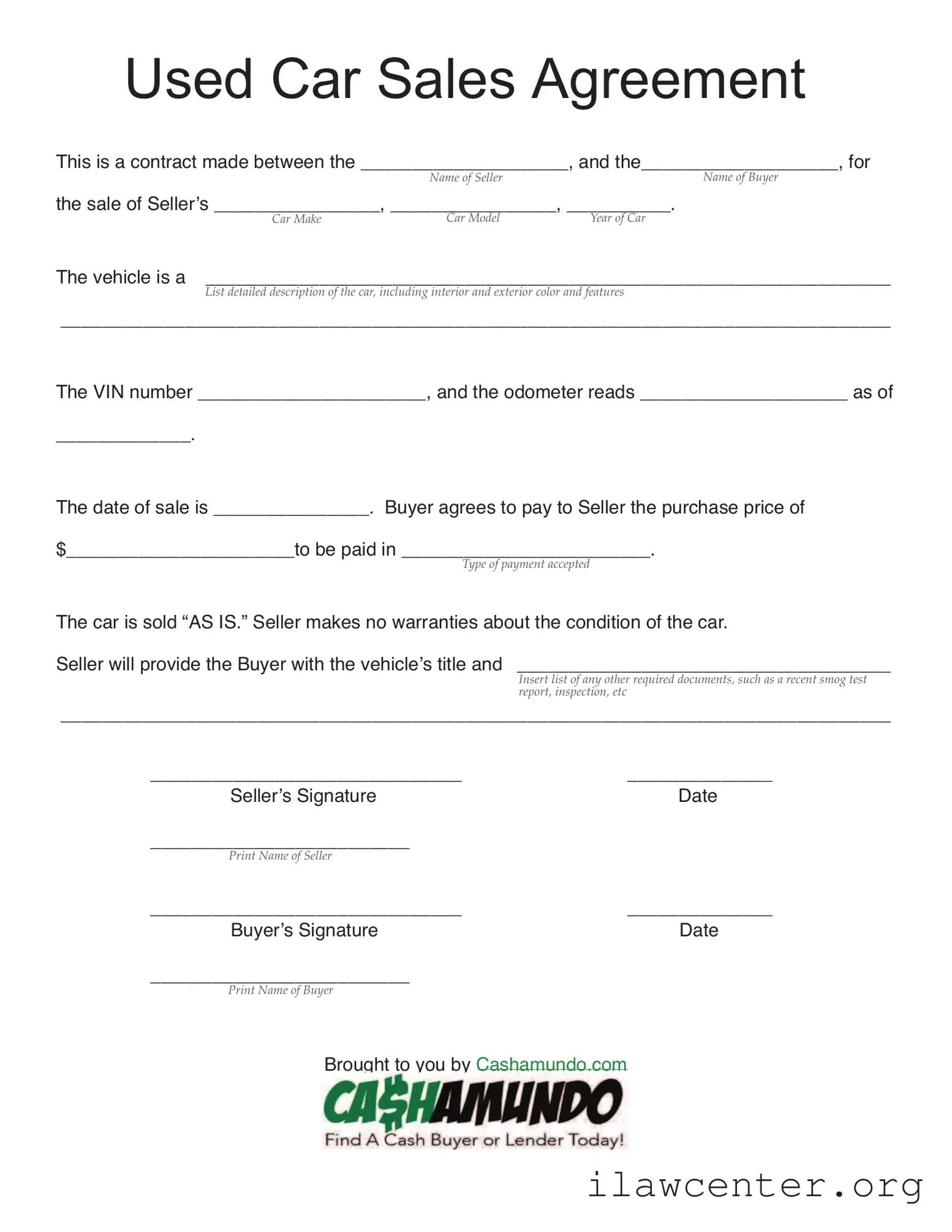
When purchasing a used car, having a clear and comprehensive agreement between the buyer and seller is essential. The Used Car Agreement form serves as that important document, outlining key details of the transaction. This contract begins by identifying the seller and buyer, ensuring both parties are clearly named. It specifies the vehicle being sold, including its make, model, and year, as well as a detailed description that covers both the interior and exterior features. The form also includes critical information such as the Vehicle Identification Number (VIN) and the odometer reading at the time of sale. Additionally, it states the date of sale and the agreed-upon purchase price, along with the payment method. One crucial aspect of this agreement is that the car is sold “AS IS,” meaning the seller does not offer any warranties regarding the vehicle's condition. To facilitate a smooth transfer, the seller commits to providing the buyer with the vehicle’s title and any other necessary documents, such as a recent smog test report or inspection certificate. Finally, both parties sign the document, formalizing the agreement and ensuring that all terms are understood and accepted.

Used Car Agreement Preview

Used Car Sales Agreement
This is a contract made between the ____________________, and the___________________, for
the sale of Seller’s ________________, ________________, __________.
The vehicle is a __________________________________________________________________
________________________________________________________________________________
The VIN number ______________________, and the odometer reads ____________________ as of
_____________.
The date of sale is _______________. Buyer agrees to pay to Seller the purchase price of
$______________________to be paid in ________________________.
The car is sold “AS IS.” Seller makes no warranties about the condition of the car.
Seller will provide the Buyer with the vehicle’s title and ____________________________________
________________________________________________________________________________
______________________________ ______________
Seller’s Signature Date
_________________________
______________________________ ______________
Buyer’s Signature Date
_________________________
Brought to you by
Cashamundo.com
Name of Seller
Name of Buyer
Car Make
Car Model Year of Car
List detailed description of the car, including interior and exterior color and features
Type of payment accepted
Insert list of any other required documents, such as a recent smog test
report, inspection, etc
Print Name of Seller
Print Name of Buyer

File Properties

Fact Name Description
Parties Involved The agreement is made between the Seller and the Buyer for the sale of a used car.
Vehicle Details Includes information about the car's make, model, year, and a detailed description of its condition and features.
Payment Terms The Buyer agrees to pay a specified purchase price using an agreed-upon payment method.
Legal Disclaimer The car is sold "AS IS," meaning the Seller does not provide any warranties regarding the vehicle's condition.

Instructions on Utilizing Used Car Agreement

After gathering the necessary information, you can begin filling out the Used Car Agreement form. This form is essential for documenting the sale of a used vehicle between the seller and the buyer. Ensure that all details are accurate to avoid any future disputes.

  1. Start by entering the Name of Seller in the first blank space.
  2. Next, fill in the Name of Buyer in the second blank space.
  3. In the section labeled Used Car Sales Agreement, write the details of the vehicle being sold:
    • Car Make
    • Car Model
    • Year of Car
  4. Provide a detailed description of the car, including interior and exterior color and features.
  5. Enter the VIN number in the designated space.
  6. Record the odometer reading as of the date of sale.
  7. Fill in the date of sale.
  8. Specify the purchase price of the vehicle.
  9. Indicate the type of payment accepted (e.g., cash, check, etc.).
  10. Note that the car is sold “AS IS” and that the seller makes no warranties about the condition of the car.
  11. List any other required documents that the seller will provide, such as the vehicle’s title and any inspection reports.
  12. Have the seller sign and date the form in the designated area.
  13. Print the Name of Seller below the signature.
  14. Have the buyer sign and date the form in the designated area.
  15. Print the Name of Buyer below the signature.

Important Facts about Used Car Agreement

What is the Used Car Agreement form?

The Used Car Agreement form is a contract between a seller and a buyer for the sale of a used vehicle. It outlines the details of the transaction, including the vehicle's make, model, year, and condition. This form serves to protect both parties by clearly stating the terms of the sale.

What information do I need to fill out on the form?

You will need to provide several key details on the form. This includes the names of both the seller and the buyer, the make, model, and year of the car, a detailed description of the vehicle, the VIN number, and the odometer reading. Additionally, you must specify the sale date and the purchase price, along with the payment method.

What does "AS IS" mean in the agreement?

When a car is sold "AS IS," it means the seller makes no guarantees about the vehicle's condition. The buyer accepts the car in its current state, including any existing defects or issues. It is important for buyers to thoroughly inspect the vehicle before finalizing the purchase.

What documents will the seller provide to the buyer?

The seller must provide the buyer with the vehicle's title, which proves ownership. Depending on local laws, the seller may also need to provide additional documents, such as a recent smog test report or an inspection certificate. These documents should be listed on the agreement form.

How is the payment structured in the agreement?

The payment structure must be clearly defined in the agreement. This includes the total purchase price and the method of payment. Common payment methods include cash, check, or electronic transfer. Ensure that both parties agree on the payment terms before signing the contract.

Do I need witnesses to sign the Used Car Agreement?

What should I do if I have questions after signing the agreement?

If you have questions after signing the agreement, it's best to reach out to the other party involved in the transaction. Clear communication can often resolve misunderstandings. If legal concerns arise, consulting a legal professional may be necessary to understand your rights and obligations under the agreement.

Common mistakes

When filling out the Used Car Agreement form, individuals often make several common mistakes that can lead to confusion or disputes later on. One frequent error is failing to provide complete and accurate information about the seller and buyer. It is crucial to ensure that both names are filled out correctly, as this establishes the parties involved in the transaction.

Another mistake is neglecting to describe the vehicle in detail. The section requesting the car's make, model, and year must be completed accurately. Additionally, a thorough description of the car's features, including its interior and exterior colors, is essential. This information helps both parties understand exactly what is being sold and can prevent misunderstandings.

People often overlook the importance of the Vehicle Identification Number (VIN). This number is unique to each vehicle and serves as a vital identifier. Failing to include the correct VIN can lead to issues with registration or ownership verification down the line.

Another common oversight is not accurately recording the odometer reading. The odometer reading should reflect the mileage at the time of sale. Inaccurate readings can lead to disputes regarding the vehicle's condition and value, so it is important to double-check this information.

Additionally, individuals may forget to specify the date of sale and the payment details. The date is important for establishing when the transaction took place, while the payment section should clearly outline the agreed-upon price and the method of payment. Leaving this information blank can create complications for both the buyer and seller.

Another mistake is misunderstanding the "AS IS" clause. By signing the agreement, the buyer acknowledges that they are accepting the vehicle in its current condition without any warranties from the seller. Buyers should fully understand what this means before finalizing the agreement.

Furthermore, sellers often neglect to list any additional required documents. If there are documents like a recent smog test report or inspection, these should be clearly outlined in the agreement. Providing all necessary documentation is essential for a smooth transaction.

Finally, signatures and dates are critical components of the agreement. Both the seller and buyer must sign the document and date it to make it legally binding. Failing to do so can render the agreement unenforceable.

By paying attention to these details, both parties can ensure that the Used Car Agreement form is completed accurately, reducing the likelihood of misunderstandings or disputes in the future.

Documents used along the form

When purchasing a used car, several documents accompany the Used Car Agreement to ensure a smooth transaction. Each document serves a specific purpose and provides essential information for both the buyer and seller. Below is a list of common forms and documents associated with this agreement.

  • Vehicle Title: This document proves ownership of the car. It must be transferred from the seller to the buyer during the sale.
  • Bill of Sale: A record of the transaction that includes details about the car, the purchase price, and the names of both parties. This document acts as proof of purchase.
  • Odometer Disclosure Statement: This form confirms the car's mileage at the time of sale. It protects against odometer fraud and is often required by law.
  • Smog Test Certificate: In many states, a recent smog test is necessary to ensure the vehicle meets environmental standards. This certificate must be provided by the seller.
  • Vehicle History Report: This report provides information about the car's past, including accidents, title issues, and service history. It helps the buyer make an informed decision.
  • Inspection Report: If the car has undergone a mechanical inspection, this report details the condition of the vehicle. It can help identify any potential issues.
  • Warranty Documents: If the vehicle comes with a warranty, these documents outline the coverage and terms. They are important for the buyer to understand their rights.
  • Power of Attorney: In some cases, the seller may grant power of attorney to another person to handle the transaction. This document authorizes that individual to act on behalf of the seller.
  • Financing Agreement: If the buyer is financing the purchase, this document outlines the terms of the loan, including interest rates and payment schedules.

Having these documents prepared and reviewed can facilitate a successful sale and protect both parties involved. Ensure that all paperwork is complete and accurate to avoid any complications down the road.

Similar forms

The Used Car Agreement form shares similarities with several other documents related to vehicle transactions. Here is a list of those documents:

  • Bill of Sale: This document serves as proof of the transaction between the buyer and seller. It includes details about the vehicle, such as make, model, and VIN, similar to the Used Car Agreement.
  • Vehicle Title Transfer: This document officially transfers ownership of the vehicle from the seller to the buyer. Like the Used Car Agreement, it requires signatures from both parties and includes vehicle identification information.
  • Odometer Disclosure Statement: This statement verifies the vehicle's mileage at the time of sale. It is often included in the Used Car Agreement to ensure transparency about the car's condition.
  • Warranty Document: If applicable, this document outlines any warranties provided by the seller. The Used Car Agreement states that the car is sold "AS IS," which contrasts with warranties but serves a similar purpose in detailing the sale terms.
  • Smog Certification: In many states, a recent smog test report is required for the sale of a used car. This document complements the Used Car Agreement by ensuring the vehicle meets environmental regulations.
  • Inspection Report: An inspection report provides a detailed assessment of the vehicle's condition. It can be referenced in the Used Car Agreement to inform the buyer about any issues before the sale.

Dos and Don'ts

When filling out the Used Car Agreement form, it’s essential to approach the task with care. Here’s a list of things to do and avoid to ensure a smooth transaction.

  • Do double-check all personal information.
  • Do accurately describe the vehicle, including make, model, and year.
  • Do provide the correct VIN number and odometer reading.
  • Do clearly state the purchase price and payment method.
  • Don't leave any sections blank; incomplete forms can lead to issues.
  • Don't overlook the "AS IS" clause; understand its implications.
  • Don't forget to sign and date the agreement.
  • Don't skip listing any additional required documents.

Following these guidelines will help ensure that your Used Car Agreement is completed correctly and protects both parties involved in the transaction.

Misconceptions

Misconceptions about the Used Car Agreement form can lead to confusion and potential disputes. Here are six common misunderstandings:

  • Misconception 1: The Used Car Agreement guarantees the car's condition.
  • Many buyers believe that signing the agreement means the seller guarantees the vehicle's quality. However, the form states that the car is sold “AS IS,” indicating that the seller makes no warranties about its condition.

  • Misconception 2: The seller must provide extensive warranties.
  • Some buyers expect sellers to offer warranties or guarantees. This is not the case with the Used Car Agreement, as it explicitly states that the seller does not make any warranties.

  • Misconception 3: The buyer can return the car for any reason.
  • Buyers often think they can return the vehicle if they are dissatisfied. Since the agreement sells the car “AS IS,” buyers should thoroughly inspect the vehicle before purchase.

  • Misconception 4: The agreement is not legally binding.
  • Some individuals believe that the Used Car Agreement is merely a formality. In reality, it is a legally binding contract that outlines the terms of the sale and can be enforced in court.

  • Misconception 5: Payment methods are flexible and negotiable.
  • Buyers may assume that any payment method is acceptable. The agreement specifies the type of payment accepted, which should be agreed upon before signing.

  • Misconception 6: The seller can withhold the title after the sale.
  • It is a common belief that sellers can delay providing the vehicle title. However, the agreement states that the seller must provide the title and any other required documents at the time of sale.

Key takeaways

When filling out and using the Used Car Agreement form, keep the following key takeaways in mind:

  • Accurate Information: Ensure that all details, such as the names of the seller and buyer, car make, model, year, and VIN number, are filled out accurately.
  • Vehicle Description: Provide a detailed description of the vehicle, including its interior and exterior color, features, and any notable conditions.
  • Odometer Reading: Record the current odometer reading and the date it was noted. This information is crucial for establishing the car's mileage.
  • Payment Terms: Clearly state the purchase price and the method of payment. Specify if the payment is made in cash, check, or another form.
  • AS IS Clause: Understand that the car is sold "AS IS," meaning the seller does not guarantee its condition. Buyers should inspect the vehicle before finalizing the sale.
  • Required Documents: List any additional documents required for the sale, such as the vehicle title and smog test report, to ensure a smooth transaction.