Utah Dmv Tc 656 PDF Template

Utah Dmv Tc 656 PDF Template

The Utah DMV TC 656 form is essential for various vehicle ownership changes, such as transferring titles or correcting information. This form allows individuals to provide necessary details about the vehicle, its owners, and any lien holders involved. To ensure a smooth process, it’s important to fill out the form accurately and completely.

Ready to get started? Fill out the form by clicking the button below.

Article Guide

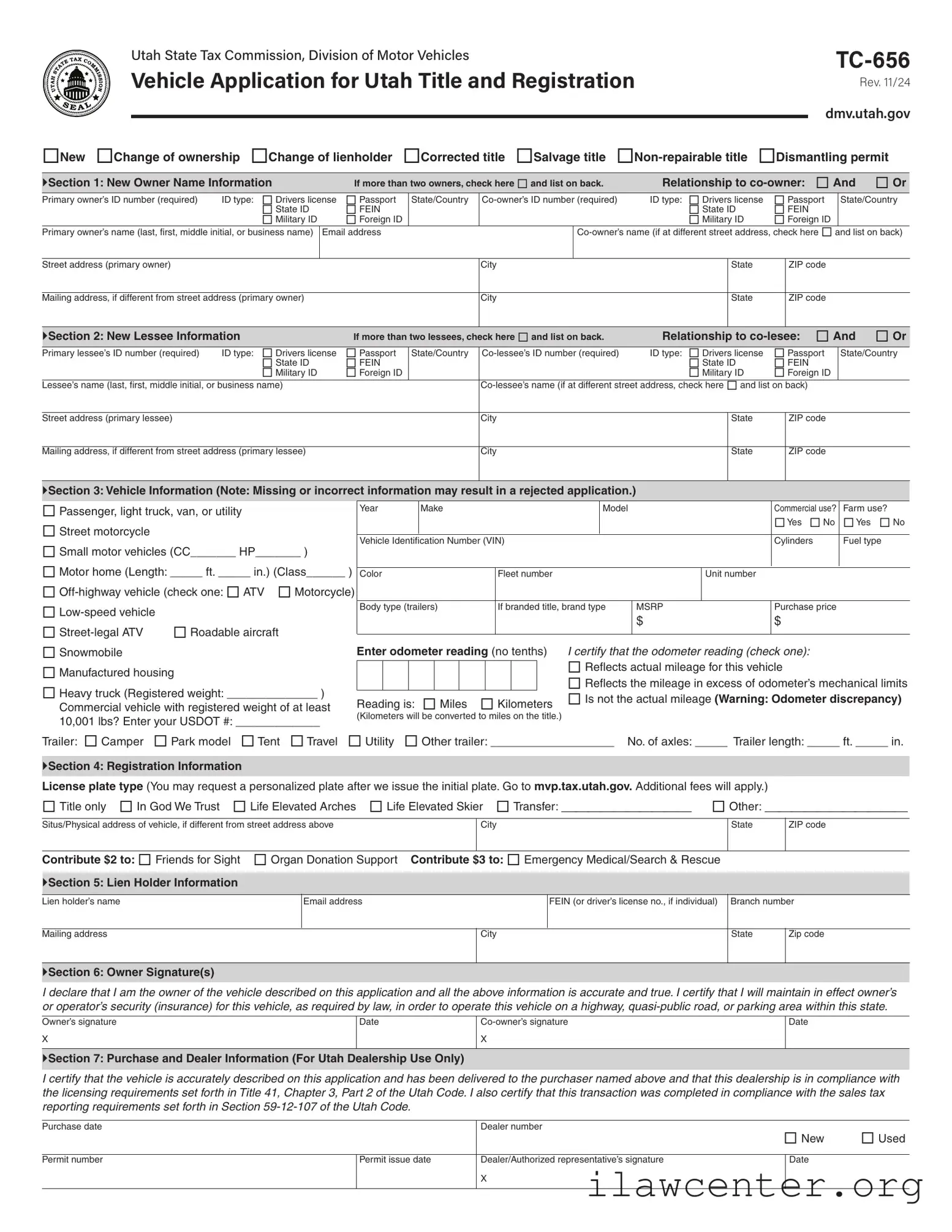
The Utah DMV TC 656 form plays a crucial role in the process of vehicle ownership and registration within the state. This form is utilized for various purposes, including changing ownership, updating lienholder information, and applying for corrected or salvage titles. It consists of several sections that require specific details about the new owner, lessee, and vehicle information. Section 1 gathers essential data about the primary owner and any co-owners, such as names, addresses, and driver’s license numbers. Section 2 focuses on lessee information, ensuring that all parties involved are accurately represented. Vehicle specifics are captured in Section 3, where details like make, model, and vehicle identification number (VIN) are mandatory. This section emphasizes the importance of providing correct information to avoid application rejection. Registration details and license plate preferences are outlined in Section 4, while Section 5 addresses lien holder information. Finally, Sections 6 and 7 require signatures and dealer certifications, confirming the accuracy of the provided information and compliance with state regulations. Each part of the TC 656 form is designed to facilitate a smooth transaction and ensure legal compliance for vehicle owners in Utah.

Utah Dmv Tc 656 Preview

New
Change of ownership
Change of lienholder
Corrected title
Salvage title
Non-repairable title
Dismantling permit
Section 1: New Owner Name Information If more than two owners, check here
and list on back. Relationship to co-owner:
And
Or
Primary owner’s ID number (required) ID type:
Drivers license
Passport State/Country Co-owner’s ID number (required) ID type:
Drivers license
Passport State/Country
State ID
FEIN
State ID
FEIN
Military ID
Foreign ID
Military ID
Foreign ID
Primary owner’s name (last, first, middle initial, or business name) Email address Co-owner’s name (if at different street address, check here
and list on back)
Street address (primary owner) City State ZIP code
Mailing address, if different from street address (primary owner) City State ZIP code
Section 2: New Lessee Information If more than two lessees, check here
and list on back. Relationship to co-lesee:
And
Or
Primary lessee’s ID number (required) ID type:
Drivers license
Passport State/Country Co-lessee’s ID number (required) ID type:
Drivers license
Passport State/Country
State ID
FEIN
State ID
FEIN
Military ID
Foreign ID
Military ID
Foreign ID
Lessee’s name (last, first, middle initial, or business name) Co-lessee’s name (if at different street address, check here
and list on back)
Street address (primary lessee) City State ZIP code
Mailing address, if different from street address (primary lessee) City State ZIP code
Section 3: Vehicle Information (Note: Missing or incorrect information may result in a rejected application.)
Passenger, light truck, van, or utility
Street motorcycle
Small motor vehicles (CC_______ HP_______ )
Motor home (Length: _____ ft. _____ in.) (Class______ )
Off-highway vehicle (check one:
ATV
Motorcycle)
Low-speed vehicle
Street-legal ATV
Roadable aircraft
Snowmobile
Manufactured housing
Heavy truck (Registered weight: ______________ )
Commercial vehicle with registered weight of at least
10,001 lbs? Enter your USDOT #: _____________
Trailer:
Camper
Park model
Tent
Travel
Utility
Other trailer: ___________________ No. of axles: _____ Trailer length: _____ ft. _____ in.
Section 4: Registration Information
License plate type (You may request a personalized plate after we issue the initial plate. Go to mvp.tax.utah.gov. Additional fees will apply.)
Title only
In God We Trust
Life Elevated Arches
Life Elevated Skier
Transfer:
__________
Other:
___________
Situs/Physical address of vehicle, if different from street address above City State ZIP code
Contribute $2 to:
Friends for Sight
Organ Donation Support Contribute $3 to:
Emergency Medical/Search & Rescue
Section 5: Lien Holder Information
Lien holder’s name Email address FEIN (or driver’s license no., if individual) Branch number
Mailing address City State Zip code
Section 6: Owner Signature(s)
I declare that I am the owner of the vehicle described on this application and all the above information is accurate and true. I certify that I will maintain in effect owner’s
or operator’s security (insurance) for this vehicle, as required by law, in order to operate this vehicle on a highway, quasi-public road, or parking area within this state.
Owner’s signature Date Co-owner’s signature Date
X X
Section 7: Purchase and Dealer Information (For Utah Dealership Use Only)
I certify that the vehicle is accurately described on this application and has been delivered to the purchaser named above and that this dealership is in compliance with
the licensing requirements set forth in Title 41, Chapter 3, Part 2 of the Utah Code. I also certify that this transaction was completed in compliance with the sales tax
reporting requirements set forth in Section 59-12-107 of the Utah Code.
Purchase date Dealer number
New
Used
Permit number Permit issue date Dealer/Authorized representative’s signature Date
X
Year Make Model
Commercial use
? Farm use?
Yes
No
Yes
No
Vehicle Identification Number (VIN) Cylinders Fuel type
Color Fleet number Unit n
umber
Body type (trailers) If branded title, brand type MSRP Purchase price
$ $
I certify that the odometer reading (check one):
Reflects actual mileage for this vehicle
Reflects the mileage in excess of odometer’s mechanical limits
Is not the actual mileage (Warning: Odometer discrepancy)
Enter odometer reading (no tenths)
Reading is:
Miles
Kilometers
(Kilometers will be converted to miles on the title.)






File Properties

Fact Name Description
Form Purpose The TC-656 form is used for various vehicle ownership changes in Utah, including new ownership, lienholder changes, and title corrections.
Governing Law This form is governed by Title 41, Chapter 1 of the Utah Code, which outlines vehicle registration and ownership transfer procedures.
Sections Included The form contains several sections, such as owner information, vehicle details, lienholder data, and signatures, ensuring all necessary information is collected.
Odometer Disclosure Applicants must disclose the vehicle's odometer reading, confirming whether it reflects actual mileage or if there is an odometer discrepancy.
Signature Requirement Both the primary owner and co-owner must sign the form, affirming the accuracy of the information provided and compliance with insurance requirements.
Additional Contributions The form allows contributors to donate to various causes, such as organ donation support and emergency medical services, during the registration process.

Instructions on Utilizing Utah Dmv Tc 656

Filling out the Utah DMV TC 656 form is a straightforward process that requires careful attention to detail. This form is essential for various vehicle-related transactions, including ownership changes and title corrections. Follow the steps below to ensure accurate completion of the form.

  1. Choose the appropriate option: At the top of the form, select the reason for filling out the form by checking the corresponding box (e.g., New, Change of ownership, etc.).
  2. Section 1 - New Owner Name Information: Enter the primary owner's name, driver’s license number (or FEIN for businesses), date of birth, and email address. If there is a co-owner, fill in their details as well.
  3. Address Information: Provide the primary owner's street address, city, state, and ZIP code. If the mailing address differs, include that information as well.
  4. Section 2 - New Lessee Information: If applicable, fill in the lessee's and co-lessee's details, including names, driver’s license numbers (or FEIN), and dates of birth.
  5. Lessee Address: Provide the primary lessee's street address and any different mailing address.
  6. Section 3 - Vehicle Information: Fill in the vehicle's year, make, model, and Vehicle Identification Number (VIN). Indicate the vehicle type and any other relevant details, such as odometer reading and color.
  7. Section 4 - Registration Information: Select the license plate type and provide the situs/physical address of the vehicle if different from the owner's address. You may also choose to contribute to various funds.
  8. Section 5 - Lien Holder Information: If applicable, enter the lien holder’s name, mailing address, and contact information.
  9. Section 6 - Owner Signature(s): Both the primary owner and co-owner must sign and date the form, certifying that the information provided is accurate.
  10. Section 7 - Purchase and Dealer Information: If applicable, the dealer must complete this section, including purchase date and dealer information.

Once you have completed the form, review all entries for accuracy. Missing or incorrect information could lead to delays or rejection of your application. After verifying that everything is correct, submit the form as instructed by your local DMV office.

Important Facts about Utah Dmv Tc 656

What is the Utah DMV TC-656 form used for?

The Utah DMV TC-656 form is used for various vehicle-related transactions, including changing ownership, updating lienholder information, correcting titles, and applying for salvage or non-repairable titles. It can also be used to obtain a dismantling permit.

Who needs to fill out the TC-656 form?

Anyone involved in a vehicle transaction in Utah, such as a buyer, seller, or lienholder, may need to complete the TC-656 form. This includes individuals, businesses, and dealerships.

What information is required on the TC-656 form?

The form requires detailed information about the new owner, co-owner, lessee, and vehicle. This includes names, addresses, driver's license numbers, vehicle identification number (VIN), make, model, and odometer readings. Ensure all information is accurate to avoid rejection.

How do I submit the TC-656 form?

You can submit the completed TC-656 form to your local DMV office. Depending on the transaction, you may also be able to submit it online or by mail. Check with your local DMV for specific submission guidelines.

Is there a fee associated with submitting the TC-656 form?

Yes, there may be fees associated with the transactions related to the TC-656 form, such as title transfer fees, registration fees, and personalized plate fees. The exact amount will depend on the type of transaction and your local DMV regulations.

What happens if I make a mistake on the TC-656 form?

If you make a mistake, the form may be rejected. It is crucial to double-check all entries for accuracy before submission. If you realize a mistake after submitting, contact the DMV as soon as possible for guidance on correcting the issue.

Do I need to provide proof of insurance with the TC-656 form?

Yes, you must certify that you will maintain insurance for the vehicle as required by law. However, you do not need to submit proof of insurance with the form. You will need to have it in effect to operate the vehicle legally.

What if I am transferring a vehicle from a dealership?

If you are purchasing from a dealership, they will typically complete the relevant sections of the TC-656 form on your behalf. Ensure you receive a copy of the completed form for your records and verify that all information is correct.

How long does it take to process the TC-656 form?

Processing times can vary. Generally, if submitted in person, you may receive immediate assistance. If submitted by mail, processing can take several weeks. Check with your local DMV for specific timelines.

Can I fill out the TC-656 form online?

The TC-656 form may be available for online completion, depending on your local DMV's capabilities. Visit the Utah DMV website for information on online services and to access the form electronically if available.

Common mistakes

Filling out the Utah DMV TC 656 form can seem straightforward, but many individuals make common mistakes that can lead to delays or rejections. One frequent error is failing to provide complete information in the New Owner Name Information section. This section requires not only the primary owner’s name but also their driver’s license number and date of birth. Omitting any of these details can result in the application being returned.

Another mistake involves the Vehicle Information section. Applicants often neglect to include the Vehicle Identification Number (VIN) or provide incorrect details about the vehicle’s make, model, and year. Such inaccuracies can lead to complications in registration and may even require resubmission of the form. It is essential to double-check that all vehicle information matches the documentation.

Some people also overlook the importance of the Odometer Disclosure. This section requires a clear declaration of the odometer reading. Failing to check the appropriate box or misreporting the mileage can raise red flags and complicate the ownership transfer process. This aspect is crucial, as discrepancies may lead to legal issues down the line.

In the Registration Information section, individuals often forget to specify the type of license plate they desire. Whether opting for a standard plate or a personalized one, it is vital to indicate this choice clearly. Leaving this section blank can lead to delays in processing the application.

Another common pitfall is in the Owner Signature(s) section. Both the primary owner and co-owner must sign the form for it to be valid. Failing to include one of the signatures can result in the application being deemed incomplete. Additionally, the date of the signatures must be included, as this is a critical part of the application process.

Moreover, applicants sometimes neglect to provide the lien holder’s information when applicable. This information is necessary if there is a loan or lien on the vehicle. Missing this detail can lead to further complications, especially if the vehicle is not fully owned.

Finally, many individuals do not read the instructions thoroughly before submitting the form. Each section has specific requirements that must be met. Taking the time to review the form and ensuring that all necessary fields are filled out correctly can save time and prevent frustration.

Documents used along the form

The Utah DMV TC 656 form is essential for various vehicle-related transactions, including ownership changes and lienholder updates. When completing this form, you may also need to gather additional documents that support your application. Here are five common forms and documents often used alongside the TC 656.

  • TC-817 Form: This form is required if you are applying for a personalized license plate. It includes sections for customization options and additional fees associated with the request.
  • Bill of Sale: A bill of sale serves as proof of the transaction between the buyer and seller. It typically includes details such as the purchase price, vehicle identification number (VIN), and signatures from both parties.
  • Odometer Disclosure Statement: This document is necessary to disclose the vehicle's mileage at the time of sale. It helps prevent fraud by ensuring that the odometer reading is accurate and provides a record for future reference.
  • Title Application: If you are applying for a new title or correcting an existing one, you may need to complete a title application form. This document requests information about the vehicle and its ownership history.
  • Proof of Insurance: Before registering a vehicle, you must provide proof of insurance coverage. This document verifies that the vehicle is insured in compliance with state laws, ensuring financial protection in case of accidents.

Gathering these documents can streamline the application process and help ensure that your transaction is completed without delays. Each form plays a vital role in providing the necessary information to the DMV, allowing for a smooth transfer of ownership or registration.

Similar forms

The Utah DMV TC-656 form is essential for various vehicle-related transactions. It shares similarities with several other documents used in vehicle registration and ownership transfer. Here are eight documents that are similar to the TC-656 form:

  • Bill of Sale: This document serves as proof of the sale and transfer of ownership from the seller to the buyer. Like the TC-656, it includes details about the vehicle and the parties involved.
  • Application for Title: This form is used to apply for a new title after purchasing a vehicle. It requires similar information about the vehicle and owners, ensuring a smooth transfer process.
  • Vehicle Registration Application: This document registers a vehicle with the state and is similar in that it collects information about the owner and the vehicle, ensuring compliance with state laws.
  • Title Transfer Form: When a vehicle changes ownership, this form is used to officially transfer the title. It requires similar owner information and vehicle details as the TC-656.
  • Odometer Disclosure Statement: This document verifies the odometer reading at the time of sale. It is often included with title transfer documents, similar to how the TC-656 handles odometer disclosures.
  • Power of Attorney for Vehicle Transactions: This form allows one person to act on behalf of another in vehicle-related matters. It shares the need for clear identification of the parties involved, much like the TC-656.
  • Salvage Title Application: When a vehicle is declared a total loss, this application is used to obtain a salvage title. It requires information about the vehicle and its previous ownership, similar to the TC-656.
  • Lien Release Form: This document is used to release a lien on a vehicle. It often accompanies title transfer documents and requires similar details about the lienholder and the vehicle.

Dos and Don'ts

Filling out the Utah DMV TC 656 form can seem daunting, but getting it right is crucial for a smooth registration process. Here are some essential dos and don’ts to keep in mind:

  • Do double-check all personal information for accuracy. Mistakes can delay your application.
  • Do include the correct Vehicle Identification Number (VIN). This is vital for identifying your vehicle.
  • Do ensure that you sign and date the form. Your signature confirms the information is true.
  • Do provide a valid email address. This allows the DMV to contact you if there are any issues.
  • Don't leave any sections blank. Missing information can lead to rejection.
  • Don't use abbreviations for street names or cities. Write them out fully to avoid confusion.
  • Don't forget to check the box for any additional contributions if you wish to donate. It’s an easy way to support good causes.

By following these guidelines, you can help ensure that your application is processed quickly and efficiently. Take your time, review your entries, and avoid the common pitfalls. Your vehicle registration is important—make sure it’s done right!

Misconceptions

  • Misconception 1: The TC 656 form is only for new vehicle registrations.
  • This form can also be used for changes in ownership, lienholders, and for correcting titles.

  • Misconception 2: Only individuals can complete the TC 656 form.
  • Businesses can also fill out this form using their Federal Employer Identification Number (FEIN) instead of a driver’s license number.

  • Misconception 3: Odometer readings are optional on the TC 656 form.
  • Providing accurate odometer readings is crucial. Missing or incorrect information may lead to a rejected application.

  • Misconception 4: The TC 656 form does not require signatures.
  • Owner and co-owner signatures are mandatory to confirm the accuracy of the information provided.

  • Misconception 5: You cannot change the mailing address on the TC 656 form.
  • The form allows you to specify a different mailing address from the street address, ensuring all correspondence reaches you.

  • Misconception 6: The TC 656 form is only for passenger vehicles.
  • This form covers various vehicle types, including motorcycles, trailers, and commercial vehicles.

  • Misconception 7: Additional fees are not necessary when filing the TC 656 form.
  • Some transactions, such as personalized plates, may incur additional fees that must be paid at the time of submission.

Key takeaways

Filling out the Utah DMV TC 656 form may seem daunting at first, but understanding its key components can simplify the process. Here are some essential takeaways to keep in mind:

  • Accurate Information is Crucial: Ensure all details, especially in the vehicle information section, are correct. Missing or incorrect information can lead to application rejection.
  • Owner and Lessee Details: Provide complete names, addresses, and identification numbers for both the primary owner and any co-owners or lessees. This helps in establishing clear ownership.
  • Odometer Disclosure: Be prepared to disclose the vehicle's odometer reading accurately. This is vital for preventing potential issues related to mileage discrepancies.
  • Registration Choices: Familiarize yourself with the various license plate types available. If opting for a personalized plate, remember to complete the additional TC-817 form.
  • Signature Requirement: Both the owner and co-owner must sign the form, confirming the accuracy of the information provided. This step is essential for validating the application.
  • Contributions: Consider optional contributions to programs such as organ donation support or emergency medical services. These are small ways to give back while processing your vehicle registration.

By keeping these takeaways in mind, you can approach the Utah DMV TC 656 form with confidence, ensuring a smoother experience in registering your vehicle.