Fillable Vehicle Accident Damage Release Document

Fillable Vehicle Accident Damage Release Document

The Vehicle Accident Damage Release form is a legal document that allows individuals to formally release a party from liability for damages resulting from a vehicle accident. This form is crucial for ensuring that all parties involved understand their rights and responsibilities following an incident. To protect your interests, consider filling out the form by clicking the button below.

Article Guide

When involved in a vehicle accident, navigating the aftermath can be overwhelming. One important document that often comes into play is the Vehicle Accident Damage Release form. This form serves as a formal agreement between the parties involved, allowing one party to release the other from any further claims related to the accident. Typically, it outlines the specific damages being released, ensuring that all parties understand what is being settled. By signing this form, the individual acknowledges that they have received compensation for their damages and agrees not to pursue any additional claims in the future. It's crucial to understand the implications of signing such a document, as it can significantly affect your rights and options moving forward. Whether you are the driver, passenger, or even a bystander, knowing how this form works and its potential consequences can empower you to make informed decisions in the wake of an accident.

Vehicle Accident Damage Release Preview

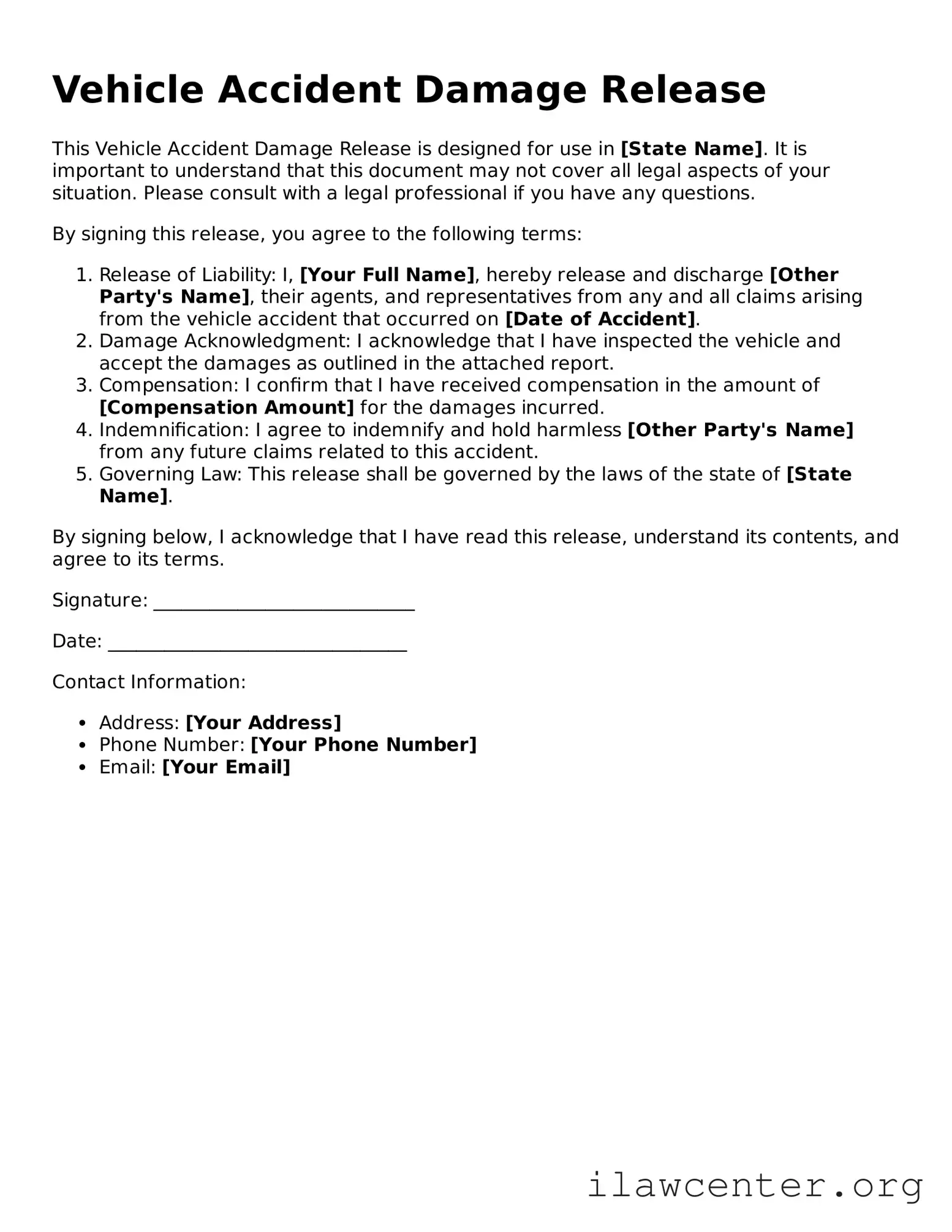
Vehicle Accident Damage Release

This Vehicle Accident Damage Release is designed for use in [State Name]. It is important to understand that this document may not cover all legal aspects of your situation. Please consult with a legal professional if you have any questions.

By signing this release, you agree to the following terms:

  1. Release of Liability: I, [Your Full Name], hereby release and discharge [Other Party's Name], their agents, and representatives from any and all claims arising from the vehicle accident that occurred on [Date of Accident].
  2. Damage Acknowledgment: I acknowledge that I have inspected the vehicle and accept the damages as outlined in the attached report.
  3. Compensation: I confirm that I have received compensation in the amount of [Compensation Amount] for the damages incurred.
  4. Indemnification: I agree to indemnify and hold harmless [Other Party's Name] from any future claims related to this accident.
  5. Governing Law: This release shall be governed by the laws of the state of [State Name].

By signing below, I acknowledge that I have read this release, understand its contents, and agree to its terms.

Signature: ____________________________

Date: ________________________________

Contact Information:

  • Address: [Your Address]
  • Phone Number: [Your Phone Number]
  • Email: [Your Email]

PDF Form Characteristics

Fact Name Description
Purpose The Vehicle Accident Damage Release form is used to release liability for damages resulting from a vehicle accident.
State-Specific Forms Each state may have its own version of the form, which must comply with local laws and regulations.
Governing Laws In many states, the form is governed by tort law, which addresses civil wrongs and damages.
Signatories Both parties involved in the accident must sign the form to acknowledge the release of liability.
Effectiveness Once signed, the form generally prevents the injured party from claiming further damages related to the accident.

Instructions on Utilizing Vehicle Accident Damage Release

After obtaining the Vehicle Accident Damage Release form, you will need to complete it accurately to ensure a smooth processing of your claim. Follow the steps outlined below to fill out the form correctly.

  1. Begin by entering your personal information at the top of the form. This includes your full name, address, and contact number.
  2. Next, provide details about the vehicle involved in the accident. Include the make, model, year, and vehicle identification number (VIN).
  3. In the designated section, describe the circumstances of the accident. Be clear and concise, providing relevant details such as the date, time, and location of the incident.
  4. Indicate the extent of the damage to your vehicle. You may need to attach additional documentation, such as photographs or repair estimates, if required.
  5. If applicable, list any other parties involved in the accident, including their names and contact information.
  6. Review the form for accuracy. Ensure that all sections are completed and that there are no errors or omissions.
  7. Finally, sign and date the form at the bottom. This signifies your agreement to the terms outlined in the release.

Important Facts about Vehicle Accident Damage Release

What is a Vehicle Accident Damage Release form?

A Vehicle Accident Damage Release form is a legal document used to formally release one party from liability for damages resulting from a vehicle accident. This form is typically signed by the injured party or the party claiming damages, indicating that they agree to accept a certain amount of compensation in exchange for waiving any further claims related to the accident.

When should I use this form?

You should use the Vehicle Accident Damage Release form after you have reached a settlement with the other party involved in the accident. It is important to use this form once you have received compensation and are ready to finalize the agreement, ensuring that you will not pursue any additional claims for damages related to the incident.

What information is required on the form?

The form typically requires basic information such as the names and contact details of both parties, details of the accident (including date and location), a description of the damages, and the amount of compensation agreed upon. Additionally, both parties must sign and date the form to make it legally binding.

Is the form legally binding?

Yes, once both parties sign the Vehicle Accident Damage Release form, it becomes a legally binding contract. This means that the party releasing the claims cannot later seek additional compensation for the same accident. It is crucial to ensure that all details are accurate before signing.

What happens if I sign the form but later discover additional damages?

If you sign the form and later discover additional damages, you may have limited options. Generally, signing the release means you cannot pursue further claims related to that accident. It is advisable to thoroughly assess all damages and consult with a legal professional before signing the form to avoid this situation.

Can I modify the form after it has been signed?

Once the Vehicle Accident Damage Release form is signed, modifications are generally not allowed. Any changes would typically require a new agreement to be drafted and signed by both parties. This ensures that both parties are in agreement about any alterations to the original terms.

Do I need a lawyer to complete this form?

While it is not mandatory to have a lawyer to complete the Vehicle Accident Damage Release form, consulting with one can be beneficial. A lawyer can help ensure that your rights are protected and that the form is filled out correctly. This is especially important if the accident resulted in significant damages or injuries.
Common mistakes

Filling out a Vehicle Accident Damage Release form can be a straightforward process, but many individuals make common mistakes that can complicate matters. One frequent error is failing to provide accurate personal information. This includes not only your name and address but also your contact number. Incomplete or incorrect details can delay communication with insurance companies and other parties involved.

Another common mistake is neglecting to include all relevant details about the accident. This means not describing the incident clearly or omitting key facts such as the date, time, and location. Providing a thorough account helps ensure that all parties understand the circumstances surrounding the accident.

People often overlook the importance of documenting damage accurately. This includes not only the visible damage to the vehicles but also any injuries sustained. If you fail to document this information properly, it could impact any future claims or negotiations regarding compensation.

Some individuals rush through the form and skip the signature section. Not signing the document can render it invalid. Always double-check that you have signed and dated the form before submission. This simple step can prevent unnecessary delays in processing your claim.

Additionally, misunderstanding the terms of the release can lead to significant issues. Individuals sometimes do not read the fine print, which can include clauses that limit their rights to pursue further claims. It’s essential to understand what you are agreeing to before signing.

Another mistake is not keeping a copy of the completed form. Failing to retain a copy means you have no record of what was submitted. This can be problematic if there are disputes or if you need to reference the information later.

Many people also forget to include supporting documentation. This can include photographs of the damage, police reports, or witness statements. Providing this additional evidence can strengthen your case and clarify the situation for all parties involved.

In some cases, individuals submit the form without checking for errors. Typos or incorrect information can lead to misunderstandings or delays. It is always wise to review the form thoroughly before sending it off.

Lastly, some people fail to understand the timeline for submitting the form. Each insurance company may have different deadlines, and missing these can jeopardize your claim. Being aware of these timelines ensures that you stay on track with your claim process.

Documents used along the form

When dealing with the aftermath of a vehicle accident, several forms and documents may accompany the Vehicle Accident Damage Release form. Each of these documents plays a crucial role in ensuring that all parties involved are protected and that the necessary information is exchanged effectively. Below is a list of commonly used forms that may be relevant in such situations.

  • Accident Report Form: This form is typically completed by law enforcement at the scene of the accident. It contains essential details about the incident, including the date, time, location, and parties involved.
  • Insurance Claim Form: After an accident, this form is submitted to your insurance company to initiate the claims process. It outlines the details of the accident and the damages incurred.
  • Medical Release Form: This document authorizes healthcare providers to share medical information with insurance companies or other relevant parties, often necessary for claims related to injuries sustained in the accident.
  • Witness Statement Form: Witnesses to the accident can provide valuable information. This form collects their accounts and observations, which may be crucial for determining fault.
  • Property Damage Assessment Form: This form details the extent of damage to vehicles and property involved in the accident. It is often used by insurance adjusters to evaluate claims.
  • Settlement Agreement: Once negotiations are complete, this document outlines the terms of the settlement between parties, including any compensation agreed upon for damages or injuries.
  • Release of Liability Form: This form is signed to release one party from any further liability related to the accident, protecting them from future claims once a settlement is reached.
  • Vehicle Repair Estimate: This document provides an estimate for the costs associated with repairing the vehicle involved in the accident. It is often required by insurance companies before approving claims.
  • Subrogation Form: If your insurance company pays for your damages, this form allows them to pursue reimbursement from the at-fault party's insurance, ensuring they can recover costs.

Understanding these documents can significantly aid in navigating the complexities that arise following a vehicle accident. Each form serves a specific purpose, contributing to a smoother resolution process for all parties involved.

Similar forms

  • Release of Liability Form: This document releases one party from any legal claims or liabilities resulting from an incident. Like the Vehicle Accident Damage Release, it aims to protect one party from future lawsuits related to the event.
  • Settlement Agreement: A settlement agreement outlines the terms of a resolution between parties following an incident. It is similar in that it often includes a release of claims, ensuring that both parties agree to the terms and waive further legal action.
  • Waiver of Claims: A waiver of claims is a document where one party agrees not to pursue any legal claims against another party. This is akin to the Vehicle Accident Damage Release as both serve to prevent future legal disputes.
  • Indemnity Agreement: An indemnity agreement involves one party agreeing to compensate another for any losses or damages. This document shares similarities with the Vehicle Accident Damage Release by providing protection against financial liability stemming from an incident.

Dos and Don'ts

When filling out a Vehicle Accident Damage Release form, it's important to approach the task with care. This document can have significant implications for your rights and responsibilities following an accident. Here are ten things you should and shouldn't do:

  • Do read the entire form thoroughly before filling it out.
  • Don't rush through the process. Take your time to ensure accuracy.
  • Do provide clear and honest information regarding the accident.
  • Don't omit any details, even if they seem minor. Every piece of information counts.
  • Do double-check your contact information for accuracy.
  • Don't use abbreviations or unclear terms that could lead to misunderstandings.
  • Do sign and date the form where required.
  • Don't forget to keep a copy of the completed form for your records.
  • Do consult with a legal professional if you have questions about the form.
  • Don't hesitate to ask for clarification if any part of the form is confusing.

By following these guidelines, you can help ensure that your Vehicle Accident Damage Release form is filled out correctly, protecting your interests in the process.

Misconceptions

Misconceptions about the Vehicle Accident Damage Release form can lead to confusion and potential legal issues. Here are seven common misunderstandings:

  1. It releases all liability. Many people believe that signing this form absolves them of all responsibility. In reality, it only pertains to specific damages agreed upon in the release.
  2. It is mandatory to sign. Some individuals think they must sign the form to receive compensation. However, signing is voluntary and should be carefully considered.
  3. It covers future claims. A common misconception is that the release form covers any future claims related to the accident. Typically, it only addresses current damages.
  4. All damages are included. Some believe that the form automatically includes all damages. However, it is essential to read the details, as certain damages may be excluded.
  5. Insurance companies require it immediately. Many think that insurance companies demand the form right away. In fact, it is wise to consult with an attorney before signing.
  6. It is the same as a settlement agreement. People often confuse the release form with a settlement agreement. While related, they serve different purposes and have different implications.
  7. Signing it means you agree with the accident's fault. Some assume that signing the form indicates agreement on fault. This is not necessarily true; the form focuses on damages, not liability.

Understanding these misconceptions can help individuals make informed decisions after a vehicle accident.

Key takeaways

When dealing with a Vehicle Accident Damage Release form, there are several important points to keep in mind. Here are some key takeaways:

  • Understand the Purpose: This form is used to release a party from liability for damages after an accident. Knowing its purpose helps you fill it out correctly.
  • Gather Necessary Information: Before completing the form, collect all relevant details, such as accident dates, involved parties, and vehicle information.
  • Review Before Signing: Always read the entire form carefully before signing. Make sure you understand what you are agreeing to.
  • Keep a Copy: After submitting the form, retain a copy for your records. This can be useful for future reference or disputes.