Vehicle Payoff Authorization PDF Template

Vehicle Payoff Authorization PDF Template

The Vehicle Payoff Authorization form is a crucial document that allows an individual to authorize the payoff of a motor vehicle loan. This form facilitates the transfer of ownership and ensures that all necessary documents are provided to the new owner or financial institution. To streamline your vehicle payoff process, consider filling out the form by clicking the button below.

Article Guide

The Vehicle Payoff Authorization form is a crucial document for anyone looking to settle the financial obligations tied to a motor vehicle. This form allows the vehicle owner to authorize a third party to either pay off the remaining balance on their vehicle or accept the payment on their behalf. It includes essential details such as the vehicle's make, model, and identification number, ensuring clarity in the transaction. The form also outlines the responsibilities of both parties, including the transfer of ownership documents and the cancellation of any insurance policies associated with the vehicle. Furthermore, it emphasizes that the vehicle is sold "AS IS," meaning no warranties are provided. This document must be signed in the presence of a witness, and if required, notarization can be included for added legal assurance. Understanding this form is vital for a smooth transaction and to avoid potential disputes in the future.

Vehicle Payoff Authorization Preview

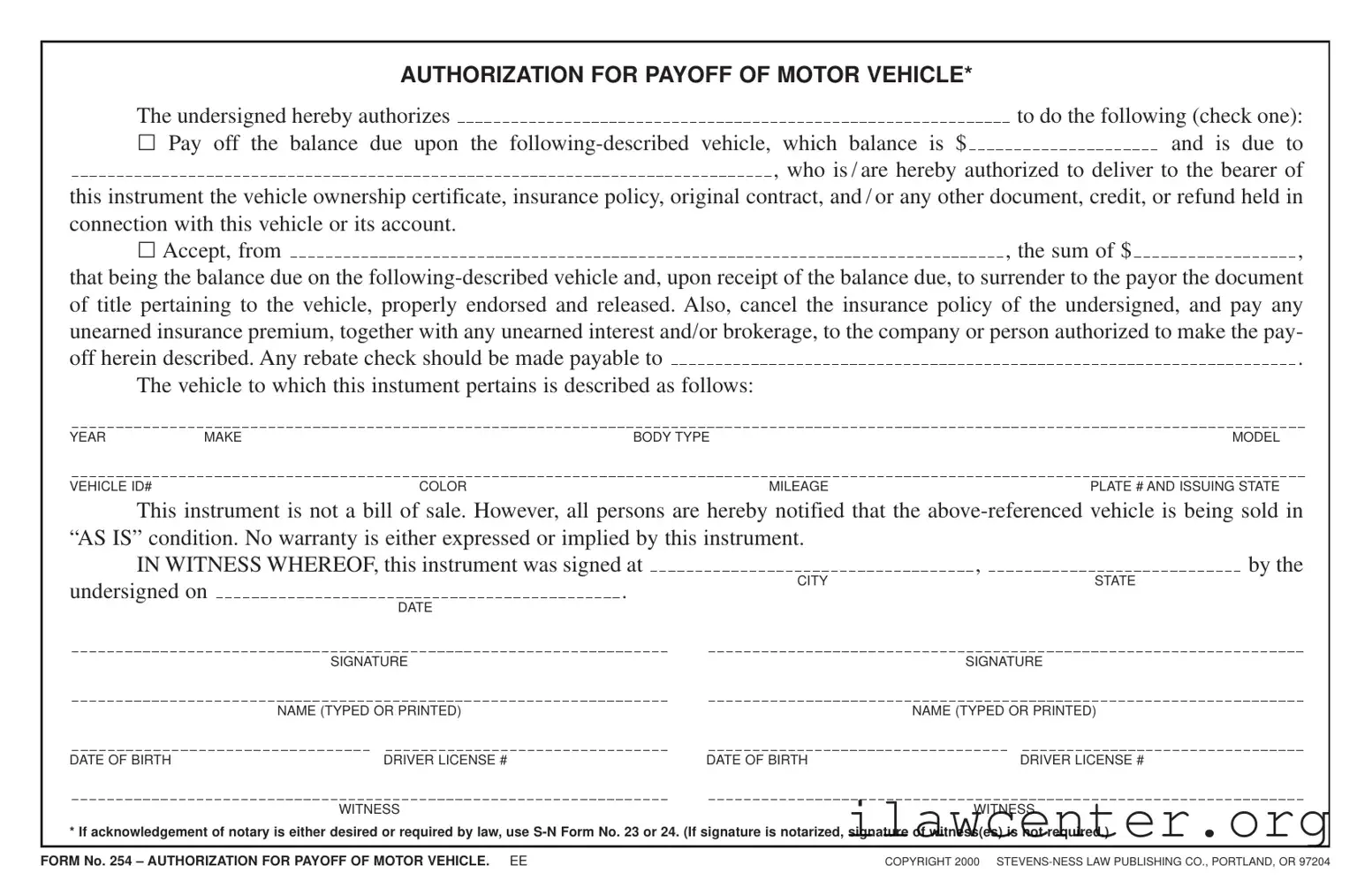
AUTHORIZATION FOR PAYOFF OF MOTOR VEHICLE*
The undersigned hereby authorizes to do the following (check one):
a Pay off the balance due upon the following-described vehicle, which balance is $ and is due to
, who is / are hereby authorized to deliver to the bearer of
this instrument the vehicle ownership certificate, insurance policy, original contract, and / or any other document, credit, or refund held in
connection with this vehicle or its account.
a Accept, from , the sum of $ ,
that being the balance due on the following-described vehicle and, upon receipt of the balance due, to surrender to the payor the document
of title pertaining to the vehicle, properly endorsed and released. Also, cancel the insurance policy of the undersigned, and pay any
unearned insurance premium, together with any unearned interest and/or brokerage, to the company or person authorized to make the pay-
off herein described. Any rebate check should be made payable to .
The vehicle to which this instument pertains is described as follows:
YEAR MAKE BODY TYPE MODEL
VEHICLE ID# COLOR MILEAGE PLATE # AND ISSUING STATE
This instrument is not a bill of sale. However, all persons are hereby notified that the above-referenced vehicle is being sold in
AS IS” condition. No warranty is either expressed or implied by this instrument.
IN WITNESS WHEREOF, this instrument was signed at , by the
CITY STATE
undersigned on .
DATE
SIGNATURE SIGNATURE
NAME (TYPED OR PRINTED) NAME (TYPED OR PRINTED)
DATE OF BIRTH DRIVER LICENSE # DATE OF BIRTH DRIVER LICENSE #
WITNESS WITNESS
* If acknowledgement of notary is either desired or required by law, use S-N Form No. 23 or 24. (If signature is notarized, signature of witness(es) is not required.)
FORM No. 254 – AUTHORIZATION FOR PAYOFF OF MOTOR VEHICLE. EE COPYRIGHT 2000 STEVENS-NESS LAW PUBLISHING CO., PORTLAND, OR 97204

File Properties

Fact Name Details
Purpose The Vehicle Payoff Authorization form allows a vehicle owner to authorize a third party to pay off the remaining balance on their vehicle loan.
Parties Involved This form involves the vehicle owner, the lender, and the party responsible for making the payoff.
Vehicle Description The form requires detailed information about the vehicle, including the year, make, model, and Vehicle Identification Number (VIN).
Payment Instructions The form provides options for either paying off the balance directly or accepting the payoff amount from the lender.
Insurance Cancellation Upon completion of the payoff, the form authorizes the cancellation of the insurance policy associated with the vehicle.
As Is Condition The vehicle is sold in "AS IS" condition, meaning there are no warranties regarding its condition or performance.
Witness Requirement A witness signature may be required unless the signature is notarized, in which case a witness is not necessary.
Governing Law The laws governing the use of this form may vary by state. It is important to check local regulations.
Form Number This specific form is designated as FORM No. 254, published by Stevens-Ness Law Publishing Co.

Instructions on Utilizing Vehicle Payoff Authorization

Completing the Vehicle Payoff Authorization form is an essential step in facilitating the payoff process for a motor vehicle. Once you have filled out the form correctly, it will allow the necessary parties to proceed with the transaction without delay.

  1. Begin by indicating whether you are authorizing a payoff or accepting a payment. Check the appropriate box at the top of the form.
  2. In the first section, if you are paying off the balance, enter the amount due in the space provided next to “balance is $” and specify to whom the payment is due.
  3. Next, provide details about the vehicle. Fill in the YEAR, MAKE, BODY TYPE, MODEL, VEHICLE ID#, COLOR, MILEAGE, and PLATE # AND ISSUING STATE in the designated fields.
  4. If you are accepting a payment, write the amount being accepted in the space next to “the sum of $” and include the name of the person or entity making the payment.
  5. Indicate who should receive any rebate check by entering their name in the specified area.
  6. Complete the section regarding the signers. Each signer must provide their NAME (TYPED OR PRINTED), DATE OF BIRTH, and DRIVER LICENSE #.
  7. Sign the form in the designated signature areas. If there are multiple signers, ensure that all required signatures are present.
  8. If a witness is required, have the witness sign in the appropriate area. If notarization is needed, consider using the S-N Form No. 23 or 24 as mentioned.
  9. Finally, include the CITY and STATE where the form is signed, along with the DATE of signing.

Important Facts about Vehicle Payoff Authorization

What is a Vehicle Payoff Authorization form?

The Vehicle Payoff Authorization form is a document that allows a vehicle owner to authorize another party to pay off the remaining balance on their vehicle loan. This form facilitates the transfer of ownership documents and ensures that the loan is settled properly.

Who needs to fill out this form?

This form is typically filled out by the vehicle owner, also known as the borrower. It can also be completed by a third party, such as a dealership or a financial institution, if they are involved in the payoff process.

What information is required on the form?

The form requires specific details about the vehicle, including the year, make, model, vehicle identification number (VIN), color, and mileage. Additionally, the form needs the names of the parties involved, the amount owed, and other relevant information regarding the insurance policy and title transfer.

What does it mean to authorize a payoff?

Authorizing a payoff means giving permission for a designated person or entity to pay off the remaining balance on a vehicle loan on your behalf. This can help in transferring ownership and ensuring that all financial obligations related to the vehicle are settled.

Is this form a bill of sale?

No, the Vehicle Payoff Authorization form is not a bill of sale. It is an authorization for the payoff of a vehicle loan and does not transfer ownership by itself. The ownership transfer typically occurs after the payoff is completed and the title is properly endorsed.

What happens after the payoff is made?

Once the payoff is made, the authorized party must surrender the title document to the payor. This step is crucial as it officially transfers ownership of the vehicle. The insurance policy may also be canceled, and any unearned premiums should be returned to the original owner.

Can I use this form if my vehicle is sold “AS IS”?

Yes, the Vehicle Payoff Authorization form can still be used if the vehicle is sold “AS IS.” However, it is important to understand that selling “AS IS” means that no warranties are provided regarding the vehicle’s condition. This should be clearly communicated to all parties involved.

Do I need a witness or notarization for this form?

While a witness is not always required, it is advisable to have one for added validity. If notarization is desired or required by law, it is necessary to use the appropriate S-N Form No. 23 or 24. If the signature is notarized, a witness signature is not required.

What if I have questions about filling out the form?

If you have questions about completing the Vehicle Payoff Authorization form, it is best to consult with a legal professional or a financial advisor. They can provide guidance tailored to your specific situation and ensure that the form is filled out correctly.

Where can I obtain a Vehicle Payoff Authorization form?

You can typically obtain a Vehicle Payoff Authorization form from financial institutions, car dealerships, or online legal document services. Ensure that you are using the most current version of the form to avoid any issues during the payoff process.

Common mistakes

Completing the Vehicle Payoff Authorization form can be straightforward, but several common mistakes can lead to complications. Awareness of these pitfalls can help ensure a smooth process.

One frequent error is failing to provide accurate financial information. When stating the balance due, it is essential to enter the correct amount. Omitting or misreporting this figure can delay the payoff process and create misunderstandings with the lender.

Another mistake involves neglecting to specify the correct recipient of the payment. The form requires clear identification of the entity or individual to whom the balance is owed. Inaccurate details can result in the payment being sent to the wrong party, complicating the payoff and ownership transfer.

People often overlook the importance of including all required vehicle details. The form requests information such as the year, make, model, and Vehicle Identification Number (VIN). Missing any of these details can lead to confusion and potential disputes regarding the vehicle's identity.

Signatures are crucial, yet many individuals forget to sign the form or provide incomplete signatures. Both parties involved in the transaction must sign, and their names should be typed or printed clearly. Without proper signatures, the authorization may not be considered valid.

Another common oversight is the failure to include the date of birth and driver’s license number for both signatories. This information is often necessary for verification purposes. Omitting it can cause delays in processing the authorization.

Finally, some individuals may not realize the importance of having a witness present during the signing process. If a notary acknowledgment is not required, a witness can still provide an extra layer of validation. Not including a witness can lead to questions about the authenticity of the signatures.

By being mindful of these common mistakes, individuals can navigate the Vehicle Payoff Authorization process more effectively and avoid unnecessary complications.

Documents used along the form

When dealing with the Vehicle Payoff Authorization form, several other documents may come into play. Each of these forms serves a specific purpose in the vehicle payoff process, ensuring that all parties are protected and informed. Below is a list of documents commonly used alongside the Vehicle Payoff Authorization form.

  • Title Transfer Form: This document facilitates the transfer of vehicle ownership from the seller to the buyer. It includes details such as the vehicle identification number (VIN) and the names of both parties.
  • Bill of Sale: A bill of sale acts as a receipt for the transaction. It outlines the sale price, vehicle details, and the date of sale, confirming the transfer of ownership.
  • Odometer Disclosure Statement: This form is required by law in many states to document the vehicle's mileage at the time of sale. It helps prevent odometer fraud.
  • Insurance Cancellation Form: This form notifies the insurance company to cancel the policy on the vehicle being sold. It ensures that the seller is no longer liable for insurance costs.
  • Loan Payoff Statement: Issued by the lender, this document outlines the total amount needed to pay off the vehicle loan. It is crucial for ensuring that the loan is settled correctly.
  • Power of Attorney: In some cases, a power of attorney may be needed to allow one party to act on behalf of another in the vehicle transaction. This can simplify the process, especially if one party cannot be present.
  • Notarized Signature Form: If required, this form provides a space for a notary to verify the signatures on the Vehicle Payoff Authorization form, adding an extra layer of authenticity.
  • Payment Receipt: This document serves as proof of payment for the vehicle. It details the amount paid and the method of payment, protecting both the buyer and seller.
  • State-Specific Forms: Some states may have additional requirements or forms that need to be completed during the vehicle sale process. Always check local regulations.

Understanding these documents can help streamline the vehicle payoff process and ensure all necessary steps are taken. Always consult with a legal expert if you have questions about any of these forms.

Similar forms

The Vehicle Payoff Authorization form is an important document in the vehicle sale process, particularly when it comes to settling the balance owed on a vehicle. Several other documents serve similar purposes, ensuring that transactions involving vehicles are conducted smoothly and legally. Here’s a look at six documents that share similarities with the Vehicle Payoff Authorization form:

  • Title Transfer Form: This document facilitates the transfer of ownership from the seller to the buyer. Like the Vehicle Payoff Authorization, it requires signatures and details about the vehicle, ensuring that all parties are in agreement about the change in ownership.
  • Bill of Sale: A bill of sale is a record of the transaction between the buyer and seller. It outlines the terms of the sale, including the purchase price and vehicle details, similar to how the Vehicle Payoff Authorization outlines the payoff details.
  • Power of Attorney (POA): This document allows one person to act on behalf of another in legal matters. In the context of vehicle transactions, a POA can authorize someone to handle the payoff process, akin to the authorization provided in the Vehicle Payoff Authorization form.
  • Loan Payoff Statement: This statement details the remaining balance on a vehicle loan. It is essential for ensuring that the correct amount is paid off, much like how the Vehicle Payoff Authorization specifies the balance due.
  • Insurance Cancellation Form: When selling a vehicle, the seller often needs to cancel their insurance policy. This form is similar to the Vehicle Payoff Authorization as it also requires the seller's consent and outlines specific actions to be taken regarding the vehicle.
  • Release of Lien Form: If a vehicle has an outstanding loan, a lien is placed on the title. A release of lien form is required to remove this lien once the loan is paid off, just as the Vehicle Payoff Authorization facilitates the release of the vehicle title upon payment.

Understanding these documents can empower individuals during vehicle transactions, ensuring a smoother process and protecting their interests.

Dos and Don'ts

When filling out the Vehicle Payoff Authorization form, it's essential to ensure accuracy and clarity. Here are some important do's and don'ts to keep in mind:

  • Do double-check all vehicle information, including the year, make, model, and VIN.
  • Do clearly state the amount due on the vehicle.
  • Do ensure that all signatures are present and legible.
  • Do provide the correct name for the person or company receiving the payoff.
  • Don't leave any sections blank; fill in all required fields.
  • Don't forget to include your contact information for any follow-up questions.

By following these guidelines, you can help ensure a smooth process when completing the form.

Misconceptions

  • Misconception 1: The Vehicle Payoff Authorization form is a bill of sale.
  • This form does not serve as a bill of sale. It is solely an authorization for the payoff of a vehicle. Buyers and sellers should understand that this document does not transfer ownership on its own.

  • Misconception 2: The form guarantees a warranty on the vehicle.
  • The form clearly states that the vehicle is sold "AS IS." This means there are no warranties, either expressed or implied. Buyers should be aware that they accept the vehicle in its current condition.

  • Misconception 3: Completing the form is optional for the seller.
  • Misconception 4: The form can be used without the necessary signatures.
  • All required signatures must be present for the form to be valid. This includes the signatures of both parties involved in the transaction. Missing signatures can invalidate the authorization.

Key takeaways

When filling out and using the Vehicle Payoff Authorization form, consider the following key points:

  • Complete All Sections: Ensure every section of the form is filled out accurately, including vehicle details and the names of the parties involved.
  • Choose the Correct Authorization: Clearly check the appropriate box to indicate whether you are authorizing a payoff or accepting payment.
  • Provide Accurate Financial Information: Specify the exact balance due and ensure it matches any agreements made with the lender or buyer.
  • Document Ownership Transfer: Understand that this form facilitates the transfer of ownership documents, including the title and insurance policy.
  • Consider Notarization: If necessary, have the form notarized to enhance its validity, especially if required by law.
  • Keep Copies: Retain copies of the completed form and any related documents for your records after submission.