Vehicle POA REG 260 PDF Template

Vehicle POA REG 260 PDF Template

The Vehicle POA REG 260 form is a legal document that allows an individual to designate another person to act on their behalf regarding vehicle-related matters. This form is essential for ensuring that transactions such as title transfers, registration, and other vehicle dealings can be handled smoothly and efficiently. To get started on filling out the form, click the button below.

Article Guide

The Vehicle Power of Attorney (POA) REG 260 form is an essential document for vehicle owners in the United States, particularly when it comes to delegating authority for vehicle-related transactions. This form allows an individual, known as the principal, to appoint another person, referred to as the agent, to act on their behalf regarding specific vehicle matters. These matters may include signing title documents, transferring ownership, or handling registration issues. The Vehicle POA REG 260 form is particularly useful in situations where the vehicle owner is unavailable, such as during travel or illness. It is designed to ensure that all transactions are conducted smoothly and legally, providing peace of mind to both the principal and the agent. By completing this form, vehicle owners can maintain control over their assets while allowing trusted individuals to manage necessary tasks. Understanding the key components and proper usage of the REG 260 form is vital for anyone looking to navigate the complexities of vehicle ownership and transactions effectively.

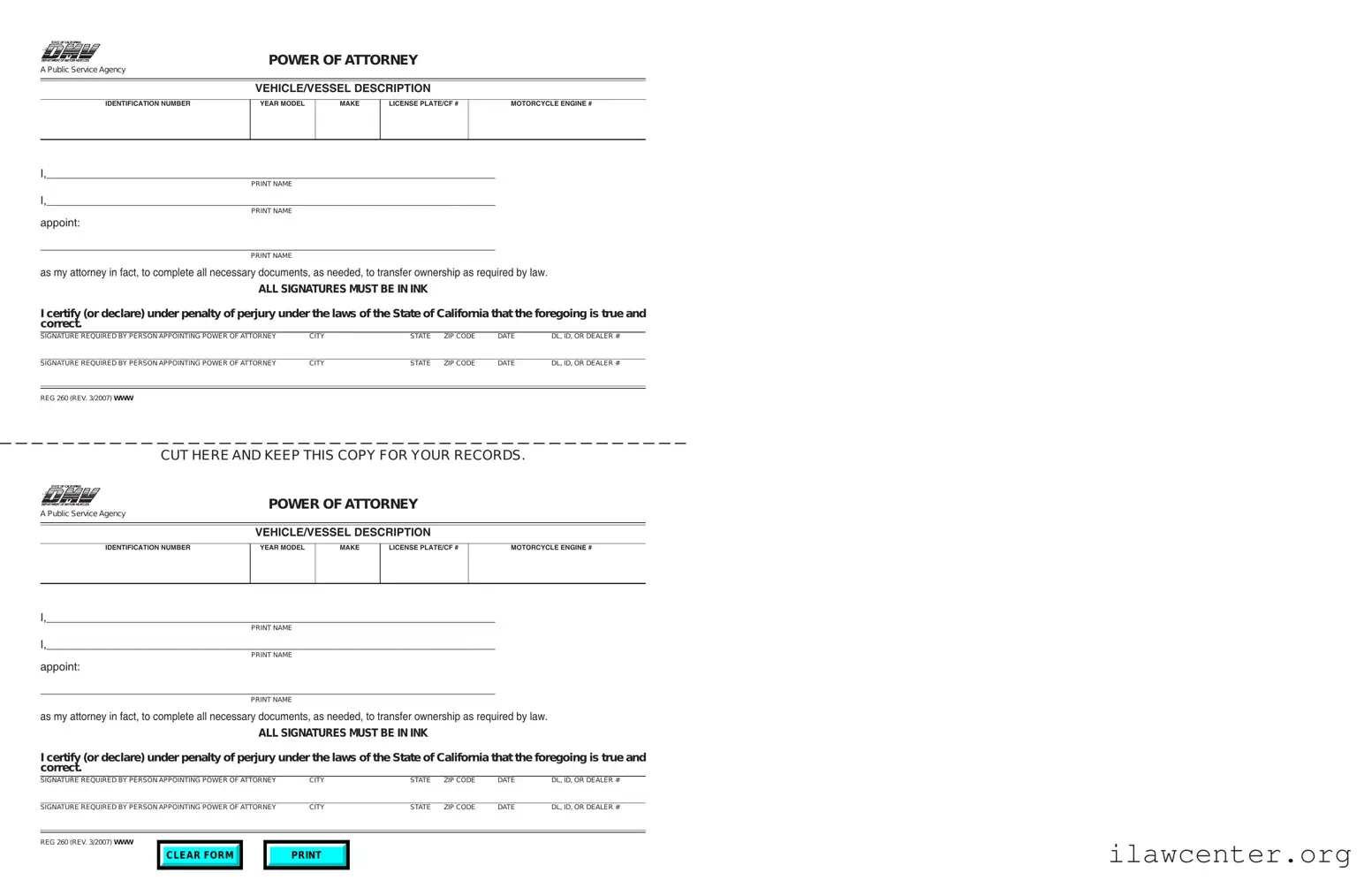
Vehicle POA REG 260 Preview

POWER OF ATTORNEY

A Public Service Agency

VEHICLE/VESSEL DESCRIPTION

IDENTIFICATION NUMBER

YEAR MODEL

MAKE

LICENSE PLATE/CF #

MOTORCYCLE ENGINE #

I,________________________________________________________________________

PRINT NAME

I,________________________________________________________________________

PRINT NAME

appoint:

_________________________________________________________________________

PRINT NAME

as my attorney in fact, to complete all necessary documents, as needed, to transfer ownership as required by law.

ALL SIGNATURES MUST BE IN INK

I certify (or declare) under penalty of perjury under the laws of the State of California that the foregoing is true and correct.

SIGNATURE REQUIRED BY PERSON APPOINTING POWER OF ATTORNEY

CITY

STATE

ZIP CODE

DATE

DL, ID, OR DEALER #


SIGNATURE REQUIRED BY PERSON APPOINTING POWER OF ATTORNEY

CITY

STATE

ZIP CODE

DATE

DL, ID, OR DEALER #


REG 260 (REV. 3/2007) WWW


CUT HERE AND KEEP THIS COPY FOR YOUR RECORDS.

POWER OF ATTORNEY

A Public Service Agency

VEHICLE/VESSEL DESCRIPTION

IDENTIFICATION NUMBER

YEAR MODEL

MAKE

LICENSE PLATE/CF #

MOTORCYCLE ENGINE #

I,________________________________________________________________________

PRINT NAME

I,________________________________________________________________________

PRINT NAME

appoint:

_________________________________________________________________________

PRINT NAME

as my attorney in fact, to complete all necessary documents, as needed, to transfer ownership as required by law.

ALL SIGNATURES MUST BE IN INK

I certify (or declare) under penalty of perjury under the laws of the State of California that the foregoing is true and correct.

SIGNATURE REQUIRED BY PERSON APPOINTING POWER OF ATTORNEY

CITY

STATE

ZIP CODE

DATE

DL, ID, OR DEALER #


SIGNATURE REQUIRED BY PERSON APPOINTING POWER OF ATTORNEY

CITY

STATE

ZIP CODE

DATE

DL, ID, OR DEALER #

REG 260 (REV. 3/2007) WWW

CLEAR FORM

PRINT

File Properties

Fact Name Details
Purpose The Vehicle POA REG 260 form allows an individual to designate another person to act on their behalf regarding vehicle-related matters.
Governing Law This form is governed by the laws of the state where it is filed, typically under vehicle code regulations.
Eligibility Any vehicle owner can complete the form to grant power of attorney to another individual.
Signature Requirement The form must be signed by the vehicle owner to be valid.
Notarization In some states, notarization may be required for the form to be accepted.
Revocation The power of attorney can be revoked at any time by the vehicle owner, provided they notify the designated individual.
Use Cases Common uses include transferring ownership, registering a vehicle, or handling title issues.
Validity The form remains valid until revoked by the vehicle owner or until the specific task is completed.
Submission The completed form should be submitted to the appropriate state motor vehicle department.

Instructions on Utilizing Vehicle POA REG 260

Once you have the Vehicle POA REG 260 form in hand, it’s time to get started on filling it out. Completing this form accurately is essential for ensuring that the necessary authority is granted for vehicle-related transactions. Follow these steps carefully to avoid any delays.

  1. Begin by entering the owner's name in the designated field. This should be the name of the person who currently holds the title to the vehicle.
  2. Next, fill in the owner's address. Make sure to include the street address, city, state, and zip code.
  3. Provide the vehicle identification number (VIN). This is a unique 17-character code that identifies your vehicle.
  4. In the next section, write the make and model of the vehicle. This information helps to clarify which vehicle is being referenced.
  5. Specify the year of the vehicle. This is typically found on the title or registration.
  6. Designate the name of the person being granted power of attorney. This is the individual who will have the authority to act on your behalf.
  7. Fill in the address of the person receiving power of attorney. Just like before, include all relevant details.
  8. Sign and date the form at the bottom. Your signature confirms that you are granting the specified powers.

After completing the form, review it carefully for any errors or omissions. Once verified, it’s advisable to submit the form to the appropriate department or agency. Timely submission will help facilitate the process you are initiating.

Important Facts about Vehicle POA REG 260

What is the Vehicle POA REG 260 form?

The Vehicle POA REG 260 form is a Power of Attorney document specifically designed for vehicle transactions in the United States. It allows an individual, known as the principal, to authorize another person, referred to as the agent, to act on their behalf regarding vehicle-related matters. This can include tasks such as signing documents, transferring titles, or handling registration processes. By using this form, the principal can ensure that their vehicle affairs are managed smoothly, even if they cannot be present to do so themselves.

Who needs to fill out the Vehicle POA REG 260 form?

How do I complete the Vehicle POA REG 260 form?

Completing the Vehicle POA REG 260 form is straightforward. Start by entering your personal information as the principal, including your name, address, and contact details. Next, provide the same information for your agent. It's important to clearly outline the specific powers you are granting to your agent, such as transferring ownership or signing documents. After filling out the necessary sections, both you and your agent must sign the form. Make sure to keep a copy for your records and provide a copy to your agent for their reference.

Is the Vehicle POA REG 260 form legally binding?

Yes, the Vehicle POA REG 260 form is legally binding as long as it is completed correctly and signed by both the principal and the agent. However, it is advisable to check state-specific regulations, as requirements may vary. In most cases, the form should be notarized to enhance its validity. Once executed, the agent can act on your behalf regarding the specified vehicle matters, making it a powerful tool for managing your vehicle affairs efficiently.

Common mistakes

Completing the Vehicle Power of Attorney (POA) REG 260 form can be straightforward, but several common mistakes can lead to delays or complications. One frequent error is failing to provide accurate vehicle information. This includes details such as the Vehicle Identification Number (VIN), make, model, and year. Inaccurate or missing information can result in processing delays.

Another mistake often made is not signing the form correctly. The form requires the signature of the vehicle owner, and if this is omitted or if the signature does not match the name on the title, the form may be rejected. It's essential to ensure that the signature is clear and matches the name as it appears on the vehicle title.

People also tend to overlook the importance of including the date on the form. Omitting the date can lead to confusion regarding the validity of the POA. This information is crucial for establishing when the authority was granted, which can affect any transactions related to the vehicle.

In addition, individuals sometimes forget to provide the correct contact information for the person receiving the power of attorney. This includes a valid phone number and address. Without this information, the Department of Motor Vehicles (DMV) may have difficulty reaching the designated agent, which can hinder the processing of the form.

Lastly, not reading the instructions carefully can result in errors. Each section of the form has specific requirements, and overlooking these can lead to incomplete submissions. It's advisable to review the form thoroughly before submission to ensure all sections are filled out correctly and completely.

Documents used along the form

The Vehicle Power of Attorney (POA) REG 260 form is an important document that allows one individual to authorize another to act on their behalf regarding vehicle-related matters. When completing this form, there are several other documents that may be required or beneficial to accompany it. Below is a list of these forms and documents, each described briefly for your understanding.

  • Vehicle Title: This document proves ownership of the vehicle. It is crucial for transferring ownership or for any legal transactions involving the vehicle.
  • Bill of Sale: This document serves as a receipt for the sale of a vehicle. It includes details about the buyer, seller, and the vehicle, and can be useful for record-keeping and legal purposes.
  • Registration Application: This form is necessary to register a vehicle with the state. It typically includes information about the vehicle and the owner, and it is essential for obtaining a license plate and legal driving status.
  • Proof of Insurance: This document demonstrates that the vehicle is insured. Most states require proof of insurance to register a vehicle and to legally operate it on public roads.
  • Identification Documents: A valid driver's license or state-issued ID is often required to verify the identity of the individuals involved in the transaction or authorization.
  • Release of Liability: This form protects the seller from future claims related to the vehicle after it has been sold. It is especially important to have when transferring ownership to another party.
  • Odometer Disclosure Statement: This document records the vehicle's mileage at the time of sale. It is required by law to prevent odometer fraud during vehicle transfers.
  • Loan Payoff Statement: If the vehicle is financed, this document outlines the remaining balance owed on the loan. It is important for ensuring that the title can be transferred free of liens.

When dealing with vehicle transactions, having the right documents in hand can facilitate a smoother process. Each of these forms plays a significant role in ensuring that all legal requirements are met and that the interests of all parties involved are protected.

Similar forms

The Vehicle POA REG 260 form is a critical document that allows an individual to authorize someone else to act on their behalf regarding vehicle-related matters. Several other documents serve similar purposes, each tailored for specific situations. Here are five documents that are similar to the Vehicle POA REG 260 form:

  • General Power of Attorney (GPOA): This document grants broad authority to an agent to make decisions on behalf of the principal, covering various matters, including financial and legal issues, not just limited to vehicles.
  • Limited Power of Attorney: This form restricts the agent’s powers to specific tasks or a defined period. Like the Vehicle POA, it allows the agent to handle particular transactions, but its scope is narrower.
  • Vehicle Title Transfer Form: When selling or transferring ownership of a vehicle, this form is used to officially change the title. While it does not grant authority, it is essential for completing vehicle transactions, similar to the Vehicle POA in its purpose.
  • Bill of Sale: This document records the sale of a vehicle and outlines the terms agreed upon by the buyer and seller. It serves as proof of the transaction and, like the Vehicle POA, is crucial in vehicle ownership changes.
  • Release of Liability Form: This form protects the seller from future claims after selling a vehicle. It is similar to the Vehicle POA in that it facilitates the transfer of ownership and responsibilities associated with the vehicle.

Dos and Don'ts

When filling out the Vehicle POA REG 260 form, attention to detail is crucial. Here are some essential guidelines to ensure a smooth process.

  • Do: Read the instructions carefully before starting to fill out the form.
  • Do: Provide accurate information to avoid delays in processing.
  • Do: Sign and date the form where indicated to validate it.
  • Do: Double-check all entries for completeness and correctness.
  • Don't: Leave any required fields blank; this can lead to rejection of the form.
  • Don't: Use white-out or correction fluid on the form; this can cause issues with processing.

Following these guidelines will help ensure that your Vehicle POA REG 260 form is completed correctly and submitted without unnecessary complications.

Misconceptions

When it comes to the Vehicle Power of Attorney (POA) REG 260 form, there are several misconceptions that can lead to confusion. Here are five common misunderstandings:

  1. It can only be used for selling a vehicle.

    Many people think the Vehicle POA REG 260 is only for selling a car. In reality, it can also be used for other transactions, like transferring ownership or handling registration issues.

  2. Only the vehicle owner can fill it out.

    Some believe that only the registered owner can complete the form. However, anyone authorized by the owner can fill it out, as long as they have the owner's consent.

  3. It must be notarized to be valid.

    While notarization adds an extra layer of security, it is not a requirement for the Vehicle POA REG 260 to be valid in most cases. Always check your state’s specific requirements.

  4. It expires after a single use.

    This form does not automatically expire after one transaction. The authority granted can be limited or ongoing, depending on how the form is completed.

  5. It’s only for private sales.

    People often think the form is only applicable for private sales. In fact, it can also be used in transactions involving dealerships or other entities.

Understanding these misconceptions can help ensure that you use the Vehicle POA REG 260 form correctly and effectively.

Key takeaways

The Vehicle Power of Attorney (POA) REG 260 form is an important document for vehicle owners in the U.S. Here are key takeaways to understand its purpose and usage:

  1. Purpose of the Form: The REG 260 form allows a vehicle owner to designate another individual to act on their behalf regarding vehicle-related matters.
  2. Who Can Be Designated: You can appoint a trusted friend, family member, or a professional to handle transactions, such as title transfers or registration renewals.
  3. Specific Authority: Clearly outline the specific powers granted to the designated individual. This may include signing documents and making decisions related to the vehicle.
  4. Duration: The authority granted can be temporary or permanent, depending on your needs. Specify the duration on the form if necessary.
  5. Signature Requirement: The form must be signed by the vehicle owner to be valid. Ensure that the signature matches the name on the vehicle title.
  6. Notarization: While notarization is not always required, it can add an extra layer of authenticity and may be needed by some institutions.
  7. Submitting the Form: After filling out the form, submit it to the relevant state agency or organization that requires it for processing vehicle transactions.
  8. Revocation: You can revoke the power of attorney at any time by providing written notice to the designated individual and any relevant agencies.
  9. Keep Copies: Always keep a copy of the completed REG 260 form for your records. This can be useful for future reference.
  10. Consultation: If unsure about filling out the form or its implications, consider consulting a legal professional for guidance.

Understanding these key points can help ensure that the Vehicle POA REG 260 form is filled out correctly and used effectively, providing peace of mind when delegating vehicle-related responsibilities.