Verification Rent Mortgage PDF Template

Verification Rent Mortgage PDF Template

The Verification Rent Mortgage form is a crucial document used to confirm an applicant's rental or mortgage payment history. This form helps lenders assess the creditworthiness of individuals applying for loans by collecting essential information from landlords or creditors. To ensure a smooth application process, please fill out the form by clicking the button below.

Article Guide

The Verification Rent Mortgage form serves as a crucial document in the loan application process, enabling lenders to assess the financial reliability of applicants. This form is utilized when a borrower seeks a loan and requires confirmation of their rental or mortgage payment history from their landlord or creditor. The form consists of two main parts: the first part is completed by the lender, who provides essential details such as the name and address of both the landlord and the lender, as well as information regarding the applicant and the property in question. The second part is designated for the landlord or creditor to fill out, offering insights into the applicant's payment history, including rental amounts, any arrears, and mortgage details if applicable. Important questions regarding the account's status, such as whether payments are current and if the account is satisfactory, are also included. The form emphasizes confidentiality, ensuring that the information shared will be protected, except where disclosure is mandated by law. It is important to note that this document must be sent directly to the lender, rather than through the applicant, to maintain the integrity of the verification process.

Verification Rent Mortgage Preview

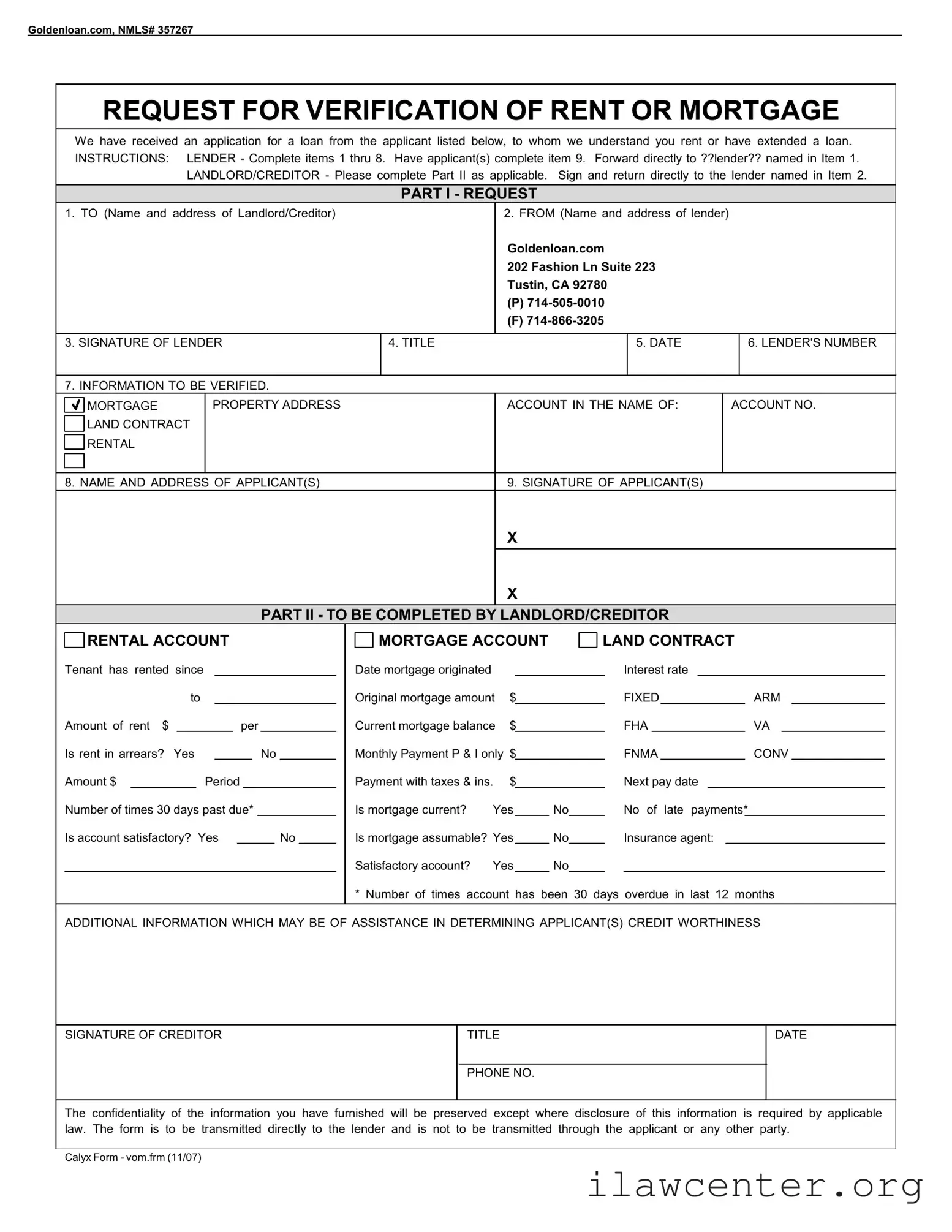
REQUEST FOR VERIFICATION OF RENT OR MORTGAGE
PART I - REQUEST
PART II - TO BE COMPLETED BY LANDLORD/CREDITOR
X
X
We have received an application for a loan from the applicant listed below, to whom we understand you rent or have extended a loan.
INSTRUCTIONS: LENDER - Complete items 1 thru 8. Have applicant(s) complete item 9. Forward directly to ??lender?? named in Item 1.
LANDLORD/CREDITOR - Please complete Part II as applicable. Sign and return directly to the lender named in Item 2.
1. TO (Name and address of Landlord/Creditor) 2. FROM (Name and address of lender)
3. SIGNATURE OF LENDER 4. TITLE 5. DATE 6. LENDER'S NUMBER
7. INFORMATION TO BE VERIFIED.
PROPERTY ADDRESS ACCOUNT IN THE NAME OF: ACCOUNT NO.
MORTGAGE
LAND CONTRACT
RENTAL
8. NAME AND ADDRESS OF APPLICANT(S) 9. SIGNATURE OF APPLICANT(S)
RENTAL ACCOUNT MORTGAGE ACCOUNT LAND CONTRACT
Tenant has rented since
to
Date mortgage originated
Amount of rent $ per
Original mortgage amount $
Is rent in arrears? Yes No
Current mortgage balance $
Amount $ Period
Monthly Payment P & I only $
Number of times 30 days past due*
Payment with taxes & ins. $
Is account satisfactory? Yes No
Is mortgage current? Yes No
Is mortgage assumable? Yes No
Satisfactory account? Yes No
Interest rate
FIXED ARM
FHA VA
FNMA CONV
Next pay date
No of late payments*
Insurance agent:
* Number of times account has been 30 days overdue in last 12 months
ADDITIONAL INFORMATION WHICH MAY BE OF ASSISTANCE IN DETERMINING APPLICANT(S) CREDIT WORTHINESS
SIGNATURE OF CREDITOR TITLE DATE
PHONE NO.
The confidentiality of the information you have furnished will be preserved except where disclosure of this information is required by applicable
law. The form is to be transmitted directly to the lender and is not to be transmitted through the applicant or any other party.
Calyx Form - vom.frm (11/07)
Goldenloan.com
202 Fashion Ln Suite 223
Tustin, CA 92780
(P) 714-505-0010
(F) 714-866-3205
Goldenloan.com, NMLS# 357267

File Properties

Fact Name Description
Purpose The Verification Rent Mortgage form is used to confirm an applicant's rental or mortgage payment history as part of the loan application process.
Part I Part I of the form is completed by the lender, including information about the applicant and the lender's contact details.
Part II Part II is filled out by the landlord or creditor, providing details about the rental or mortgage account, including payment history and current status.
Applicant's Signature The applicant must sign the form, indicating their consent for the lender to verify their rental or mortgage information.
Confidentiality The form emphasizes that the information provided will remain confidential unless disclosure is required by law.
Direct Submission The completed form must be sent directly to the lender and not through the applicant or any other intermediary.
Verification Details The form requests specific information to be verified, such as the amount of rent, mortgage balance, and payment history.
State-Specific Regulations In California, the governing laws include the California Civil Code and other applicable state regulations regarding rental agreements and mortgage disclosures.
Contact Information The lender's contact information, including phone and fax numbers, is provided for easy communication regarding the verification process.
Completion Instructions Clear instructions guide both the lender and landlord/creditor on how to fill out their respective sections of the form.

Instructions on Utilizing Verification Rent Mortgage

Filling out the Verification Rent Mortgage form is a straightforward process that requires attention to detail. This form is essential for lenders to verify the rental or mortgage information of an applicant. By following the steps below, you can ensure that the form is completed accurately and efficiently.

  1. Identify the Lender: In Part I, locate the section labeled "FROM." Enter the name and address of the lender, which is GOLDENLOAN.COM, 202 FASHION LN SUITE 223, TUSTIN, CA 92780.
  2. Fill in the Landlord/Creditor Information: In the "TO" section, provide the name and address of the landlord or creditor who is being contacted for verification.
  3. Sign the Form: The lender must sign the form in the designated area for "SIGNATURE OF LENDER." Include the lender's title, date, and lender's number as well.
  4. Complete Verification Details: Under "INFORMATION TO BE VERIFIED," fill in the mortgage property address, account name, account number, and specify if it is a land contract or rental.
  5. Applicant Information: In item 8, write the name and address of the applicant(s) who are applying for the loan.
  6. Applicant Signature: Have the applicant(s) sign in item 9 to authorize the verification process.
  7. Landlord/Creditor Section: If you are the landlord or creditor, complete Part II with details about the rental or mortgage account, including the rental amount, payment history, and whether the account is satisfactory.
  8. Contact Information: The landlord or creditor must provide their signature, title, phone number, and date in the designated areas at the bottom of Part II.
  9. Submission: Ensure that the completed form is sent directly to the lender mentioned in item 2 without going through the applicant or any other party.

Once you have filled out the form completely and accurately, it is important to submit it as instructed. This will help facilitate the loan application process for the applicant and ensure that all necessary information is verified by the lender.

Important Facts about Verification Rent Mortgage

What is the Verification Rent Mortgage form?

The Verification Rent Mortgage form is used by lenders to confirm the rental or mortgage payment history of an applicant. It helps lenders assess the applicant's creditworthiness by collecting information from landlords or creditors regarding the payment history and current status of the rental or mortgage account.

Who needs to fill out this form?

The form needs to be completed by both the lender and the landlord or creditor. The lender fills out the initial sections, while the landlord or creditor provides information about the rental or mortgage account in Part II. The applicant must also sign the form to give permission for this information to be shared.

How does the verification process work?

Once the lender fills out their part, they send the form directly to the landlord or creditor named in the document. The landlord or creditor then completes their section, providing details about the rental or mortgage account, and returns it directly to the lender. This process ensures that the information is accurate and confidential.

What information does the landlord or creditor need to provide?

The landlord or creditor must provide details such as the rental or mortgage account status, payment history, any arrears, and whether the account is satisfactory. They may also include additional information that could help the lender evaluate the applicant's creditworthiness.

Is there a specific format for submitting the form?

Yes, the form must be completed according to the instructions provided. It should be filled out clearly and accurately. After the landlord or creditor completes their section, they must send it directly to the lender without going through the applicant or any other party.

What happens if the rent or mortgage is in arrears?

If the rent or mortgage is in arrears, the landlord or creditor will indicate this on the form. They will specify the amount owed and how many times the account has been overdue. This information is crucial for the lender to understand the applicant's financial situation.

How is the information from this form kept confidential?

The information provided on the Verification Rent Mortgage form is kept confidential. It will only be disclosed if required by law. This ensures that the applicant's financial details are protected during the loan application process.

Common mistakes

Filling out the Verification Rent Mortgage form can be straightforward, but several common mistakes can lead to delays or complications. It’s important to be aware of these errors to ensure a smooth process.

One frequent mistake is not providing complete information in the “TO” and “FROM” sections. Both the landlord or creditor and the lender must be clearly identified. Missing names or addresses can cause the form to be returned for corrections, delaying the verification process.

Another common error involves the applicant’s signature. The form requires the applicant(s) to sign in item 9. If this signature is missing, the lender cannot proceed with the verification. It is crucial that applicants double-check this section before submitting the form.

In Part II, landlords or creditors often overlook the need to indicate whether the rent is in arrears. This is a critical piece of information. If the response is unclear or omitted, it can raise questions about the applicant's reliability as a tenant.

Additionally, some landlords fail to provide accurate rental amounts or dates. The form asks for the amount of rent and the date the tenant began renting. Any discrepancies can lead to confusion and may jeopardize the loan application.

Another mistake involves the verification of the mortgage account. Landlords or creditors should ensure that the mortgage balance and payment amounts are up to date. Providing outdated information can mislead the lender about the applicant's financial situation.

It is also essential to address the question regarding whether the mortgage is current. If the answer is "No," it should be accompanied by an explanation. Failing to provide context may lead to further inquiries from the lender.

Landlords sometimes forget to sign the form. The signature of the creditor is a vital part of the verification process. Without it, the lender may reject the submission altogether.

Lastly, additional information that could assist in determining the applicant’s creditworthiness is often left blank. Providing thorough details can enhance the applicant's chances of securing the loan.

By avoiding these common mistakes, applicants and landlords can help ensure that the Verification Rent Mortgage form is completed accurately and efficiently, leading to a smoother loan approval process.

Documents used along the form

The Verification Rent Mortgage form is essential for lenders to confirm an applicant's rental or mortgage history. Alongside this form, several other documents may be required to complete the verification process. Here are five commonly used forms that often accompany the Verification Rent Mortgage form:

  • Loan Application Form: This document collects detailed information about the applicant, including personal, financial, and employment history. It serves as the foundation for the loan approval process.
  • Credit Report Authorization: This form allows the lender to obtain the applicant's credit report. It provides insight into the applicant's credit history and financial behavior, which is crucial for assessing creditworthiness.
  • Income Verification Document: This may include recent pay stubs, tax returns, or bank statements. It verifies the applicant's income and ensures they can afford the loan payments.
  • Debt-to-Income Ratio Calculation: This document outlines the applicant's monthly debt obligations compared to their income. It helps lenders evaluate the applicant's ability to manage additional debt responsibly.
  • Property Appraisal Report: This report assesses the value of the property being financed or rented. It ensures that the loan amount is justified based on the property's market value.

These documents work together to provide a comprehensive view of the applicant's financial situation, facilitating informed lending decisions.

Similar forms

The Verification Rent Mortgage form serves a specific purpose in the loan application process. However, it shares similarities with several other documents that also aim to verify financial information. Below are four documents that are comparable to the Verification Rent Mortgage form:

  • Verification of Employment (VOE): This document is used to confirm an applicant's employment status and income. Like the Verification Rent Mortgage form, it requires input from a third party—typically the employer. Both forms are essential for assessing the applicant's ability to repay a loan.
  • Credit Report Authorization: This form allows lenders to obtain a credit report from credit bureaus. Similar to the Verification Rent Mortgage form, it involves the applicant's consent and is crucial for evaluating creditworthiness. Both documents help lenders make informed decisions based on the applicant's financial history.
  • Bank Statement Verification: This document verifies an applicant's bank account balances and transaction history. It shares the same goal as the Verification Rent Mortgage form: to provide the lender with a clear picture of the applicant's financial situation. Both documents require third-party verification, ensuring accuracy and reliability.
  • Asset Verification Form: Used to confirm an applicant's assets, this form collects information about savings, investments, and other financial resources. Like the Verification Rent Mortgage form, it seeks to provide a comprehensive view of the applicant's financial health, assisting lenders in their decision-making process.

Each of these documents plays a vital role in the overall assessment of an applicant's financial stability, ensuring that lenders have the necessary information to make sound lending decisions.

Dos and Don'ts

When filling out the Verification Rent Mortgage form, it is essential to approach the process with care and attention to detail. Here are nine important dos and don’ts to keep in mind:

  • Do read the entire form thoroughly before beginning. Understanding each section will help ensure accuracy.
  • Do fill out all required fields completely. Incomplete information can delay the verification process.
  • Do use clear and legible handwriting or type the information. This helps prevent any misinterpretations.
  • Do double-check the contact information for both the landlord and lender. This is crucial for smooth communication.
  • Do ensure that the signature of the lender is included. This validates the request for verification.
  • Don’t provide false information. Misrepresentation can have serious consequences for all parties involved.
  • Don’t submit the form without confirming that all necessary parties have signed it. Missing signatures can lead to rejection.
  • Don’t send the form through the applicant or any other party. It must go directly to the lender to maintain confidentiality.
  • Don’t forget to check for any specific instructions from the lender that may not be included in the form.

By following these guidelines, you can help ensure a smoother verification process and contribute to a more efficient experience for everyone involved.

Misconceptions

Understanding the Verification Rent Mortgage form can be challenging, and several misconceptions often arise. Here are ten common misunderstandings, along with explanations to clarify them.

  1. Only landlords can fill out the form. Many believe that only landlords are eligible to complete this form. However, creditors, such as mortgage lenders, can also be involved in filling out relevant sections.
  2. The form is only for rental properties. Some think this form is solely for rental verification. In reality, it also applies to mortgage accounts, making it useful for both renters and homeowners.
  3. It is optional for lenders to send the form. Some individuals assume that lenders can choose whether or not to use this form. In fact, it is often a required part of the loan application process.
  4. Rent or mortgage verification is always positive. There is a misconception that the verification process guarantees a positive outcome. The form simply verifies the information; it does not ensure approval for a loan.
  5. All sections of the form must be completed. Many believe that every section of the form is mandatory. While it is important to provide as much information as possible, not all sections may apply to every situation.
  6. The applicant must submit the form themselves. Some think the applicant must handle the submission of the form. In fact, it should be sent directly from the landlord or creditor to the lender.
  7. Confidentiality is not guaranteed. There is a concern that the information shared will not be kept confidential. However, the form explicitly states that confidentiality will be preserved, except where required by law.
  8. Verification takes a long time. Some assume that the verification process is lengthy. While it can vary, many lenders strive to process this information quickly to keep the loan application moving forward.
  9. All lenders use the same form. Some believe that every lender uses the same verification form. In reality, different lenders may have their own specific forms or requirements.
  10. The form is outdated and no longer used. There is a misconception that this form is no longer relevant. On the contrary, it is still widely used in the mortgage application process today.

By addressing these misconceptions, individuals can better understand the Verification Rent Mortgage form and its purpose in the loan application process.

Key takeaways

When completing the Verification Rent Mortgage form, it is important to follow specific guidelines to ensure accuracy and compliance. Here are key takeaways regarding the process:

  • Complete all required sections: Lenders must fill out items 1 through 8 accurately. This includes providing the name and address of the landlord or creditor and the applicant.
  • Applicant's involvement: The applicant is responsible for signing in item 9. This signature is necessary for the verification process to proceed.
  • Direct submission: The completed form should be sent directly to the lender named in item 1. It should not be transmitted through the applicant or any other party.
  • Landlord/Creditor's responsibilities: Landlords or creditors must complete Part II of the form. This section includes important details about the rental or mortgage account.
  • Confidentiality assurance: The information provided will remain confidential, except when disclosure is mandated by law. This protects the privacy of all parties involved.