
Verification Rental PDF Template

Verification Rental PDF Template

The Verification Rental form is a document used to confirm a tenant's rental history. It allows landlords to gather essential information about a current or former tenant, including payment history and adherence to lease agreements. If you need to verify a tenant's history, fill out the form by clicking the button below.

Article Guide

The Verification Rental form plays a crucial role in the rental application process. It serves as a tool for landlords to assess the rental history of potential tenants. This form requests essential information from previous landlords, helping to establish the reliability and behavior of applicants. Key aspects include details about the tenant's move-in and move-out dates, monthly rent, and payment history. Landlords are also asked to evaluate the tenant's adherence to rules, care of the rental unit, and any complaints from neighbors. Furthermore, the form inquires about the presence of pets and overall tenant ratings. It also seeks to clarify whether the tenant provided proper notice before moving out and if the full security deposit was returned. By gathering this information, the Verification Rental form aims to provide a comprehensive overview of a tenant's past behavior, enabling landlords to make informed decisions.

Verification Rental Preview

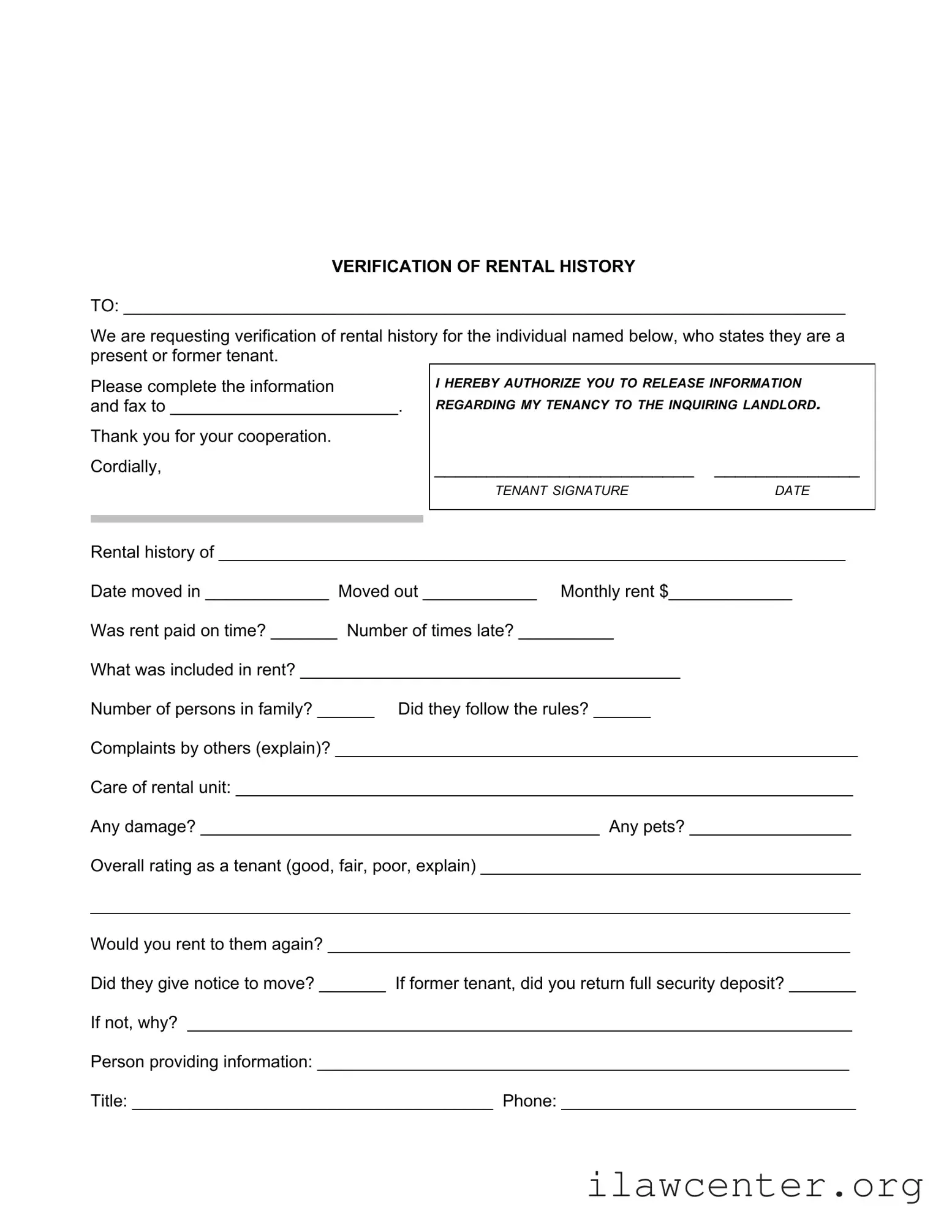
VERIFICATION OF RENTAL HISTORY
TO: ____________________________________________________________________________
We are requesting verification of rental history for the individual named below, who states they are a
present or former tenant.
Please complete the information
and fax to ________________________.
Thank you for your cooperation.
Cordially,
Rental history of __________________________________________________________________
Date moved in _____________ Moved out ____________ Monthly rent $_____________
Was rent paid on time? _______ Number of times late? __________
What was included in rent? ________________________________________
Number of persons in family? ______ Did they follow the rules? ______
Complaints by others (explain)? _______________________________________________________
Care of rental unit: _________________________________________________________________
Any damage? __________________________________________ Any pets? _________________
Overall rating as a tenant (good, fair, poor, explain) ________________________________________
________________________________________________________________________________
Would you rent to them again? _______________________________________________________
Did they give notice to move? _______ If former tenant, did you return full security deposit? _______
If not, why? ______________________________________________________________________
Person providing information: ________________________________________________________
Title: ______________________________________ Phone: _______________________________
I HEREBY AUTHORIZE YOU TO RELEASE INFORMATION
REGARDING MY TENANCY TO THE INQUIRING LANDLORD.
_________________________ ______________
TENANT SIGNATURE DATE

File Properties

Fact Name Details
Purpose The Verification of Rental History form is designed to collect information about a tenant's rental history from their previous landlord.
Authorization The tenant must provide authorization for the release of their rental history information to the inquiring landlord.
Information Required Landlords must fill out details such as the tenant's move-in and move-out dates, monthly rent, and payment history.
Tenant Evaluation The form includes sections for assessing the tenant's behavior, care of the rental unit, and overall rating as a tenant.
Legal Considerations In states like California, the governing law regarding tenant screening and rental history verification is outlined in the California Civil Code Section 1785.
Confidentiality All information provided must be kept confidential and used solely for the purpose of evaluating the tenant's application.

Instructions on Utilizing Verification Rental

Completing the Verification Rental form requires careful attention to detail. Each section must be filled out accurately to ensure that the requesting landlord receives the necessary information regarding the tenant's rental history. Below are the steps to successfully fill out the form.

  1. Begin by entering the name of the landlord or property management company in the space provided at the top of the form.
  2. In the section labeled "I HEREBY AUTHORIZE YOU TO RELEASE INFORMATION," write the tenant's name who is requesting the verification.
  3. Provide the fax number where the completed form should be sent.
  4. Have the tenant sign the form in the designated area, and include the date of signature.
  5. Fill in the tenant's rental history details, including their name, date of move-in, and date of move-out.
  6. Indicate the monthly rent amount and whether rent was paid on time.
  7. Note the number of times the rent was late, if applicable.
  8. Describe what was included in the rent (e.g., utilities, parking, etc.).
  9. State the number of persons living in the rental unit.
  10. Assess whether the tenant followed the rules and note any complaints from others, providing explanations as necessary.
  11. Evaluate the care of the rental unit, detailing any damage or issues observed.
  12. Indicate whether the tenant had any pets during their tenancy.
  13. Provide an overall rating of the tenant (good, fair, poor) and include an explanation for this rating.
  14. State whether you would rent to the tenant again.
  15. If the tenant has moved out, indicate whether they provided notice to vacate.
  16. For former tenants, confirm if the full security deposit was returned and explain any reasons if it was not.
  17. Lastly, provide your name, title, and contact phone number in the spaces provided at the bottom of the form.

Important Facts about Verification Rental

What is the purpose of the Verification Rental form?

The Verification Rental form is designed to collect essential information about a tenant's rental history. Landlords use this form to verify the details provided by prospective tenants. It helps in assessing whether the tenant has a good track record of paying rent on time, following community rules, and maintaining the rental unit. This verification process is crucial for landlords to make informed decisions about potential tenants.

Who completes the Verification Rental form?

The form is typically completed by the landlord or property manager of the rental unit where the tenant currently resides or previously lived. They provide detailed information about the tenant's rental history, including payment habits, care of the unit, and overall behavior as a tenant. The tenant must authorize this information to be released by signing the form.

What information is required on the Verification Rental form?

The form requires several key pieces of information, including the tenant's name, dates of tenancy, monthly rent amount, payment history, and any complaints or issues during their stay. Additionally, it asks about the condition of the rental unit, any damages, and whether pets were present. This comprehensive data helps landlords evaluate the suitability of the tenant.

How does a landlord use the information provided?

Landlords analyze the information provided on the Verification Rental form to assess the reliability and responsibility of a potential tenant. They look for patterns in payment history, adherence to rules, and overall conduct. This evaluation aids in determining whether to approve the rental application and can influence the terms of the lease agreement.

What should a tenant do if they believe the information is incorrect?

If a tenant believes that the information provided on the Verification Rental form is inaccurate, they should address this issue directly with the landlord or property manager who completed the form. It’s advisable to gather any supporting documents that can help clarify the situation. Open communication can often resolve discrepancies and ensure that the tenant's rental history is accurately represented.

Common mistakes

Filling out the Verification of Rental History form can seem straightforward, but there are common mistakes that can lead to delays or misunderstandings. One of the most frequent errors is leaving out essential details. For instance, not providing the tenant's full name or the correct dates of residency can create confusion for the landlord seeking verification.

Another mistake is failing to sign the authorization section. Without a signature, the request for information is incomplete. This can result in the landlord being unable to process the verification, causing frustration for both parties.

Inaccurate information can also be a significant issue. For example, if the monthly rent is listed incorrectly, it can lead to mistrust. It’s important to double-check all figures and dates before submitting the form.

Some people forget to include the number of late payments. This information is crucial for landlords to assess a tenant's reliability. Not mentioning this can paint an incomplete picture of the tenant's rental history.

Another common oversight is neglecting to provide a clear explanation of any complaints received. If there were issues, being vague or omitting this information can raise red flags for the landlord.

When it comes to pets, failing to specify whether the tenant had any can also lead to misunderstandings. If pets were present but not mentioned, this could be a problem later on.

People sometimes leave the overall rating as a tenant blank. This section is important for landlords to gauge the tenant's suitability. Providing a thoughtful rating can help the landlord make an informed decision.

Additionally, not including a contact number for the person providing information can cause delays. Landlords may need to follow up for clarification or additional details.

Another mistake is not indicating whether the tenant gave proper notice to move. This is a key detail that can affect future rental agreements.

Finally, failing to explain why a security deposit was not returned can lead to distrust. Transparency in this area is essential for a smooth rental history verification process.

Documents used along the form

The Verification of Rental form is a crucial document in the rental application process, helping landlords assess a potential tenant's rental history. However, several other forms and documents often accompany it to provide a comprehensive view of a tenant's qualifications and background. Below is a list of commonly used forms that complement the Verification of Rental form.

  • Rental Application Form: This document is typically filled out by prospective tenants. It gathers essential information such as personal details, employment history, and references. Landlords use it to evaluate the applicant's suitability for the rental property.
  • Credit Report Authorization Form: This form allows landlords to obtain a credit report on the applicant. It provides insight into the tenant's financial history, including credit scores, outstanding debts, and payment history, which are critical for assessing their ability to pay rent reliably.
  • Income Verification Form: Often required by landlords, this form helps confirm a tenant's income level. It may include pay stubs, tax returns, or bank statements, ensuring that the applicant has sufficient income to cover the rent.
  • Lease Agreement: Once a tenant is approved, this legally binding document outlines the terms and conditions of the rental arrangement. It details the responsibilities of both the landlord and tenant, including rent payment schedules, maintenance obligations, and rules regarding the property.

These documents work together to create a clearer picture of a potential tenant's reliability and suitability. By carefully reviewing each form, landlords can make informed decisions, fostering a positive rental experience for all parties involved.

Similar forms

  • Rental Application Form: Similar to the Verification Rental form, a rental application collects information from prospective tenants about their rental history, income, and references. Both documents aim to evaluate a tenant's suitability for a rental property.
  • Tenant Reference Form: This form requests feedback from previous landlords or property managers regarding a tenant's behavior and payment history. Like the Verification Rental form, it seeks to confirm a tenant's reliability and adherence to rental agreements.
  • Lease Agreement: A lease agreement outlines the terms of rental, including rent amount and duration. While the Verification Rental form focuses on past behavior, the lease establishes expectations for future conduct.
  • Credit Report Authorization: This document allows landlords to check a tenant's credit history. It is similar in that both seek to assess a tenant's financial responsibility and ability to pay rent consistently.
  • Eviction Record Request: This request seeks information about a tenant's past evictions. Both the Verification Rental form and eviction record request aim to provide insights into a tenant's rental history and reliability.
  • Background Check Consent Form: This form authorizes a landlord to conduct a background check on a tenant. Both documents serve to evaluate a tenant’s history and potential risks associated with renting to them.
  • Security Deposit Agreement: This agreement details the terms surrounding the security deposit. While it focuses on financial aspects, it shares the Verification Rental form's purpose of ensuring a clear understanding of tenant obligations.
  • Move-In/Move-Out Inspection Report: This report documents the condition of a rental unit at the beginning and end of a tenancy. Both forms address the care of the rental unit, helping landlords assess tenant responsibility.
  • Landlord Reference Letter: A landlord reference letter provides a summary of a tenant's rental history from the perspective of a previous landlord. It is similar in its goal of verifying a tenant's reliability and character.
  • Pet Agreement: This document outlines the terms regarding pets in a rental unit. While it specifically addresses pet ownership, it shares the Verification Rental form's focus on tenant behavior and compliance with rental rules.

Dos and Don'ts

When filling out the Verification Rental form, there are important dos and don’ts to keep in mind. Following these guidelines can help ensure the process goes smoothly.

  • Do provide accurate and complete information about the tenant's rental history.
  • Do ensure that the form is signed and dated by the tenant to authorize the release of information.
  • Don't leave any sections blank. Incomplete forms can delay the verification process.
  • Don't provide personal opinions or irrelevant information that does not pertain to the tenant's rental history.

Misconceptions

Understanding the Verification Rental form is crucial for both tenants and landlords. However, several misconceptions can lead to confusion. Here are nine common misunderstandings:

  1. The form is only for current tenants. Many believe it applies only to current tenants, but it can also verify the rental history of former tenants.
  2. Landlords must complete the form themselves. Some think only landlords can fill it out, but property managers or other authorized personnel can also provide the information.
  3. All questions are mandatory. While providing comprehensive information is helpful, not all questions are required. Landlords can skip questions that are not applicable.
  4. It guarantees approval for a new rental. Many tenants assume that a positive verification guarantees their acceptance for a new rental, but landlords consider multiple factors.
  5. Only payment history is relevant. Some people think only on-time payments matter, but other factors, like tenant behavior and property care, are equally important.
  6. The form is confidential. There is a belief that all information provided is confidential, but landlords may share this information with other property managers as part of their verification process.
  7. It can be filled out by anyone. Some assume that anyone can fill out the form, but it should be completed by someone with direct knowledge of the tenant's history.
  8. Negative feedback will always hurt a tenant. While negative feedback can impact a tenant’s application, constructive comments may provide context that helps landlords make informed decisions.
  9. Returning the form is optional. Many think that landlords can choose whether to return the completed form, but it is essential for them to respond to maintain transparency and fairness.

Being aware of these misconceptions can help streamline the rental process and ensure that all parties have a clear understanding of the Verification Rental form.

Key takeaways

When filling out and using the Verification Rental form, there are several important points to keep in mind. These key takeaways can help ensure that the process is smooth and efficient.

  • Complete All Required Fields: Ensure that all sections of the form are filled out completely. Missing information can delay the verification process.
  • Provide Accurate Dates: Clearly indicate the dates the tenant moved in and out. This information is crucial for understanding the rental history.
  • Detail Payment History: Specify whether rent was paid on time and how many times it was late. This helps the new landlord assess the tenant's reliability.
  • Include Tenant Behavior: Describe any complaints or issues with the tenant's behavior. This can include adherence to rules and care of the rental unit.
  • Provide Contact Information: Ensure that the person providing the information includes their name, title, and phone number. This allows the inquiring landlord to follow up if necessary.

By keeping these points in mind, both landlords and tenants can facilitate a more effective rental verification process.