Veterinary Certificate Travel PDF Template

Veterinary Certificate Travel PDF Template

The Veterinary Certificate Travel form is an essential document for pet owners planning to travel with their animals, whether domestically or internationally. This form provides crucial information required by most airlines and must be signed by a licensed veterinarian within ten days of travel. Ensure your pet is ready for the journey by filling out the form completely for each animal.

To get started, please click the button below to fill out the form.

Article Guide

Traveling with pets can be a rewarding experience, but it also comes with its own set of responsibilities. One crucial aspect of pet travel is the Veterinary Certificate Travel form, which serves as an essential document for both domestic and international airline journeys. This form is designed to ensure that your pet meets the health and safety requirements set by airlines. It must be completed and signed by a licensed veterinarian no more than ten days before your departure. Each form should be filled out entirely for each animal, capturing vital information such as the owner’s contact details, the pet's species and breed, and specific health certifications. These health certifications include confirmation of the pet’s fitness for travel, the absence of fleas, ticks, and parasites, as well as proof of rabies vaccination status. The rabies vaccine must be administered at least 21 days prior to travel and is valid for a specific period, depending on the type of vaccine given. Additionally, during colder months, airlines may require an acclimation certificate to ensure the safety of your pet. Understanding the requirements of the Veterinary Certificate Travel form is key to a smooth travel experience for both you and your furry companion.

Veterinary Certificate Travel Preview

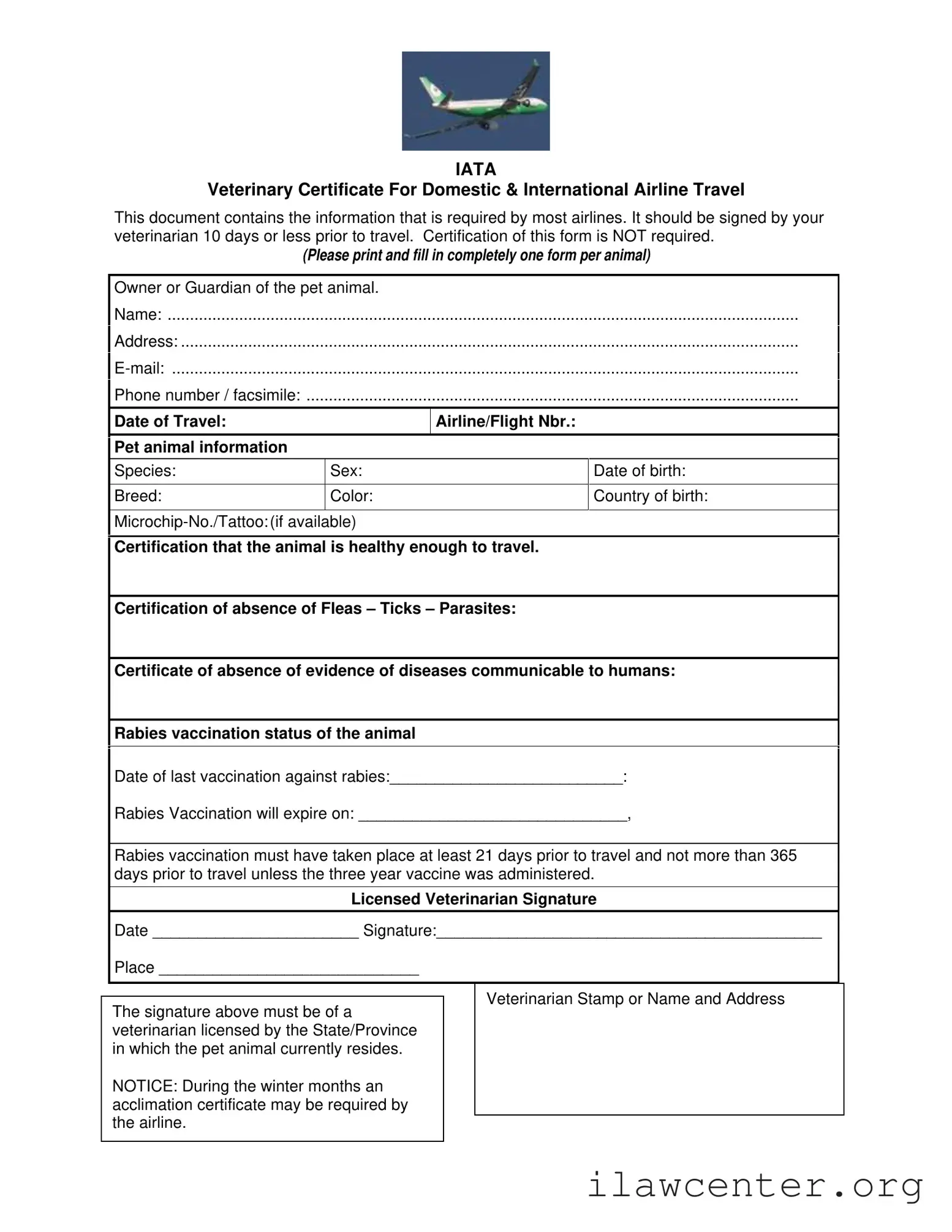
IATA
Veterinary Certificate For Domestic & International Airline Travel
This document contains the information that is required by most airlines
. It should be signed by your
veterinarian 10 days or less prior to travel.
C
ertification of this form is NOT required
.
(Please print and fill in
completely
one form per animal)
Owner or Guardian of the pet animal.
Name:
................................................................
................................
................................
.............
Address:
................................
................................
................................
................................
..........
E-
mail:
................................................................
................................
................................
............
Phone number / facsimile:
................................
................................
................................
..............
Date of Travel:
Airline/Flight Nbr.:
Pet animal information
Species:
Sex:
Date of bi
rth:
Breed:
Color:
Country of birth:
Microchip
-
No./Tattoo:
(if available)
Certification that the animal is healthy enough to travel.
Certification of absence of Fleas
Ticks
Parasites:
Certificate of absence of evidence of diseases communicable
to humans:
Rabies vaccination status of the animal
Date of last vaccination against rabies:__________________________:
Rabies Vaccination will expire on: ______________________________,
Rabies vaccination must have taken place at least 21 days prior to travel and not more than 365
days prior to travel unless the three year vaccine was administered.
Licensed Veterinarian Signature
Date _______________________ Signature:___________________________________________
Place ___________________________
__
The signature above must be of a
veterinarian licensed by the State
/Province
in which the pet animal currently resides.
NOTICE: During the winter months an
acclimation certificate may be required by
the airline.
Veterinarian Stamp o
r Name and Address

File Properties

Fact Name Description
Purpose The IATA Veterinary Certificate is essential for both domestic and international airline travel, ensuring that pet animals meet health and safety standards.
Veterinarian Signature This form must be signed by a licensed veterinarian no more than 10 days before travel, confirming the pet's health and fitness for travel.
Rabies Vaccination Documentation of rabies vaccination is crucial; the vaccine must be administered at least 21 days prior to travel and not more than 365 days prior unless it is a three-year vaccine.
Certification Requirements While certification of the form itself is not mandatory, it is important to provide complete and accurate information to avoid issues during travel.
State-Specific Regulations Different states may have specific laws governing pet travel; for instance, California requires compliance with the California Code of Regulations, Title 17, Section 2606 regarding rabies vaccination.

Instructions on Utilizing Veterinary Certificate Travel

Once you have gathered all necessary information about your pet and your travel plans, you can proceed to fill out the Veterinary Certificate Travel form. Completing this form accurately ensures that your pet meets airline requirements for travel. Follow these steps to ensure a smooth process.

  1. Begin by filling in your name as the owner or guardian of the pet animal.
  2. Provide your complete address, including street, city, state, and zip code.
  3. Enter your email address for any correspondence regarding the travel.
  4. Include your phone number or facsimile number for immediate contact.
  5. Specify the date of travel to help coordinate your pet's arrangements.
  6. Fill in the airline name and flight number for the journey.
  7. Indicate the species of your pet (e.g., dog, cat).
  8. Provide the breed of your pet.
  9. Specify the sex of your pet (male or female).
  10. Describe the color of your pet for identification purposes.
  11. Include the date of birth of your pet.
  12. State the country of birth of your pet.
  13. If available, provide the microchip number or tattoo number.
  14. Certify that your pet is healthy enough to travel.
  15. Certify the absence of fleas, ticks, and parasites.
  16. Confirm the absence of diseases communicable to humans.
  17. State the rabies vaccination status of your pet.
  18. Record the date of the last rabies vaccination.
  19. Indicate when the rabies vaccination will expire.
  20. Ensure that the rabies vaccination was administered at least 21 days before travel and not more than 365 days prior to travel, unless a three-year vaccine was given.
  21. Have a licensed veterinarian sign the form and include the date of signing.
  22. Provide the veterinarian's signature and ensure their name and address are clearly printed.
  23. Be aware that during winter months, an acclimation certificate may be required by the airline.

Important Facts about Veterinary Certificate Travel

What is the purpose of the IATA Veterinary Certificate for travel?

The IATA Veterinary Certificate is designed to provide essential information required by most airlines for the transport of pets. This document ensures that pets are healthy enough to travel and are free from diseases that could be communicable to humans. It includes details about the pet, such as species, breed, and vaccination status, and must be signed by a licensed veterinarian within ten days prior to travel.

How should the Veterinary Certificate be completed?

One form must be printed and filled out completely for each animal traveling. The owner or guardian of the pet should provide their name, address, email, and phone number. Additionally, information about the pet, including species, breed, sex, color, date of birth, and microchip or tattoo number (if available), must be included. The veterinarian will certify the pet's health status and vaccination details, particularly regarding rabies.

What are the rabies vaccination requirements for travel?

The rabies vaccination must have been administered at least 21 days before travel and cannot exceed 365 days unless a three-year vaccine was given. The certificate must indicate the date of the last vaccination and the expiration date of the rabies vaccination. This information is crucial to ensure compliance with airline policies and regulations regarding pet travel.

Are there any additional requirements during winter months?

During winter months, airlines may require an acclimation certificate to ensure the pet can safely travel in colder temperatures. It is advisable for pet owners to check with the specific airline for any additional requirements or documentation needed for their pet’s travel during this time.

Common mistakes

Filling out the Veterinary Certificate Travel form is a crucial step for pet owners planning to travel with their animals. However, several common mistakes can lead to delays or complications. Understanding these pitfalls can help ensure a smooth travel experience for both the pet and the owner.

One frequent error occurs when pet owners fail to provide complete information about their animal. The form requires specific details, such as the species, breed, and microchip number. Omitting any of this information can result in the airline refusing to accept the pet for travel. It is essential to double-check that all fields are filled out accurately and thoroughly before submission.

Another mistake involves the timing of the veterinarian's signature. The form must be signed by a licensed veterinarian no more than 10 days prior to travel. Some pet owners mistakenly believe that an earlier signature is acceptable. This misstep can lead to complications at the airport, as airlines strictly enforce this requirement.

In addition, many pet owners overlook the importance of the rabies vaccination details. The form requires the date of the last rabies vaccination and the expiration date. Failing to provide this information or not adhering to the vaccination timeline—at least 21 days before travel—can result in the pet being denied boarding. It is vital to ensure that the vaccination is current and properly documented.

Lastly, the absence of required certifications can be a significant oversight. The form includes sections for certifying the absence of fleas, ticks, and other parasites, as well as diseases communicable to humans. Neglecting to complete these sections can raise red flags for airline personnel. Pet owners should ensure that all necessary certifications are included and clearly stated.

By avoiding these common mistakes, pet owners can facilitate a smoother travel process. Attention to detail and adherence to the form's requirements are essential for ensuring that pets can travel safely and comfortably.

Documents used along the form

When traveling with pets, several documents may be required in addition to the Veterinary Certificate Travel form. These documents ensure the health and safety of the animal during transit and compliance with airline and international regulations.

  • Health Certificate: This document, signed by a licensed veterinarian, confirms that the pet is free from infectious diseases and is fit for travel. It is often required for interstate or international travel.
  • Rabies Vaccination Certificate: This certificate verifies that the pet has received a rabies vaccination within the required time frame. It is essential for international travel and may be required for certain states.
  • Acclimation Certificate: Some airlines require this document during winter months. It certifies that the pet can withstand temperature extremes during transport.
  • Import Permit: For international travel, an import permit may be necessary. This document allows the entry of the pet into another country and typically includes specific health requirements.
  • Microchip Registration: While not always a formal document, proof of microchip registration is important. It ensures the pet can be identified if lost during travel.
  • Airline-Specific Forms: Some airlines have their own specific forms that need to be completed prior to travel. These may include additional health declarations or travel arrangements.
  • Pet Travel Insurance: Although not mandatory, having pet travel insurance can provide peace of mind. It covers unexpected medical expenses or travel disruptions.

Being well-prepared with these documents can help ensure a smooth travel experience for both the pet and the owner. Always check with the airline and destination country for specific requirements before traveling.

Similar forms

The Veterinary Certificate Travel form is essential for pet travel, ensuring that animals meet health and safety requirements. Several other documents serve similar purposes in various contexts. Here are seven documents that share similarities with the Veterinary Certificate Travel form:

  • Health Certificate: This document verifies that an animal is healthy and free from contagious diseases. Like the Veterinary Certificate, it often requires a veterinarian's signature and is necessary for travel or boarding.
  • Pet Passport: A pet passport includes vaccination records and health certifications, much like the Veterinary Certificate. It is commonly used for international travel and helps streamline the process at customs.
  • Import Permit: This document is required by some countries for animals entering their borders. It often necessitates health certifications similar to those found in the Veterinary Certificate.
  • Rabies Certificate: This specific certificate confirms that an animal has been vaccinated against rabies. It is a key component of the Veterinary Certificate and is crucial for travel to many regions.
  • Acclimation Certificate: This document may be required by airlines during winter months. It certifies that an animal can safely endure temperature changes, akin to the health assurances in the Veterinary Certificate.
  • Microchip Registration Form: This form provides details about an animal's microchip, which is often included in the Veterinary Certificate. It helps ensure the pet can be identified if lost during travel.
  • Travel Insurance Policy: While not directly related to health, this document protects against unforeseen issues during travel. It complements the Veterinary Certificate by ensuring coverage in case of emergencies.

Dos and Don'ts

When filling out the Veterinary Certificate Travel form, it is essential to follow certain guidelines to ensure a smooth process for traveling with your pet. Below are some recommendations on what you should and shouldn't do.

  • Do fill out the form completely and accurately for each animal.
  • Do have the form signed by a licensed veterinarian within 10 days of travel.
  • Do provide all required information about your pet, including species, breed, and vaccination status.
  • Do ensure that the rabies vaccination is administered at least 21 days before travel.
  • Don't forget to include your contact information, such as phone number and email address.
  • Don't overlook the need for an acclimation certificate during winter months, if required by the airline.

By adhering to these guidelines, you can help ensure that your pet's travel experience is as safe and comfortable as possible. Proper preparation is key to avoiding potential issues at the airport or during your journey.

Misconceptions

Understanding the requirements for traveling with your pet can be challenging, especially when it comes to the Veterinary Certificate Travel form. Here are five common misconceptions that pet owners may have regarding this important document:

  • Certification is always required. Many pet owners believe that a certification is mandatory for all travel situations. In reality, certification of the Veterinary Certificate Travel form is not required, although it is advisable to have it signed by a veterinarian.
  • One form is needed for multiple pets. Some individuals think they can use a single form for multiple animals. Each pet requires its own completed form, ensuring that all necessary information is accurately provided.
  • The form can be signed anytime before travel. It is a common belief that the Veterinary Certificate can be signed well in advance of travel. However, the form must be signed by a veterinarian no more than 10 days prior to travel to ensure the information is current and accurate.
  • Rabies vaccination is the only health requirement. Many pet owners mistakenly assume that only rabies vaccination is necessary. While rabies vaccination is crucial, the form also requires certification regarding the absence of fleas, ticks, parasites, and communicable diseases.
  • All veterinarians can sign the form. There is a misconception that any veterinarian can sign the Veterinary Certificate. In fact, the signature must come from a veterinarian who is licensed in the state or province where the pet currently resides.

By clearing up these misconceptions, pet owners can better prepare for a smooth travel experience with their beloved animals. It is always wise to check with the airline for any specific requirements that may apply to your situation.

Key takeaways

When preparing for travel with your pet, the IATA Veterinary Certificate is an essential document. Here are some key takeaways to ensure you fill it out correctly and understand its importance:

  • One form per animal: You need to complete a separate certificate for each pet you are traveling with.
  • Veterinarian's signature: The form must be signed by a licensed veterinarian no more than 10 days before your travel date.
  • No certification required: While the form needs to be filled out, it does not require any additional certification.
  • Health certification: Ensure that your veterinarian certifies that your pet is healthy enough to travel.
  • Flea and tick check: The veterinarian must confirm that your pet is free of fleas, ticks, and other parasites.
  • Rabies vaccination: Record your pet’s rabies vaccination status, including the date of the last vaccination.
  • Timing of vaccinations: Rabies vaccination must be administered at least 21 days before travel and not more than 365 days prior.
  • Microchip information: If available, include your pet’s microchip number or tattoo on the form.
  • Winter travel: Be aware that during winter months, airlines may require an additional acclimation certificate.
  • Contact details: Provide accurate contact information, including your name, address, email, and phone number.

By following these guidelines, you can help ensure a smooth travel experience for both you and your pet.