Waiver Service PDF Template

Waiver Service PDF Template

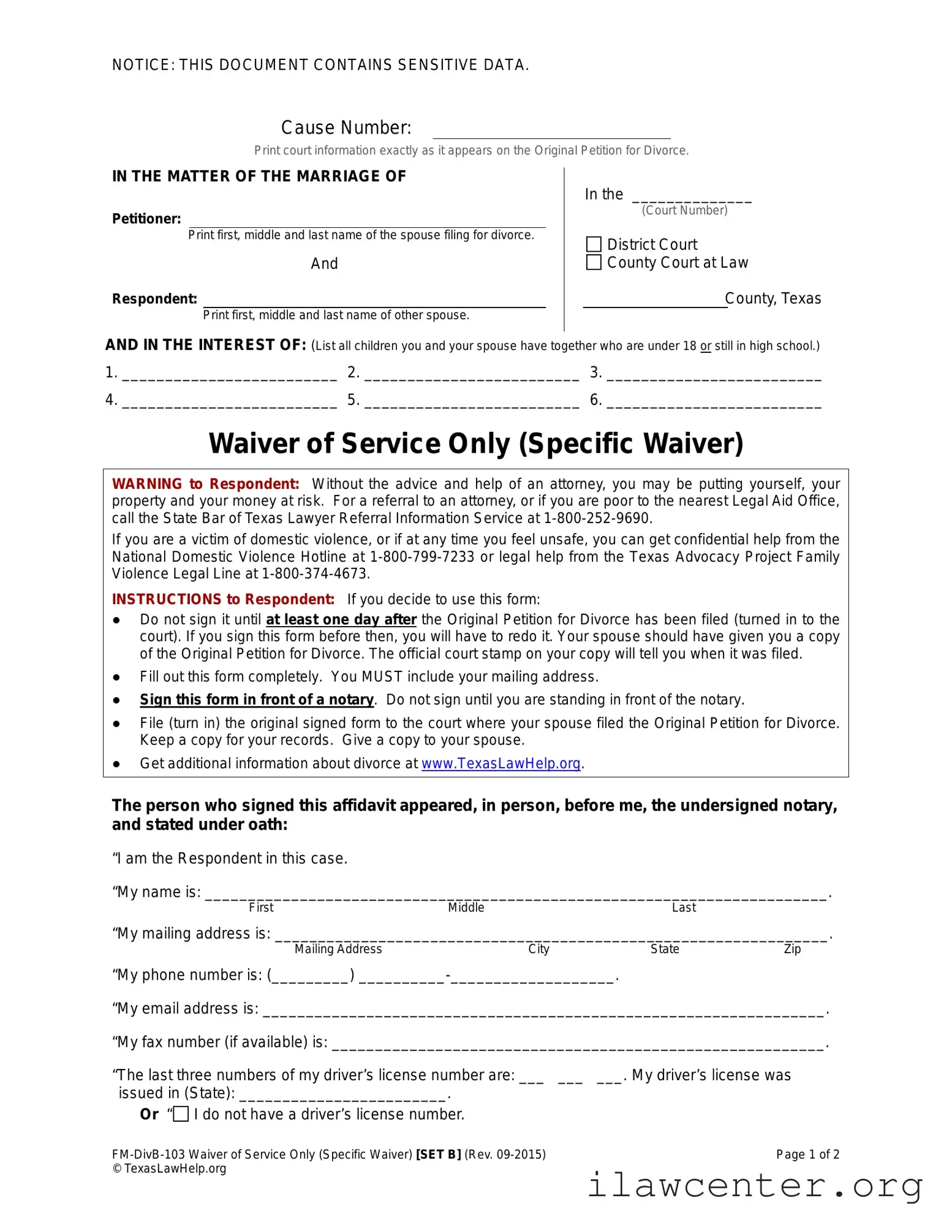
The Waiver Service form is a legal document used in divorce proceedings, allowing one spouse to waive their right to be formally served with divorce papers. This form requires the respondent to acknowledge receipt of the Original Petition for Divorce and to agree to the court's jurisdiction over the case. To proceed with your divorce, please fill out the form by clicking the button below.

Article Guide

The Waiver Service form plays a crucial role in the divorce process, particularly for individuals who wish to streamline their legal proceedings. This document allows the respondent—the spouse who did not initiate the divorce—to waive their right to receive formal service of process. By completing this form, the respondent acknowledges receipt of the Original Petition for Divorce and agrees to the terms outlined within it. The form requires essential information, including the names of both spouses, the court details, and the names of any children under 18. It also contains important warnings, emphasizing the necessity of legal counsel and the potential risks of proceeding without it. Specific instructions guide the respondent on how to properly fill out and file the form, including the need for notarization. Furthermore, the form addresses military status and name changes, ensuring that all relevant aspects of the respondent's situation are considered. This comprehensive approach helps facilitate a smoother divorce process while protecting the rights of all parties involved.

Waiver Service Preview

NOTICE: THIS DOCUMENT CONTAINS SENSITIVE DATA.

Cause Number:

Print court information exactly as it appears on the Original Petition for Divorce.

IN THE MATTER OF THE MARRIAGE OF

In the ______________


Petitioner:

(Court Number)


Print first, middle and last name of the spouse filing for divorce.

District Court


And

County Court at Law

Respondent:

County, Texas

Print first, middle and last name of other spouse.

AND IN THE INTEREST OF: (List all children you and your spouse have together who are under 18 or still in high school.)

1._________________________ 2. _________________________ 3. _________________________

4._________________________ 5. _________________________ 6. _________________________

Waiver of Service Only (Specific Waiver)

WARNING to Respondent: Without the advice and help of an attorney, you may be putting yourself, your property and your money at risk. For a referral to an attorney, or if you are poor to the nearest Legal Aid Office, call the State Bar of Texas Lawyer Referral Information Service at 1-800-252-9690.

If you are a victim of domestic violence, or if at any time you feel unsafe, you can get confidential help from the National Domestic Violence Hotline at 1-800-799-7233 or legal help from the Texas Advocacy Project Family Violence Legal Line at 1-800-374-4673.

INSTRUCTIONS to Respondent: If you decide to use this form:

Do not sign it until at least one day after the Original Petition for Divorce has been filed (turned in to the court). If you sign this form before then, you will have to redo it. Your spouse should have given you a copy of the Original Petition for Divorce. The official court stamp on your copy will tell you when it was filed.

Fill out this form completely. You MUST include your mailing address.

Sign this form in front of a notary. Do not sign until you are standing in front of the notary.

File (turn in) the original signed form to the court where your spouse filed the Original Petition for Divorce. Keep a copy for your records. Give a copy to your spouse.

Get additional information about divorce at www.TexasLawHelp.org.

The person who signed this affidavit appeared, in person, before me, the undersigned notary, and stated under oath:

“I am the Respondent in this case.

“My name is: ________________________________________________________________________.

FirstMiddleLast

“My mailing address is: ________________________________________________________________.

Mailing AddressCityStateZip

“My phone number is: (_________) __________-___________________.

“My email address is: _________________________________________________________________.

“My fax number (if available) is: _________________________________________________________.

“The last three numbers of my driver’s license number are: ___ ___

___. My driver’s license was

issued in (State): ________________________.


Or I do not have a driver’s license number.


FM-DivB-103 Waiver of Service Only (Specific Waiver) [SET B] (Rev. 09-2015)

Page 1 of 2

© TexasLawHelp.org


“The last three numbers of my social security number are: ___ ___ ___. Or I do not have a social security number.

“I have been given a copy of the Original Petition for Divorce filed in this case. I have read the Original Petition for Divorce and understand what it says. I do not give up my right to review a different Petition for Divorce if it gets changed (amended).

“I understand that I have the right to be given a copy of the Original Petition for Divorce by a constable, sheriff or other official process server (legal notice). I do not want to be given legal notice. I give up my right to legal notice.

“I ask that the Court not enter any orders in this case unless the order is signed by me or unless I have received prior written notice of the date, time, and place of hearing.

“If I reach an agreement and sign a Final Decree of Divorce, the court can enter the Decree without me being present and without giving me notice. If I sign an agreed Final Decree of Divorce, I do not want a court reporter to make a record of the testimony.

“I understand that by signing this form I am entering an appearance in this case. I agree that a Judge or Associate Judge in the county and state where this case is filed may make decisions about my divorce, even if the divorce should have been filed in another county.

I understand that I must let the Court and my spouse’s attorney (or my spouse if s/he is not represented by an attorney) know in writing if my mailing address or email address changes during this case. If I don’t, then I understand that any notices about this case will be sent to me at the mailing address or email address on this form.

Military Status (Check one box.)

I am not in the military.

I am in the military. I agree to the provisions stated above and I waive only the rights, privileges, and exemptions I have under the Servicemember’s Civil Relief Act that are contrary to those provisions.

Name Change (Check one box.)

I am NOT asking the court to change my name.

I ask the Court to change my name back to a name I used before my marriage. I am not asking the court to change my name to avoid criminal prosecution or creditors.”

_________________________________________________________________________________________

First

Middle

Last

-------

Signature of Respondent (Do NOT sign until you are in front of a notary.)

Notary fills out below.

State of

(Print name of state where this Affidavit is notarized)

County of

(Print the name of the county where this Affidavit is notarized)

----

Date

Sworn to and subscribed before me, the undersigned notary, on this date:


/

/

at


a.m./p.m.

Month

day

year


time


circle one


by

(Print name of person who is signing this Affidavit. NOT the notary’s name.)

[Notary Stamps Here ]


Notary’s----Signature


FM-DivB-103 Waiver of Service Only (Specific Waiver) [SET B] (Rev. 09-2015)


Page 2 of 2

© TexasLawHelp.org


File Properties

Fact Name Fact Description
Purpose The Waiver Service form allows a respondent in a divorce case to waive their right to be formally served with legal documents, streamlining the divorce process.
Filing Requirement The form must be signed in front of a notary and filed with the court where the original divorce petition was submitted.
Legal Advice Warning Respondents are warned that signing the form without legal advice may jeopardize their rights and interests in the divorce proceedings.
Governing Law This form is governed by Texas family law, specifically under the Texas Family Code.

Instructions on Utilizing Waiver Service

Filling out the Waiver Service form is a crucial step in the divorce process. After completing the form, it will need to be signed in front of a notary and submitted to the court where the Original Petition for Divorce was filed. It is essential to follow the steps carefully to ensure that the form is filled out correctly and that you meet all necessary legal requirements.

  1. Locate the Cause Number at the top of the form. Print the court information exactly as it appears on the Original Petition for Divorce.
  2. In the section labeled IN THE MATTER OF THE MARRIAGE OF, fill in the name of the Petitioner, which is the spouse filing for divorce. Include the first, middle, and last name.
  3. Indicate whether the case is in the District Court or County Court at Law by checking the appropriate box.
  4. Next, fill in the name of the Respondent, which is the other spouse. Again, include the first, middle, and last name.
  5. In the section AND IN THE INTEREST OF:, list all children under 18 or still in high school that you and your spouse have together. Write their names in the provided spaces.
  6. Read the WARNING to Respondent carefully. Understand the importance of seeking legal advice.
  7. Complete the INSTRUCTIONS to Respondent section. Ensure you do not sign the form until at least one day after the Original Petition for Divorce has been filed.
  8. Fill out the form completely, including your mailing address. This is crucial for receiving any notices related to your case.
  9. Sign the form in front of a notary public. Do not sign until you are in their presence.
  10. After signing, file the original signed form with the court where the Original Petition for Divorce was filed. Keep a copy for your records and provide a copy to your spouse.
  11. For additional information regarding divorce, visit www.TexasLawHelp.org.

Important Facts about Waiver Service

What is the purpose of the Waiver Service form?

The Waiver Service form is used in divorce proceedings to allow one spouse, known as the Respondent, to waive their right to be formally served with legal notice of the divorce. By signing this form, the Respondent acknowledges they have received a copy of the Original Petition for Divorce and agree to the terms without requiring a formal legal notice. This can simplify the divorce process, making it faster and less contentious.

What are the key steps I need to follow to complete the Waiver Service form?

First, wait at least one day after the Original Petition for Divorce has been filed before signing the form. Ensure that you fill out all required information, including your mailing address, and sign it in front of a notary. It’s essential to keep a copy for your records and provide a copy to your spouse. Finally, file the original signed form with the court where the divorce was filed. Following these steps helps ensure that the form is valid and properly processed by the court.

What should I consider before signing the Waiver Service form?

Before signing, think about whether you fully understand the implications of waiving your right to legal notice. It is strongly advised to consult with an attorney to ensure that you are aware of your rights and any potential risks. If you are a victim of domestic violence or feel unsafe, seek help from a trusted source. Signing this form means you are allowing the court to proceed without your presence or formal notice, so it’s crucial to be certain about your decision.

Can I change my mind after signing the Waiver Service form?

Once you sign the Waiver Service form and submit it to the court, you are essentially agreeing to proceed with the divorce without formal notification. While you can still participate in the divorce proceedings, it may be more complicated to retract your waiver. If you have concerns or wish to change your decision, it’s best to consult with a legal professional who can guide you on the appropriate steps to take.

Common mistakes

Filling out the Waiver Service form can be a straightforward process, but many people make common mistakes that can lead to delays or complications. One frequent error is failing to print the court information exactly as it appears on the Original Petition for Divorce. This detail is crucial, as any discrepancies could result in the form being rejected.

Another mistake involves incomplete information. Many individuals forget to include their mailing address. This omission can hinder communication from the court and your spouse. Always double-check that every required field is filled out completely.

Signing the form before meeting with a notary is another pitfall. It’s important to remember that you must not sign the document until you are in front of the notary. If you do, you will need to redo the entire form, wasting time and effort.

People also often neglect to file the original signed form with the correct court. Make sure you know where your spouse filed the Original Petition for Divorce. Failing to submit the form to the right location can lead to unnecessary complications.

Additionally, some forget to keep copies of the signed form. It’s essential to retain a copy for your records and provide one to your spouse. This ensures that both parties have the same information and can avoid misunderstandings.

Another common oversight is not updating the court about changes in your mailing or email address. If you don’t inform the court and your spouse’s attorney of any changes, important notices may not reach you, which could impact your case.

Finally, individuals sometimes overlook their military status. If you are in the military, you must check the appropriate box and understand the implications of waiving certain rights under the Servicemember’s Civil Relief Act. Ignoring this section can lead to unintended consequences regarding your legal rights.

Documents used along the form

When navigating the divorce process, the Waiver Service form is just one of several important documents you may encounter. Each document serves a unique purpose and can help clarify rights, responsibilities, and procedures. Understanding these forms can empower you to make informed decisions during this challenging time.

  • Original Petition for Divorce: This document initiates the divorce process. It outlines the grounds for divorce and details the requests being made to the court, including child custody, property division, and support obligations.
  • Final Decree of Divorce: Once the divorce is finalized, this document serves as the official court order that outlines the terms of the divorce, including custody arrangements and division of assets.
  • Affidavit of Service: This form confirms that the other party has been officially notified of the divorce proceedings. It is crucial for ensuring that the court recognizes that the respondent has received proper notice.
  • Child Support Worksheet: If children are involved, this worksheet helps calculate the appropriate amount of child support based on income and expenses, ensuring that the needs of the children are met.
  • Temporary Orders: This document requests immediate relief from the court regarding child custody, support, and other matters while the divorce is pending. It helps establish temporary arrangements until a final decision is made.
  • Property Inventory and Appraisal: This form lists all marital assets and debts, providing a clear picture of what needs to be divided. It often includes appraisals for significant items like real estate or vehicles.
  • Marital Settlement Agreement: This is a written agreement between both parties that outlines how assets, debts, and custody will be divided. It can expedite the divorce process if both parties agree on the terms.
  • Motion to Modify: If circumstances change after the divorce is finalized, this document requests the court to modify existing orders related to custody or support, ensuring that they remain fair and relevant.
  • Notice of Hearing: This form informs all parties involved about the date, time, and location of court hearings related to the divorce. It ensures that everyone has the opportunity to attend and present their case.
  • Certificate of Completion: Some jurisdictions require proof of completion of a divorce education program. This document certifies that the individual has fulfilled this requirement, which can be necessary for the finalization of the divorce.

Familiarizing yourself with these documents can significantly ease the divorce process. Each form plays a vital role in ensuring that your rights are protected and that the proceedings run smoothly. When in doubt, seeking guidance from a qualified professional can provide clarity and support during this time.

Similar forms

The Waiver Service form is an important document in divorce proceedings, particularly for the respondent. It shares similarities with several other legal documents, each serving distinct but related purposes. Below is a list of six documents that are similar to the Waiver Service form, along with an explanation of how they relate:

  • Notice of Appearance: This document indicates that a party has formally entered a case. Like the Waiver Service form, it allows a respondent to acknowledge their participation in the legal process without being served with formal notice.
  • Affidavit of Service: This document confirms that legal documents have been delivered to a party. Similar to the Waiver Service form, it addresses the issue of notification, ensuring that the respondent is aware of the proceedings.
  • Motion to Dismiss: This document requests the court to terminate a case. It shares the purpose of clarifying a party's position in a legal matter, much like the Waiver Service form does by establishing the respondent's agreement to proceed without formal service.
  • Response to Petition: This document allows the respondent to formally reply to the claims made in the Original Petition for Divorce. It is similar to the Waiver Service form in that it provides a way for the respondent to communicate their stance to the court.
  • Joint Stipulation: This document is an agreement between parties on certain issues in a case. Like the Waiver Service form, it reflects a mutual understanding and agreement between the parties involved.
  • Final Decree of Divorce: This document finalizes the divorce and outlines the terms agreed upon by both parties. While it serves a different function, it is similar in that it requires the consent of both parties, much like the Waiver Service form seeks to establish consent regarding service of process.

Dos and Don'ts

Things You Should Do:

  • Fill out the Waiver Service form completely and accurately.
  • Include your mailing address on the form.
  • Sign the form in front of a notary public.
  • File the original signed form with the court where your spouse filed the Original Petition for Divorce.
  • Keep a copy of the form for your records and provide a copy to your spouse.

Things You Shouldn't Do:

  • Do not sign the form until at least one day after the Original Petition for Divorce has been filed.
  • Do not forget to check the official court stamp on your copy to confirm the filing date.
  • Do not sign the form until you are physically present in front of the notary.
  • Do not ignore the need to inform the court and your spouse’s attorney if your contact information changes.
  • Do not assume you understand everything without reading the Original Petition for Divorce carefully.

Misconceptions

Misconception 1: The Waiver Service form can be signed at any time.

Many people believe they can sign the Waiver Service form whenever they choose. However, it is essential to wait at least one day after the Original Petition for Divorce has been filed. Signing the form too early will require you to redo it.

Misconception 2: Completing the form is optional.

Some individuals think that filling out the Waiver Service form is not mandatory. In reality, the form must be filled out completely, including your mailing address. Omitting this information can lead to complications in the divorce process.

Misconception 3: Notarization is not necessary.

Another common belief is that the form does not need to be notarized. This is incorrect. The form must be signed in front of a notary public. Failing to do so will invalidate the document.

Misconception 4: The court will automatically notify me about hearings.

Some respondents assume that the court will inform them about hearings and other important updates. In fact, it is the responsibility of the respondent to notify the court and the spouse's attorney of any changes to their mailing or email address. If this is not done, notices will be sent to the address listed on the form.

Key takeaways

When filling out and using the Waiver Service form, consider the following key takeaways:

  • Timing is crucial: Do not sign the form until at least one day after the Original Petition for Divorce has been filed. Signing it too early will require you to redo the form.
  • Complete information is necessary: Fill out the form entirely, including your mailing address. Incomplete forms may cause delays in the process.
  • Notarization is required: Sign the form only in front of a notary. This step is essential for the form to be considered valid.
  • Keep copies: After filing the original signed form with the court, retain a copy for your records and provide one to your spouse. This ensures both parties have access to the same information.