Attorney-Verified  Cease and Desist Letter Document for Washington

Attorney-Verified Cease and Desist Letter Document for Washington

A Washington Cease and Desist Letter form is a legal document used to formally request that an individual or organization stop engaging in certain behaviors. This letter serves as a warning and can be an important step in resolving disputes without resorting to litigation. If you need to take action, consider filling out the form by clicking the button below.

Article Guide

In Washington State, a Cease and Desist Letter serves as a crucial tool for individuals and businesses looking to address unwanted actions or behaviors that infringe on their rights. This formal document notifies the recipient of their objectionable conduct and demands that they stop immediately. The letter typically outlines the specific actions that are causing concern, whether they involve harassment, intellectual property infringement, or other unlawful behaviors. It often includes a clear statement of the sender's rights and the potential consequences if the recipient fails to comply. By providing a structured approach to resolving disputes, the Washington Cease and Desist Letter not only helps protect one's interests but also serves as a preliminary step before pursuing more formal legal action. Understanding the essential components of this letter, such as the sender's information, the recipient's details, and a detailed description of the objectionable conduct, is vital for anyone considering its use. Properly crafted, this letter can effectively convey the seriousness of the situation while encouraging a swift resolution without the need for court intervention.

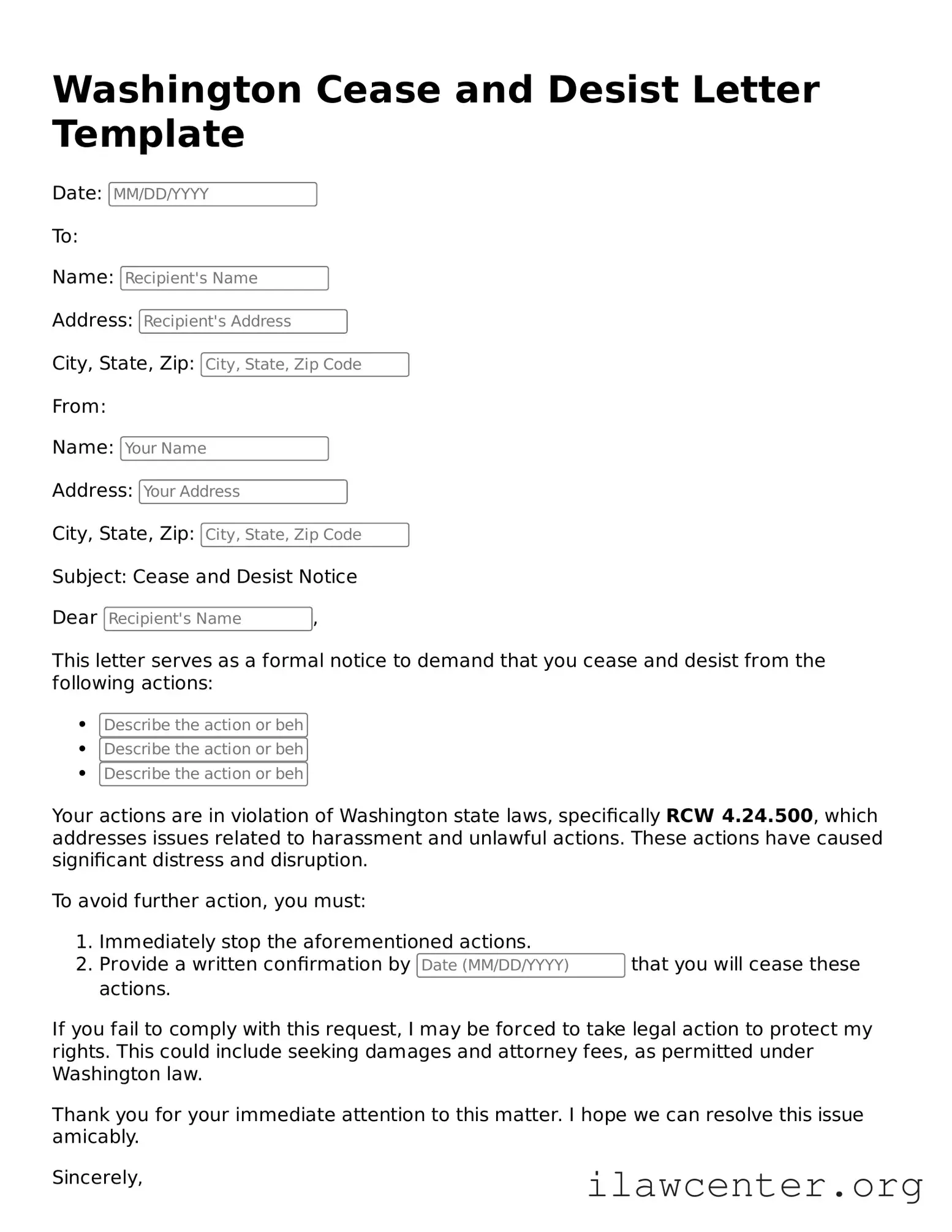
Washington Cease and Desist Letter Preview

Washington Cease and Desist Letter Template

Date:

To:

Name:

Address:

City, State, Zip:

From:

Name:

Address:

City, State, Zip:

Subject: Cease and Desist Notice

Dear ,

This letter serves as a formal notice to demand that you cease and desist from the following actions:

Your actions are in violation of Washington state laws, specifically RCW 4.24.500, which addresses issues related to harassment and unlawful actions. These actions have caused significant distress and disruption.

To avoid further action, you must:

  1. Immediately stop the aforementioned actions.
  2. Provide a written confirmation by that you will cease these actions.

If you fail to comply with this request, I may be forced to take legal action to protect my rights. This could include seeking damages and attorney fees, as permitted under Washington law.

Thank you for your immediate attention to this matter. I hope we can resolve this issue amicably.

Sincerely,

PDF Form Characteristics

Fact Name Description
Purpose A Washington Cease and Desist Letter is used to formally request that an individual or entity stop certain actions that are deemed unlawful or harmful.
Governing Laws The letter is governed by Washington state laws, particularly those related to harassment, defamation, and intellectual property.
Format The letter should be clear and concise, typically including the sender's information, a description of the objectionable conduct, and a request for cessation.
Delivery Method It is advisable to send the letter via certified mail to ensure that there is proof of delivery.
Legal Standing While a cease and desist letter is not a legally binding document, it can serve as evidence in court if the matter escalates.
Response Time Typically, the recipient is expected to respond within a specific timeframe, often 10 to 30 days, depending on the situation.

Instructions on Utilizing Washington Cease and Desist Letter

Once you have the Washington Cease and Desist Letter form in front of you, it’s time to start filling it out. This form is a crucial step in addressing a situation that requires immediate attention. Follow these steps carefully to ensure that all necessary information is included.

  1. Begin by entering your name and contact information at the top of the form. This includes your address, phone number, and email.
  2. Next, provide the date on which you are completing the letter. This helps establish a timeline for your request.
  3. Identify the recipient of the letter. Write their name and address clearly. Make sure to double-check the spelling to avoid any confusion.
  4. In the next section, clearly state the reason for your cease and desist request. Be specific about the actions or behaviors that are causing concern.
  5. Include any relevant details or evidence that supports your claim. This could be dates, descriptions, or any other pertinent information.
  6. Clearly outline what you want the recipient to do or refrain from doing. Be direct and unambiguous in your request.
  7. Finally, sign the letter at the bottom. Your signature adds authenticity and indicates that you stand by the contents of the letter.

After completing the form, it’s essential to send it to the recipient promptly. Make sure to keep a copy for your records. Depending on the situation, you may also want to consider sending it via certified mail to ensure it is received.

Important Facts about Washington Cease and Desist Letter

What is a Washington Cease and Desist Letter?

A Washington Cease and Desist Letter is a formal document sent to an individual or organization to demand that they stop a specific action that is believed to be illegal or harmful. It serves as a warning before further legal action may be taken. This letter is often used in cases of harassment, copyright infringement, or other disputes.

Who can send a Cease and Desist Letter in Washington?

Any individual or business that believes their rights are being violated can send a Cease and Desist Letter. This includes copyright holders, trademark owners, or anyone who feels they are being wronged. It’s important that the sender has a legitimate reason for the demand.

What should be included in a Cease and Desist Letter?

A well-crafted Cease and Desist Letter should include specific details about the issue at hand. This typically includes the sender's contact information, a clear description of the behavior that needs to stop, any relevant evidence, and a deadline for compliance. It may also outline the potential consequences if the recipient fails to comply.

Is a Cease and Desist Letter legally binding?

No, a Cease and Desist Letter is not legally binding. It is a request rather than a court order. However, it can serve as an important step in establishing a record of your complaint, which may be useful if further legal action becomes necessary.

How does one respond to a Cease and Desist Letter?

If you receive a Cease and Desist Letter, it’s essential to take it seriously. You can choose to comply with the demands, negotiate the terms, or contest the claims made in the letter. Consulting with an attorney can provide guidance on the best course of action based on your specific situation.

Can I send a Cease and Desist Letter without a lawyer?

Yes, you can draft and send a Cease and Desist Letter without a lawyer. However, having legal assistance can ensure that your letter is appropriately worded and that your rights are fully protected. A lawyer can also help you understand the potential implications of sending such a letter.

What happens if the recipient ignores the Cease and Desist Letter?

If the recipient ignores the letter, you may consider taking further action. This could involve filing a lawsuit or seeking mediation. The letter serves as a warning, and ignoring it can sometimes lead to more serious legal consequences for the recipient.

How long should I wait for a response to my Cease and Desist Letter?

It’s reasonable to give the recipient a specific timeframe to respond, typically between 10 to 30 days. If you don’t receive a response within that period, you may want to follow up or consider your next steps, which could include legal action.

Can a Cease and Desist Letter be used for harassment cases?

Yes, a Cease and Desist Letter is commonly used in harassment cases. It can be an effective way to formally request that the harasser stop their behavior. Documenting the harassment and providing evidence can strengthen your case.

Is there a specific format for a Washington Cease and Desist Letter?

While there is no official format required, a Cease and Desist Letter should be clear, concise, and professional. It should include all necessary details and be addressed to the correct person or entity. Templates are available online, but personalizing the letter to fit your situation is important.
Common mistakes

When individuals decide to fill out the Washington Cease and Desist Letter form, they often overlook critical details that can impact the effectiveness of their request. One common mistake is failing to provide complete contact information. Without accurate names, addresses, and phone numbers, the recipient may struggle to understand who is making the request. This oversight can lead to confusion and hinder the resolution process.

Another frequent error involves the lack of specificity regarding the actions that prompted the cease and desist request. Vague descriptions can leave the recipient unsure about what behavior needs to stop. To ensure clarity, it is essential to outline the specific actions that are considered objectionable, detailing how they violate the sender's rights or cause harm.

Many individuals also neglect to include a clear deadline for compliance. Without a specified timeframe, the recipient may not feel a sense of urgency to address the issue. Including a reasonable deadline can motivate prompt action and help facilitate a resolution to the dispute.

Additionally, some people mistakenly use aggressive or confrontational language in their letters. While it is important to assert one’s rights, a tone that is overly hostile can backfire. A respectful and professional tone encourages cooperation and may lead to a more favorable outcome.

Another common pitfall is failing to keep a copy of the completed letter. This mistake can create complications if the issue escalates or if there is a need to refer back to the original request. Maintaining a record of correspondence is vital for tracking the situation and ensuring that all parties are on the same page.

Lastly, individuals often overlook the importance of sending the letter through a verifiable method, such as certified mail. This step provides proof of delivery and can be crucial if further legal action becomes necessary. By ensuring that the letter is received and acknowledged, the sender strengthens their position in any potential disputes.

Documents used along the form

A Washington Cease and Desist Letter is a formal request for someone to stop an activity that is believed to be unlawful or harmful. When dealing with legal matters, it's often necessary to use additional forms and documents to support your case or clarify your position. Below is a list of other documents that are commonly used alongside a Cease and Desist Letter.

  • Demand Letter: This document outlines a request for compensation or action, often serving as a precursor to legal action. It clearly states the grievance and what the sender expects in response.
  • Notice of Intent to Sue: This letter informs the recipient that the sender is considering legal action if the issue is not resolved. It typically includes a deadline for response.
  • Settlement Agreement: This is a formal contract between parties that outlines the terms of a settlement. It aims to resolve disputes without going to court.
  • Affidavit: A written statement confirmed by oath or affirmation, used as evidence in court. It can support claims made in a Cease and Desist Letter.
  • Response to Cease and Desist Letter: This document is sent by the recipient of the Cease and Desist Letter, addressing the claims made and outlining their position.
  • Complaint: This is the formal document filed in court to initiate a lawsuit. It details the plaintiff's case against the defendant.
  • Answer: A legal document filed by the defendant in response to a complaint. It addresses the allegations and may include defenses.
  • Release of Liability: This document protects one party from legal claims made by another. It can be used to settle disputes and prevent future claims.
  • Confidentiality Agreement: Also known as a non-disclosure agreement, this document ensures that sensitive information shared between parties remains confidential.
  • Power of Attorney: This legal document allows one person to act on behalf of another in legal or financial matters. It can be relevant if someone needs to respond to a Cease and Desist Letter on behalf of another.

Understanding these documents can help individuals navigate legal disputes more effectively. Each serves a unique purpose and can be crucial in supporting your position when dealing with a Cease and Desist Letter in Washington.

Similar forms

  • Demand Letter: A demand letter is a formal request for payment or action. Like a cease and desist letter, it outlines a specific issue and requests that the recipient take corrective measures. Both documents aim to resolve disputes before escalating to legal action.
  • Notice of Violation: This document informs someone that they have breached a law or regulation. Similar to a cease and desist letter, it serves as a warning and encourages compliance to avoid further consequences.
  • Settlement Agreement: A settlement agreement is used to resolve disputes without going to court. It can be similar to a cease and desist letter in that both aim to settle issues amicably, though a settlement agreement is typically a more formalized resolution.
  • Letter of Intent: This document outlines the intentions of one party to enter into an agreement with another. While a cease and desist letter demands action, a letter of intent expresses interest in negotiating terms, often to prevent future conflicts.
  • Legal Notice: A legal notice serves to inform someone of their rights or obligations. It shares similarities with a cease and desist letter in that both communicate important information and potential legal consequences if action is not taken.
  • Formal Complaint: A formal complaint is a document submitted to a court or authority to initiate legal proceedings. While a cease and desist letter aims to prevent legal action, both documents address grievances and seek resolution.

Dos and Don'ts

When filling out the Washington Cease and Desist Letter form, it's essential to approach the task with care. Below are some key do's and don'ts to keep in mind:

  • Do ensure that all information is accurate and complete.
  • Do clearly state the reason for the cease and desist request.
  • Do include your contact information for follow-up.
  • Do keep a copy of the letter for your records.
  • Don't use aggressive or threatening language.
  • Don't forget to check for any specific requirements that may apply.

By following these guidelines, you can effectively communicate your intentions while maintaining a professional tone.

Misconceptions

Misconceptions about the Washington Cease and Desist Letter form can lead to confusion and misapplication of the law. Below are nine common misconceptions, along with explanations to clarify each point.

  1. Cease and Desist Letters are legally binding.

    This is not true. A cease and desist letter is a formal request to stop certain actions but does not carry legal weight on its own. It serves as a warning and may precede legal action.

  2. Only lawyers can draft a Cease and Desist Letter.

    While legal professionals often draft these letters, individuals can also create them. However, it is advisable to seek legal counsel to ensure clarity and effectiveness.

  3. A Cease and Desist Letter guarantees compliance.

    There is no guarantee that the recipient will comply with the demands outlined in the letter. It is a tool to prompt action, but further legal steps may be necessary if the issue persists.

  4. All Cease and Desist Letters are the same.

    Each letter should be tailored to the specific situation. The content and tone may vary based on the context and the nature of the dispute.

  5. Sending a Cease and Desist Letter is always the first step.

    In some cases, informal communication may precede a cease and desist letter. It is often beneficial to attempt resolution before escalating to formal demands.

  6. Cease and Desist Letters can only be used for copyright infringement.

    These letters can address a variety of issues, including defamation, trademark infringement, harassment, and other legal disputes. Their application is not limited to copyright matters.

  7. Once a Cease and Desist Letter is sent, legal action is unavoidable.

    Sending a letter does not automatically mean that legal action will follow. It is often a step in the negotiation process, and resolution may still be achieved without litigation.

  8. Receiving a Cease and Desist Letter means you are guilty of wrongdoing.

    Receiving such a letter does not imply guilt. It is a claim made by the sender, and the recipient has the right to respond and contest the allegations.

  9. Cease and Desist Letters can be ignored without consequence.

    Ignoring a cease and desist letter can lead to further legal action. It is advisable to take such communications seriously and respond appropriately.

Key takeaways

When considering the Washington Cease and Desist Letter form, it's essential to understand its purpose and the proper way to fill it out. Here are some key takeaways to keep in mind:

  • Understand the Purpose: A Cease and Desist Letter serves as a formal request to stop unlawful activities or behaviors that infringe upon your rights.
  • Identify the Recipient: Clearly identify the individual or entity you are addressing in the letter. This ensures that your message reaches the right person.
  • Be Specific: Clearly outline the actions or behaviors you want to cease. Providing specific examples can strengthen your case.
  • State the Legal Basis: While legal jargon should be avoided, mentioning relevant laws or regulations can add weight to your request.
  • Set a Deadline: Indicate a reasonable timeframe within which the recipient must comply with your request. This creates a sense of urgency.
  • Maintain a Professional Tone: Keep the letter professional and respectful. Aggressive language may escalate the situation rather than resolve it.
  • Document Everything: Keep a copy of the letter and any correspondence related to the matter. This documentation can be crucial if further action is needed.

By following these guidelines, you can effectively utilize the Washington Cease and Desist Letter form to protect your rights and interests.