Attorney-Verified  Divorce Settlement Agreement Document for Washington

Attorney-Verified Divorce Settlement Agreement Document for Washington

The Washington Divorce Settlement Agreement form is a legal document that outlines the terms and conditions agreed upon by both parties during a divorce. This agreement covers various aspects such as asset division, child custody, and support arrangements. To ensure a smooth process, it is essential to fill out this form accurately; click the button below to get started.

Article Guide

The Washington Divorce Settlement Agreement form plays a crucial role in the divorce process, as it outlines the terms agreed upon by both parties regarding the division of assets, liabilities, and other essential matters. This document addresses various aspects such as child custody arrangements, visitation schedules, and child support obligations, ensuring that the best interests of any children involved are prioritized. Additionally, it covers spousal support, property division, and the handling of debts. By providing a clear framework for these issues, the form helps to minimize disputes and facilitate a smoother transition for both parties as they navigate the complexities of divorce. Completing this agreement requires careful consideration and negotiation, as it serves as a binding contract that reflects the mutual understanding of both individuals. Ultimately, the Divorce Settlement Agreement form aims to provide a fair resolution that allows both parties to move forward with their lives after the dissolution of their marriage.

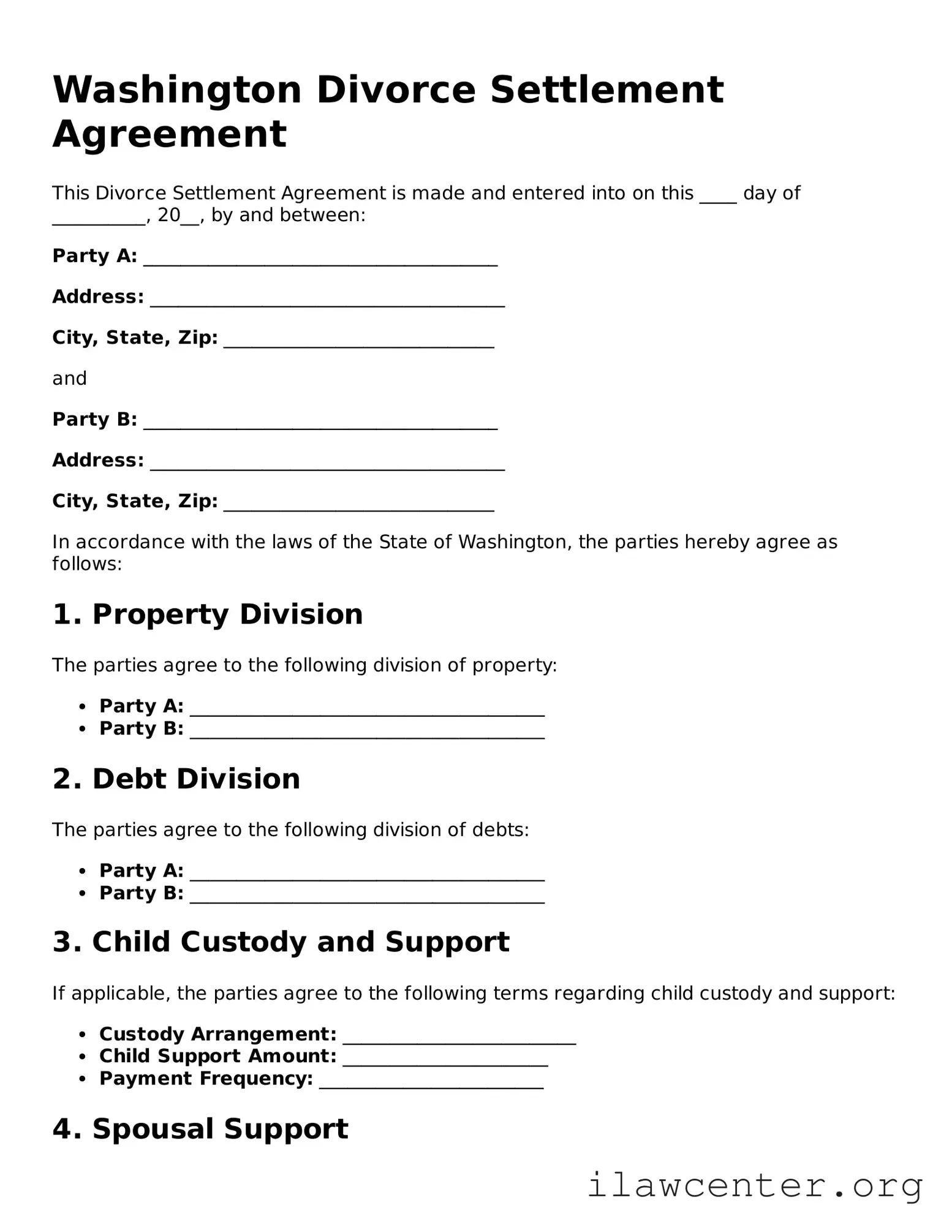
Washington Divorce Settlement Agreement Preview

Washington Divorce Settlement Agreement

This Divorce Settlement Agreement is made and entered into on this ____ day of __________, 20__, by and between:

Party A: ______________________________________

Address: ______________________________________

City, State, Zip: _____________________________

and

Party B: ______________________________________

Address: ______________________________________

City, State, Zip: _____________________________

In accordance with the laws of the State of Washington, the parties hereby agree as follows:

1. Property Division

The parties agree to the following division of property:

  • Party A: ______________________________________
  • Party B: ______________________________________

2. Debt Division

The parties agree to the following division of debts:

  • Party A: ______________________________________
  • Party B: ______________________________________

3. Child Custody and Support

If applicable, the parties agree to the following terms regarding child custody and support:

  • Custody Arrangement: _________________________
  • Child Support Amount: ______________________
  • Payment Frequency: ________________________

4. Spousal Support

If applicable, the parties agree to the following terms regarding spousal support:

  • Amount: _____________________________________
  • Duration: ____________________________________

5. Miscellaneous Provisions

The parties agree to the following additional terms:

  • ______________________________________________
  • ______________________________________________

6. Governing Law

This Agreement shall be governed by the laws of the State of Washington.

IN WITNESS WHEREOF, the parties have executed this Divorce Settlement Agreement as of the date first above written.

Party A Signature: ____________________________

Date: ______________________________________

Party B Signature: ____________________________

Date: ______________________________________

PDF Form Characteristics

Fact Name Description
Purpose The Washington Divorce Settlement Agreement form is used to outline the terms of a divorce settlement between spouses.
Governing Laws This form is governed by the Revised Code of Washington (RCW) Title 26, which covers marriage and divorce.
Mutual Agreement Both parties must agree to the terms outlined in the settlement agreement for it to be valid.
Asset Division The form addresses the division of marital assets and debts, ensuring fair distribution.
Child Custody If applicable, the agreement includes provisions for child custody, visitation, and support.
Filing Requirements Once completed, the form must be filed with the court as part of the divorce proceedings.

Instructions on Utilizing Washington Divorce Settlement Agreement

After obtaining the Washington Divorce Settlement Agreement form, you will need to complete it carefully to ensure all necessary information is included. This form is essential for finalizing the terms of your divorce. Follow these steps to fill it out accurately.

  1. Begin with your personal information. Fill in your full name, address, and contact information at the top of the form.
  2. Provide your spouse's information in the designated section. Include their full name, address, and contact details.
  3. Next, indicate the date of your marriage and the date of separation. Make sure these dates are accurate.
  4. List all children from the marriage, including their names and birthdates. This section is important for custody and support arrangements.
  5. Detail the division of property. Clearly outline what each party will receive. Include any real estate, vehicles, or other significant assets.
  6. Address debts. List any debts that need to be divided, specifying who will be responsible for each one.
  7. Include any spousal support or alimony arrangements. State the amount and duration of support if applicable.
  8. Sign and date the form at the bottom. Both parties must sign to validate the agreement.
  9. Make copies of the completed form for your records and for your spouse.

Once the form is completed and signed, it will need to be submitted to the court as part of the divorce process. Be sure to follow any additional local court requirements to ensure everything is in order.

Important Facts about Washington Divorce Settlement Agreement

What is a Washington Divorce Settlement Agreement?

A Washington Divorce Settlement Agreement is a legal document that outlines the terms of a divorce between two parties. It details how assets, debts, child custody, and support will be handled. This agreement is crucial for ensuring that both parties have a clear understanding of their rights and responsibilities post-divorce.

Who needs to complete a Divorce Settlement Agreement?

Both spouses involved in a divorce need to complete this agreement. It is essential for couples who wish to settle their divorce amicably without going to trial. By agreeing on the terms, both parties can avoid lengthy court proceedings and achieve a more personalized resolution.

What should be included in the Divorce Settlement Agreement?

Key components of the agreement typically include the division of property, allocation of debts, child custody arrangements, visitation schedules, and child or spousal support. Each section should be detailed to minimize misunderstandings and ensure that both parties are on the same page.

How is the Divorce Settlement Agreement enforced?

Once signed, the Divorce Settlement Agreement becomes a legally binding contract. If one party fails to adhere to the terms, the other party can seek enforcement through the court. This may involve filing a motion for contempt or other legal remedies to ensure compliance.

Can the Divorce Settlement Agreement be modified?

Yes, the Divorce Settlement Agreement can be modified, but only under specific circumstances. Changes in financial situations, relocation, or changes in the needs of the children may warrant a modification. Both parties must agree to the changes, and it is advisable to document any modifications formally.

Do I need a lawyer to draft a Divorce Settlement Agreement?

While it is not mandatory to have a lawyer, it is highly recommended. A legal professional can help ensure that the agreement is fair, comprehensive, and compliant with Washington state laws. They can also provide valuable advice on protecting your rights and interests throughout the divorce process.

How long does it take to finalize a Divorce Settlement Agreement?

The time it takes to finalize the agreement can vary significantly based on the complexity of the issues involved and the willingness of both parties to negotiate. If both spouses can communicate effectively and agree on terms, the process can be completed in a matter of weeks. However, disputes may extend the timeline considerably.

Common mistakes

Filling out the Washington Divorce Settlement Agreement form can be a daunting task, and many people make common mistakes that can lead to complications down the line. One frequent error is not fully understanding the terms of the agreement. It's crucial to know what each section means and how it affects your rights and responsibilities. Taking the time to read through the instructions and definitions can save you from future misunderstandings.

Another common mistake is overlooking the importance of complete and accurate financial disclosures. Many individuals fail to provide all necessary information about their income, assets, and debts. This can create issues later, especially if one party feels they were not fully informed about the other's financial situation. Always ensure that you disclose all relevant financial information to avoid potential disputes.

People also often forget to consider the long-term implications of their decisions. For example, when dividing assets or determining child support, it’s easy to focus on immediate needs without thinking about how these decisions will affect you in the future. Consulting with a financial advisor or a legal professional can help you make choices that are beneficial in the long run.

Additionally, many individuals neglect to discuss the agreement with their spouse before submitting it. Open communication can lead to a smoother process and may prevent disagreements from arising later. By discussing the terms together, both parties can ensure that the agreement reflects their mutual understanding and intentions.

Finally, one of the most significant mistakes is failing to review the completed form before submission. It’s important to double-check for errors or omissions. Even minor mistakes can lead to delays or complications in the divorce process. Taking a moment to carefully review the entire document can help ensure that everything is in order and accurately reflects your agreement.

Documents used along the form

When navigating the divorce process in Washington, several key forms and documents are often used alongside the Divorce Settlement Agreement. These documents help ensure that all aspects of the divorce are addressed comprehensively and legally. Below is a list of commonly used forms that can facilitate the divorce proceedings.

  • Petition for Dissolution of Marriage: This document initiates the divorce process. It outlines the reasons for the divorce and the desired outcomes regarding property division, child custody, and support.
  • Summons: This form is issued to notify the other spouse that a divorce action has been filed. It provides details on how and when to respond to the petition.
  • Financial Disclosure Forms: Both parties must complete these forms to provide a clear picture of their financial situation. This includes income, expenses, assets, and debts, which are crucial for equitable distribution.
  • Child Custody Agreement: If children are involved, this document outlines the parenting plan, including custody arrangements, visitation schedules, and decision-making responsibilities.
  • Child Support Order: This form establishes the financial support obligations for the non-custodial parent. It specifies the amount and frequency of payments to ensure the child’s needs are met.
  • Final Judgment of Dissolution: This is the court’s final decision on the divorce, incorporating all agreements made during the process. It officially ends the marriage and outlines the terms agreed upon by both parties.

Understanding these documents can greatly aid in navigating the complexities of divorce in Washington. Each form plays a vital role in ensuring that the divorce process is thorough and fair for both parties involved.

Similar forms

  • Separation Agreement: This document outlines the terms agreed upon by both parties during a separation. Similar to a Divorce Settlement Agreement, it addresses issues such as property division, child custody, and support, though it may not finalize the divorce itself.
  • Child Custody Agreement: Focused specifically on the arrangements for children, this agreement details custody and visitation rights. Like the Divorce Settlement Agreement, it aims to provide clarity and structure for co-parenting post-divorce.
  • Property Settlement Agreement: This document specifically addresses the division of marital assets and debts. It serves a similar purpose to the Divorce Settlement Agreement by ensuring that both parties understand their rights and obligations regarding property.
  • Marital Settlement Agreement: Often used interchangeably with the Divorce Settlement Agreement, this document encompasses all aspects of the divorce settlement, including financial support and asset division, ensuring a comprehensive resolution.
  • Spousal Support Agreement: This agreement focuses solely on financial support provided by one spouse to another after separation or divorce. It is similar in intent to the Divorce Settlement Agreement, as it seeks to ensure fair support arrangements.
  • Final Judgment of Divorce: This court-issued document finalizes the divorce and includes the terms agreed upon in the Divorce Settlement Agreement. While it serves a different function, it is the culmination of the negotiations and agreements laid out in the settlement.

Dos and Don'ts

When filling out the Washington Divorce Settlement Agreement form, it is crucial to approach the task with care. Here are some guidelines to help you navigate the process effectively.

  • Do read the entire form thoroughly before starting. Understanding the requirements will save you time and effort.
  • Do provide accurate and complete information. Incomplete or incorrect details can delay the process.
  • Do consult with a lawyer if you have questions or uncertainties. Professional guidance can clarify complex issues.
  • Do keep copies of all documents submitted. Having a record can be helpful for future reference.
  • Don't rush through the form. Taking your time ensures you don’t overlook important sections.
  • Don't omit any financial disclosures. Full transparency is essential for an equitable settlement.

By following these dos and don’ts, you can help ensure that your Divorce Settlement Agreement is completed accurately and efficiently.

Misconceptions

When navigating the complexities of a divorce, misunderstandings about the Washington Divorce Settlement Agreement form can lead to confusion and unnecessary stress. Here are ten common misconceptions, clarified for better understanding.

  1. The form is only for couples without children. Many believe that the Divorce Settlement Agreement is only necessary for childless couples. In reality, it is essential for all divorcing couples, regardless of whether children are involved, as it outlines the division of assets and responsibilities.
  2. Once signed, the agreement cannot be changed. Some individuals think that after signing the agreement, it is set in stone. However, modifications can be made if both parties agree, and circumstances change.
  3. The form is the same for every divorce. Each divorce is unique, and the agreement should reflect the specific circumstances of the couple involved. Customization is often necessary to address individual needs and concerns.
  4. Legal representation is not necessary. While some may feel confident handling the process alone, having legal representation can provide valuable guidance and ensure that all aspects of the agreement are properly addressed.
  5. The agreement automatically becomes a court order. Signing the form does not automatically make it enforceable by the court. It must be submitted and approved by a judge to gain legal standing.
  6. All assets will be split 50/50. Many assume that assets are divided equally. In Washington, which follows community property laws, assets acquired during the marriage are typically divided equally, but this does not apply to all situations.
  7. Child support is not included in the agreement. Some people think that child support is a separate issue. In fact, it is often included in the Divorce Settlement Agreement and should be clearly outlined.
  8. Spousal support is guaranteed. There is a misconception that spousal support (alimony) is automatically granted. In reality, it depends on various factors, including the length of the marriage and each spouse's financial situation.
  9. The form is only necessary if both parties agree. Even in contested divorces, having a Divorce Settlement Agreement can help clarify issues and serve as a basis for negotiation.
  10. Filing the form is a quick process. Many underestimate the time it takes to prepare and file the agreement. It often requires careful consideration and negotiation, which can take longer than anticipated.

Understanding these misconceptions can help individuals approach their divorce with clarity and confidence. It’s important to seek guidance and ensure that all aspects of the Divorce Settlement Agreement are thoroughly addressed.

Key takeaways

When filling out and using the Washington Divorce Settlement Agreement form, it is essential to understand the following key takeaways:

  • Ensure all personal information is accurate, including names, addresses, and contact details.
  • Clearly outline the division of assets and debts to avoid future disputes.
  • Include child custody arrangements, specifying visitation rights and responsibilities.
  • Address child support payments, detailing amounts and payment schedules.
  • Consider spousal support if applicable, including duration and payment terms.
  • Both parties must sign the agreement to make it legally binding.
  • Consult with a legal professional to ensure all aspects of the agreement comply with Washington state laws.
  • File the completed agreement with the court as part of the divorce proceedings.

Following these guidelines can help ensure a smoother divorce process and minimize potential conflicts in the future.