Attorney-Verified  Non-compete Agreement Document for Washington

Attorney-Verified Non-compete Agreement Document for Washington

A Washington Non-compete Agreement is a legal document that restricts an employee from working for a competitor or starting a similar business for a specified period after leaving their job. This agreement is designed to protect a company's confidential information and trade secrets. If you need to fill out a Non-compete Agreement, click the button below to get started.

Article Guide

The Washington Non-compete Agreement form is a crucial document for employers and employees alike, designed to protect business interests while ensuring fair labor practices. In Washington State, this agreement outlines the terms under which an employee agrees not to engage in competitive activities after leaving their job. Key aspects of the form include the duration of the non-compete period, the geographical scope of the restriction, and the specific activities that are considered competitive. It is essential that the agreement is reasonable and not overly burdensome to the employee, as Washington law mandates certain limitations to uphold fairness in employment practices. Additionally, the form must be signed by both parties, indicating mutual consent to the outlined terms. Understanding these components is vital for both employers looking to safeguard their trade secrets and employees who want to ensure their rights are protected when transitioning to new opportunities.

Washington Non-compete Agreement Preview

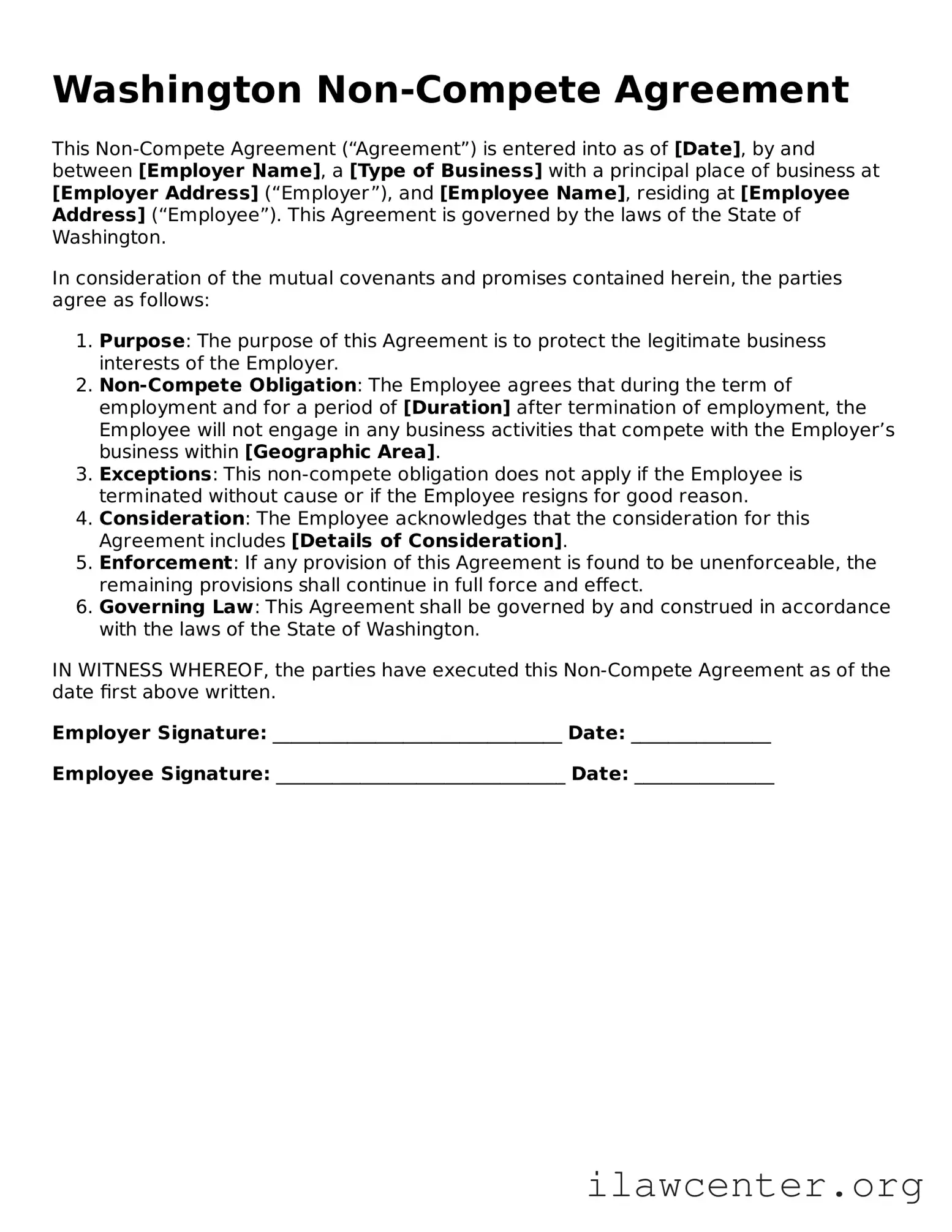
Washington Non-Compete Agreement

This Non-Compete Agreement (“Agreement”) is entered into as of [Date], by and between [Employer Name], a [Type of Business] with a principal place of business at [Employer Address] (“Employer”), and [Employee Name], residing at [Employee Address] (“Employee”). This Agreement is governed by the laws of the State of Washington.

In consideration of the mutual covenants and promises contained herein, the parties agree as follows:

  1. Purpose: The purpose of this Agreement is to protect the legitimate business interests of the Employer.
  2. Non-Compete Obligation: The Employee agrees that during the term of employment and for a period of [Duration] after termination of employment, the Employee will not engage in any business activities that compete with the Employer’s business within [Geographic Area].
  3. Exceptions: This non-compete obligation does not apply if the Employee is terminated without cause or if the Employee resigns for good reason.
  4. Consideration: The Employee acknowledges that the consideration for this Agreement includes [Details of Consideration].
  5. Enforcement: If any provision of this Agreement is found to be unenforceable, the remaining provisions shall continue in full force and effect.
  6. Governing Law: This Agreement shall be governed by and construed in accordance with the laws of the State of Washington.

IN WITNESS WHEREOF, the parties have executed this Non-Compete Agreement as of the date first above written.

Employer Signature: _______________________________ Date: _______________

Employee Signature: _______________________________ Date: _______________

PDF Form Characteristics

Fact Name Description
Definition A non-compete agreement is a contract that restricts an employee from working for competitors after leaving a job.
Governing Law In Washington, non-compete agreements are governed by Washington State law, specifically RCW 49.62.
Enforceability To be enforceable, a non-compete agreement must be reasonable in duration, geographic area, and scope of activity.
Consideration Employers must provide something of value, known as consideration, in exchange for the employee's agreement to the non-compete.
Restrictions Washington law places limits on non-compete agreements, including a maximum duration of 18 months for most agreements.

Instructions on Utilizing Washington Non-compete Agreement

Completing the Washington Non-compete Agreement form is a crucial step in establishing clear boundaries for employment relationships. Ensure that you have all necessary information at hand, as accuracy is key to the effectiveness of the agreement.

  1. Gather Information: Collect all relevant details, including the names of the parties involved, the date of the agreement, and the specifics of the employment relationship.
  2. Fill in the Parties' Names: Clearly write the full legal names of both the employer and the employee at the top of the form.
  3. Specify the Effective Date: Enter the date on which the agreement will take effect. This is typically the start date of employment.
  4. Define the Scope: Outline the specific activities or business interests that the non-compete clause will cover. Be as detailed as possible.
  5. Set the Duration: Indicate how long the non-compete will be in effect after the employee leaves the company. This could range from several months to a few years.
  6. Include Geographic Limitations: Specify any geographic areas where the non-compete will apply. This could be a specific city, state, or region.
  7. Review for Clarity: Go through the completed form to ensure all information is clear and accurate. Ambiguities can lead to disputes later.
  8. Sign and Date: Both parties must sign and date the agreement. Ensure that each party receives a copy for their records.

Important Facts about Washington Non-compete Agreement

What is a non-compete agreement in Washington State?

A non-compete agreement is a legal contract between an employer and an employee that restricts the employee from working for competitors or starting a similar business within a certain geographical area and time frame after leaving the company. In Washington State, these agreements must be reasonable in scope and duration to be enforceable. Employers often use them to protect their business interests, trade secrets, and client relationships.

Are non-compete agreements enforceable in Washington?

Yes, non-compete agreements can be enforceable in Washington, but they must meet specific criteria. The law requires that the agreement be necessary to protect the employer's legitimate business interests, such as trade secrets or customer relationships. Additionally, the duration of the restriction should generally not exceed 18 months, and the geographical area must be reasonable. If an agreement fails to meet these standards, a court may deem it unenforceable.

Can I negotiate the terms of a non-compete agreement?

Absolutely. Employees have the right to negotiate the terms of a non-compete agreement before signing it. It's important to understand that these agreements can significantly impact your future employment opportunities. If you believe the terms are too restrictive or unfair, you should discuss your concerns with your employer. Seeking legal advice can also help you navigate the negotiation process effectively.

What should I do if I believe my non-compete agreement is unfair?

If you feel that your non-compete agreement is overly restrictive or unjust, consider taking several steps. First, review the agreement carefully to understand its terms and limitations. Next, discuss your concerns with your employer, as they may be willing to modify the agreement. If necessary, consult with a legal professional who specializes in employment law. They can provide guidance on your rights and options, including the possibility of challenging the agreement's enforceability in court.

Common mistakes

When filling out the Washington Non-compete Agreement form, individuals often overlook critical details that can lead to complications down the line. One common mistake is failing to clearly define the scope of the non-compete. It is essential to specify the geographical area and the types of activities that are restricted. Without this clarity, the agreement may be deemed unenforceable.

Another frequent error is neglecting to include a specific duration for the non-compete clause. Washington law requires that non-compete agreements be reasonable in time. A vague or overly long duration can raise questions about the agreement's validity.

Many people also forget to consider the consideration aspect of the agreement. In legal terms, consideration refers to what each party stands to gain. If an employee is asked to sign a non-compete after they have already started working, the employer must offer something of value, such as a promotion or a bonus, to make the agreement valid.

Additionally, individuals sometimes fail to consult with a legal professional before signing the agreement. Legal advice can provide insights into the enforceability of the terms and help avoid potential pitfalls. Skipping this step can lead to misunderstandings and unintentional commitments.

Another mistake is not reviewing the entire document thoroughly. It is crucial to read all sections of the agreement, as some clauses may contain provisions that are unfavorable or unexpected. Ignoring fine print can result in unintended consequences.

People often misinterpret the importance of mutuality in non-compete agreements. Both parties should ideally be subject to similar restrictions to ensure fairness. If only one party is bound by the agreement, it may be challenged in court.

In some cases, individuals fail to keep a copy of the signed agreement for their records. Having a personal copy is vital for reference and can help clarify obligations if disputes arise later.

Another common oversight is not understanding the implications of violating the agreement. Many individuals do not realize that breaching a non-compete can lead to legal action, including financial penalties. Awareness of these consequences is crucial before signing.

People also sometimes overlook the need for periodic review of the agreement. As circumstances change, such as job roles or market conditions, it may be necessary to revisit and potentially renegotiate the terms of the non-compete.

Lastly, individuals might assume that all non-compete agreements are the same. However, laws and enforceability can vary significantly by state. Understanding Washington’s specific regulations is essential to ensure compliance and effectiveness.

Documents used along the form

When entering into a Non-compete Agreement in Washington, several other forms and documents may be used to support the agreement and clarify the terms of the employment relationship. Each of these documents serves a specific purpose, ensuring that both parties understand their rights and obligations. Below is a list of commonly used documents alongside the Non-compete Agreement.

  • Employment Agreement: This document outlines the terms of employment, including job responsibilities, compensation, and duration of employment. It often includes confidentiality clauses and may reference the non-compete terms.
  • Confidentiality Agreement: Also known as a Non-disclosure Agreement (NDA), this document protects sensitive information shared during the course of employment. It ensures that employees do not disclose proprietary information to outside parties.
  • Severance Agreement: This agreement details the terms of separation between an employer and an employee. It may include provisions regarding the enforcement of the non-compete clause after termination of employment.
  • Intellectual Property Agreement: This document addresses the ownership of any inventions or creations made by the employee during their time with the company. It can clarify how intellectual property rights relate to the non-compete terms.
  • Offer Letter: An offer letter formally presents the job offer to the candidate. It typically includes a summary of the position, salary, and may reference the requirement to sign a Non-compete Agreement.
  • Non-solicitation Agreement: This document prevents an employee from soliciting clients or employees from the company after leaving. It complements the non-compete by addressing specific competitive actions.

Understanding these documents can help both employers and employees navigate the complexities of employment relationships. Each form plays a vital role in protecting interests and ensuring clarity in agreements. By being informed, all parties can foster a more transparent and cooperative work environment.

Similar forms

A Non-compete Agreement is a legal document designed to prevent an individual from engaging in activities that compete with their employer after leaving the company. While it serves a specific purpose, it shares similarities with several other legal documents. Here are seven documents that are akin to a Non-compete Agreement, each serving its own unique role in protecting business interests and relationships:

  • Non-disclosure Agreement (NDA): This document prevents individuals from sharing confidential information learned during their employment. Like a Non-compete Agreement, it safeguards a company’s proprietary information, ensuring that sensitive data remains protected even after the employment relationship ends.
  • Non-solicitation Agreement: This agreement restricts a former employee from soliciting clients or employees of the company for a specified period. It complements the Non-compete Agreement by protecting the company’s relationships and workforce from potential poaching.
  • Employment Contract: An employment contract outlines the terms and conditions of employment, including duties, compensation, and duration. It may include clauses similar to those found in a Non-compete Agreement, establishing expectations regarding competition and confidentiality.
  • Confidentiality Agreement: Often used interchangeably with an NDA, this document focuses on protecting sensitive business information. It ensures that employees do not disclose trade secrets or proprietary information, similar to the protective intent of a Non-compete Agreement.
  • Intellectual Property Assignment Agreement: This document ensures that any inventions or creative works developed during employment are owned by the employer. It parallels the Non-compete Agreement by protecting the company’s intellectual assets from being used by former employees in competing ventures.
  • Severance Agreement: Typically provided when an employee leaves a company, this document may include clauses that restrict future employment with competitors. Like the Non-compete Agreement, it aims to protect the business's interests after the employee's departure.
  • Partnership Agreement: In business partnerships, this document outlines the roles and responsibilities of each partner. It often contains non-compete clauses that prevent partners from engaging in competing businesses, similar to the protective measures found in a Non-compete Agreement.

Understanding these documents can help individuals and businesses navigate their rights and obligations in various professional relationships. Each serves to protect interests, whether they be trade secrets, client relationships, or the integrity of the workforce.

Dos and Don'ts

When filling out the Washington Non-compete Agreement form, it is essential to be careful and thorough. Here are some important dos and don'ts to consider:

  • Do read the entire agreement carefully before signing.
  • Do ensure that the terms are reasonable and clearly defined.
  • Don't rush through the process without understanding your obligations.
  • Don't ignore the potential impact on your future employment opportunities.

Misconceptions

Non-compete agreements can be confusing, especially in Washington state. Here are seven common misconceptions about these agreements.

  1. Non-compete agreements are always enforceable.

    This is not true. In Washington, non-compete agreements must meet specific criteria to be enforceable. If they do not, a court may refuse to uphold them.

  2. All employees must sign a non-compete agreement.

    Not all employees are required to sign these agreements. Non-compete agreements are typically reserved for employees in certain positions, particularly those with access to sensitive information or trade secrets.

  3. Non-compete agreements last indefinitely.

    In Washington, non-compete agreements cannot last longer than 18 months after employment ends. After this period, they generally become unenforceable.

  4. Non-compete agreements are the same as non-disclosure agreements.

    These are different legal tools. Non-disclosure agreements protect confidential information, while non-compete agreements restrict where and how an employee can work after leaving a job.

  5. Signing a non-compete means you cannot work in your field again.

    This is misleading. A non-compete agreement may limit where you can work or the specific companies you can join, but it does not necessarily bar you from working in your field altogether.

  6. Employers can change the terms of a non-compete agreement at any time.

    This is incorrect. Any changes to a non-compete agreement typically require mutual consent from both the employer and the employee.

  7. Non-compete agreements are only for high-level executives.

    This is a misconception. Non-compete agreements can apply to various employees, not just executives. However, the reason for the agreement often depends on the employee's role and access to sensitive information.

Key takeaways

When considering the Washington Non-compete Agreement form, several key points should be taken into account to ensure its effectiveness and compliance with state law.

  • Understand the Purpose: A non-compete agreement is designed to protect a business's interests by preventing employees from working for competitors or starting a competing business for a specified period after leaving the company.
  • Know the Limitations: Washington law imposes restrictions on non-compete agreements. They must be reasonable in duration, geographic scope, and the type of work restricted.
  • Consider the Employee's Position: Non-compete agreements are more enforceable for higher-level employees who have access to sensitive information or trade secrets. Lower-level employees may not be subject to such restrictions.
  • Review and Update Regularly: It is important to periodically review non-compete agreements to ensure they comply with current laws and reflect any changes in business practices or employee roles.