Attorney-Verified  Notary Acknowledgement Document for Washington

Attorney-Verified Notary Acknowledgement Document for Washington

The Washington Notary Acknowledgement form is a legal document used to verify the identity of a signer and confirm that they willingly signed a document in front of a notary public. This form serves as a crucial step in ensuring the authenticity of various legal transactions. To learn more about how to fill out this form correctly, click the button below.

Article Guide

The Washington Notary Acknowledgement form plays a crucial role in the notarization process, ensuring that documents are authenticated and legally recognized. This form is essential for various transactions, including real estate deals, legal agreements, and financial documents. When a notary public uses this form, they verify the identity of the signer and confirm that the signer willingly executed the document. The form captures key details such as the date of notarization, the name of the signer, and the notary's official seal. It also includes a statement affirming that the signer appeared before the notary and acknowledged their signature. By using this form, individuals can enhance the credibility of their documents and provide assurance to all parties involved. Understanding the intricacies of the Washington Notary Acknowledgement form is vital for anyone looking to navigate legal processes smoothly and effectively.

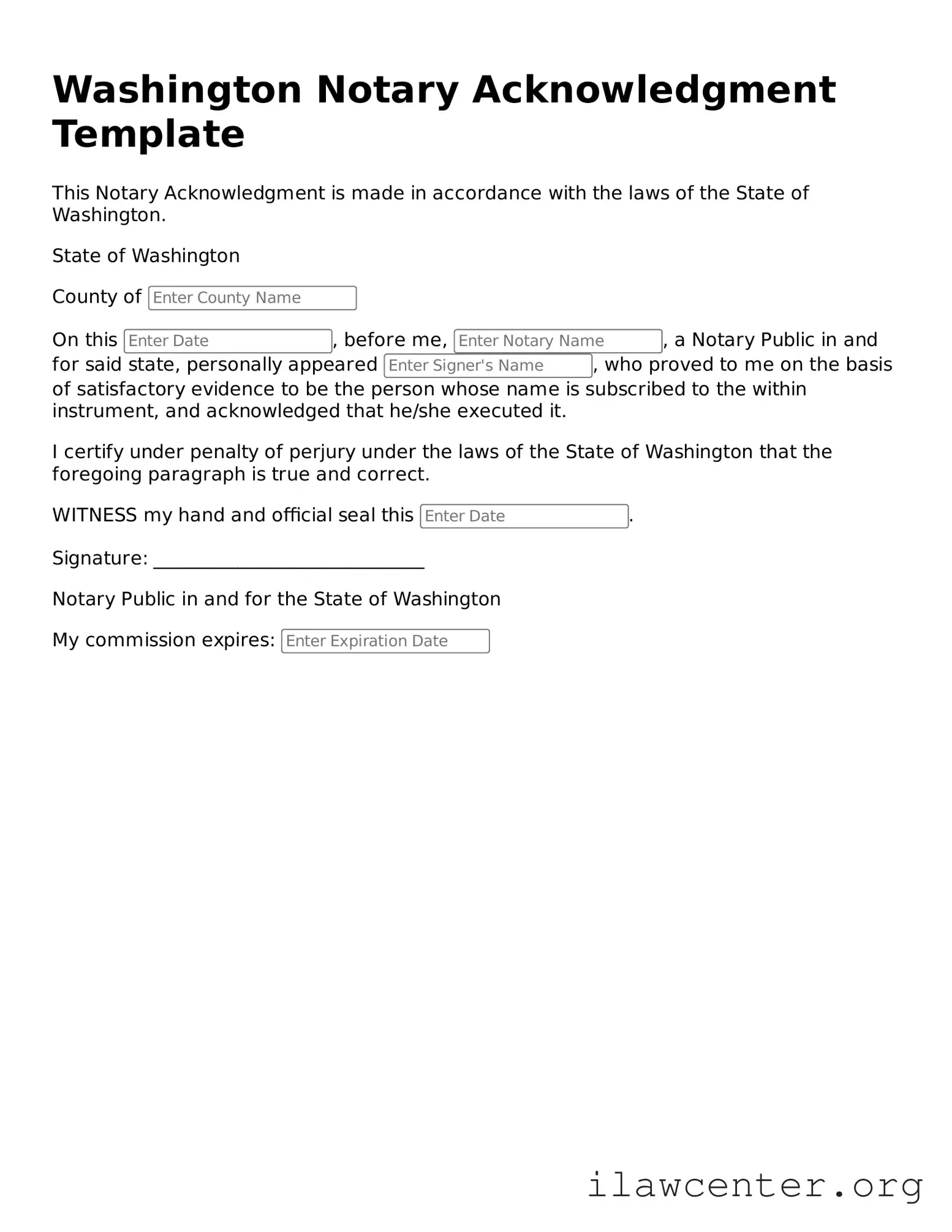
Washington Notary Acknowledgement Preview

Washington Notary Acknowledgment Template

This Notary Acknowledgment is made in accordance with the laws of the State of Washington.

State of Washington

County of

On this , before me, , a Notary Public in and for said state, personally appeared , who proved to me on the basis of satisfactory evidence to be the person whose name is subscribed to the within instrument, and acknowledged that he/she executed it.

I certify under penalty of perjury under the laws of the State of Washington that the foregoing paragraph is true and correct.

WITNESS my hand and official seal this .

Signature: _____________________________

Notary Public in and for the State of Washington

My commission expires:

PDF Form Characteristics

Fact Name Description
Purpose The Washington Notary Acknowledgement form is used to verify the identity of the signer and their willingness to sign a document.
Governing Law This form is governed by the Revised Code of Washington (RCW) 42.44.030.
Signature Requirement The signer must personally appear before the notary public and sign the document in their presence.
Notary's Role The notary public must complete the acknowledgement section, confirming the identity of the signer.
Record Keeping Notaries are required to maintain a journal of all notarial acts, including acknowledgements.
Validity A properly executed Notary Acknowledgement is generally valid for use in any legal context where notarization is required.

Instructions on Utilizing Washington Notary Acknowledgement

After obtaining the Washington Notary Acknowledgement form, you will need to complete it accurately to ensure it is valid. Follow the steps below to fill out the form correctly.

  1. Begin by entering the date at the top of the form. This should be the date when the notary acknowledgment is being completed.
  2. Fill in the name of the person who is signing the document. This is the individual whose signature will be acknowledged.
  3. Next, provide the address of the person signing. This should include the street address, city, state, and zip code.
  4. Indicate the type of document being acknowledged. Be specific about the document's name or purpose.
  5. In the designated area, the notary public should sign their name. This indicates they have witnessed the signature.
  6. Below the notary's signature, the notary should print their name clearly.
  7. Fill in the notary's commission expiration date. This is the date when the notary's authority to act will end.
  8. Finally, ensure that the notary's seal is affixed to the form. This is a crucial step for the document's validity.

Once the form is completed, it is ready for submission or filing as needed. Make sure to keep a copy for your records.

Important Facts about Washington Notary Acknowledgement

What is a Washington Notary Acknowledgement form?

The Washington Notary Acknowledgement form is a document used to verify the identity of a signer and confirm that they willingly signed a document. This form is often required for legal documents, such as deeds, contracts, and affidavits, to ensure that the signatures are authentic and that the signers understand the contents of the documents they are signing.

Who can act as a notary in Washington?

In Washington, a notary public must be at least 18 years old, a resident of the state, and able to read and write English. Notaries are appointed by the Secretary of State and must complete a training course and pass an exam. Additionally, they must obtain a surety bond and maintain a journal of their notarial acts.

How do I complete a Notary Acknowledgement form?

To complete a Notary Acknowledgement form, the signer must appear in person before the notary. The notary will ask for identification to verify the signer’s identity. After confirming that the signer understands the document, the notary will complete the form by filling in details such as the date, the signer's name, and the notary's information. Finally, the notary will sign and seal the form.

Is a Notary Acknowledgement form required for all documents?

No, a Notary Acknowledgement form is not required for all documents. However, it is often necessary for documents that will be filed with a court or government agency. It's important to check the specific requirements for the type of document being signed to determine if notarization is needed.

What is the difference between a Notary Acknowledgement and a Notary Jurat?

A Notary Acknowledgement confirms that the signer has willingly signed a document, while a Notary Jurat involves the signer taking an oath or affirmation regarding the truthfulness of the contents of the document. A Jurat requires the signer to appear before the notary and swear to the truth of the document, whereas an Acknowledgement does not require an oath.

Can I use a Notary Acknowledgement form for out-of-state documents?

How long is a Notary Acknowledgement valid?

A Notary Acknowledgement does not have a specific expiration date. However, the validity of the document it accompanies may be subject to time limits based on the type of document or the laws governing its use. It is essential to consult legal guidelines or an attorney to understand any applicable timeframes for the document in question.

Common mistakes

Filling out the Washington Notary Acknowledgment form can be straightforward, but many individuals make common mistakes that can lead to delays or complications. One frequent error is failing to include the correct date. It’s essential to ensure that the date of the acknowledgment matches the date when the notary actually witnessed the signing of the document. If there’s a discrepancy, it could raise questions about the validity of the notarization.

Another mistake often seen is not having the signer present at the time of notarization. The law requires that the signer must be physically present before the notary. If the notary acknowledges a signature without the signer being there, the notarization could be deemed invalid.

People sometimes overlook the need to properly identify the signer. The notary must confirm the identity of the individual signing the document. This usually involves checking a government-issued ID. Skipping this step can lead to issues down the line, especially if the document is ever challenged.

Additionally, some individuals forget to include the notary’s official seal. The seal is a crucial part of the notarization process. Without it, the acknowledgment may not hold up in court or during any official proceedings. Always ensure that the seal is affixed in the appropriate place on the form.

Another common error is neglecting to complete all required fields on the form. Each section serves a purpose, and leaving any part blank can create confusion or invalidate the notarization. Take the time to review the form carefully before submitting it.

Sometimes, people misinterpret the wording of the acknowledgment itself. It’s important to ensure that the acknowledgment reflects the correct type of document being notarized. Mislabeling the document can lead to serious legal implications.

Errors can also occur when signers fail to sign the document before the notary does their part. The notary’s role is to witness the signing, not to sign beforehand. Make sure that the signer completes their signature first.

In some cases, individuals may not understand the importance of the notary’s signature. The notary must sign the form to validate the acknowledgment. If this step is overlooked, the entire process may be rendered ineffective.

Finally, people may rush through the process without double-checking their work. Taking a moment to review the completed form can prevent many of these mistakes. A careful approach ensures that the notarization is valid and that the document can be relied upon when needed.

Documents used along the form

In the realm of legal documents, the Washington Notary Acknowledgement form often appears alongside various other forms. Each of these documents serves a specific purpose and helps facilitate the notarization process. Below is a list of commonly used forms and documents that may accompany the Notary Acknowledgement in Washington State.

  • Power of Attorney: This document allows one person to authorize another to act on their behalf in legal matters. It is often notarized to confirm the identity of the signatory.
  • Affidavit: An affidavit is a written statement confirmed by oath or affirmation. It is typically used as evidence in court and must be notarized to verify the authenticity of the signature.
  • Deed: A deed is a legal document that transfers ownership of real property. Notarization is crucial to ensure the transfer is valid and enforceable.
  • Loan Agreement: This document outlines the terms of a loan between a lender and a borrower. Notarization may be required to authenticate the signatures of both parties.
  • Contract: A contract is a legally binding agreement between two or more parties. Notarizing a contract can add an extra layer of security and credibility to the document.
  • Will: A will outlines how a person's assets will be distributed after their death. While not always required, notarization can help validate the will and reduce the risk of disputes.
  • Certificate of Trust: This document provides evidence of the existence of a trust and the authority of the trustee. Notarization helps confirm the identities of those involved.
  • Real Estate Closing Documents: These documents finalize the sale or transfer of property. Notarization is often required to ensure all parties have agreed to the terms and conditions.

Understanding these documents and their functions can help individuals navigate the notarization process more effectively. Each form plays a vital role in ensuring that legal agreements are recognized and enforceable in Washington State.

Similar forms

  • Affidavit: Like a notary acknowledgment, an affidavit is a written statement confirmed by oath or affirmation. It serves as a way to present facts in a legal context, often requiring a notary's signature to verify the identity of the person making the statement.
  • Power of Attorney: This document allows one person to act on behalf of another in legal matters. A notary acknowledgment is often required to ensure that the person granting the power is doing so willingly and understands the implications.
  • Deed: A deed transfers ownership of property. Notary acknowledgment is necessary to confirm that the signatures on the deed are genuine and that the parties involved understand the transaction.
  • Trust Agreement: This document outlines the terms of a trust. Notary acknowledgment helps verify the identities of the parties involved and ensures that they are entering into the agreement knowingly and voluntarily.
  • Loan Agreement: Similar to a notary acknowledgment, a loan agreement outlines the terms of a loan between parties. Notarization may be required to confirm the identities of the signers and to provide an added layer of legal protection for the agreement.

Dos and Don'ts

When filling out the Washington Notary Acknowledgment form, it is essential to follow certain guidelines to ensure the document is completed correctly. Here are some do's and don'ts to keep in mind:

  • Do ensure that the signer is present when you complete the acknowledgment.
  • Do verify the identity of the signer by checking a valid form of identification.
  • Do fill in all required fields on the form accurately.
  • Do use clear and legible handwriting or type the information if possible.
  • Don't sign the acknowledgment form before the signer has completed their part.
  • Don't alter or modify the form after it has been signed by the individual.
  • Don't forget to date the acknowledgment to reflect the date of the signing.

Following these guidelines can help ensure that the acknowledgment is valid and legally binding. It is important to approach this task with care and attention to detail.

Misconceptions

Understanding the Washington Notary Acknowledgement form is crucial for anyone involved in legal documentation. However, several misconceptions can lead to confusion. Here are six common misconceptions:

  1. Notaries can verify the content of documents.

    This is incorrect. A notary's role is to verify the identity of the signer and ensure they are signing voluntarily. They do not assess the content of the document.

  2. All documents require a notary acknowledgment.

    Not every document needs a notary. Only certain legal documents, such as deeds or powers of attorney, typically require notarization.

  3. Notaries can provide legal advice.

    This is a misconception. Notaries cannot offer legal advice or interpret documents. They are there to witness signatures, not to guide legal processes.

  4. Notarization guarantees a document's legality.

    Notarization does not make a document legal. It merely confirms that the signature is valid and that the signer acted willingly.

  5. Notaries must know the signer personally.

    While personal knowledge can be beneficial, it is not a requirement. A notary can use identification to verify a signer's identity.

  6. Notary services are always free.

    This is misleading. While some notaries may offer free services, many charge a fee for their time and expertise.

By clarifying these misconceptions, individuals can navigate the notarization process more effectively and ensure their documents are properly acknowledged.

Key takeaways

When filling out and using the Washington Notary Acknowledgement form, it’s essential to understand the key elements involved. Here are some important takeaways to consider:

  • Purpose of the Form: The Notary Acknowledgement form serves to verify the identity of the signer and confirm that they willingly signed the document.
  • Completeness: Ensure all sections of the form are filled out completely. Missing information can lead to delays or rejections.
  • Identification: The notary must verify the identity of the signer through acceptable forms of identification, such as a driver's license or passport.
  • Signature Requirements: The signer must be present at the time of notarization. They should sign the document in front of the notary.
  • Notary's Role: The notary public is responsible for completing their section of the form, which includes their signature, seal, and the date of notarization.
  • Retention of Records: Notaries are required to keep a record of all notarizations. This helps maintain accountability and can be important for future reference.

Understanding these key points will help ensure that the Notary Acknowledgement form is completed correctly and used effectively.