Attorney-Verified  Real Estate Purchase Agreement Document for Washington

Attorney-Verified Real Estate Purchase Agreement Document for Washington

The Washington Real Estate Purchase Agreement is a legal document that outlines the terms and conditions for buying and selling property in Washington State. This form serves as a crucial tool for both buyers and sellers, ensuring that all parties are on the same page regarding the sale. Ready to take the next step? Fill out the form by clicking the button below!

Article Guide

The Washington Real Estate Purchase Agreement form serves as a crucial document in the home buying and selling process. This form outlines the terms and conditions agreed upon by the buyer and seller, ensuring that both parties understand their rights and obligations. Key aspects include the purchase price, financing details, and the timeline for closing the sale. Additionally, the agreement addresses contingencies, such as inspections and appraisals, which protect the interests of both parties. It also specifies the property description, ensuring clarity about what is included in the sale. By clearly laying out these elements, the agreement helps to minimize misunderstandings and provides a framework for a smooth transaction.

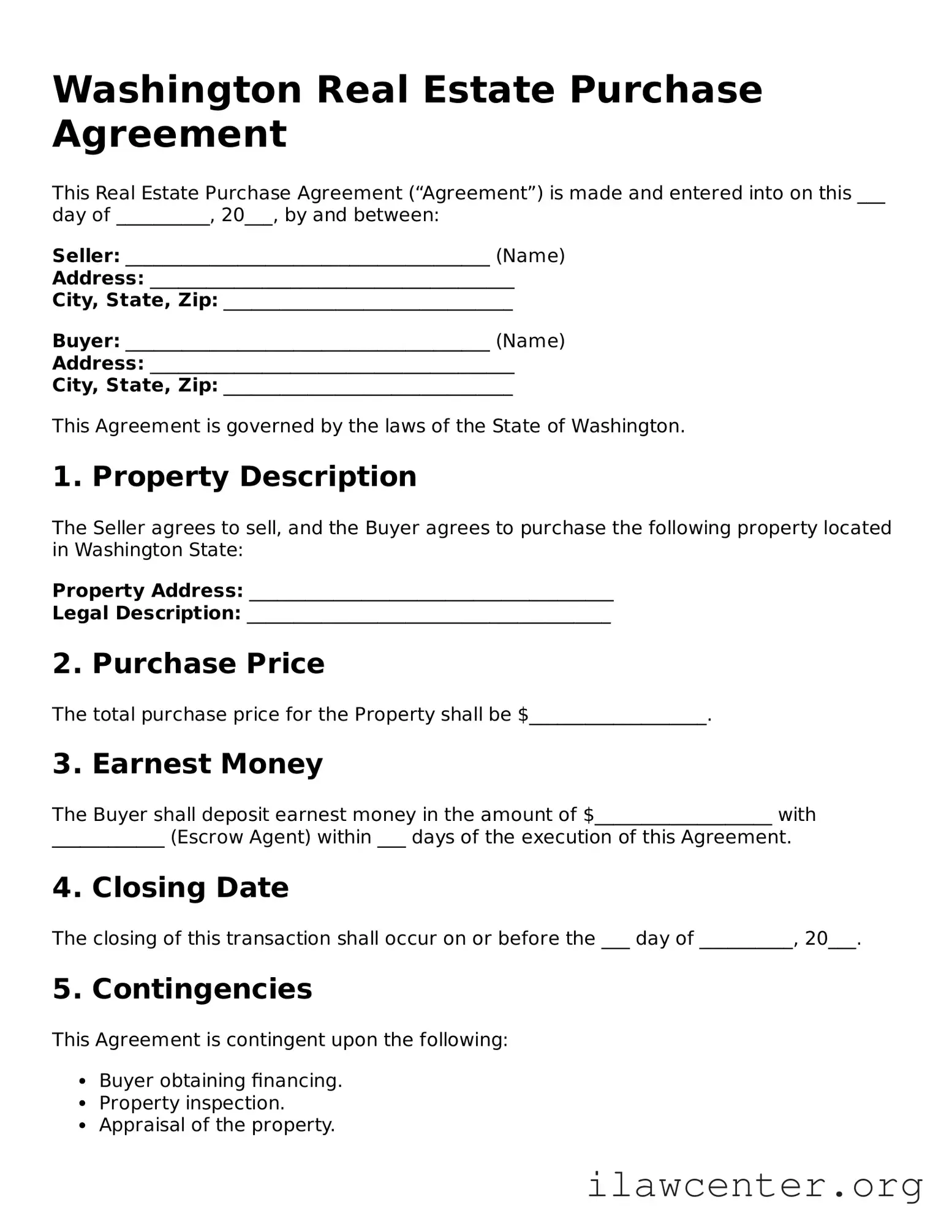
Washington Real Estate Purchase Agreement Preview

Washington Real Estate Purchase Agreement

This Real Estate Purchase Agreement (“Agreement”) is made and entered into on this ___ day of __________, 20___, by and between:

Seller: _______________________________________ (Name)
Address: _______________________________________
City, State, Zip: _______________________________

Buyer: _______________________________________ (Name)
Address: _______________________________________
City, State, Zip: _______________________________

This Agreement is governed by the laws of the State of Washington.

1. Property Description

The Seller agrees to sell, and the Buyer agrees to purchase the following property located in Washington State:

Property Address: _______________________________________
Legal Description: _______________________________________

2. Purchase Price

The total purchase price for the Property shall be $___________________.

3. Earnest Money

The Buyer shall deposit earnest money in the amount of $___________________ with ____________ (Escrow Agent) within ___ days of the execution of this Agreement.

4. Closing Date

The closing of this transaction shall occur on or before the ___ day of __________, 20___.

5. Contingencies

This Agreement is contingent upon the following:

  • Buyer obtaining financing.
  • Property inspection.
  • Appraisal of the property.

6. Disclosures

The Seller agrees to provide all required disclosures as per Washington State law, including but not limited to:

  • Lead-based paint disclosure (if applicable).
  • Real property disclosure statement.

7. Signatures

By signing below, both parties agree to the terms and conditions outlined in this Agreement.

Seller's Signature: _____________________________
Date: _____________________

Buyer's Signature: _____________________________
Date: _____________________

PDF Form Characteristics

Fact Name Details
Governing Law The Washington Real Estate Purchase Agreement is governed by the laws of the State of Washington.
Purpose This form outlines the terms and conditions under which a buyer agrees to purchase real estate from a seller.
Parties Involved The agreement involves at least two parties: the buyer and the seller.
Property Description A detailed description of the property being sold is required, including the address and legal description.
Purchase Price The purchase price must be clearly stated, along with any deposits or earnest money involved.
Contingencies Common contingencies may include financing, inspections, and the sale of the buyer's current home.
Closing Date The agreement should specify a closing date, which is when the ownership is officially transferred.
Disclosures Sellers are required to provide certain disclosures about the property, including any known defects.
Signatures Both parties must sign the agreement for it to be legally binding.

Instructions on Utilizing Washington Real Estate Purchase Agreement

Once you have the Washington Real Estate Purchase Agreement form in front of you, it's time to fill it out carefully. This form is essential for any real estate transaction in Washington. Completing it accurately will help ensure a smooth process as you move forward with your purchase.

  1. Read the entire form. Familiarize yourself with all sections before you start filling it out.
  2. Enter the date. Write the date at the top of the form where indicated.
  3. Fill in the buyer's information. Include the full names and contact details of all buyers.
  4. Provide the seller's information. Include the full names and contact details of all sellers.
  5. Describe the property. Clearly state the address and any relevant details about the property being purchased.
  6. Specify the purchase price. Write the total amount the buyer is offering for the property.
  7. Detail the earnest money. Indicate the amount of earnest money the buyer will provide and how it will be held.
  8. Outline any contingencies. List any conditions that must be met for the sale to proceed, such as inspections or financing.
  9. Sign and date the form. Ensure that all buyers and sellers sign and date the agreement in the appropriate sections.

After completing the form, make sure to review it carefully for any errors or missing information. Once everything is in order, you can proceed with submitting the agreement to the appropriate parties involved in the transaction.

Important Facts about Washington Real Estate Purchase Agreement

What is the Washington Real Estate Purchase Agreement form?

The Washington Real Estate Purchase Agreement form is a legal document used when a buyer wants to purchase real estate in Washington State. This form outlines the terms and conditions of the sale, including the purchase price, financing details, and any contingencies that must be met before the sale is finalized.

Who needs to use this form?

This form is typically used by buyers and sellers involved in a real estate transaction in Washington State. Real estate agents often assist in filling out this form to ensure all necessary details are included and that both parties understand their rights and obligations.

What information is included in the agreement?

The agreement includes essential information such as the names of the buyer and seller, the property address, the purchase price, earnest money deposit details, and any contingencies such as inspections or financing approvals. It may also specify closing dates and other important deadlines.

Is the agreement legally binding?

Yes, once both parties sign the Washington Real Estate Purchase Agreement, it becomes a legally binding contract. This means that both the buyer and seller are obligated to fulfill the terms outlined in the agreement, provided that all conditions are met.

Can the agreement be modified after it is signed?

Yes, the agreement can be modified, but both parties must agree to any changes. Modifications should be documented in writing and signed by both the buyer and seller to ensure clarity and enforceability.

What happens if one party does not fulfill their obligations?

If one party fails to meet their obligations under the agreement, the other party may have legal options available. This could include seeking damages or enforcing the contract through legal action. It is advisable to consult with a legal professional in such situations.

Are there any contingencies that can be included in the agreement?

Yes, common contingencies include financing contingencies, inspection contingencies, and appraisal contingencies. These allow the buyer to back out of the deal or negotiate terms if certain conditions are not met. It is important to specify these contingencies clearly in the agreement.

How long is the agreement valid?

The validity of the agreement typically lasts until the closing date specified in the contract. However, if the conditions of the agreement are not met by that date, the agreement may become void unless both parties agree to extend it.

What should I do if I have questions about the agreement?

If you have questions about the Washington Real Estate Purchase Agreement, it is best to consult with a real estate agent or a legal professional. They can provide guidance and help clarify any terms or conditions that may be confusing.

Where can I obtain a copy of the form?

The Washington Real Estate Purchase Agreement form can be obtained from various sources, including real estate offices, legal stationery stores, or online through real estate websites. It is essential to use the most current version of the form to ensure compliance with state laws.
Common mistakes

Filling out the Washington Real Estate Purchase Agreement form can be a daunting task for many. One common mistake that people make is not providing complete information. When sections are left blank or filled out partially, it can lead to confusion or disputes later on. Always ensure that every relevant field is filled in accurately to avoid complications.

Another frequent error is failing to specify the purchase price clearly. This figure is crucial as it sets the foundation for the entire agreement. If the price is not stated or is ambiguous, it can create misunderstandings between the buyer and seller. Make sure to write the purchase price in both numerical and written form to eliminate any potential discrepancies.

Many individuals overlook the importance of including contingencies in the agreement. Contingencies are conditions that must be met for the sale to proceed, such as securing financing or passing a home inspection. Without these provisions, buyers may find themselves locked into a purchase that they cannot complete due to unforeseen circumstances.

Another mistake is neglecting to review the closing date. This date is essential for both parties as it marks when the property will officially change hands. If the closing date is not clearly defined, it can lead to delays and frustration. Both the buyer and seller should agree on a realistic timeline and include it in the agreement.

Buyers often forget to clarify what is included in the sale. Items such as appliances, fixtures, or even landscaping features can sometimes be a point of contention. Clearly listing what is included or excluded from the sale can help prevent misunderstandings and ensure that both parties are on the same page.

Lastly, failing to sign and date the agreement is a critical mistake that can render the document invalid. Both the buyer and seller must sign the agreement to indicate their acceptance of the terms. Without signatures, the agreement holds no legal weight, and the transaction cannot proceed. Always double-check that all necessary signatures are present before submitting the form.

Documents used along the form

When entering into a real estate transaction in Washington, several forms and documents accompany the Real Estate Purchase Agreement. These documents help ensure that both parties are informed and protected throughout the process. Here is a list of commonly used forms:

  • Seller's Disclosure Statement: This document provides information about the property's condition, including any known issues or defects. It helps buyers make informed decisions.
  • Buyer’s Inspection Contingency: This clause allows the buyer to have the property inspected. If significant issues are found, the buyer can negotiate repairs or withdraw from the agreement.
  • Earnest Money Agreement: This outlines the deposit made by the buyer to show serious intent to purchase. It details how the funds will be handled if the sale proceeds or falls through.
  • Title Report: This document reveals the ownership history and any liens or encumbrances on the property. It ensures that the seller has the right to sell the property.
  • Closing Disclosure: Provided before closing, this document outlines the final loan terms, closing costs, and other financial details. It ensures transparency for the buyer.
  • Property Deed: This legal document transfers ownership of the property from the seller to the buyer. It must be recorded with the county to be effective.
  • Home Warranty Agreement: This optional agreement covers repairs or replacements for certain home systems and appliances for a specified period after the sale.
  • Affidavit of Title: This document certifies that the seller has clear title to the property and discloses any relevant information that could affect ownership.

Using these documents in conjunction with the Real Estate Purchase Agreement helps ensure a smooth transaction. Each form plays a vital role in protecting the interests of both buyers and sellers. It is important to review and understand each document thoroughly before proceeding.

Similar forms

  • Lease Agreement: Similar to a Real Estate Purchase Agreement, a lease agreement outlines the terms under which a tenant can occupy a property. Both documents specify the duration, payment terms, and responsibilities of the parties involved.

  • Option to Purchase Agreement: This document grants a buyer the right to purchase a property at a later date. Like the Real Estate Purchase Agreement, it includes terms regarding price and conditions but focuses on future purchase rights rather than an immediate transaction.

  • Real Estate Listing Agreement: This agreement is between a property owner and a real estate agent. It details the terms of the agent's representation, including commission rates and marketing strategies, similar to how a purchase agreement outlines buyer and seller responsibilities.

  • Purchase and Sale Agreement: Often used interchangeably with the Real Estate Purchase Agreement, this document also formalizes the sale of property. It includes details about the property, purchase price, and closing conditions.

  • Escrow Agreement: This document involves a neutral third party holding funds during a real estate transaction. Like the Real Estate Purchase Agreement, it ensures that all parties meet their obligations before the transaction is completed.

  • Title Transfer Document: This legal document facilitates the transfer of property ownership. It complements the Real Estate Purchase Agreement by finalizing the buyer's acquisition of the property after all terms have been met.

  • Financing Agreement: This document outlines the terms of a loan used to purchase real estate. It is similar to the Real Estate Purchase Agreement in that both documents detail financial obligations and conditions related to the property purchase.

  • Disclosure Statement: This document provides important information about the property's condition and any known issues. It is similar to the Real Estate Purchase Agreement in that it aims to protect the buyer by ensuring transparency in the transaction.

Dos and Don'ts

When filling out the Washington Real Estate Purchase Agreement form, it is crucial to be thorough and accurate. Here are some essential dos and don'ts to consider:

  • Do read the entire agreement carefully before signing.
  • Do ensure all parties involved have clearly stated their names and contact information.
  • Don't leave any blanks in the agreement; fill in all necessary information.
  • Don't rush through the process; take your time to understand each section.

Misconceptions

Understanding the Washington Real Estate Purchase Agreement (REPA) is crucial for both buyers and sellers. However, several misconceptions can lead to confusion. Here are six common misunderstandings about this important document:

  1. The REPA is a standard form that cannot be customized.

    While the REPA is a widely used template, it can be tailored to fit the specific needs of the transaction. Parties can negotiate terms and include additional clauses to address unique circumstances.

  2. Signing the REPA means the sale is final.

    Signing the REPA is an important step, but it does not complete the sale. The agreement is contingent upon various conditions, such as inspections and financing, which must be satisfied before closing.

  3. The REPA protects only the buyer's interests.

    This is not accurate. The REPA is designed to protect both parties. It outlines the rights and responsibilities of buyers and sellers, ensuring that both have legal recourse if the terms are not met.

  4. Once submitted, the REPA cannot be changed.

    Changes can be made to the REPA, but both parties must agree to any modifications. This flexibility allows for adjustments based on negotiations or changing circumstances.

  5. The REPA is a legally binding document immediately upon signing.

    While the REPA becomes legally binding once both parties sign, it may still be subject to contingencies. These conditions must be fulfilled before the agreement is enforceable.

  6. Real estate agents do not need to be involved in the REPA process.

    Although it is possible to complete the REPA without an agent, having professional guidance is highly recommended. Agents can provide valuable insights and help navigate the complexities of the agreement.

By addressing these misconceptions, individuals can better understand the Washington Real Estate Purchase Agreement and make informed decisions in their real estate transactions.

Key takeaways

Filling out and using the Washington Real Estate Purchase Agreement form is a crucial step in the home buying process. Here are some key takeaways to keep in mind:

  • The agreement outlines the terms of the sale, including the purchase price, closing date, and any contingencies.
  • Both the buyer and seller must sign the document for it to be legally binding.
  • It's essential to include all necessary details to avoid misunderstandings later on.
  • Buyers should be aware of their rights and obligations, as well as those of the seller, as specified in the agreement.
  • Consider consulting with a real estate professional or attorney to ensure the agreement meets all legal requirements.

Understanding these key points can help facilitate a smoother transaction and protect the interests of all parties involved.