Attorney-Verified  RV Bill of Sale Document for Washington

Attorney-Verified RV Bill of Sale Document for Washington

The Washington RV Bill of Sale form serves as a crucial document in the transfer of ownership for recreational vehicles within the state. This form not only provides proof of the sale but also outlines essential details such as the buyer and seller information, vehicle specifications, and the sale price. Understanding its importance can help ensure a smooth transaction process for both parties involved.

To get started on your RV sale, fill out the form by clicking the button below.

Article Guide

When buying or selling a recreational vehicle (RV) in Washington State, having a properly executed RV Bill of Sale is essential for a smooth transaction. This document serves as a receipt, providing proof of the sale and detailing important information about the vehicle and the parties involved. It typically includes the names and addresses of both the buyer and seller, the vehicle's make, model, year, and Vehicle Identification Number (VIN), as well as the sale price and date of the transaction. Additionally, the form may outline any warranties or conditions related to the sale, ensuring both parties are clear on the terms. By completing this form, buyers can protect themselves against potential disputes, while sellers can confirm the transfer of ownership. Understanding the key components of the RV Bill of Sale helps facilitate a transparent and legally sound exchange, making it a vital part of the RV buying and selling process in Washington.

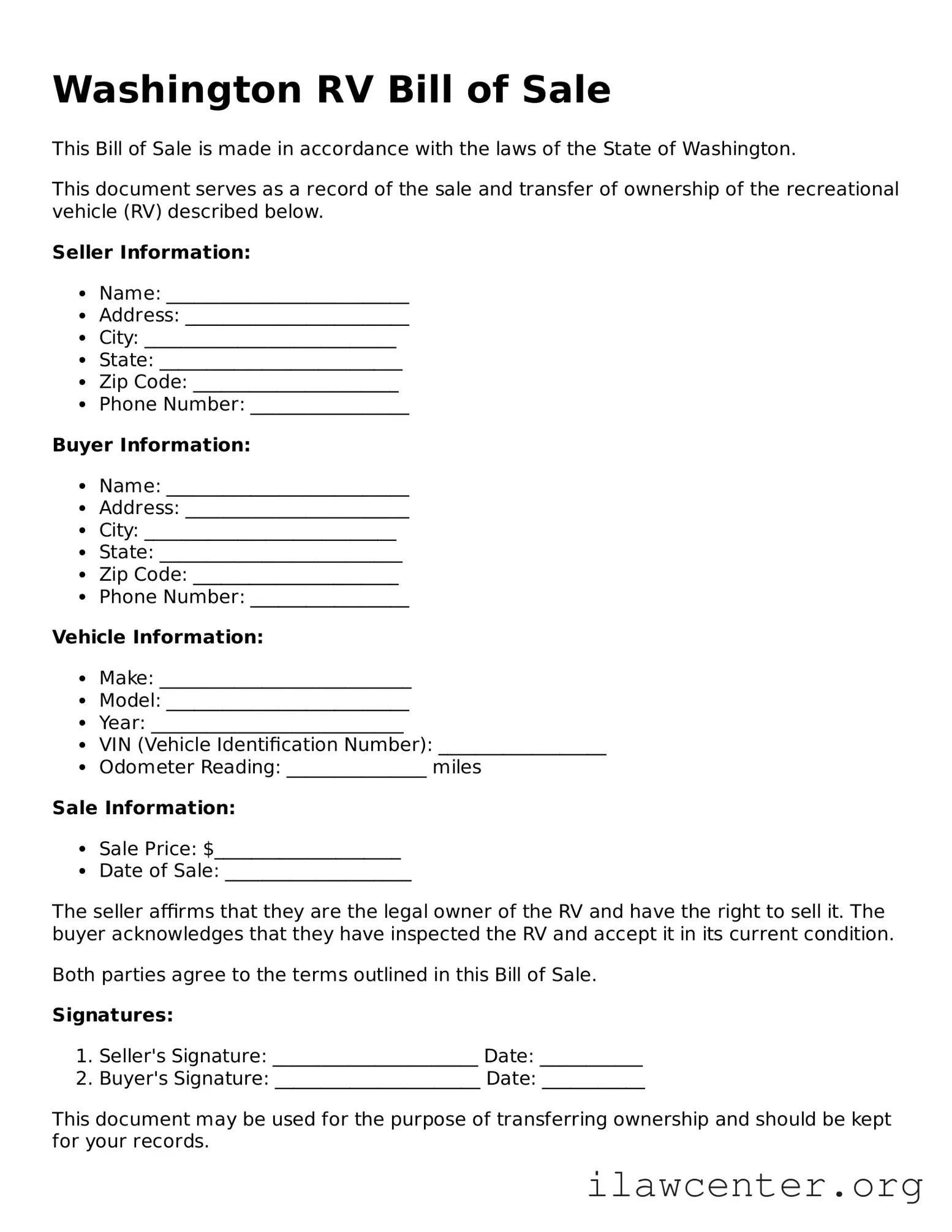
Washington RV Bill of Sale Preview

Washington RV Bill of Sale

This Bill of Sale is made in accordance with the laws of the State of Washington.

This document serves as a record of the sale and transfer of ownership of the recreational vehicle (RV) described below.

Seller Information:

  • Name: __________________________
  • Address: ________________________
  • City: ___________________________
  • State: __________________________
  • Zip Code: ______________________
  • Phone Number: _________________

Buyer Information:

  • Name: __________________________
  • Address: ________________________
  • City: ___________________________
  • State: __________________________
  • Zip Code: ______________________
  • Phone Number: _________________

Vehicle Information:

  • Make: ___________________________
  • Model: __________________________
  • Year: ___________________________
  • VIN (Vehicle Identification Number): __________________
  • Odometer Reading: _______________ miles

Sale Information:

  • Sale Price: $____________________
  • Date of Sale: ____________________

The seller affirms that they are the legal owner of the RV and have the right to sell it. The buyer acknowledges that they have inspected the RV and accept it in its current condition.

Both parties agree to the terms outlined in this Bill of Sale.

Signatures:

  1. Seller's Signature: ______________________ Date: ___________
  2. Buyer's Signature: ______________________ Date: ___________

This document may be used for the purpose of transferring ownership and should be kept for your records.

PDF Form Characteristics

Fact Name Description
Purpose The Washington RV Bill of Sale form is used to document the sale of a recreational vehicle, ensuring both parties have a record of the transaction.
Governing Law This form is governed by the Washington State laws related to vehicle sales and ownership transfers.
Required Information The form typically requires details such as the buyer's and seller's names, addresses, and the RV's make, model, and VIN.
Notarization While notarization is not mandatory, having the document notarized can provide an additional layer of authenticity.
Sales Tax Sales tax may apply to the transaction, and it is the buyer's responsibility to pay this tax when registering the RV.
Title Transfer The Bill of Sale serves as a supporting document for transferring the title of the RV from the seller to the buyer.
Record Keeping Both parties should keep a copy of the Bill of Sale for their records, as it may be required for future reference.
Availability The Washington RV Bill of Sale form can be obtained online or through various legal form providers.

Instructions on Utilizing Washington RV Bill of Sale

Once you have the Washington RV Bill of Sale form in front of you, it's time to provide the necessary information to ensure a smooth transaction. Completing this form accurately will help protect both the buyer and the seller, making the transfer of ownership clear and official.

  1. Obtain the Form: Make sure you have the correct Washington RV Bill of Sale form. You can find it online or at your local Department of Licensing office.
  2. Fill in the Date: Write the date of the sale at the top of the form.
  3. Seller Information: Enter the seller's full name and address. This includes street address, city, state, and ZIP code.
  4. Buyer Information: Provide the buyer's full name and address in the same format as the seller's information.
  5. Vehicle Details: Fill in the details of the RV being sold. This includes the make, model, year, vehicle identification number (VIN), and any other relevant details.
  6. Odometer Reading: Record the current odometer reading at the time of sale. This is important for both parties.
  7. Sale Price: Clearly state the sale price of the RV. This should be the agreed amount between the buyer and seller.
  8. Signatures: Both the seller and buyer must sign the form. Ensure that the signatures are dated as well.
  9. Witness or Notary (if required): Depending on local regulations, you may need a witness or notary to sign the document.

After completing the form, make copies for both the buyer and seller. This will serve as proof of the transaction for both parties. The next steps involve submitting the form to the appropriate authorities, which may include the Department of Licensing, to finalize the transfer of ownership.

Important Facts about Washington RV Bill of Sale

What is a Washington RV Bill of Sale?

A Washington RV Bill of Sale is a legal document that records the sale of a recreational vehicle (RV) between a buyer and a seller. This form includes essential details such as the vehicle's make, model, year, and Vehicle Identification Number (VIN). It serves as proof of ownership transfer and can be important for registration and title purposes.

Why do I need a Bill of Sale for my RV?

A Bill of Sale is crucial for documenting the transaction between the buyer and seller. It protects both parties by providing a written record of the sale. In Washington, this document is often required for registering the RV in the new owner's name and may be necessary for tax purposes. Without it, proving ownership could become complicated.

What information should be included in the RV Bill of Sale?

The RV Bill of Sale should include the following information: the names and addresses of both the buyer and seller, the date of sale, a description of the RV (including make, model, year, and VIN), the purchase price, and any terms of the sale. Both parties should sign the document to validate it. Additional details, such as odometer readings and any warranties, can also be included for clarity.

Is the RV Bill of Sale required to register my RV in Washington?

Yes, in Washington, you typically need a Bill of Sale to register your RV. The Washington Department of Licensing requires this document to establish proof of ownership. It’s advisable to keep a copy for your records as well. Failing to provide this document may delay the registration process.

Can I create my own RV Bill of Sale, or do I need a specific form?

You can create your own RV Bill of Sale, but it must include all necessary information to be valid. However, using a specific form designed for Washington can help ensure that you do not miss any important details. Many online resources offer templates that comply with state requirements, making the process easier for both buyers and sellers.

Common mistakes

Filling out the Washington RV Bill of Sale form can seem straightforward, but many people make common mistakes that can lead to complications down the road. One frequent error is not including all necessary information. Buyers and sellers must provide accurate details about the RV, including the make, model, year, and Vehicle Identification Number (VIN). Omitting any of this information can create confusion and potentially lead to disputes later.

Another mistake involves incorrect signatures. Both the buyer and the seller must sign the form to validate the sale. If either party forgets to sign or if the signatures do not match the names provided, the document may be deemed invalid. This can cause issues with registration and ownership transfer.

People also often overlook the importance of the date of sale. Not specifying the date can create ambiguity regarding when the transaction took place. This is crucial for legal purposes, especially if there are any issues that arise after the sale. A clear date helps establish a timeline and protects both parties.

Additionally, some individuals fail to understand the significance of the sale price. The amount paid for the RV should be clearly stated on the form. This figure is not just for record-keeping; it can affect taxes and registration fees. Inaccurate pricing can lead to financial discrepancies later.

Lastly, many people neglect to keep a copy of the completed Bill of Sale. After filling out the form, it’s essential to retain a copy for personal records. This document serves as proof of the transaction and can be invaluable if any disputes arise in the future. Without a copy, it may be challenging to resolve any issues that come up after the sale is finalized.

Documents used along the form

When purchasing or selling an RV in Washington, several documents may accompany the RV Bill of Sale to ensure a smooth transaction. Each of these forms serves a specific purpose and helps protect both the buyer and the seller. Here’s a list of commonly used documents that you might find helpful.

  • Title Transfer Document: This document officially transfers ownership of the RV from the seller to the buyer. It must be signed by both parties and submitted to the Department of Licensing.
  • Vehicle Registration Application: After the sale, the new owner needs to register the RV in their name. This application collects essential information about the vehicle and its new owner.
  • Odometer Disclosure Statement: This form is required to disclose the RV's mileage at the time of sale. It helps prevent fraud by ensuring that the odometer reading is accurate.
  • Emissions Compliance Certificate: Depending on the RV's age and type, this certificate may be necessary to confirm that the vehicle meets state emissions standards.
  • Sales Tax Form: This document is used to calculate and report any applicable sales tax on the transaction. It ensures that the tax is collected properly during the sale.

Having these documents ready can streamline the buying or selling process. Each form plays a crucial role in ensuring that the transaction is legally sound and that both parties are protected. Always consider consulting with a professional if you have questions about any of these documents.

Similar forms

  • Vehicle Bill of Sale: This document serves a similar purpose as the RV Bill of Sale, detailing the transfer of ownership for a motor vehicle. It includes information about the buyer, seller, and vehicle specifications.
  • Boat Bill of Sale: Like the RV Bill of Sale, this document is used to transfer ownership of a boat. It contains essential details such as the boat's identification number, make, model, and sale price.
  • Motorcycle Bill of Sale: This form is used for the sale of motorcycles. It includes pertinent information about the motorcycle and the parties involved in the transaction, similar to the RV Bill of Sale.
  • Trailer Bill of Sale: This document is used when selling a trailer. It outlines the details of the trailer and the transaction, mirroring the structure of the RV Bill of Sale.
  • Aircraft Bill of Sale: This document facilitates the transfer of ownership for an aircraft. It shares similarities with the RV Bill of Sale in terms of documenting buyer and seller information and aircraft details.
  • Mobile Home Bill of Sale: This form is used for the sale of mobile homes. It includes similar information as the RV Bill of Sale, such as the parties involved and the specifics of the mobile home.
  • Personal Property Bill of Sale: This document is used for the sale of personal property, including items like furniture or electronics. While broader in scope, it maintains a similar purpose of transferring ownership.
  • Farm Equipment Bill of Sale: This form is used for the sale of farm equipment. It includes details about the equipment and the transaction, paralleling the RV Bill of Sale in its structure and intent.

Dos and Don'ts

When filling out the Washington RV Bill of Sale form, it’s important to be thorough and accurate. Here are some essential dos and don’ts to keep in mind:

  • Do include all required information, such as the RV's make, model, year, and Vehicle Identification Number (VIN).
  • Do ensure that both the seller and buyer sign the document. This step is crucial for the transfer of ownership.
  • Do provide the sale price and date of the transaction. This information is necessary for tax purposes.
  • Do keep a copy of the completed form for your records. Having a copy can help resolve any future disputes.
  • Don't leave any fields blank. Incomplete forms can lead to delays or complications during the registration process.
  • Don't forget to check for any local regulations that may apply. Different areas might have specific requirements for RV sales.

Misconceptions

The Washington RV Bill of Sale form is an important document for anyone buying or selling a recreational vehicle. However, there are several misconceptions that can lead to confusion. Here are six common misunderstandings:

  1. It’s not necessary for private sales. Many people think a bill of sale is only needed for dealership transactions. In reality, it’s essential for private sales to protect both parties.
  2. All RVs require a notary. Some believe that every RV sale must be notarized. This is not true; notarization is only required in specific circumstances.
  3. Only the seller needs to sign. It’s a common misconception that only the seller's signature is needed. Both the buyer and seller should sign the bill of sale to make it valid.
  4. It doesn’t need to include a purchase price. Some think that the sale price is optional. However, including the purchase price is crucial for tax purposes and for establishing the terms of the sale.
  5. It can be handwritten. While it’s possible to create a handwritten bill of sale, using a standardized form is recommended for clarity and to ensure all necessary information is included.
  6. Once signed, it cannot be changed. Many believe that once the bill of sale is signed, it cannot be altered. In fact, if both parties agree, they can amend the document as needed.

Understanding these misconceptions can help ensure a smooth transaction when buying or selling an RV in Washington. Always take the time to prepare the necessary documentation correctly.

Key takeaways

When filling out and using the Washington RV Bill of Sale form, several key points should be kept in mind to ensure a smooth transaction. Here are some essential takeaways:

  1. Complete Information: Ensure that all fields on the form are filled out completely. This includes details about the RV, such as the make, model, year, and Vehicle Identification Number (VIN).
  2. Seller and Buyer Details: Both the seller and buyer must provide their full names, addresses, and contact information. Accurate details help in future correspondence.
  3. Purchase Price: Clearly state the purchase price of the RV. This amount is important for both parties and may affect tax obligations.
  4. Signatures Required: Both the seller and buyer must sign the form. Without signatures, the document may not be legally binding.
  5. Notarization: While not always required, having the Bill of Sale notarized can add an extra layer of security and legitimacy to the transaction.
  6. Record Keeping: Keep a copy of the completed Bill of Sale for your records. This document serves as proof of the transaction and may be needed for future reference.
  7. Transfer of Title: The Bill of Sale is often used in conjunction with the transfer of the RV title. Ensure that the title is also signed over to the buyer at the time of sale.
  8. Local Regulations: Be aware of any local regulations or additional requirements that may apply to RV sales in Washington State. This can include emissions testing or other compliance measures.

By following these guidelines, both buyers and sellers can navigate the RV transaction process with greater ease and confidence.