Attorney-Verified  Small Estate Affidavit Document for Washington

Attorney-Verified Small Estate Affidavit Document for Washington

The Washington Small Estate Affidavit is a legal document that allows individuals to claim the assets of a deceased person without going through the lengthy probate process, provided the estate meets certain criteria. This form simplifies the transfer of property and ensures that heirs can access what they are entitled to in a timely manner. If you need to fill out this form, click the button below to get started.

Article Guide

In the realm of estate planning and administration, the Washington Small Estate Affidavit form serves as a crucial tool for individuals navigating the complexities of settling a loved one’s estate. Designed for estates with a value not exceeding a specific threshold, this form simplifies the process of transferring assets without the need for formal probate proceedings. By utilizing the Small Estate Affidavit, heirs can efficiently claim personal property, such as bank accounts or vehicles, while minimizing the time and costs typically associated with larger estates. The form requires the affiant—often a close relative or designated representative—to provide essential information, including details about the deceased, a list of assets, and a declaration affirming that all debts and taxes have been addressed. This streamlined approach not only eases the burden on grieving families but also empowers them to take charge of their inheritance with clarity and confidence. Understanding the nuances of this form is essential for anyone involved in the estate settlement process in Washington State, as it can significantly influence the ease and speed with which assets are transferred.

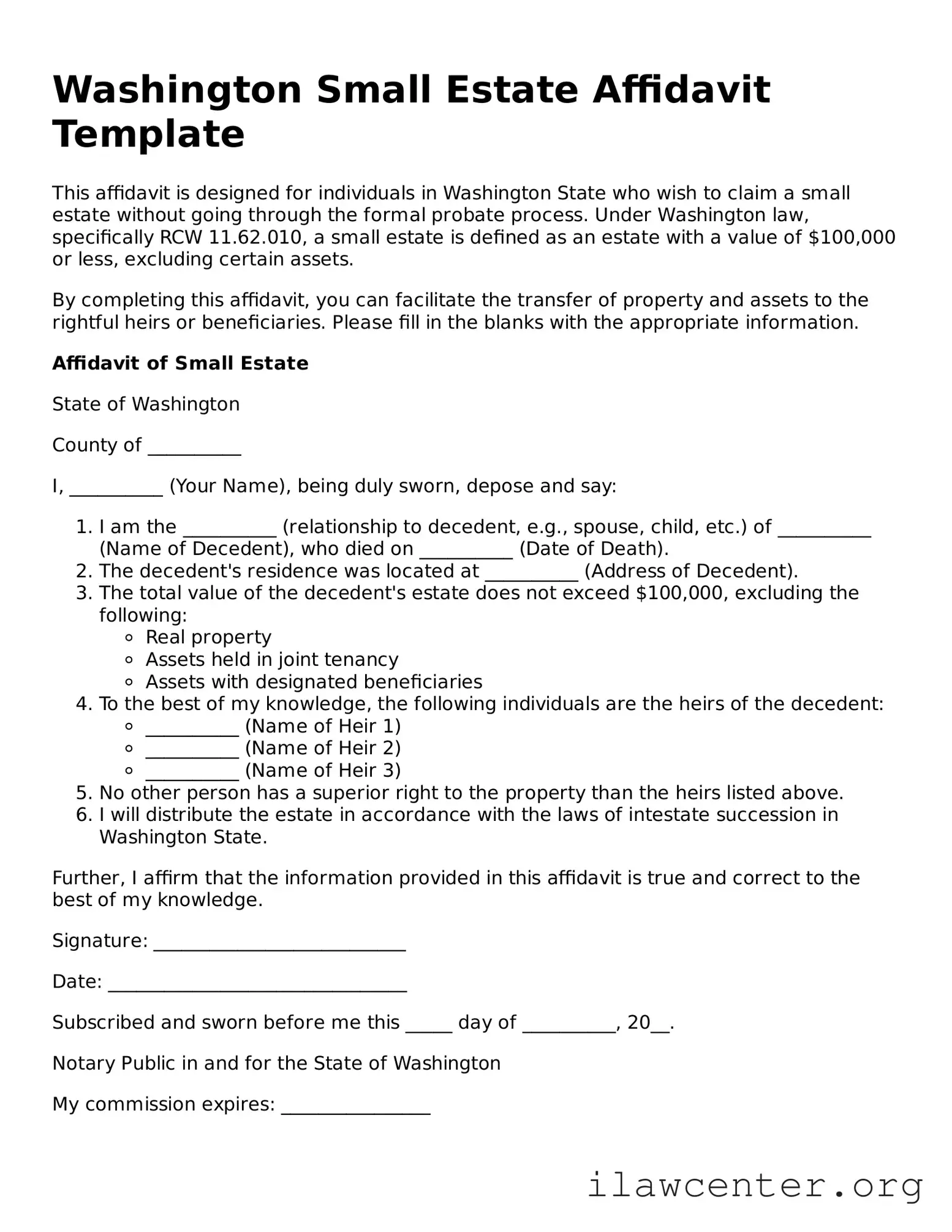
Washington Small Estate Affidavit Preview

Washington Small Estate Affidavit Template

This affidavit is designed for individuals in Washington State who wish to claim a small estate without going through the formal probate process. Under Washington law, specifically RCW 11.62.010, a small estate is defined as an estate with a value of $100,000 or less, excluding certain assets.

By completing this affidavit, you can facilitate the transfer of property and assets to the rightful heirs or beneficiaries. Please fill in the blanks with the appropriate information.

Affidavit of Small Estate

State of Washington

County of __________

I, __________ (Your Name), being duly sworn, depose and say:

  1. I am the __________ (relationship to decedent, e.g., spouse, child, etc.) of __________ (Name of Decedent), who died on __________ (Date of Death).
  2. The decedent's residence was located at __________ (Address of Decedent).
  3. The total value of the decedent's estate does not exceed $100,000, excluding the following:
    • Real property
    • Assets held in joint tenancy
    • Assets with designated beneficiaries
  4. To the best of my knowledge, the following individuals are the heirs of the decedent:
    • __________ (Name of Heir 1)
    • __________ (Name of Heir 2)
    • __________ (Name of Heir 3)
  5. No other person has a superior right to the property than the heirs listed above.
  6. I will distribute the estate in accordance with the laws of intestate succession in Washington State.

Further, I affirm that the information provided in this affidavit is true and correct to the best of my knowledge.

Signature: ___________________________

Date: ________________________________

Subscribed and sworn before me this _____ day of __________, 20__.

Notary Public in and for the State of Washington

My commission expires: ________________

PDF Form Characteristics

Fact Name Description
Purpose The Washington Small Estate Affidavit is used to simplify the process of transferring assets from a deceased person's estate when the total value is below a certain threshold.
Value Limit The current limit for using this affidavit is $100,000 in personal property, excluding real estate.
Eligibility Only individuals who are legally entitled to inherit under Washington state law can use this form.
Governing Law The use of the Small Estate Affidavit is governed by Washington State law, specifically RCW 11.62.010.
Filing Requirement The affidavit must be signed under oath and filed with the appropriate court if required by the circumstances of the estate.
Asset Types This affidavit can be used for various types of personal property, including bank accounts, vehicles, and personal belongings.
Timeframe The form can typically be submitted immediately after the death of the individual, as long as all conditions are met.
Notarization While notarization is not always required, having the affidavit notarized can help to validate the document and facilitate the transfer of assets.

Instructions on Utilizing Washington Small Estate Affidavit

Filling out the Washington Small Estate Affidavit form is a straightforward process that allows individuals to claim assets of a deceased person without going through the lengthy probate process. After completing the form, you will need to submit it to the appropriate court along with any required documentation.

  1. Obtain the Washington Small Estate Affidavit form. You can find it online or at your local court.
  2. Fill in the deceased person's full name and date of death at the top of the form.
  3. Provide your full name, address, and relationship to the deceased in the designated sections.
  4. List all assets belonging to the deceased, including bank accounts, real estate, and personal property. Be specific about each item.
  5. Indicate whether the total value of the estate is under the limit set by Washington law for small estates.
  6. Sign the affidavit in front of a notary public. This step is essential for the document to be legally binding.
  7. Make copies of the completed and notarized affidavit for your records and for any interested parties.
  8. File the affidavit with the appropriate court in the county where the deceased lived.

Important Facts about Washington Small Estate Affidavit

What is a Washington Small Estate Affidavit?

The Washington Small Estate Affidavit is a legal document that allows individuals to claim the assets of a deceased person without going through the full probate process. This form is designed for estates that meet certain criteria, making it a simpler and more efficient option for settling small estates. It can help heirs or beneficiaries access funds and property quickly.

Who is eligible to use the Small Estate Affidavit?

To use the Small Estate Affidavit, the estate must generally have a total value of $100,000 or less in personal property, excluding real estate. The person filing the affidavit must be an heir or a beneficiary named in the deceased's will. It's important to ensure that the affidavit is filed within a specific time frame after the death of the individual.

What assets can be claimed using the Small Estate Affidavit?

The Small Estate Affidavit can be used to claim various types of personal property, such as bank accounts, vehicles, and personal belongings. However, it cannot be used for real estate or property that is not classified as personal property. If the estate includes real estate, a different process will be required.

How do I complete the Small Estate Affidavit?

Completing the Small Estate Affidavit involves filling out a specific form that can be obtained from the Washington State government website or local court offices. You will need to provide information about the deceased, the assets being claimed, and your relationship to the deceased. Ensure that all required signatures are included and that the document is notarized.

Where do I file the Small Estate Affidavit?

The completed Small Estate Affidavit must be filed in the county where the deceased person lived at the time of their death. This filing may involve submitting the affidavit to the local probate court or another designated office. Be sure to check with your local court for specific filing requirements and procedures.

Is there a fee associated with filing the Small Estate Affidavit?

Yes, there may be a filing fee when submitting the Small Estate Affidavit. The fee can vary by county, so it is advisable to check with the local court for the exact amount. Some counties may offer fee waivers for individuals who demonstrate financial hardship.

What happens after I file the Small Estate Affidavit?

Once the Small Estate Affidavit is filed and accepted, you will be able to access the deceased person's assets. Financial institutions and other entities will typically require a copy of the affidavit to release funds or transfer property. It's important to keep a copy of the filed affidavit for your records.

Can the Small Estate Affidavit be contested?
Common mistakes

Filling out the Washington Small Estate Affidavit form can be a straightforward process, but mistakes can easily occur. One common error is not accurately identifying the value of the estate. The law allows for small estates to avoid probate, but only if the total value of the estate falls below a certain threshold. Failing to include all assets or miscalculating their worth can lead to complications and potentially disqualify the estate from this streamlined process.

Another frequent mistake is neglecting to include all necessary heirs or beneficiaries. When completing the affidavit, it’s crucial to list every individual entitled to inherit. Omitting an heir can not only delay the process but may also lead to disputes later on. It’s essential to ensure that everyone who has a claim to the estate is acknowledged in the form.

Some individuals mistakenly believe that they can submit the affidavit without notarization. However, the Washington Small Estate Affidavit must be signed in front of a notary public. This step adds a layer of authenticity and helps to prevent fraud. Skipping this important step can render the affidavit invalid, causing unnecessary delays in the estate settlement process.

Another common oversight involves failing to provide adequate documentation. While the affidavit itself is a vital piece of the puzzle, supporting documents like death certificates or proof of ownership for assets are equally important. Without these documents, the affidavit may not be accepted by the court or financial institutions, leading to further complications.

Lastly, some people underestimate the importance of reading the instructions carefully. Each section of the Small Estate Affidavit has specific requirements. Ignoring these guidelines can result in incomplete or incorrect information. Taking the time to thoroughly understand the form can save time and effort in the long run, ensuring a smoother process for settling the estate.

Documents used along the form

The Washington Small Estate Affidavit is a crucial document for those looking to settle the estate of a deceased individual without going through formal probate. However, several other forms and documents are often needed to ensure a smooth process. Below is a list of commonly used documents that accompany the Small Estate Affidavit.

  • Death Certificate: This official document serves as proof of the individual's passing. It is typically required to validate the Small Estate Affidavit and may be needed for various financial institutions and asset transfers.
  • List of Assets: A detailed inventory of the deceased's assets is essential. This list should include all property, bank accounts, and personal belongings, helping to clarify what is included in the small estate.
  • Affidavit of Heirship: This document establishes the rightful heirs of the deceased. It can be particularly important if there are disputes about who inherits the estate or if the family dynamics are complicated.
  • Notice to Creditors: This notice informs any creditors of the deceased that they must present their claims against the estate within a specified timeframe. It helps protect the estate from unexpected debts and ensures that all obligations are settled before distribution to heirs.

Having these documents prepared can significantly expedite the process of settling an estate. It is advisable to gather all necessary paperwork to avoid delays and ensure compliance with Washington state laws.

Similar forms

  • Will: A will outlines how a person's assets should be distributed after their death. Like the Small Estate Affidavit, it serves as a legal document that directs the distribution of property, but a will requires probate, while a Small Estate Affidavit may not.
  • Letters Testamentary: This document is issued by a court to an executor named in a will. It grants authority to manage the deceased's estate. Similar to the Small Estate Affidavit, it facilitates the transfer of assets, but it involves a formal probate process.
  • Trust: A trust is a legal arrangement where a trustee holds assets for the benefit of beneficiaries. Both trusts and Small Estate Affidavits can simplify asset distribution, but trusts often require more complex management and may not need court intervention.
  • Probate Petition: This is a request filed with the court to initiate the probate process for a deceased person's estate. While a Small Estate Affidavit can bypass probate for smaller estates, a probate petition is necessary for larger estates that do not qualify.
  • Affidavit of Heirship: This document establishes the heirs of a deceased person. Like the Small Estate Affidavit, it can help transfer property without going through probate, but it specifically focuses on determining rightful heirs rather than asset distribution.

Dos and Don'ts

When filling out the Washington Small Estate Affidavit form, it is important to follow certain guidelines to ensure accuracy and compliance with the law. Below is a list of things to do and avoid during this process.

  • Do ensure that the total value of the estate does not exceed the limit set by Washington law.
  • Do provide accurate and complete information about the deceased, including their full name and date of death.
  • Do sign the affidavit in the presence of a notary public to validate the document.
  • Do keep copies of all submitted documents for your records.
  • Don't omit any required information, as this may delay the process or lead to rejection of the affidavit.
  • Don't attempt to use the affidavit for estates that do not qualify under Washington's small estate provisions.
  • Don't forget to check for any outstanding debts or claims against the estate before filing.
  • Don't submit the affidavit without first reviewing it for errors or inaccuracies.

Misconceptions

The Washington Small Estate Affidavit is a useful tool for settling small estates without going through the full probate process. However, several misconceptions can lead to confusion. Here are four common misunderstandings:

  • Only heirs can use the Small Estate Affidavit. Many believe that only heirs can file this affidavit. In reality, any person entitled to inherit under the law can use it, not just designated heirs.
  • The Small Estate Affidavit can be used for any estate. Some think this form applies to all estates. However, it is specifically for estates valued under a certain threshold, which is currently $100,000 for personal property and $240,000 for real property.
  • Filing the Small Estate Affidavit eliminates all taxes. There is a belief that using this affidavit means no taxes are owed. While it simplifies the process, it does not exempt the estate from taxes, which may still need to be addressed.
  • The Small Estate Affidavit is a lengthy process. Many assume that completing this affidavit is time-consuming. In fact, it is generally a straightforward process that can be completed quickly, allowing for efficient estate resolution.

Understanding these misconceptions can help individuals navigate the estate settlement process more effectively.

Key takeaways

When dealing with the Washington Small Estate Affidavit, understanding the nuances of the form can significantly ease the process of settling a small estate. Here are some key takeaways to keep in mind:

  • Eligibility Criteria: The Small Estate Affidavit can only be used for estates valued at $100,000 or less, excluding real property. Ensure that the estate meets this threshold before proceeding.
  • Required Information: The form requires specific details, including the names and addresses of heirs, a description of the decedent's assets, and any outstanding debts. Accurate information is crucial for a smooth process.
  • Notarization: The affidavit must be signed in front of a notary public. This step adds a layer of authenticity and can help prevent disputes regarding the validity of the document.
  • Distribution of Assets: Once the affidavit is filed and approved, it allows the heirs to collect assets directly from financial institutions or other entities. This expedites the process of transferring ownership without the need for formal probate proceedings.