Wedding Ceremony Script PDF Template

Wedding Ceremony Script PDF Template

The Wedding Ceremony Script form is a document that outlines the structure and content of a wedding ceremony, providing guidance for officiants and couples alike. This form helps ensure that all important elements of the ceremony are included and organized in a meaningful way. Ready to create your perfect ceremony? Fill out the form by clicking the button below.

Article Guide

The Wedding Ceremony Script form serves as a vital tool for couples planning their nuptials, ensuring that every detail of their special day is thoughtfully organized and articulated. This form typically includes sections for the couple's names, the date and location of the ceremony, and the officiant's information. It may also outline the sequence of events, such as the processional, exchange of vows, and ring ceremony, allowing for a smooth flow during the event. Additionally, couples can personalize their ceremony by including readings, music selections, and any cultural or religious traditions they wish to incorporate. The form acts as a guide, helping to eliminate confusion and ensure that all participants are on the same page. By carefully crafting this script, couples can create a memorable experience that reflects their unique love story and values.

Wedding Ceremony Script Preview

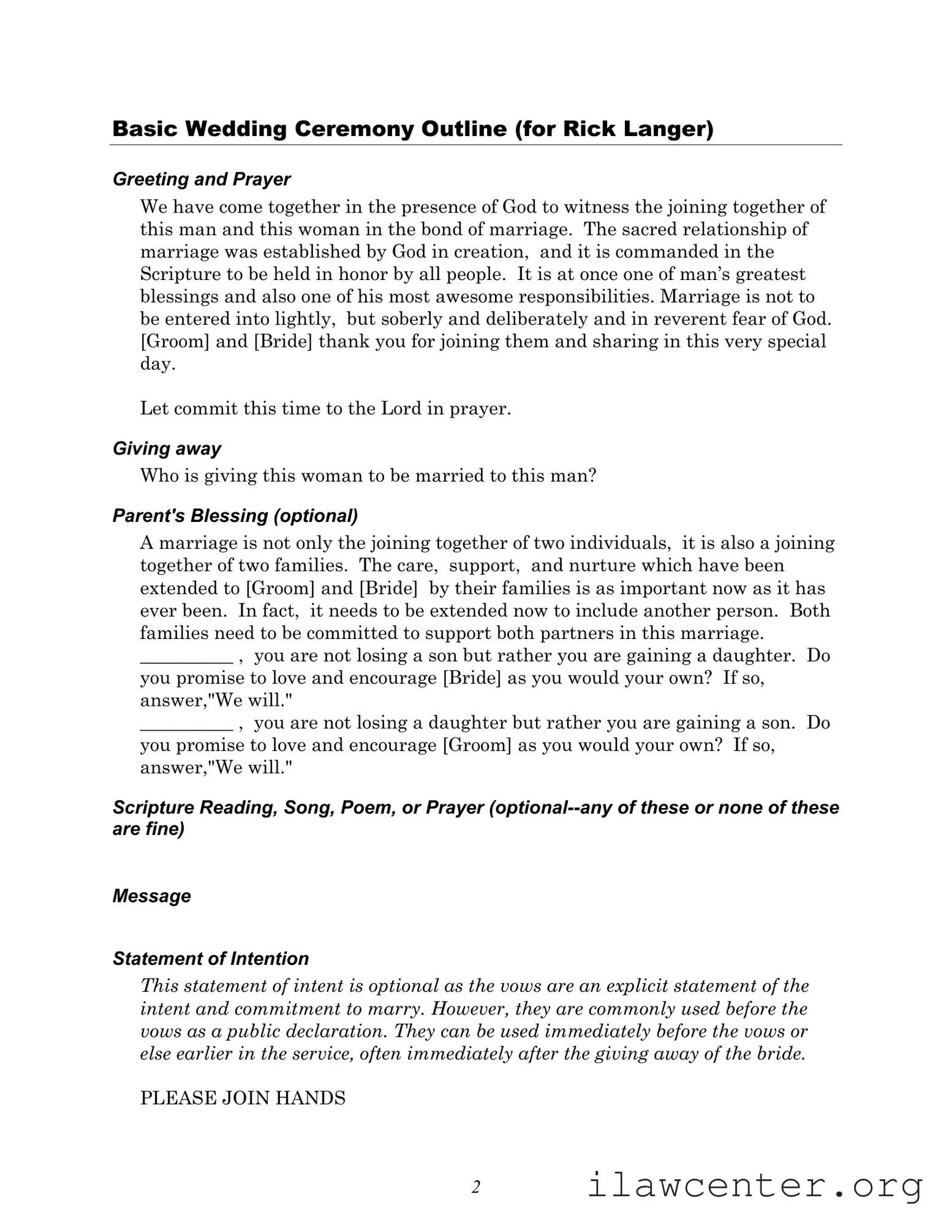
Basic Wedding Ceremony Outline (for Rick Langer)

Greeting and Prayer

We have come together in the presence of God to witness the joining together of this man and this woman in the bond of marriage. The sacred relationship of marriage was established by God in creation, and it is commanded in the Scripture to be held in honor by all people. It is at once one of man’s greatest blessings and also one of his most awesome responsibilities. Marriage is not to be entered into lightly, but soberly and deliberately and in reverent fear of God. [Groom] and [Bride] thank you for joining them and sharing in this very special day.

Let commit this time to the Lord in prayer.

Giving away

Who is giving this woman to be married to this man?

Parent's Blessing (optional)

A marriage is not only the joining together of two individuals, it is also a joining together of two families. The care, support, and nurture which have been extended to [Groom] and [Bride] by their families is as important now as it has ever been. In fact, it needs to be extended now to include another person. Both families need to be committed to support both partners in this marriage.

__________ , you are not losing a son but rather you are gaining a daughter. Do

you promise to love and encourage [Bride] as you would your own? If so, answer,"We will."

__________ , you are not losing a daughter but rather you are gaining a son. Do

you promise to love and encourage [Groom] as you would your own? If so, answer,"We will."

Scripture Reading, Song, Poem, or Prayer (optional--any of these or none of these are fine)

Message

Statement of Intention

This statement of intent is optional as the vows are an explicit statement of the intent and commitment to marry. However, they are commonly used before the vows as a public declaration. They can be used immediately before the vows or else earlier in the service, often immediately after the giving away of the bride.

PLEASE JOIN HANDS

2

---------------, Do you intend to take this woman whose hand you hold to be your

lawful wedded wife; and do you pledge before God and man to love, honor, and protect her through sunshine and shadow alike; keeping yourself unto her alone until death shall separate you? If so, answer “I Do”?

------------- Do you intend to take this man, whose hand you hold, to be your

lawful wedded husband; and do you pledge before God and man to be to him a loving and true wife, through sunshine and shadow alike, keeping yourself unto him alone, until death shall separate you? If so, answer “I Do”

Vows

[Groom] , repeat after me:

I [Groom] take you [Bride], to be my wife, to have and to hold, from this day forward, for better or for worse, for richer or for poorer,

in sickness and in health, to love and to cherish, excluding all others,

as long as we both shall live. With God as my witness,

I give you my pledge.

[Bride], repeat after me:

I [Bride] take you [Groom] , to be my husband, to have and to hold, from this day forward, for better or for worse, for richer or for poorer, in sickness and in health, to love and to cherish, excluding all others,

as long as we both shall live. With God as my witness,

I give you my pledge.

Rings

You have chosen to seal you vows by the giving and receiving of rings. The ring forms a perfect circle, without a beginning or an end, and is thereby a symbol of eternity and signifies the duration of the commitment you are making. The gold of which the rings are made signify the purity and value of the relationship into which you enter. Let us now exchange these rings.

[Groom] /[Bride] You have the privilege of placing this ring on [Bride]/[Groom] finger in virtue of the exclusive covenant relationship into which you now enter. Repeat after me: I give you this ring, as a symbol of my vow, and with all that I am, and with all that I have, I will honor you.

3

Lighting of unity candle/Song (optional)

Prayer of Blessing

Pronouncement

And now, by the authority invested in me as a minister of the Gospel, and in accordance with the laws of the State of California, I now pronounce you man and wife. You may kiss the bride.

Introduction

It is my pleasure to introduce to you, for the very first time, Mr. and Mrs. [Last Name].

Recessional

Questions to consider

1.Do we want to include the Parent’s Blessing? If so, are there any special family dynamics which need to be resolved ahead of time?

2.Do we want to personalize vows or use traditional vows? (If you want personalized vows, please discuss with pastor ahead of time. Some sample vows are given below.)

3.Are there any special people we would like to include in the service itself? (For example, a friend or relative you would like to have do a special reading or a prayer of blessing etc.)

4.Have we made plans for songs/music and decided where we want them included in the service?

5.Do we have any special requests for the content of the message? (evangelistic message included, special verses, etc.)

4

Other sample services and ideas

These sample services and alternative vows and readings are taken in large measure from the Pastor’s Service Manual for the EFCA. Individual pastors do not follow these examples explicitly—but they can be a good source of ideas. Please understand that pastors may have personal preferences and convictions about the structure of certain portions of the marriage ceremony. Do not assume that because a particular component of a marriage ceremony is listed below that all of our pastors would feel comfortable using it. The final decision for the content of the ceremony will rest with the pastor performing the ceremony.

EFCA Pastor’s Manual Ceremony

Call to worship

I delight greatly in the LORD; my soul rejoices in my God; For he has clothed me with garments of salvation and arrayed me in a robe of righteousness, as a bridegroom adorns his head like a priest, and as a bride adorns herself with jewels. (Isaiah 61:10)

Dear friends, God is love. Whoever lives in love lives in God, and God in him. In this way, love is made complete among us… (1 John 4:16)

Today we celebrate how wide and long and high and deep the love of Christ is, and we want to know this love that surpasses knowledge—that we may be filled to the measure of all the fullness of God. (Ephesians 3:18-19)

Invocation

Invite God’s presence and recognize that marriage is part of his good plan. Ask God’s Spirit to supervise the service and sanctify all that happens.

Welcome

Greet the guests on behalf of the bride and groom. A few personal comments regarding the couple would be appropriate although not necessary.

Song or Special Music: Optional

Statement on Marriage:

Dearly beloved, we are assembled here in the presence of God, to join this Man and this Woman in holy marriage; which is instituted of God, regulated by His commandments, blessed by our Lord Jesus Christ, and to be held in honor among all men. Let us therefore reverently remember that God has established and sanctified marriage, for the welfare and happiness of mankind. Our Savior has declared that a man shall leave his father and mother and cleave unto his wife. By His apostles, He has instructed those who enter into this relation to cherish a mutual esteem and love; to bear with each other’s infirmities and weak-nesses; to comfort each other in sickness, trouble, and sorrow; in honesty and industry to provide for each other, and for their household, in temporal

5

things; to pray for and encourage each other in the things which pertain to God; and to live together as the heirs of the grace of life.

Vows of Intent

These vows may also precede the Vows after the Charge, as two parts of the same Vows. Used at this point in the service, the implication is that the Bride’s Father is hearing these as a condition of giving his daughter.

G****, will you have this woman to be your wedded wife, to live together in holy marriage? Will you love her, comfort her, honor and keep her and forsaking all others, keep only unto her as long as you both shall live? (Groom answers, “I will.”)

B****, will you have this man to be your wedded husband, to live together in holy marriage? Will you love him, comfort him, honor and keep him and forsak- ing all others, keep only unto him as long as you both shall live? (Bride answers, “I will.”)

Giving of the Bride

Who gives this woman to be married to this man? Father: “Her mother and I.” (The father, guardian, brother or friend of the woman shall put the woman’s right hand in the right hand of the man. She may give him a kiss. At this point the wedding party may move forward to the plat-form.)

Song or Special Music Optional

Scripture passages to consider

Genesis 2:18-24 - Eve brought to Adam Ruth 1:16-17 - Ruth’s loyalty to Naomi Psalm 121 - “I lift up my eyes to the hills…” Psalm 127 - “Unless the Lord builds the house…” Psalm 128 - The blessing of a large family Ecclesiastes 4:8-12 - “Two are better than one…” Song 2:10-13 - The season of love

Song 8:6-7 - “Many waters cannot quench love…”

Isaiah 61:1-4 - “…to bestow on them a crown of beauty…” Malachi 2:15-16 - Warning not to break faith in marriage Matthew 19:4-6 - Jesus’ restatement of Genesis 2:24 John 2:1-11 - The wedding and miracle at Cana Romans 12:9-13 - Guidelines for loving one another

1 Corinthians 13 - The love chapter

Ephesians 5:18-33 - Paul’s teaching on marriage Philippians 2:1-11 - Assuming the humble attitude of Christ Colossians 3:12-14 - Qualities of Christian relationships

2 Peter 1:5-8 - “…add to your faith goodness, etc.” 1 John 4:7-12 - “Let us love one another…”

6

Message

Vows

The pastor may say, “Will you now make your vows to one another?” The man and the woman are to face each other, holding hands. The Bride gives her flowers to the Maid of Honor.

The Groom repeats the vow after the pastor as follows:

I, G****, take you B****, to be my wedded wife, / to have and to hold from this day forward, / for better for worse, / for richer, for poorer, / in sickness and in health, / to love and to cherish, till death us do part, / according to God’s holy plan / and with God’s gracious help.

[Alternative ending: …according to God’s holy ordinance; / and thereto I pledge to you my troth.—or--and thereto I pledge myself to you.]

The Bride repeats the vow after the pastor as follows:

I, B****, take you, G****, to be my wedded husband, / to have and to hold from this day forward, / for better for worse, / for richer, for poorer, / in sickness and in health, / to love and to cherish, till death us do part, / according to God’s holy plan / and with God’s gracious help.

Giving of Rings

You have determined to seal your vows by the giving and receiving of rings. Rings are a sacred symbol, signaling to others that you are in an exclusive commitment to your beloved. The precious metal from which they are forged reminds you of the precious possession you have in marriage. And the infinite circle they form remind you that your new relationship is never to end.

G****, indicating your responsibility to B**** to receive her into your care and keeping, I give you this ring to place on her finger, as both a symbol and promise that you receive her. Just as this ring circles her finger, so you are to encompass her with strength and protecting love.

Groom (repeating after the pastor):

B****, this ring I give you / as a constant reminder / of my abiding love and commitment.

B****, indicating your responsibility to G****, to receive him into your care and devotion, I give you this ring to place on his finger as both a symbol and promise that you receive him. Just as this ring circles his finger, so you are to encompass him with strength and protecting love.

Bride (repeating after the pastor):

G****, this ring I give you / as a constant reminder / of my abiding love and commitment.

7

[Alternative: This ring I give you / in token and pledge / of our constant faith and abiding love.]

Optional: Unity Candle

Special music is often done during the Unity Candle ceremony. Another alter- native is the reading of Gen. 2:20b-24. Some couples extinguish their individual candles after lighting the central candle while others leave them burning. At this point, some choose to present roses to mothers.

Prayer of Dedication

Couples may kneel if a kneeling bench is provided. The Lord’s Prayer may be spoken or sung at the conclusion of this prayer.

Our eternal Father, send your blessing upon G**** and B****, whom we bless in your name, that they may live faithfully together. May they keep the vows they have made, and may they remain ever in perfect love and peace to-gether, and live according to your Word, through Jesus Christ our Lord. Amen.

Pronouncement

For inasmuch as G**** and B**** have consented together in holy wedlock, and have witnessed the same before God and this company, and thereto have pledged their faith each to the other, and have declared the same by joining hands and by giving and receiving rings, I pronounce that they are husband and wife together, in the name of the Father and of the Son and of the Holy Spirit. Those whom God has joined together, let not man put asunder.

Kiss

You may kiss your bride.

Benediction

“The LORD bless you and keep you; The LORD make His face shine upon you and be gracious unto you. The LORD turn his face toward you and give you peace” (Numbers 6:24-26).

Presentation of Couple

(The bride retrieves her flowers from the Maid of Honor and the couple turns to face the congregation.) It gives me great delight to introduce to you Mr. and Mrs_____________.

8

Special elements & alternative wordings and readings

Call to Worship

Of all the honored guests at this occasion, the One most special, most honored, will be the Lord God Almighty, our heavenly Father and loving Savior. In mercy, he will shield us from his shining presence. His voice, which unleashed is like the sound of many waters, will only whisper silently in hearts. But he is certainly here, for the creation of a home is his doing as surely as the creation of oceans or oaks. While this is G**** and B****’s special day, we would be remiss not to acknowledge such a royal Visitor, such a holy Guest. It is his presence that will make this day truly significant. It is his listening that makes these vows so sol-emn. It is his smile that puts laughter on our lips and brings delight to this day. Let us pray.

Invocation

Lord, we invite you to take the place of honor at this wedding. We are grateful that you would come. To think that the God who is robed in unapproachable light would bring his glory to this service, that the King who reigns over all the universe from his sapphire throne would bring his dignity and grandeur to this ceremony, that the Savior who blessed little children and the Creator of roses would bring his tenderness and beauty to this celebration leaves us in awe. Loving Father, thank you for being here with us. May G**** and B**** have a special sense and appreciation of the privilege of your presence. We know that this warm favor is only ours through the graces of Jesus Christ so it is in his name we pray this. Amen.

Statements on Marriage

G**** and B****, marriage is an honorable estate whose bond and covenant was instituted by God in creation. Our Lord Jesus Christ adorned and beautified this holy estate by his presence and first miracle at a wedding in Cana of Galilee.

Marriage signifies to us the mystery of the union between Christ and his church. And Scripture commands that marriage be honored among all people. Therefore, no one should enter this state of life unadvisedly, lightly, or wantonly; but reverently, discreetly, advisedly, soberly, and in the fear of God; duly considering the causes for which matrimony was ordained.

At the beginning of the Bible, we discover the first instance of the marriage state when Adam discovers Eve and exclaims, “This at last is bone from my bones and flesh from my flesh.” So intimate is this oneness between male and female that in the New Testament Paul uses it to illustrate the intimacy between Christ and the church. He also draws a clear line separating the distinctive functions of

9

husband and wife, when he instructs the woman to be sub-missive to her husband as to the Lord, and commands the man to love his wife as Christ has loved the church, giving himself up for her. G**** and B****, marriage is established by God. In this contract a man and woman willingly bind themselves together in love and become one, even as Christ is one with the church, his Body.

Family-Related Activities before “The Giving of the Bride”

Charge to Family and Friends: A brief challenge to recognize the holiness of this new union and to do all in their power to support it, holding this couple to their vows. (This might also be after the rings and unity candle.)

Thanks to Parents: Personal words to families and/or friends. Flowers or some other token of love and honor may be given at this point.

Prayer or Blessing by Parents: If there are believing parents, the families/ parents may gather with Bride and Groom for prayers together. These may be quiet, while music plays, or prayed for all to hear, perhaps by the fathers.

Professions of Faith

Many couples want to make their Christian faith explicit, especially when there are many unbelievers present. They may repeat a creed, have a Bible text read, offer words of testimony, have the pastor summarize their testimonies, or be sure the pastor’s charge includes the elements of the gospel.

Communion

Following the Ring Ceremony, just before or after the Unity Candle.

There are differences of opinion whether or not Communion belongs in a wedding ceremony. Those arguing against suggest that since the Lord’s Supper is meant to be a meal for the entire congregation, and since that is seldom practical in a wedding, it is inappropriate. On the other hand, other pastors believe that having a believing couple partake affords them an opportunity to express their faith through this very significant Christian symbol. Think through your theological approach. Special music may provide a suitable background to this solemn moment.

Family Blessing, or Vows to Receive Children

Occasionally, someone comes to the marriage with children. Vows such as these might be useful after the wedding vows.

________, when you marry ________ you are also making a commitment to

her/his children. To love ________ means you want to love and care for her/his

children as well. You have asked to make this commitment publicly so I put before you these questions:

10

Do you understand that in marrying _______ you agree to love her/his children even as you love her/him? I do.

Do you promise to love and care for her/his children as you would your own? I do.

Will you work with _______ to create a home where these children will learn about the love of God in Christ, both through your teaching and your example? I will.

Will you make it your practice to pray for and with these children? I will.

Blessing of the Couple by Older Children

The following provides an opportunity for the couple to pledge their care for a new blended family, and for the children to bless the couple. The children gather with the couple and the pastor begins…

Today we celebrate not only a new relationship between G**** and B****, but also the beginning of new relationships between their children—

_______________—who now have a share in this marriage and will inevitably be

touched by the covenant their parents enter into today. It will both complicate and enrich their lives. They, too, will have much to contribute and will need to help create a home and a way of life in which all of you will grow into the best people you can be. G**** and B****, as you give yourselves to one another in love and loyalty, do you promise always to keep room in your life together for

___children’s names___? Will you commit yourselves to respect and honor them as individuals? Do you pledge now to cherish, encourage and tenderly care for them as long as they need you? Yes, we do.

The children will now give their blessing to this marriage:

We (I) wish to offer to both of you our blessing and congratulations. We love you deeply and we are delighted that you have found each other. We want you to know that just as you have always loved and supported us, we promise our love and our support for your new relationship. It is our wish for you that you live fully and deeply and that your lives together will be richer and more fulfilling than either could be alone.

Pronouncement

And now, having heard you make these pledges of your affection and take these vows of fidelity, I do, by virtue of the authority vested in me, as a minister of the gospel and in accordance with the laws of God and the State of ______,

pronounce you husband and wife, no longer two, but now one, in the name of the Father and of the Son and of the Holy Spirit.

Or…

Inasmuch as G**** and B**** have consented together to marriage, and have made their vows before God and these witness, and have symbolized their vows by giving and receiving rings, I pronounce that they are husband and wife. Those whom God has joined, let no one separate.

11

File Properties

Fact Name Description
Purpose The Wedding Ceremony Script form outlines the structure and content of the wedding ceremony, ensuring that all essential elements are included.
State-Specific Forms Different states may have specific requirements for wedding ceremonies, so it’s important to check local laws.
Governing Laws In California, for example, the Family Code Section 400-402 governs marriage ceremonies.
Content Requirements Typically, the script includes vows, readings, and declarations, which personalize the ceremony for the couple.
Officiant Role The officiant is responsible for leading the ceremony and ensuring that it complies with state laws.
Signature Requirement Some states require the officiant and witnesses to sign the marriage license after the ceremony, making it legally binding.
Customization The Wedding Ceremony Script can be tailored to reflect the couple’s beliefs, traditions, and personal stories, making it unique.

Instructions on Utilizing Wedding Ceremony Script

Getting ready for a wedding ceremony is an exciting time, and filling out the Wedding Ceremony Script form is a crucial step in planning your special day. This form helps you outline the key elements of your ceremony, ensuring everything goes smoothly. Follow these steps to complete the form efficiently.

  1. Gather Necessary Information: Before you start, collect all the details you need, such as names, dates, and any specific rituals or traditions you want to include.
  2. Start with the Basics: Fill in the names of the couple at the top of the form. Make sure to spell everything correctly, as this will be part of your official documents.
  3. Specify the Date and Location: Clearly write down the date and venue of the ceremony. This information is essential for coordinating with vendors and guests.
  4. Outline the Ceremony Structure: Use the provided sections to outline the order of events. Think about how you want to start, the vows, and any readings or music.
  5. Include Personal Touches: Add any personal elements you want, such as special readings, songs, or rituals that reflect your relationship.
  6. Review and Edit: Once you’ve filled out the form, take a moment to review everything. Check for typos and ensure all details are accurate.
  7. Save and Submit: After confirming that the form is complete, save your work and submit it according to the instructions provided.

Following these steps will help you create a thoughtful and organized script for your wedding ceremony. Enjoy the process and celebrate your love!

Important Facts about Wedding Ceremony Script

What is a Wedding Ceremony Script form?

A Wedding Ceremony Script form is a document that outlines the structure and content of a wedding ceremony. It helps couples organize their vows, readings, and any special rituals they wish to include. This script serves as a guide for officiants and participants, ensuring that the ceremony flows smoothly and includes all the desired elements.

Who should use the Wedding Ceremony Script form?

This form is ideal for couples planning their wedding ceremony, officiants who need a clear outline, and anyone involved in the ceremony who wants to understand their roles. Whether you’re having a traditional ceremony or a personalized one, this form can help clarify your vision.

How do I fill out the Wedding Ceremony Script form?

Filling out the form involves several steps. Start by entering your names and the date of the ceremony. Then, outline the order of events, such as the processional, readings, vows, and recessional. You can also include any specific phrases or rituals you want to incorporate. Take your time to ensure that every detail reflects your unique relationship.

Can I customize the Wedding Ceremony Script form?

Absolutely! The form is designed to be flexible. You can add, remove, or modify sections to fit your personal style and preferences. Feel free to include any cultural or religious elements that are meaningful to you. This script should be a true reflection of your love story.

Is there a specific format I should follow?

While there is no strict format, it is helpful to follow a general structure. Typically, a ceremony includes an introduction, readings, the exchange of vows, ring exchange, and a closing. You can arrange these elements in a way that feels right for you, but maintaining a logical flow will enhance the overall experience.

Can I include readings or songs in the script?

Yes, including readings or songs is a wonderful way to personalize your ceremony. You can specify where these elements fit within the script. Be sure to choose pieces that resonate with you as a couple, whether they are poems, excerpts from literature, or meaningful songs.

What if I want to make changes after submitting the form?

Changes can usually be made up until the final draft of the script is prepared. It’s important to communicate any updates to your officiant or whoever is responsible for finalizing the script. Keeping an open line of communication will help ensure that your ceremony reflects your wishes.

Who should review the completed Wedding Ceremony Script?

Once the script is completed, it’s a good idea for both partners to review it together. You may also want to share it with your officiant and any family members or friends who will be participating in the ceremony. Their feedback can be valuable in making sure everything is in order.

How far in advance should I complete the Wedding Ceremony Script form?

It’s best to complete the form several months before your wedding date. This allows ample time for revisions and discussions with your officiant. Starting early can also help reduce stress as your wedding day approaches, giving you peace of mind that everything is planned.

Can I use the Wedding Ceremony Script form for a non-traditional ceremony?

Yes, the form is versatile and can be used for non-traditional ceremonies as well. Whether you are planning a themed wedding, an elopement, or a unique celebration, the script can be adapted to fit your vision. Embrace creativity and make your ceremony truly your own!

Common mistakes

Planning a wedding can be both exciting and overwhelming, especially when it comes to filling out the Wedding Ceremony Script form. Many couples make common mistakes that can lead to confusion or miscommunication on their big day. Here are eight mistakes to watch out for.

First, one of the most frequent errors is leaving out important details. Couples often forget to include the names of key participants, such as the officiant, bridal party, and parents. This information helps everyone involved know their roles and ensures a smooth ceremony.

Another mistake is using unclear language. When describing the ceremony elements, vague terms can lead to misunderstandings. Instead of saying "something special," it’s better to specify what that entails, whether it's a sand ceremony, unity candle, or a special reading.

Additionally, couples sometimes overlook the order of events. A well-structured script flows seamlessly, guiding everyone through the ceremony. Failing to outline the sequence can result in awkward pauses or confusion about what comes next.

Many couples also forget to proofread their form. Typos and grammatical errors can detract from the overall professionalism of the ceremony. Taking the time to review the script ensures that everything is polished and ready for the big day.

Another common issue is neglecting to communicate with the officiant. It's essential to discuss the script with the person leading the ceremony. They may have preferences or suggestions that can enhance the experience for everyone involved.

Some couples make the mistake of not considering their audience. The ceremony should reflect the couple’s personality while also being accessible to guests. Including elements that resonate with family and friends can create a more meaningful experience.

Furthermore, failing to account for time can lead to a rushed ceremony. Couples often underestimate how long each part will take. Planning for each segment allows for a more relaxed atmosphere, giving everyone time to enjoy the moment.

Lastly, many couples forget to include a backup plan for unexpected situations. Weather changes, technical difficulties, or last-minute cancellations can occur. Having contingency plans in place ensures that the ceremony can proceed smoothly, no matter what happens.

By avoiding these common mistakes, couples can fill out their Wedding Ceremony Script form with confidence, paving the way for a beautiful and memorable celebration.

Documents used along the form

When planning a wedding, several documents work in conjunction with the Wedding Ceremony Script form to ensure that the event runs smoothly. Each of these documents serves a unique purpose, helping couples organize their special day effectively. Below is a list of commonly used forms and documents that complement the Wedding Ceremony Script.

  • Marriage License: This official document is required to legally marry. Couples must apply for a marriage license in their state, providing necessary identification and information. It is typically obtained before the wedding day and must be signed by the officiant and witnesses during the ceremony.
  • Wedding Planner Checklist: A comprehensive checklist helps couples keep track of all the tasks needed to prepare for the wedding. It includes everything from booking vendors to finalizing the guest list, ensuring that no detail is overlooked.
  • Seating Chart: This document outlines where each guest will sit during the reception. It is essential for organizing the space and ensuring that guests are seated according to the couple's preferences and family dynamics.
  • Vendor Contracts: These agreements outline the terms and conditions between the couple and their chosen vendors, such as caterers, florists, and photographers. They detail services provided, payment schedules, and cancellation policies, ensuring that both parties understand their obligations.

Utilizing these documents alongside the Wedding Ceremony Script form can help create a well-organized and memorable wedding experience. Each form plays a vital role in ensuring that all aspects of the ceremony and reception are coordinated effectively.

Similar forms

The Wedding Ceremony Script form is a vital document for couples planning their special day. It serves as a guide for the ceremony, detailing the order of events and the words exchanged. Several other documents share similarities with this form in terms of purpose and function. Here’s a look at eight such documents:

  • Marriage License: This legal document grants permission for a couple to marry. Like the Wedding Ceremony Script, it is essential for formalizing the union and must be prepared in advance.
  • Wedding Planner Checklist: This comprehensive list helps couples organize their wedding plans. Similar to the Ceremony Script, it outlines key components and timelines for the big day.
  • Vows: Personal promises made between partners during the ceremony. Vows can be written in a script format, mirroring the structure of the Ceremony Script in their intention to convey heartfelt sentiments.
  • Rehearsal Dinner Agenda: This document outlines the schedule for the rehearsal dinner. Like the Ceremony Script, it ensures that everyone knows their roles and the flow of events.
  • Officiant’s Script: This script guides the officiant through the ceremony, detailing their words and actions. It parallels the Wedding Ceremony Script by providing a framework for the proceedings.
  • Guest List: A compilation of invited guests. While not a script, it is essential for planning the ceremony and reception, similar to how the Ceremony Script organizes the event.
  • Seating Chart: This document outlines where guests will sit during the ceremony and reception. It shares the organizational aspect of the Ceremony Script, ensuring a smooth flow of the event.
  • Wedding Program: This printed guide provides guests with information about the ceremony, including participants and order of events. It complements the Ceremony Script by enhancing the overall experience for attendees.

Dos and Don'ts

When filling out the Wedding Ceremony Script form, there are important things to keep in mind. Here’s a list of dos and don’ts to help guide you.

  • Do include the full names of the couple.
  • Do specify the date and time of the ceremony.
  • Do mention the location clearly.
  • Do outline any specific traditions or rituals to be included.
  • Don't forget to proofread for typos or errors.
  • Don't leave out important details, like the officiant's name.
  • Don't use overly complex language or jargon.
  • Don't rush the process; take your time to ensure accuracy.

Following these guidelines can help create a beautiful and memorable ceremony script.

Misconceptions

  • Misconception 1: The Wedding Ceremony Script form is only for religious ceremonies.

    This is not true. The form can be used for various types of ceremonies, including secular and non-religious ones. It provides a flexible structure that can accommodate different beliefs and preferences.

  • Misconception 2: The form must be filled out in a specific way.

    While the form offers guidelines, there is no one-size-fits-all approach. Couples can personalize their scripts to reflect their unique relationship and style.

  • Misconception 3: Using the form means you have to follow a strict script during the ceremony.

    This is a common misunderstanding. The form serves as a template, but couples and officiants can adapt it as needed. Flexibility is key to creating a meaningful experience.

  • Misconception 4: Only professional officiants can use the Wedding Ceremony Script form.

    Anyone can utilize the form, regardless of their experience. Friends or family members can officiate a wedding using the script, making the ceremony even more personal.

Key takeaways

When filling out and using the Wedding Ceremony Script form, there are several important points to consider. Here are ten key takeaways to help guide you through the process:

  1. Understand the Purpose: The form is designed to outline the structure and key elements of the wedding ceremony.
  2. Personalization is Key: Customize the script to reflect the couple's unique love story and preferences.
  3. Include Essential Components: Ensure that the script includes vows, readings, and any rituals that are significant to the couple.
  4. Consult with Officiant: Work closely with the officiant to ensure that the script aligns with their style and legal requirements.
  5. Review for Clarity: Make sure the language is clear and easy to understand for both the couple and the guests.
  6. Practice Makes Perfect: Rehearse the ceremony using the script to ensure a smooth flow on the wedding day.
  7. Consider Timing: Keep an eye on the length of the ceremony; it should be meaningful but not overly long.
  8. Incorporate Family and Friends: Think about including readings or contributions from loved ones to make the ceremony more inclusive.
  9. Keep a Copy Handy: Have printed copies of the script available for the officiant and key participants during the ceremony.
  10. Be Flexible: Be prepared to adapt the script if necessary, as weddings can be unpredictable.

By following these takeaways, couples can create a meaningful and memorable wedding ceremony that truly reflects their love and commitment to one another.