
West Virginia Abstract Social Studies Fair PDF Template

West Virginia Abstract Social Studies Fair PDF Template

The West Virginia Abstract Social Studies Fair form is a crucial document for participants in the state’s Social Studies Fair. It requires students to summarize their projects effectively while providing a bibliography of their sources. Completing this form accurately is essential for a successful presentation, so be sure to fill it out by clicking the button below.

Article Guide

The West Virginia Abstract Social Studies Fair form is an essential component for students participating in the fair, designed to guide them in presenting their research projects effectively. Each project must include a completed abstract, which can be handwritten or typed, but must adhere to the specific format outlined in the form. The abstract is limited to two pages, excluding the bibliography, which follows and can be expanded as needed. A key requirement is that a copy of the abstract remains with the project display at all times. The form prompts students to articulate their project title, category, and type—whether it is an individual or small group effort—along with their grade division. Additionally, students are encouraged to explain their motivation for choosing their topic, outline essential questions they sought to answer, and describe the research methods employed. Validating sources of information is also a critical aspect, ensuring that students engage with credible materials. The abstract concludes with a summary of findings and suggestions for future improvements or predictions based on the research conducted. Finally, the bibliography must be formatted correctly, listing all sources consulted during the project, including books, articles, and other media. This structured approach not only helps students organize their work but also enhances their understanding of the research process.

West Virginia Abstract Social Studies Fair Preview

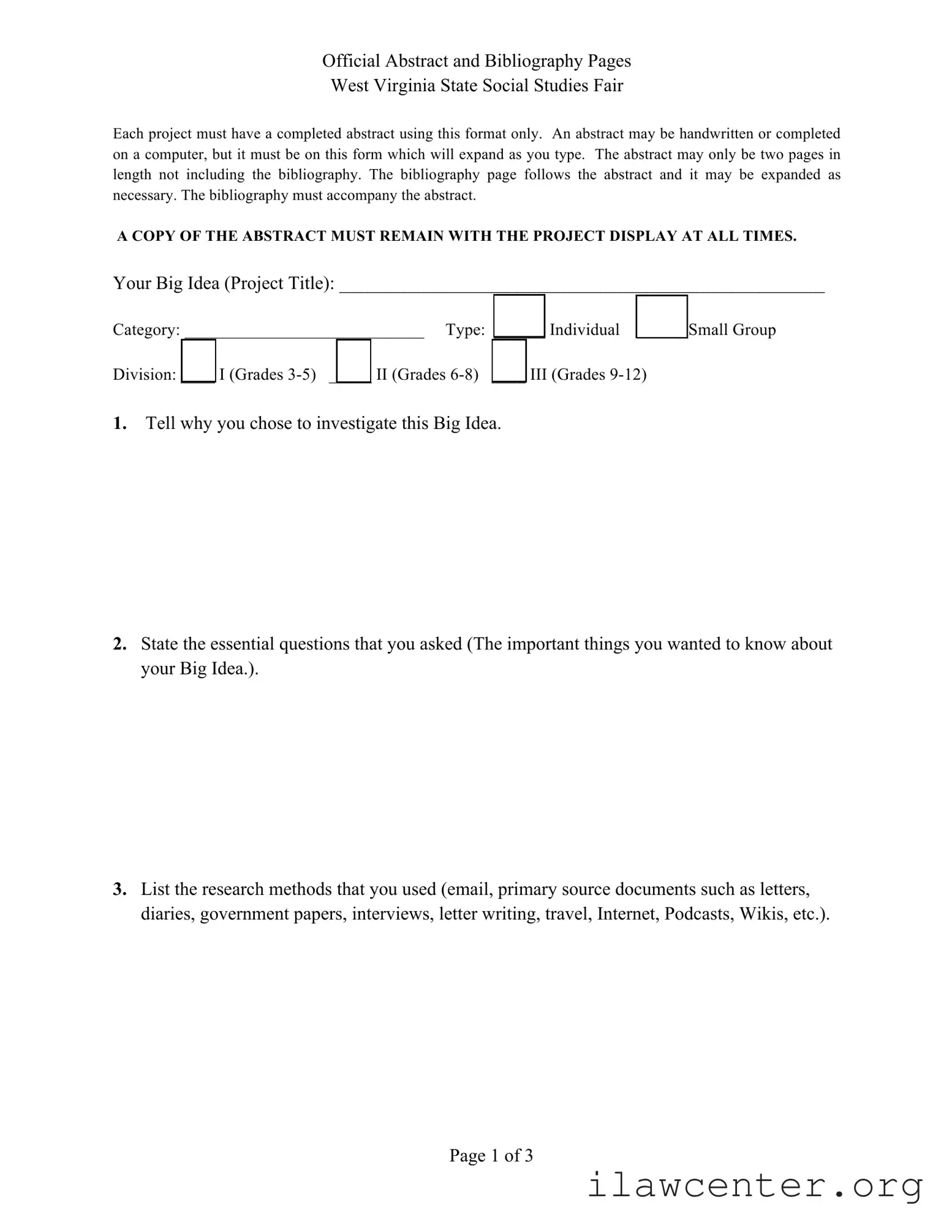
Official Abstract and Bibliography Pages

West Virginia State Social Studies Fair

Each project must have a completed abstract using this format only. An abstract may be handwritten or completed on a computer, but it must be on this form which will expand as you type. The abstract may only be two pages in length not including the bibliography. The bibliography page follows the abstract and it may be expanded as necessary. The bibliography must accompany the abstract.

A COPY OF THE ABSTRACT MUST REMAIN WITH THE PROJECT DISPLAY AT ALL TIMES.

Your Big Idea (Project Title): ____________________________________________________

Category: ____________________________ Type: ______ Individual ______Small Group

Division: ____ I (Grades 3-5) _____ II (Grades 6-8) ____ III (Grades 9-12)

1.Tell why you chose to investigate this Big Idea.

2.State the essential questions that you asked (The important things you wanted to know about your Big Idea.).

3.List the research methods that you used (email, primary source documents such as letters, diaries, government papers, interviews, letter writing, travel, Internet, Podcasts, Wikis, etc.).

Page 1 of 3

4.How did you validate your sources of information?

5.Write a brief summary of your project.

6.State your conclusion.

7.Suggest a way to change or improve the outcome, or make a future prediction about what you anticipate based on what you have learned.

Complete Your Bibliography on the Following Page

Page 2 of 3

Bibliography Page

You must use a bibliographic format which includes the author, title, place of publication,

publisher, and publication date.

Here is one of many sites for bibliography formats that include audiovisuals, Internet,

newspapers, CD-ROMs, encyclopedias, books, interviews, and magazines.

http://www.fcps.edu/KeyMS/library/bibliography.html

Page 3 of 3

File Properties

Fact Name Description
Form Requirement Each project must use the official West Virginia Abstract form for the Social Studies Fair.
Abstract Length The abstract can be up to two pages long, excluding the bibliography.
Bibliography Requirement A bibliography must accompany the abstract and can be expanded as needed.
Display Copy A copy of the abstract must remain with the project display at all times.
Project Categories Projects are categorized by division: Grades 3-5, 6-8, and 9-12.
Research Methods Students must list the research methods used, such as interviews and online resources.
Source Validation Participants should explain how they validated their sources of information.
Conclusion and Predictions Students are encouraged to state their conclusions and suggest improvements or future predictions.

Instructions on Utilizing West Virginia Abstract Social Studies Fair

Filling out the West Virginia Abstract Social Studies Fair form requires careful attention to detail. Each section of the form is designed to gather specific information about your project. Follow these steps to ensure your submission is complete and meets the requirements.

  1. Begin with the Project Title section. Write your Big Idea clearly in the designated space.
  2. Next, select the appropriate Category for your project.
  3. Indicate whether your project is an Individual or Small Group effort.
  4. Choose your Division based on your grade level: I (Grades 3-5), II (Grades 6-8), or III (Grades 9-12).
  5. Answer the first question: Why did you choose to investigate this Big Idea? Provide a thoughtful response.
  6. For the second question, state the essential questions that guided your research.
  7. List the research methods you utilized, such as interviews, Internet searches, or primary source documents.
  8. Describe how you validated your sources of information to ensure accuracy.
  9. Write a brief summary of your project, capturing the main points.
  10. State your conclusion based on your findings.
  11. Finally, suggest a way to change or improve the outcome or make a future prediction based on what you have learned.

After completing the abstract, proceed to the bibliography page. This page must include all sources used in your research. Follow the specified format for each entry, ensuring you include the author, title, place of publication, publisher, and publication date. Make sure to keep a copy of the abstract with your project display at all times.

Important Facts about West Virginia Abstract Social Studies Fair

What is the purpose of the West Virginia Abstract Social Studies Fair form?

The form is designed to guide participants in summarizing their social studies projects. It ensures that all necessary information is included, helping judges and viewers understand the project's focus, research methods, and conclusions.

Can the abstract be handwritten or does it have to be typed?

The abstract can be either handwritten or typed. However, it must be completed on the official form provided, which is designed to expand as you type.

How long can the abstract be?

The abstract may be a maximum of two pages in length, not including the bibliography. This limit helps keep summaries concise and focused.

What should be included in the bibliography?

The bibliography must list all sources used in the project. It should follow a specific format, including the author, title, place of publication, publisher, and publication date. Additional resources for formatting can be found online.

Is it necessary to keep a copy of the abstract with the project display?

Yes, a copy of the abstract must remain with the project display at all times. This allows judges and viewers to reference the summary while reviewing the project.

What types of projects can be submitted?

Projects can be submitted as individual or small group efforts. They are categorized by grade divisions: Division I for grades 3-5, Division II for grades 6-8, and Division III for grades 9-12.

What essential questions should be included in the abstract?

Participants should state the essential questions that guided their investigation. These are the key inquiries that shaped the research and provided direction for the project.

How should participants validate their sources of information?

Participants should explain how they confirmed the reliability of their sources. This may include checking the credibility of authors, cross-referencing information, or using primary source documents.

What is expected in the conclusion of the abstract?

The conclusion should summarize the findings of the project and may include suggestions for improvement or predictions based on the research. This section highlights the significance of the project and its potential impact.

Common mistakes

Completing the West Virginia Abstract Social Studies Fair form is an important step in presenting a project effectively. However, many participants make common mistakes that can hinder their chances of success. One frequent error is neglecting to follow the specified format. The abstract must be completed on the designated form, which is designed to expand as you type. Failing to use this form can lead to disqualification, as the judges may not be able to evaluate the project properly.

Another mistake often seen is the omission of crucial information. Each section of the abstract has specific requirements, such as stating the essential questions or detailing the research methods used. When participants skip these sections or provide vague answers, it can create confusion. Clear and concise responses are essential for conveying the project’s significance and depth.

Additionally, some individuals overlook the importance of validating their sources. The form specifically asks how the information was verified, yet many students either ignore this question or provide insufficient detail. This step is vital, as it demonstrates the credibility of the research conducted. Without proper validation, the project may be perceived as lacking rigor.

Another common oversight is related to the bibliography. While the abstract may be limited to two pages, the bibliography can be expanded as needed. Participants sometimes fail to include a comprehensive list of sources or do not adhere to the required bibliographic format. This can detract from the overall professionalism of the project and may lead judges to question the reliability of the research.

Finally, a significant mistake is not keeping a copy of the abstract with the project display. The instructions clearly state that a copy must remain with the project at all times. Failing to do so can result in judges being unable to assess the work accurately during the fair. Keeping a copy handy ensures that the project is fully represented and that all hard work is acknowledged.

Documents used along the form

The West Virginia Abstract Social Studies Fair form is a vital document for students participating in the fair. However, several other forms and documents often accompany it to ensure a comprehensive submission. Below is a list of these related documents.

  • Project Display Guidelines: This document outlines the requirements for setting up a project display. It includes specifications on size, materials, and presentation techniques to ensure that each project is showcased effectively.
  • Permission Slip: A permission slip may be required for students to participate in the fair. This form typically needs to be signed by a parent or guardian, granting consent for the student to present their project.
  • Judging Criteria Sheet: This sheet provides the criteria by which projects will be evaluated. It details the aspects judges will consider, such as creativity, research depth, and overall presentation quality.
  • Research Log: A research log is used to document the research process. Students should record their sources, notes, and reflections on their findings, which can help in writing the abstract and bibliography.
  • Reflection Paper: This paper allows students to reflect on their learning experience. It typically includes insights gained during the project and thoughts on the research process and outcomes.
  • Project Evaluation Form: After the fair, students may receive a project evaluation form. This document provides feedback from judges, highlighting strengths and areas for improvement for future projects.

These documents collectively enhance the educational experience of participating in the West Virginia Social Studies Fair. Each form serves a specific purpose, ensuring that students are well-prepared and informed throughout the process.

Similar forms

The West Virginia Abstract Social Studies Fair form shares similarities with various other documents commonly used in academic and research settings. Below is a list of nine documents that resemble it in purpose and structure:

  • Research Paper Abstract: Like the West Virginia form, a research paper abstract summarizes the main points of a study, providing a concise overview of the research question, methods, and conclusions.
  • Project Proposal: This document outlines a proposed project, detailing objectives, methodologies, and expected outcomes, similar to how the fair form requires participants to articulate their Big Idea and research methods.
  • Thesis Statement: A thesis statement presents the central argument of a paper, akin to how the fair form encourages participants to state their essential questions and conclusions.
  • Annotated Bibliography: Both documents require a bibliography; however, an annotated bibliography includes summaries or evaluations of each source, providing context for the research, much like the bibliography page in the fair form.
  • Research Proposal: This document details the intended research, including the significance and methodology, paralleling the way the fair form asks for validation of sources and project summaries.
  • Lab Report: A lab report documents scientific experiments, presenting objectives, methods, results, and conclusions, similar to the structured format of the fair form.
  • Presentation Outline: This document organizes the key points of a presentation, reflecting the structured approach of the fair form in guiding participants to present their findings clearly.
  • Case Study Summary: A case study summary condenses the findings of a specific investigation, much like the summary section of the fair form that requires participants to encapsulate their project.
  • Literature Review: This document surveys existing research on a topic, identifying gaps and themes, similar to how participants must articulate their research methods and conclusions in the fair form.

Dos and Don'ts

When filling out the West Virginia Abstract Social Studies Fair form, it is essential to approach the task with care and attention to detail. Here are some helpful dos and don'ts to guide you through the process.

  • Do ensure that your abstract is completed on the official form provided. This form is designed to expand as you type, making it user-friendly.
  • Do keep your abstract concise, limiting it to two pages in length, not including the bibliography.
  • Do include a bibliography that follows your abstract. Make sure it contains all necessary details such as author, title, publication place, publisher, and date.
  • Do validate your sources of information. Use reliable methods to ensure your research is credible.
  • Don't forget to keep a copy of the abstract with your project display at all times. This is a requirement for the fair.
  • Don't overlook the importance of clear and thoughtful responses to each question on the form. Take your time to reflect on your project and its implications.

Misconceptions

Misconceptions about the West Virginia Abstract Social Studies Fair form can lead to confusion and errors in project submissions. Here are four common misconceptions:

  • Misconception 1: The abstract can be longer than two pages.
  • In reality, the abstract must be limited to two pages, not including the bibliography. This ensures that all projects are concise and focused.

  • Misconception 2: The bibliography is optional.
  • This is incorrect. The bibliography is a required component that must accompany the abstract. It provides necessary citations for the sources used in the project.

  • Misconception 3: The abstract can be submitted in any format.
  • The abstract must be completed using the specific form provided. It can be handwritten or typed, but it must adhere to the designated format.

  • Misconception 4: A copy of the abstract does not need to stay with the project display.
  • It is essential that a copy of the abstract remains with the project display at all times. This allows judges and viewers to understand the project better.

Key takeaways

Filling out the West Virginia Abstract Social Studies Fair form is an essential step for students participating in the fair. Here are some key takeaways to ensure a smooth process:

  • Use the Official Form: Always complete your abstract using the designated form. This ensures that all necessary information is included and presented in the correct format.
  • Keep It Concise: The abstract should be no longer than two pages, not including the bibliography. Focus on clarity and brevity while covering the essential elements of your project.
  • Bibliography is Essential: Don’t forget to include a bibliography page that lists all sources used in your research. This page must accompany your abstract, and it can be expanded as needed.
  • Display Requirements: A copy of your abstract must remain with your project display at all times. This allows judges and attendees to easily access and review your work.

By following these guidelines, students can effectively showcase their research and insights at the West Virginia State Social Studies Fair.