Work Release PDF Template

Work Release PDF Template

The Work Release form is a legal document that allows individuals to leave a correctional facility temporarily for employment purposes. This form ensures that inmates can maintain their job commitments while serving their sentences. To learn more and get started, fill out the form by clicking the button below.

Article Guide

Understanding the Work Release form is essential for anyone navigating the complexities of employment and legal obligations. This form serves as a crucial document that outlines the conditions under which an individual is permitted to leave their current environment—often related to incarceration or rehabilitation—for the purpose of securing or maintaining employment. It typically includes key information such as the individual’s personal details, the nature of the employment, and any restrictions or requirements that must be adhered to during the work period. Additionally, the form may require signatures from various parties, including the individual, their employer, and legal authorities, ensuring that everyone is on the same page regarding the terms of the release. By grasping the significance of this document, individuals can better navigate their responsibilities and rights, fostering a smoother transition back into the workforce and society.

Work Release Preview

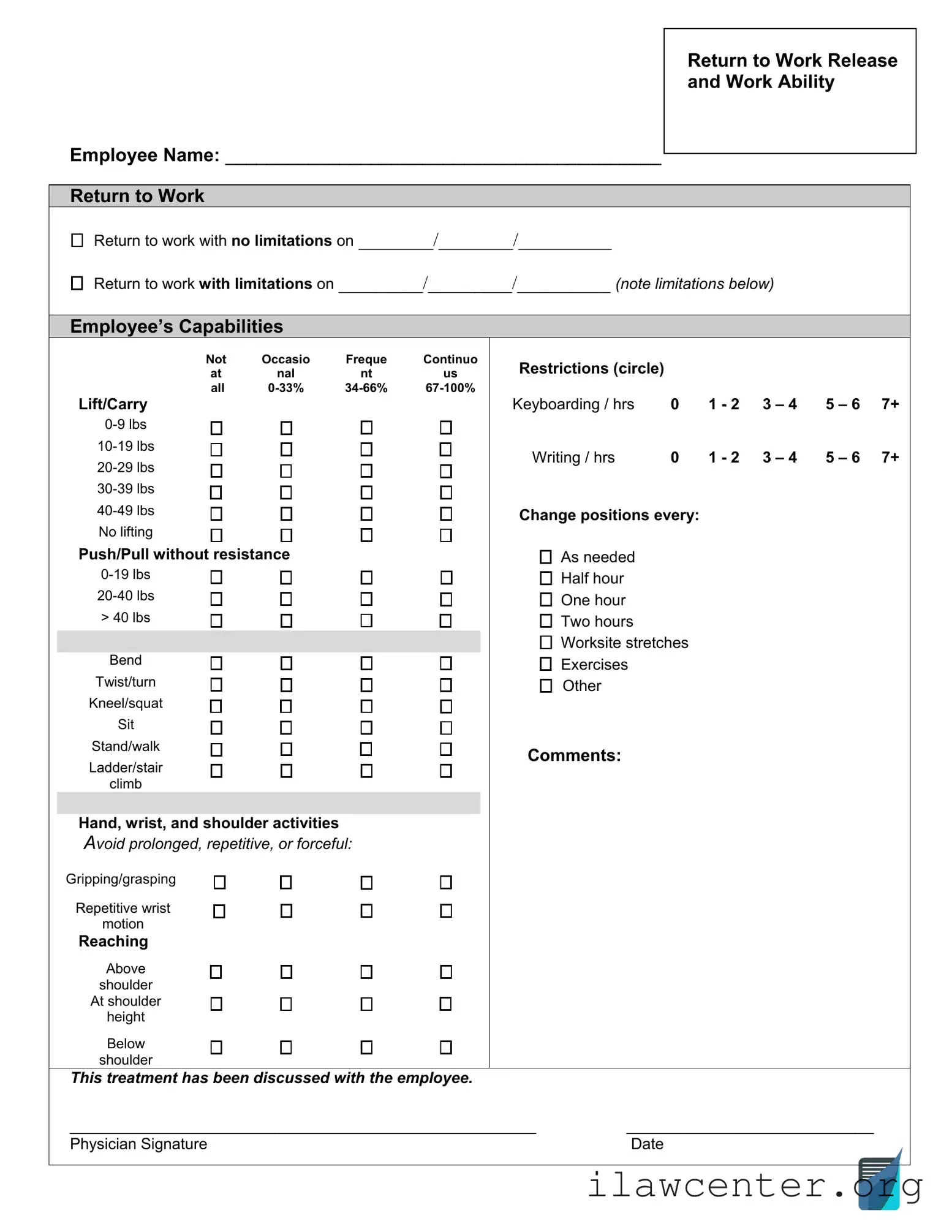
Return to Work Release and Work Ability

Employee Name: __________________________________________

Return to Work

Return to work with no limitations on ________/________/__________

Return to work with limitations on _________/_________/__________ (note limitations below)

Employee’s Capabilities


Not

Occasio

Freque

Continuo


at

nal

nt

us


Lift/Carry

all

0-33%

34-66%

67-100%


0-9 lbs


10-19 lbs


20-29 lbs


30-39 lbs


40-49 lbs


No lifting


Push/Pull without resistance


0-19 lbs


20-40 lbs


> 40 lbs


Bend


Twist/turn


Kneel/squat


Sit


Stand/walk


Ladder/stair


climb


Hand, wrist, and shoulder activities


Avoid prolonged, repetitive, or forceful:


Gripping/grasping


Repetitive wrist


motion


Reaching


Above


shoulder


At shoulder


height


Below


shoulder


This treatment has been discussed with the employee.

Restrictions (circle)


Keyboarding / hrs

0

1 - 2

3 – 4

5 – 6

7+

Writing / hrs

0

1 - 2

3 – 4

5 – 6

7+

Change positions every:

As needed

Half hour

One hour

Two hours

Worksite stretches

Exercises

Other

Comments:

_________________________________________________

__________________________

Physician Signature

Date

File Properties

Fact Name Description
Purpose The Work Release form allows individuals to leave a correctional facility for employment purposes while serving their sentence.
Eligibility Eligibility for work release varies by state and typically requires good behavior and a non-violent offense.
Governing Laws Each state has its own governing laws regarding work release programs. For example, California follows Penal Code Section 4024.2.
Application Process Individuals must submit an application for work release, which is reviewed by correctional facility staff.
Conditions Participants must comply with specific conditions, such as reporting to authorities and maintaining employment.

Instructions on Utilizing Work Release

Once you have the Work Release form in hand, it is important to complete it accurately to ensure that your request is processed smoothly. Follow the steps below to fill out the form correctly.

  1. Begin by entering your full name in the designated field.
  2. Provide your current address, including street, city, state, and zip code.
  3. Fill in your phone number, ensuring it is a number where you can be easily reached.
  4. Indicate your date of birth in the format requested on the form.
  5. Next, write your employee identification number or social security number, if applicable.
  6. List the name of your employer and the address of your workplace.
  7. Specify the dates for which you are requesting work release.
  8. Describe the reason for your request in the provided space.
  9. Sign and date the form at the bottom to validate your request.

After completing the form, review it for accuracy. Once confirmed, submit it to the appropriate authority as directed in the accompanying instructions.

Important Facts about Work Release

What is a Work Release form?

A Work Release form is a document that allows individuals, typically those involved in the criminal justice system, to leave a correctional facility for work purposes. This form ensures that the individual can maintain employment while serving their sentence, promoting rehabilitation and reintegration into society.

Who is eligible to use a Work Release form?

Eligibility for a Work Release form generally depends on the individual's legal status, the nature of their offense, and the policies of the correctional facility. Typically, individuals who are not considered a threat to public safety and who have demonstrated good behavior may qualify.

How do I apply for a Work Release form?

The application process usually involves submitting a request to the facility's administration. This may include filling out specific forms and providing documentation, such as proof of employment. It's essential to follow the facility's guidelines closely to ensure your application is considered.

What information is required on the Work Release form?

The Work Release form typically requires personal information such as your name, identification number, and details about your job. You may also need to provide information about your employer, including the company name, address, and contact information.

What are the responsibilities of the individual while on Work Release?

Individuals on Work Release must adhere to specific rules. This often includes reporting to the facility at designated times, maintaining employment, and following all legal and facility regulations. Failure to comply can result in penalties, including revocation of the Work Release privilege.

Can I lose my Work Release privileges?

Yes, it is possible to lose Work Release privileges. Violations of facility rules, failure to report back on time, or any illegal activity can lead to immediate revocation. It's crucial to stay informed about the rules and maintain a positive record while on Work Release.

How long can I be on Work Release?

The duration of Work Release varies based on individual circumstances and facility policies. Some individuals may be eligible for Work Release for the entire duration of their sentence, while others may have limited time based on their behavior and the nature of their offense.

What happens if my job ends while I am on Work Release?

If your job ends while on Work Release, you must notify the facility immediately. You may be required to find new employment within a specific timeframe to maintain your Work Release status. Failure to do so could jeopardize your privileges.

Common mistakes

Filling out a Work Release form can be a straightforward process, but many people make mistakes that can lead to delays or complications. Understanding these common errors can help ensure that your form is completed correctly and submitted without issues.

One frequent mistake is failing to provide accurate personal information. This includes your name, address, and contact details. If any of this information is incorrect or incomplete, it may cause problems in processing your request.

Another common error is neglecting to include the required dates. The Work Release form typically asks for specific start and end dates for the release. Omitting these dates can result in the form being rejected or delayed.

Many individuals also overlook the importance of signatures. A missing signature can invalidate the entire form. Ensure that you have signed and dated the form in the appropriate sections to avoid this mistake.

Providing incorrect or incomplete employer information is another issue that arises frequently. It is crucial to include the correct name and contact information for your employer. This information helps verify your employment status and the purpose of the work release.

Some people fail to specify the reason for the work release. A clear and concise explanation of why you need the release is essential. Without this information, the reviewing authority may not understand the necessity of your request.

In addition, individuals sometimes submit the form without attaching the necessary documentation. Supporting documents, such as proof of employment or medical records, may be required. Ensure you have included all relevant paperwork to support your request.

Another mistake is not checking for spelling and grammatical errors. These small errors can create confusion and may lead to misunderstandings. Taking the time to proofread your form can prevent unnecessary complications.

People often forget to keep a copy of the completed form for their records. Having a copy can be beneficial if there are any questions or if you need to follow up on your request later.

Lastly, failing to follow submission guidelines can lead to issues. Each jurisdiction may have specific instructions on how to submit the Work Release form, whether by mail, in person, or electronically. Adhering to these guidelines is crucial for timely processing.

Documents used along the form

The Work Release form is an important document that allows individuals to participate in work-related activities while under certain legal restrictions. Alongside this form, several other documents may be required to ensure compliance with legal and administrative protocols. Below is a list of commonly used forms that often accompany the Work Release form.

  • Employment Verification Form: This document confirms an individual's employment status and details about their job, such as hours worked and job responsibilities. It is often required to validate the individual's eligibility for work release.
  • Release of Liability Waiver: This form protects employers and organizations from legal claims that may arise from an individual's participation in work activities. It ensures that the individual understands the risks involved and agrees not to hold the employer responsible.
  • Supervision Agreement: This document outlines the terms of supervision while the individual is on work release. It specifies who will supervise the individual and the expectations for both parties during the work period.
  • Progress Report: This form is used to track the individual's progress and compliance with the terms of the work release. It may include information on work performance and any incidents that occur during the release period.
  • Return to Custody Notification: This document is necessary for notifying authorities if the individual fails to comply with the terms of the work release. It provides a clear protocol for addressing any violations that may occur.

Each of these documents plays a crucial role in the work release process. They help to ensure that both the individual and the employer are protected while facilitating a successful reintegration into the workforce.

Similar forms

The Work Release form is a crucial document in various contexts, particularly in the realm of employment and legal permissions. Several other documents share similarities with the Work Release form, often serving related purposes. Here’s a look at eight documents that are akin to the Work Release form:

  • Permission Slip: Like the Work Release form, a permission slip grants authorization for an individual to participate in an activity or program, often requiring a signature from a guardian or responsible party.
  • Parole Agreement: This document outlines the conditions under which a person is released from incarceration. Similar to the Work Release form, it specifies the terms of release and the responsibilities of the individual.
  • Leave of Absence Request: Employees use this form to formally request time away from work. It parallels the Work Release form in that it requires approval and outlines specific conditions for absence.
  • Medical Release Form: This document allows healthcare providers to share patient information with third parties. It shares the same essence of consent found in the Work Release form, focusing on the individual's rights and permissions.
  • Travel Authorization Form: Employees must fill out this form to gain approval for business travel. Like the Work Release form, it establishes guidelines and permissions for the individual’s activities.
  • Volunteer Release Form: This document protects organizations from liability by ensuring that volunteers understand the risks involved. It is similar in that it requires acknowledgment of terms and conditions related to participation.
  • Non-Disclosure Agreement (NDA): An NDA ensures that sensitive information remains confidential. While its focus is different, it similarly requires a signature and outlines the responsibilities of the parties involved.
  • Employment Contract: This formal agreement outlines the terms of employment, including duties and expectations. Like the Work Release form, it establishes a clear understanding of the relationship between the employer and employee.

Each of these documents plays a vital role in ensuring clarity, consent, and accountability, just as the Work Release form does in its specific context.

Dos and Don'ts

When filling out the Work Release form, it is important to follow certain guidelines to ensure accuracy and compliance. Below are six recommendations to consider:

  • Do read the form carefully before starting to fill it out.
  • Do provide all required information completely and accurately.
  • Do double-check your entries for any errors or omissions.
  • Don't leave any sections blank unless instructed otherwise.
  • Don't use abbreviations or shorthand that may cause confusion.
  • Don't submit the form without reviewing it one last time.

Following these guidelines will help ensure a smooth processing of your Work Release form.

Misconceptions

Misconceptions about the Work Release form can lead to confusion and improper use. Here are ten common misunderstandings, along with explanations to clarify each point:

  1. Work Release forms are only for people on probation. This is incorrect. Work Release forms can be utilized by individuals who are incarcerated but are granted permission to work outside of the facility, regardless of their probation status.
  2. Submitting a Work Release form guarantees approval. Not necessarily. Approval depends on various factors, including the individual's behavior and the nature of the work. Each request is evaluated on a case-by-case basis.
  3. Work Release is a form of early release from prison. This is a misconception. Work Release allows individuals to maintain employment while serving their sentence but does not shorten the length of their incarceration.
  4. Only certain jobs qualify for Work Release. While there are guidelines regarding acceptable employment, a wide range of jobs may be eligible. The key is that the work must not pose a risk to public safety.
  5. Work Release is only available to non-violent offenders. This is not entirely true. Depending on jurisdiction, some violent offenders may also qualify for Work Release if they meet specific criteria.
  6. Once approved, individuals can work whenever they want. This is misleading. Work Release schedules are typically set by the facility, and individuals must adhere to specific hours and reporting requirements.
  7. Work Release forms are the same in every state. This is incorrect. Each state has its own regulations and forms for Work Release, which can vary significantly in terms of requirements and processes.
  8. Participation in Work Release is mandatory for all inmates. This is false. Participation is voluntary, and individuals can choose whether or not to apply for Work Release.
  9. Work Release allows individuals to leave the facility at any time. This is a misunderstanding. Individuals must follow a strict schedule and are only permitted to leave for work-related purposes as approved.
  10. Work Release is a privilege that can be revoked at any time without reason. While it is a privilege, revocation typically requires a valid reason, such as a violation of the terms of the Work Release agreement.

Understanding these misconceptions is crucial for individuals considering or currently participating in a Work Release program. Clarity can help ensure that all parties are informed and prepared for the process.

Key takeaways

When filling out and using the Work Release form, keep these key takeaways in mind:

  • Ensure all personal information is accurate. Double-check names, addresses, and contact details.
  • Understand the purpose of the form. It is designed to allow individuals to work while serving a sentence.
  • Complete all required sections. Missing information can delay processing or result in rejection.
  • Consult with your supervisor or legal advisor if unsure about any part of the form.
  • Submit the form to the appropriate authority. Know who needs to receive it for approval.
  • Keep a copy of the completed form for your records. This can be important for future reference.
  • Follow up on the status of your request. Confirm that it has been received and is being processed.