Yes No Maybe List PDF Template

Yes No Maybe List PDF Template

The Yes No Maybe List is a tool designed to facilitate open communication about personal preferences and boundaries in intimate relationships. By categorizing various activities as "yes," "no," or "maybe," individuals can express their comfort levels and desires clearly. Engaging with this list can foster a deeper understanding between partners, ensuring that experiences are consensual and enjoyable.

Consider filling out the form by clicking the button below.

Article Guide

The Yes No Maybe List form is a powerful tool for individuals exploring their sexual preferences and boundaries. This form allows users to express their desires and limits regarding various activities, ranging from the adventurous to the more traditional. Each activity is rated on a scale from 0 to 5, where 0 indicates a firm "no" and 5 signifies enthusiastic consent. The list covers a wide range of topics, including bondage, role play, and various forms of sexual expression. Users can indicate their experience level and willingness to engage in each activity, providing clarity for both partners. Additional notes and nuances can be added, allowing for personalized communication about specific interests or concerns. This form fosters open dialogue, helping partners navigate their kinks and preferences in a safe and respectful manner.

Yes No Maybe List Preview

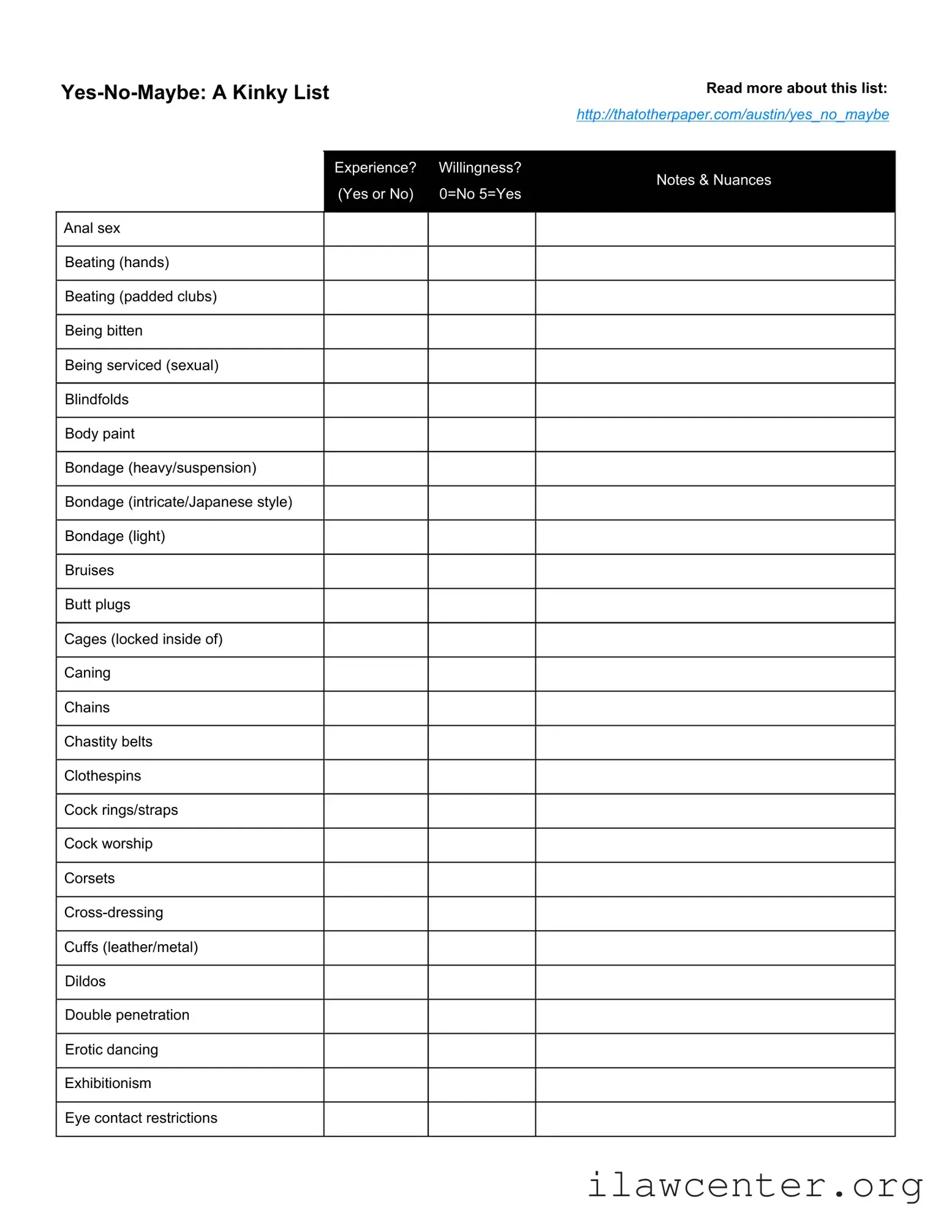
Yes-No-Maybe: A Kinky List

Read more about this list:

http://thatotherpaper.com/austin/yes_no_maybe

Experience? Willingness?

Notes & Nuances

(Yes or No) 0=No 5=Yes

Anal sex

Beating (hands)

Beating (padded clubs)

Being bitten

Being serviced (sexual)

Blindfolds

Body paint

Bondage (heavy/suspension)

Bondage (intricate/Japanese style)

Bondage (light)

Bruises

Butt plugs

Cages (locked inside of)

Caning

Chains

Chastity belts

Clothespins

Cock rings/straps

Cock worship

Corsets

Cross-dressing

Cuffs (leather/metal)

Dildos

Double penetration

Erotic dancing

Exhibitionism

Eye contact restrictions

Experience? Willingness?

Notes & Nuances

(Yes or No) 0=No 5=Yes

Face slapping

Fisting

Flogging

Following orders

Food play (cucumbers, sorbet...)

Foot worship

Gags (cloth/tape)

Genital sex

Hair pulling

Hairbrush spankings

Hand jobs (giving)

Hand jobs (receiving)

Head (giving)

Head (receiving)

High heels

Hot waxing

Ice cubes

Kneeling

Leather clothing

Leather restraints

Lingerie (wearing)

Manacles & Irons

Manicures (giving)

Manicures (receiving)

Marks (giving)

Marks (receiving)

Massage (giving)

Massage (receiving)

Modeling for erotic photos

Experience? Willingness?

Notes & Nuances

(Yes or No) 0=No 5=Yes

Nipple play/"torture"

Oral/anal play (rimming)

Orgasm denial

Outdoor sex

Over-the-knee spanking

Pain (mild to severe)

Phone sex

Pinching

Play Kidnapping

Punishment Scene

Pussy/cock whipping/spanking

Riding crops

Rubber/latex clothing

Saran wrapping

Scenes (prison, religious, etc.)

Scratching (giving)

Scratching (receiving)

Serving as a maid/butler

Shaving

Shoe/boot worship

Skinny-dipping

Slutty clothing (private or public)

Spanking

Spreader bars

Standing in corner

Stocks

Strap-on dildos

Swallowing semen

Swapping (with one other couple)

Experience? Willingness?

Notes & Nuances

(Yes or No) 0=No 5=Yes

Swinging (multiple couples)

Tattooing

Teasing

TENS Unit (electrical toy)

Thumbcuffs (metal)

Tickling

Triple Penetration

Uniforms

Vibrator on genitals

Video (recordings of you)

Video (watching others)

Violet Wand (electrical toy)

Voyeurism (watching others)

Wearing symbolic jewelry

Whips

Wooden paddles

Wrestling

Allergies

Medical conditions

Aftercare issues

Other fun stuff/ideas

File Properties

Fact Name Description
Purpose The Yes No Maybe List is designed to help individuals communicate their preferences and boundaries regarding various sexual activities.
Structure The form includes a series of activities, each accompanied by a scale from 0 to 5, indicating experience and willingness.
Categories Activities are categorized into different types, such as bondage, sensation play, and sexual acts, allowing for detailed discussions.
Notes Section A section for notes allows users to provide additional context or specific preferences related to each activity.
Confidentiality Users should maintain confidentiality when sharing their lists to ensure trust and respect among partners.
Governing Law In states like California, the governing law regarding consent and sexual activity is outlined in the California Penal Code.
Accessibility The form is accessible and user-friendly, making it suitable for individuals of varying experience levels in the BDSM community.

Instructions on Utilizing Yes No Maybe List

Completing the Yes No Maybe List form requires careful consideration of personal preferences and boundaries. This form will guide individuals in expressing their interests and comfort levels regarding various activities. Follow the steps outlined below to accurately fill out the form.

  1. Begin by reviewing the list of activities provided on the form.
  2. For each activity, assess your experience and willingness to participate.
  3. Assign a score from 0 to 5 for each activity, where 0 indicates no willingness and 5 indicates full willingness.
  4. In the "Notes & Nuances" section, provide any additional comments or specific preferences related to each activity.
  5. After completing all activities, double-check your entries for accuracy.
  6. Submit the form as instructed at the end of the document.

Important Facts about Yes No Maybe List

What is the Yes No Maybe List form?

The Yes No Maybe List form is a tool designed for individuals to communicate their preferences and boundaries regarding various sexual activities. It allows users to indicate their level of experience and willingness for each activity, helping partners understand each other's comfort zones and desires.

How do I fill out the Yes No Maybe List form?

To complete the form, review the list of activities provided. For each activity, rate your experience and willingness on a scale from 0 to 5, where 0 means "No" and 5 means "Yes." You can also add any notes or nuances that might be important for your partner to know. This ensures clear communication about what you are comfortable with.

Who should use the Yes No Maybe List form?

This form is suitable for anyone exploring their sexual preferences, whether you are in a new relationship or have been together for a while. It is particularly helpful for those interested in kink or BDSM, as it promotes open dialogue about boundaries and desires.

Is the Yes No Maybe List form confidential?

Yes, the information shared on the Yes No Maybe List form is meant to be private. It is essential to trust your partner and ensure that the details you provide are kept confidential. Open communication fosters a safe environment for exploration.

Can I change my answers later?

Absolutely. Preferences can evolve over time, and it is perfectly acceptable to revisit the form and update your responses. Regular check-ins with your partner about boundaries and desires are encouraged to ensure ongoing consent and comfort.

What if I am unsure about certain activities?

If you are uncertain about specific activities, it is advisable to mark them as "Maybe." This indicates that you are open to discussion but may need more information or experience before making a definitive choice. Engaging in conversations about these activities can help clarify your feelings.

What should I do if my partner has different preferences?

Differences in preferences are common and should be approached with understanding and respect. Discuss your respective lists openly, and consider negotiating boundaries or finding common ground. It is crucial to prioritize consent and comfort for both partners.

Are there any activities that should be avoided?

While the list includes a variety of activities, it is essential to avoid anything that makes you or your partner uncomfortable. Always prioritize safety and consent. If an activity feels wrong or raises concerns, it is best to discuss those feelings rather than proceeding.

What is the importance of aftercare in relation to the Yes No Maybe List?

Aftercare refers to the care and support provided to partners after engaging in intense activities. It is crucial to discuss aftercare preferences when filling out the Yes No Maybe List. Understanding what each partner needs post-activity can enhance emotional safety and strengthen the relationship.

Can I include additional activities or ideas on the form?

Yes, the Yes No Maybe List encourages users to include any additional activities or ideas that may not be covered in the list. This allows for a more personalized approach to your preferences and can lead to exciting new experiences for both partners.
Common mistakes

When filling out the Yes No Maybe List form, one common mistake is not being honest about personal preferences. It’s essential to accurately reflect your feelings and experiences. If you’re uncertain about a particular activity, it’s better to mark it as “Maybe” rather than forcing a “Yes” or “No.” This honesty ensures that all parties involved understand boundaries and desires, leading to a more fulfilling experience.

Another frequent error is neglecting to consider past experiences. Some individuals may rush through the form without reflecting on their history with certain activities. Taking time to think about past encounters can provide valuable insights. This reflection can help in making informed choices, which is crucial for safety and enjoyment.

Many people also fail to communicate clearly in the "Notes & Nuances" section. This part of the form is an opportunity to explain specific boundaries or preferences related to each activity. Without these details, misunderstandings can arise, potentially leading to discomfort or harm. Clear communication is vital in any relationship, especially when exploring new experiences.

Another mistake is ignoring the importance of consent. Consent should be enthusiastic and ongoing. When filling out the form, it's essential to remember that just because you are open to trying something doesn’t mean you are obligated to do so. Marking “Maybe” for uncertain activities allows for further discussion and negotiation, ensuring that everyone feels comfortable and respected.

Lastly, some individuals overlook the significance of reviewing their responses before submitting the form. A quick review can catch errors or inconsistencies that might have been overlooked during the initial completion. Taking this extra step can prevent potential issues later on and fosters a more enjoyable experience for all involved.

Documents used along the form

The Yes No Maybe List form serves as a tool for individuals to communicate their preferences and boundaries regarding various activities. It is often accompanied by other documents that help clarify and enhance the experience. Below is a list of forms and documents that are frequently used alongside the Yes No Maybe List.

  • Consent Agreement: This document outlines the mutual consent of all parties involved. It specifies the activities that are agreed upon and includes terms for safe practices.
  • Safety Checklist: This form identifies safety measures and precautions to be taken during activities. It may include items like safe words, medical information, and emergency contacts.
  • Aftercare Plan: Aftercare is crucial for emotional and physical well-being. This document details how participants will care for each other post-activity, including physical comfort and emotional support.
  • Communication Log: This log tracks discussions about preferences, boundaries, and experiences over time. It helps maintain open lines of communication and ensures that all parties feel heard.
  • Activity Journal: Participants may use this journal to reflect on their experiences. It can include notes on what worked well, what didn’t, and any feelings or insights gained.
  • Emergency Protocol: This document provides a clear plan for handling emergencies. It outlines steps to take if someone feels uncomfortable or if a situation escalates unexpectedly.

Using these additional documents alongside the Yes No Maybe List can enhance communication and safety for all participants. They help ensure that everyone is on the same page and can contribute to a more enjoyable experience.

Similar forms

  • Consent Form: Similar to the Yes No Maybe List, a consent form outlines what activities individuals are comfortable with. It emphasizes mutual agreement and understanding, ensuring that everyone involved is on the same page.
  • Risk Awareness Agreement: This document highlights potential risks associated with specific activities. Like the Yes No Maybe List, it encourages open communication about boundaries and safety measures before engaging in any activity.
  • Negotiation Checklist: A negotiation checklist serves as a guide for discussing desires and limits. It shares the same goal as the Yes No Maybe List, which is to facilitate conversations about preferences and establish clear boundaries.
  • Activity Preference Survey: This survey collects information on what individuals enjoy or want to try. Much like the Yes No Maybe List, it helps participants express their interests and limits in a structured way.
  • Scene Agreement: A scene agreement outlines the specifics of a planned encounter. It parallels the Yes No Maybe List by ensuring that all parties understand and agree on what will happen during the scene.
  • Aftercare Plan: An aftercare plan details the support and care needed after an intense experience. Similar to the Yes No Maybe List, it emphasizes the importance of communication and understanding individual needs.
  • Safety Protocol Document: This document outlines safety measures and emergency procedures. Like the Yes No Maybe List, it focuses on the well-being of all participants and reinforces the importance of being prepared.
  • Feedback Form: A feedback form allows individuals to share their experiences after an encounter. This is akin to the Yes No Maybe List, as it fosters ongoing communication and helps refine future interactions.

Dos and Don'ts

When filling out the Yes No Maybe List form, consider the following guidelines to ensure clarity and effectiveness.

  • Do be honest about your experiences and willingness. Accurate responses help facilitate better communication.
  • Do provide notes or nuances where necessary. This additional context can clarify your preferences.
  • Don't rush through the form. Take your time to reflect on each item to ensure thoughtful responses.
  • Don't leave any sections blank unless you are unsure. Complete responses are crucial for understanding boundaries.

Misconceptions

Misconceptions about the Yes No Maybe List form can lead to misunderstandings. Here are six common misconceptions clarified:

  • It is only for experienced individuals. Many people believe that the Yes No Maybe List is designed solely for those with extensive experience in kink. In reality, it is suitable for all levels, including beginners who want to explore their interests safely.
  • It promotes non-consensual activities. Some may think that the list encourages non-consensual behavior. This is false. The list is a tool for establishing clear communication and consent between partners, ensuring everyone is comfortable with their choices.
  • It is a binding contract. There is a misconception that filling out the list creates a legally binding agreement. This is not true. The list serves as a guideline for preferences and boundaries, not a contract.
  • It is only for sexual activities. Some people assume that the Yes No Maybe List pertains only to sexual acts. However, it covers a wide range of activities, including those that may not be sexual in nature, such as role play and aftercare.
  • All items must be explored. Many believe that completing the list means they must try every item they indicate. This is incorrect. The list is a way to express preferences, and individuals can choose to engage in only what they feel comfortable with.
  • It is too complicated to use. Some think that the list is overly complex and difficult to understand. In truth, it is designed to be straightforward, allowing individuals to communicate their desires easily and effectively.

Key takeaways

Using the Yes No Maybe List form can enhance communication and understanding in intimate relationships. Here are some key takeaways to consider:

  • Clarity: This form helps clarify preferences and boundaries. It allows individuals to express what they are comfortable with.
  • Honesty: Being truthful about desires and limits is essential. This form encourages open dialogue.
  • Variety: The list covers a wide range of activities. Explore different options to discover what excites you.
  • Rating System: Use the 0 to 5 scale to indicate willingness. This visual representation can simplify discussions.
  • Notes Section: Include any specific notes or nuances. This area allows for additional context and personal preferences.
  • Review Together: Discuss the completed form with your partner. This can strengthen trust and understanding.
  • Regular Updates: Revisit the list periodically. Preferences may change over time, and it’s important to stay aligned.
  • Aftercare Consideration: Discuss aftercare needs. This is vital for emotional well-being after engaging in certain activities.